Helping and Promoting Nanoscience and Nanotechnology Education: From Centre for Pharmaceutical Nanotechnology and Nanotoxicology, NanoScience Center, University of Copenhagen, Copenhagen, Denmark
A nanometer is 1000 million (one billion) times smaller than the world of meters. To put this in perspective, a stack of one billion Dollars bills would reach over 63 miles high. For comparison, a Boeing 747 airliner typically operates at an altitude of 35,000 feet or approximately 6 miles. Now imagine, you are sitting 63 miles high above and looking for a Dollar bill on the ground. The one Dollar bill is the nanometer scale.
By zooming into the nanoscale, we can study how the matter actually works. By understanding the science of nano we can make objects at this incredibly small scale and solve many problems; this is called nanotechnology. Interesting things happen at the nanoscale. Materials and substances behave differently and show strange chemical and physical properties compared with their larger-particle kin. This incredibly low scale allows for unique interactions among atoms and their constituent parts and opening the path for the materials of the future. For example, carbon, as in graphite, is soft and brittle, but becomes very hard and shows many other unique properties at nanoscale in an arrangement called a nanotube with many applications spanning electronics, textile industry, construction industry and medicine. Another example is gold, an unreactive metal, which becomes chemically reactive at nanoscale.
It is not surprising that nanotechnology is radically transforming every part of our daily lives and world economies. One is being the conservation and restoration of cultural heritage and treasures. Cleaning and preservation of artworks is a complex and challenging task since a wide range of materials has been used to construct an art piece. Accordingly, applied methodologies must ensure maximum durability, chemical inertness, and compatibility with artefacts’ materials. Indeed, nanotechnology has offered unprecedented solutions for restoration of Renaissance masterpieces, old books, wall paintings and frescoes and other objects. Examples include Masaccio’s wall paintings in Cappella Brancacci, Beato Angelico’s wall paintings in San Marco Abbey, cave murals of the Basilica of Annunciation in Nazareth, and consolidation of the murals of the archaeological site of Calakmul, Mayapan and other regions of Mexico. So how does the nanoscience of art restoration work?
Consolidation and protection of the wall paintings and limestone
Slaked lime (calcium hydroxide) was often used as a binder in wall paintings and frescoes. The size of ordinary calcium hydroxide particles is very large and when applied to artefacts it leaves a white glaze over. Instead, calcium hydroxide nanoparticles are now being used as effective agents in wall painting restoration. Because of their very small size, these nanoparticles penetrate the painted surface layers better and have superior optical properties over ordinary large-sized calcium hydroxide particles. Indeed, calcium hydroxide nanoparticles do not leave visual residues on wall paintings and frescoes after application.
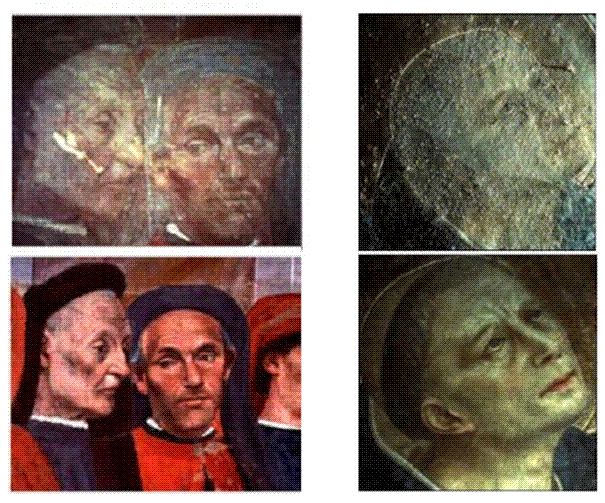
Wall paintings of Masaccio’s in Cappella Brancacci (left column) and Beato Angelico in San Marco Abbey (right column), Florence, Italy, before and after nanoparticle technology treatment
Preservation of paper and wood artefacts
Acidity causes degradation of the artefact. Nanoparticles are also helping to de-acidify paper and wood artefacts and diminish acid formation. For example, the wood in the Swedish Vasa Warship, sank during its maiden voyage in 1628, shows high acidity, due to oxidation of sulfur inside cellulose fibers. This generates sulfuric acid, which threatens the preservation of Vasa. Magnesium and calcium hydroxide nanoparticles have offered simple and cost-effective ways to fight sulphuric acid in the wood, which can be applied by either brushing, spraying or immersing the object in the nanoparticle suspension. The nanoscale size improves material spreading and penetration, and enhances reactivity (deacidification). Here, magnesium hydroxide generates magnesium carbonates on exposure to the carbon dioxide in air. Similarly, same type of treatments, and the generated magnesium carbonate, reduces the rate of oxidative degradation of cellulose in paper, caused by light irradiation, thereby enhancing preservation of old paper documents.
Cleaning of art-work
Since 1960’s polymeric resins have been used for coating and protection of canvas paintings. Unfortunately, these coatings generated a yellow tinge to artefacts. Also, once the polymer resins aged, they lost their chemical and mechanical properties resulting in further damage to the paintings. One such example is a coating material called Paraloid B37, which has been very difficult to remove from the surface of treated artefacts. Here, nanotechnology has offered another remarkable solution. Scientists have designed a lightweight nano-magnetic sponge/gel, which can be loaded with safe chemicals that can draw the material to be removed from the artefact surface. Since nanomagnetic particles have superior magnetic properties compared with its bulk material, the gel can easily be removed at distance with a permanent magnet without touching. The ‘magnetic sponge’ can also be cut and shaped for application to sculptures, thus offering flexibility in the cleaning and preservation processes of many artefacts.
Ongoing advances
Silver nanoparticles embedded in polymeric resins exhibit antibacterial and optical properties, which are also receiving attention for preservation and protection of cultural heritage.
Another interesting approach is ‘atomic layer deposition’, which creates a transparent metal oxide films that can be applied to an artefact (such as silverware) and reduce the rate of corrosion.
Scholarly readings:
P. Baglioni, G. Rodorico (2006) Soft and hard nanomaterials for restoration and conservation of cultural heritage. Soft Matter 2, 293–303.
M. Baglioni, D. Rengstl, D. Berti, M. Bonini, R. Giorgi, P. Baglioni (2010) Removal of acrylic coatings from works of art by means of nanofluids: understanding the mechanism at the nanoscale. Nanoscale 2, 1723–1732.
Further Links:
http://archive.org/details/ScienceNationsilverSaver-NanotechnologyKeepsTheShineOnSilver