 One of the significant events in ancient history is the conquest of Babylon by the Persian king, Cyrus the Great.
On October 4th, 539 BC, the Persian Army entered the city of Babylon, which was then the capital of the Babylonian state (in central Iraq). This was a bloodless campaign and no prisoners were taken. Later, on November 9th, King Cyrus of Persia visited the city. Babylonian history tells us that Cyrus was greeted by the people, who spread a pathway of green twigs before him as a sign of honor and peace (sulmu). Cyrus greeted all Babylonians in peace and brought peace to their city.
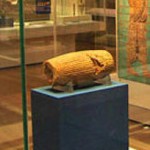
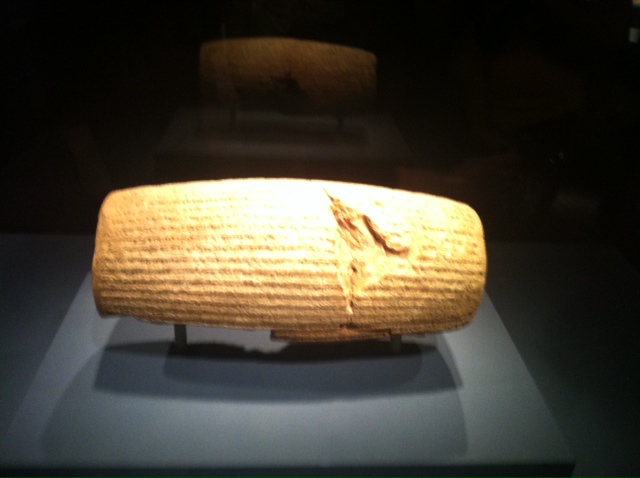
On this great event, Cyrus issued a declaration, inscribed on a clay barrel known as Cyrus’s inscription cylinder. It was discovered in 1879 by Hormoz Rassam in Babylon and today is kept in the British Museum. Many historians have reviewed it as the first declaration of human rights.
The Babylonian annals, as well as the first section of the Cyrus’ inscription, shed light on the religiopolitical plight that had angered the people of Babylon and why they invited Cyrus’s military campaign. Evidently, the Babyloninan king, Nabonidus, eliminated the festival of the new year and Nebo (one of the gods) was not brought into the city, and Bel (another god) was not taken in the procession of the festival. Also, the worship of Marduk, the king of the gods, was changed to an abomination and Nabonidus tormented the inhabitants with unbelievable oppression and forced labor. The sanctuaries of all their settlements were in ruins and the inhabitants of Sumer and Akkad had become like the living dead. Marduk, the king of the gods, scanned and searched for a righteous ruler, finally coming upon Cyrus’s good deeds and his upright mind and ordered him to march against the City of Babylon. The angry inhabitants of Akkad had revolted but were massacred by Nabonidus, who, upon his return to Babylon, was arrested, but nevertheless was treated with respect. When Nabonidus died in the year following, Cyrus participated in the national mourning time that was proclaimed for him. The gods of Akkad were then returned to their sacred cities. All the inhabitants of Sumer and Akkad, including princes and governors, greeted Cyrus as a master who brought them back from a living death. All who had been spared damage and disaster revered his very name.
Cyrus’s Declaration:
“I am Cyrus, the king of the world, great king, legitimate king (son of Cambyses) whose rule Bel and Nebo loved and whom they wanted as king to please their hearts.
“When I entered Babylon as a friend and established the seat of government in the place of the ruler under jubilation and rejoicing, Marduk, the great lord (induced) the magnanimous inhabitants of Babylon (Din Tir) (to love me) and I daily endeavored to praise him. My numerous troops walked around in Babylon in peace, I did not allow anybody to terrorize (any of the people) of the country of Sumer and Akkad. I strove for peace in Babylon (Ka Dingir ra) and in all his (other) sacred cities. As to the inhabitants of Babylon (who) against the will of the gods (had/were I abolished) the corvee (yoke) which was against their (social standing). I brought relief to their dilapidated housing, putting an end to their main complaints. Marduk, the great lord, was well pleased with my deeds and sent friendly blessing to myself, Cyrus, the King, who reveres him, to Cambyses, my son, as well as to all my troops, and we all (praised) his great (name) joyously, standing before him in peace I returned to (these) sacred cities on the other side of the Tigris, the sanctuaries of which have been ruins for a long time, the images which (used) to live therein and established for them permanent sanctuaries. I (also) gathered all their (former) inhabitants and returned (to them) their habitations. Furthermore, I resettled upon the command of Marduk, the great lord, all the gods of Sumer and Akkad who Nabonidus has brought to Babylon (su sa na) to the anger of the lord of the gods unharmed in their chapels, the places which make them happy.
May all the gods whom I have resettled in their sacred cities ask Bel and Nebo daily for a long life (six lines destroyed) and always with good words remember my good deeds that Babylonians incessantly cherished me because I resettled them in comfortable habitations I endeavored to strengthen the fortification of Imgur-Enlil and the great fortification of the City of Babylon the side brick wall by the city’s trench which the former king (had built and had not finished). This was finished around (the city), that none of the former kings, despite the labor of their yoked people, had not accomplished. I rebuilt and completed with tar and brick and installed large gates entrances were built by cedar wood covered with brass and copper pivot I strengthened all the gates I saw inscribed the name of my predecessor, King Ashurbanipal.”
On this historical turning point, by order of Cyrus, all the captive nationalities held as slaves for generations in Babylon were freed and the return to their homeland was financed. Among the liberated captives were 50,000 Jews held in Babylon for three generations whose return toward the rebuilding of their temple in Palestine, a policy that was followed by Darius and his successors. Some of the liberated Jews were invited to and did settle in Persia. Because of such a generous act, Cyrus has been anointed in the Bible. He is the only gentile in the Bible, who has been titled Messiah, an is mentioned explicitly as the Lord’s shepherd and his anointed (Messiah). Other references to Cyrus are attested in Isaiah 45:4 where Cyrus is called by name and given a title of honor; he is also called to rebuild the God’s city and free His people (Is. 45:13) and is chosen, called and brought successful by God (Is. 48:14-15).
What took place after the victory in Babylon was contrary to the standard of the time. Based on the inscriptions of the neighboring countries (Assyrians, Babylonians), it was customary to destroy the vanquished cities, level houses and temples, massacre the people or enslave the population, replace them with snakes, wolves and even carry away the soil to make the land barren. But here, peace and liberty replaced the massacre and slavery, and construction substituted for destruction. After Cyrus, his son Cambyses ruled for eight years (530BC to 522 BC) and captured Egypt, and as a sign of respect toward their culture and religion, he prostrated himself before the goddess, Meith and paid homage to Apis, the Egyptian totem (Bull).
After Cambyses, Darius took over the throne and ruled form 522BC to 486BC. From 518BC to 515BC he established peace and tranquility in Egypt and also paid homage to their totem, Apis. Darius, in his inscriptions, expresses faith in the commands of Ahuramazda. He declares “Whoever worships Ahuramazda, shall receive happiness in life and after death.” He calls Elamites faithless, and because they did not worship Ahuramazda, yet he does not pressure them to change faith. Darius exhorts his successors “thou shalt be king thereafter, protect yourself from the lies and punish the liar and deceitful.”
He entreats God’s grace for the protection of Persia against rancor, enemy, famine and the lie. At times he alludes to other gods that may either indicate the old Aryan gods who still had strong followings or the gods of other nations under his rule, for the display of reverence toward their religions.
REFERENCES:
A. Arfaee, The command of Cyrus the Great (in Persian), quoted the opinion of Sydney Smith.
Grayson, Assyrian and Babylonian chronicles, p110, dates the fall of Babylon on Oct. 12th and Cyrus’s entry on Oct 29th.
J. B. Pritchard, The ancient Near East, Vol. 1, 1958, p203.
A fragment in the Yale’s Babylon collection was identified in 1970 by P.R.Berger, the professor of Munster, Germany, as part of Cyrus’s cylinder that was transferred to the British Museum and added to the cylinder, who wrote in the journal of Assyrology (Zeiserrift fir Assiriologie), July 25, Vol. 64. The remainder of the text is quoted from A.
Arafaee, which was the missing portion kept in Yale University. Bible, 2 Chronicles 36:15-23
Bible, Ezra 1:1-11, Ezra 2:12-70
Bible, Ezra 7:8
Bible, Ezra 6:3-4-5
Bible, Ezra 7:15-25
Bible, Isaiah 44:28 and 45:1
Darius Jahanian, M.D. is an obstetrician-gynecologist in the Kansas City area, with degree from University of Tehran and Washington University, St. Louis. He is a co-founder and president of the Fravahar Zoroastrian Youth organization of Tehran. Darius served as trustee of the Rostam Guiv Trust of California 1981-89, is a trustee and VP of the Rostam Guiv Foundation of New York since 1990, and its president since 1992. He is a founder and two-term president of the Zoroastrian Association of Kansas. A noted author and lecturer on the Zoroastrian religion, Darius also teaches religion classes for children.
Source: Zoroastrianism and Biblical Connections