The World Heritage Centre of the United Nations Educational, Scientific and Cultural Organization (UNESCO) has declared largest mangrove forest on earth, the Sundarbans of Bangladesh, as a “World Heritage in Danger” site. UNESCO also discussed the future of this World Heritage site during their meeting in Azerbaijan.
The List of World Heritage in Danger is compiled by UNESCO through the World Heritage
Committee according to Article 11.4 of the World Heritage Convention, which was established in 1972 in order to designate and manage World Heritage Sites. Entries in the list are threatened World Heritage Sites for the conservation of which major operations are required and for which “assistance has been requested”. The list is intended to increase international awareness of the threats and to encourage counteractive measures by the officials of the country and/or other international experts. Threats to a site can be either proven imminent threats or potential dangers that could have adverse effects on a
site.
In the case of natural sites, determined dangers include the serious decline in the population of an endangered or other valuable species or the deterioration of natural beauty or scientific value of a property caused by human activities such as logging, pollution, settlement, mining, agriculture and major public works. Established threats for cultural properties include serious deterioration of materials, structure, ornaments or architectural coherence and the loss of historical authenticity or cultural significance. Potential dangers for both cultural and natural sites include development projects,
armed conflicts, insufficient management systems or changes in the legal protective status of the properties. In the case of cultural sites, gradual changes due to geology, climate or environment can also be potential dangers based on description of UNESCO.
Some other sites on this list include Ancient cities of Aleppo and Bosra which have experienced major destruction during years of war and conflict with the so called Islamic State and Syria’s civil war.
You can learn more about these sites on UNESCO’s List of World Heritage in Danger page
UNESCO Adds 29 New World Heritage Sites
In 2018, the United Nation’s Educational Scientific and Cultural Organization (UNESCO) inscribed 20 new sites to its World Heritage List. However, early this month, July 2019, more sites were added to the list. UNESCO added 29 more to the list of global landmarks deemed to have “outstanding universal value”.
Now places like Vatnajökull National Park in Iceland and Jaipur City in Rajasthan, India, are on the list of global cultural and natural sites that includes such famous destinations as the Palace of Versailles in France and Australia’s Great Barrier Reef.
UNESCO held its 43rd World Heritage Committee session in Baku, Azerbaijan, from June 30 to July 10 this year. During the conference, representatives from 21 member states approved a list of 29 sites, which were nominated by their countries. Each site added must meet at least one of 10 criteria, such as containing superlative natural phenomena, representing a masterpiece of human creative genius, or a unique cultural tradition.
Here are some examples:
The picturesque hills of Italy’s prosecco sparkling wine region in Valdobbiadene
About 40 miles north of Venice, Italy’s prosecco production area in the hills of Conegliano and Valdobbiadene is the second wine region in the country to be recognized by UNESCO. (Piedmont was added to the list in 2014.) It is also officially Italy’s 55th site on the list, tying it with China as the country with the most UNESCO World Heritage sites. Since the 17th century, wine producers have grown grapes for sparkling wine on the area’s rugged hills in small plots of vines on narrow terraces—known as ciglioni—giving the region a unique and picturesque look.
Another site is Bagan, Myanmar, where Buddhist monks walk around the sacred Shwezigon Paya, a pagoda in Bagan. From temples and stupas to archaeological remains and sculptures, this landscape of monumental Buddhist architecture in the central plain of Myanmar is only the second location in the country to be added to the World Heritage List. (UNESCO inscribed the Pyu Ancient Cities, the remains of three walled cities in the Ayeyarwady River basin, in 2014.) Created from a variety of materials
including stone, brick, and the gleaming gold of the Shwezigon Pagoda, the area’s emples show the range that the Bagan civilization was able to build when it was at its peak between the 11th and 13th centuries.
If you are looking for a site closer to home, the 20th-Century Architecture of Frank Lloyd Wright, in the United States is among the new additions. Fallingwater house is one of eight Frank Lloyd Wright buildings that were added as a group to the World Heritage List. In fact, the recent addition of eight Frank Lloyd Wright buildings to the World Heritage List marks the first time UNESCO has recognized modern U.S. architecture. Scattered across the United States from the Guggenheim Museum in New York City to Hollyhock House in Los Angeles and Taliesin West in Scottsdale, Arizona, these eight sites represent some of Wright’s most important contributions to 20th-century architecture.
Here are the rest of UNESCO’s confirmed 2019 World Heritage Sites, organized by region:
Africa
Ancient Ferrous Metallurgy Sites of Burkina Faso, Burkina Faso
Asia
Korean Neo-Confucian Academies, Korea
Archaeological Ruins of Liangzhu City, China
Migratory Bird Sanctuaries along the Coast of Yellow Sea–Gulf of Bohai, China
Megalithic Jar Sites in Xiengkhuang–Plain of Jars, Laos
Mozu-Furuichi Kofun Group: Mounded Tombs of Ancient Japan, Japan
Ombilin Coal Mining Heritage of Sawahlunto, Indonesia
Australia/Oceania
Budj Bim Cultural Landscape, Australia
Jaipur City, Rajasthan, India
Europe
Royal Buildings of Mafra, Portugal
Sanctuary of Bom Jesus do Monte in Braga, Portugal
Churches of the Pskov School of Architecture, Russia
Erzgebirge/Krušnohoří Mining Region, Czechia/Germany
French Austral Lands and Seas, France
A visitor to an ice cave in Vatnajökull National Park
Historic Centre of Sheki with the Khan’s Palace, Azerbaijan
Jodrell Bank Observatory, United Kingdom
Krzemionki Prehistoric Striped Flint Mining Region, Poland
Landscape for Breeding and Training of Ceremonial Carriage Horses at Kladruby and Labem, Czechia
Risco Caido and the Sacred Mountains of Gran Canaria Cultural Landscape, Spain
Water Management System of Augsburg, Germany
Middle East
Babylon, Iraq
Dilmun Burial Mounds, Bahrain
Hyrcanian Forests, Iran
North America
Writing-on-Stone / Áísínai’pi, Canada
South America
Paraty and Ilha Grande, Brazil
Fire Burns Down Parts of Tehran’s Historical Areas
By K. Dana
A large storehouse caught fire in Tehran’s historic square of Hassanabad on Wednesday, July 17. Firefighters managed to extinguish the fire after it had spread to historic parts of Tehran’s Hassanabad Square.
Hassanabad resides in a Qajar Dynasty area in Tehran. Hassanabad is one of the designed urban spaces in old Tehran, located on the intersection of two main streets, Hafez and Sepah, and erected during the first Pahlavi reign (1930-1940).
According to cultural heritage experts, hundreds of historical documents have been burned over the last hundred years, in addition to the buildings.
Exhibition of Rare and Unique Cycladic Antiquities
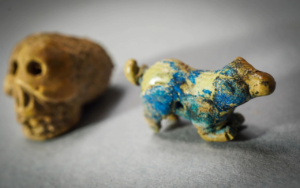
According Tornos News Many unique and rare ancient artefacts shown to the public for the first time. An extensive and extremely interesting series of exhibitions have been organised on the Cyclades islands this year by the Cyclades Ephorate of Antiquities, according to ANA. The exhibitions will feature many unique and rare ancient artifacts, many of which are shown to the public for the first time, as well as new creations that form a link with the past, promising to make the time of holiday-makers on the islands even more memorable.
Among these are the exhibitions “From the world of Homer. Tinos and the Cyclades in the Mycenaean era” that runs between July 13 and October 14, which is being held in
cooperation with the Piraeus Group Cultural Foundation (PIOP) at its Museum of Marble
Craft in the village of Pyrgos, Tinos. A second exhibition, entitled “Look Opposite) is to
be inaugurated on July 14 at Archaeological Collection of Koufonisia and will run until
September 30, 2019.
“Both exhibitions are extremely important,” noted Dimitris Athanasoulis, Director of the
Cyclades Ephorate of Antiquities, to the Athens-Macedonian News Agency (ANA). “On
the occasion of the founding of the tomb of Agia Thekla in Tinos, we have the first
exhibition for an unknown period of the Cyclades, the Mycenaean period, presenting
great and unknown material,” he added. However, the exhibition on Ano Koufonissi is
also very important, he added, as “unique discoveries from Keros and Daskalio are
revealed for the first time.”
A Man, a Horse And a Dog Found in Extremely Rare Boat Burial Unearthed in Sweden
By MICHELLE STARR
Not one, but two incredibly rare boat burials have been excavated in Uppsala, Sweden. One of these was still intact, with remains inside of not just a human, but also a dog and even a horse, all in good condition. According to archaeologists, it is a
remarkable find, and indicates the burial of a high-status male. This is a unique excavation,” said archaeologist Anton Seiler of Swedish archaeology firm The Archaeologists . “The last excavation of this grave type in Old Uppsala was almost 50 years ago.”
Ship burials are found all across Europe, particularly in Scandinavian countries, but that
doesn’t mean they were common. They seemed to have been reserved for the upper
echelons of society, those of the very highest status. These elite individuals were interred
inside a ship, or a smaller boat, often loaded with rich grave goods. The addition of horses, dogs, and hunting birds was also not uncommon. “It is a small group of people who were buried in this way,” Seiler explained . “You can suspect that they were distinguished people in the society of the time since burial ships in general are very rare.”These graves usually date back to the Iron Age, around 550 CE, and up to around the end of the Viking Age, in 1050 CE. But the ravages of time are not kind – sometimes all that remains for us to find is the ghostly imprint of where a now-rotted ship once lay.
In all of Sweden, only around 10 boat burials of this kind had been previously
discovered, and those not always in the best condition, so two newly discovered ones are
a big deal – especially when one of those is still intact. The two were found at a site in Old Uppsala, or Gamla Uppsala, by accident. The team had been working on the site of a new vicarage under construction; they had excavated a medieval well and cellar when someone spotted one of the boat graves poking out from beneath a more recent structure.
It took a month to excavate them both.One had been significantly damaged, probably when the 16th century cellar had been
built on top of it. The other contained the skeleton of an adult man in the stern, and the skeletons of a horse and dog in the bow. In addition, the grave contained arms – sword, shield and spear – as well as an ornate comb, and wood and nails from the boat itself.
Because it’s been so long since a grave of this kind has been discovered, the team will be
able to apply scientific techniques never before used on one. We don’t know much about
the graves yet – when they were interred, how old the man was when he died, whether he
was ill or injured.
“It is extremely exciting for us since boat burials are so rarely excavated,” Seiler said .
“We can now use modern science and methods that will generate new results, hypotheses and answers. We will also put the boat burials in relation to the very special area that is Old Uppsala and the excavations done here before.” We’ll be waiting to see what they find.
Meanwhile, parts of the discovery will be on display at the Gamla Uppsala Museum and
Swedish History Museum in Stockholm.
https://www.sciencealert.com/a-man-a-horse-and-a-dog-were-found-in-a-rare-intact-boat-
burial-unearthed-in-sweden
Do Not destroy history, teach Learning From History
Over the last few days, the decision of San Francisco School Board to destroy the mural at the George Washington High school on one hand, and objection of a group of university professors, artists and writers on the other, have reminded me of stories from my motherland, Iran. For the last forty years, a fanatical and oppressive government has been on a campaign of destroying art, history and culture which is not Islamic and/or is from pre-Islamic time in Iran. The Islamic regime while celebrating their brand of Islam, has attempted to destroy anything that is not religious and/or belongs to a different religion in different ways; destroying some while deliberately abandoning others and allowing them to be destroyed by nature, many times in a state of disrepair and exposed to wind and rain resulting in their destruction over time.
As advocates of preservation of cultural heritage, historical sites and art, my colleagues and I regularly make declarations and protest, and send letters to the United Nations Educational, Scientific and Cultural Organization (UNESCO) asking them not to let history of Iran to be destroyed. Through a not-for-profit organization, World Cultural Heritage Voices, I founded, we work on maintaining a cultural heritage record and focus on preservation of world heritage sites especially in the areas of the world suffering from
war, poverty and conflict and especially in the hands of negligent governments.
I am an Iranian-American, who strongly believe in non-discrimination based on race, religion, and cultural background, I strongly object to the upcoming destruction of George Washington mural by San Francisco Education Board. According to the basic text of 1972 World Heritage Convention, “Considering that deterioration or disappearance of any item of the cultural or natural heritage constitutes a harmful impoverishment of the heritage of all the nations of the world”, therefore, cultural heritage of anywhere (any location) in the world is considered a universal heritage of all humans living on Earth, and destruction of any one heritage site or item would have universal adverse impact.
While I understand and recognize the suffering and anguish that African slaves (and ancestors of many today’s African Americans) and Native Americans experienced in our common history, I have to also acknowledge that history is not just full of positive and good experiences. We cannot just focus on preservation of “good” cultural heritage. If that was the case, then we should destroy half of our museums and many historical monuments of the world. Over the last few decades we have seen how the
so-called Islamic State destroyed “un-Islamic” monuments and world heritage sites in Syria and Iraq. We saw how Taliban destroyed the world heritage designated Buddha carved on the side of mountain in Afghanistan. We have seen how the Islamic government in Iran has even destroyed the cemeteries of people from other religions in addition to several thousands of Zoroastrian temples. While the founding fathers of our nation including George Washington and Thomas Jefferson lived during times that many
land owners were also slave owners, we should not forget the sacrifices they made in order to create and build our country. Let’s remember history and learn from it.
Even if we were so naïve to think that our 21 st century children are so gullible and impressionable that seeing a mural on the wall could have a long lasting impact on their lives, would it not be better if these murals could be used as a way of teaching them about history, our country and the world? And suppose that instead of destroying the mural, we could add a large panel with the following text inscribed on it: “We Americans are proud that in the last two centuries we have made major progress towards equality that today, people of any color and background has equal rights under our constitution. And we will keep these paintings to be reminded every day of the courage and sacrifice that many have had to make so that we could live as free citizens of this country.”
Shokooh Mirzadegi
Writer, Journalist and Cultural Heritage Activist
Email: sh.mirzadegi@gmail.com
http://worldculturalheritagevoices.org
World Population Day
The United Nations’ (UN) World Population Day is annually observed on July 11 to reaffirm the human right to plan for a family. It encourages activities, events, and
information to help make this right a reality throughout the world.
World Population Day aims to increase people’s awareness about various population issues such as the importance of family planning, gender equality, poverty, maternal health, and human rights. The day is celebrated worldwide by business groups, community organizations, and individuals in many ways. Activities include seminar discussions, educational information sessions, and essay competitions.
Background
In 1968 world leaders proclaimed that individuals had a basic human right to determine
freely and responsibly the number and timing of their children. About 40 years later
modern contraception remains out of reach for millions of women, men, and young
people. World Population Day was instituted in 1989 as an outgrowth of the Day of Five
Billion, marked on July 11, 1987. The UN authorized the event as a vehicle to build an
awareness of population issues and the impact they have on development and the
environment.
Since then, with the United Nations Population Fund's (UNFPA) encouragement,
governments, non-governmental organizations, institutions, and individuals organize
various educational activities to celebrate the annual event.
Cultural Figures Oppose Destruction of San Francisco School Murals of George Washington
Hal Foster , David Harvey , Frederic Jameson , Joyce Kozloff , Rachel Kushner , Fred
Lonidier , and Barry Schwabsky are among the four hundred academics, writers, and
artists that have signed an open letter condemning the San Francisco Board of Education’s unanimous vote to destroy a series of Great Depression–era murals at George Washington High School.
The thirteen-panel mural cycle at the center of the controversy depicts George
Washington as a slave owner and includes images of a deceased Native American and the president’s slaves working on his Mount Vernon estate. The Life of George Washington was commissioned by the Federal Art Project (later the Works Progress Administration’s Art Program, created under Franklin D. Roosevelt ’s New Deal) and designed and painted by Victor Arnautoff , a Russian-born artist, communist, and Stanford University instructor, in 1936.
When Arnautoff created the murals, Washington’s history as a slave owner was a truth
that was not commonly acknowledged, and the work was praised for shedding light on
the United States violent colonialism. By the late 1960s, some were angered by the
murals, including Amy Anderson , a member of the Ahkhaamaymowin band of Métis,
who has been a leader in the campaign to remove them. She argued that they only
represent “American history from the colonizers’ perspective,” reports the New York
Times .
Stevon Cook , president of the San Francisco Board of Education, also advocated for
covering or removing the artwork. He told the New York Times that while he supports
teaching in the classroom, he opposes “violent images that are offensive to certain
communities” and are on view for all to see.
According to the open letter, those protesting the murals are more concerned about
whether viewers are uncomfortable than the work’s representation of history. The letter
states that The Life of George Washington “exposes and denounces in pictorial form the
US history of racism and colonialism.”
It continues: “The only viewers who should feel unsafe before this mural are racists. The
reasons [activists seeking the destruction of the work] give are various, but they all
depend on rejecting the objective analysis of historical exploitation and colonial violence
the mural offers and replacing it with activists’ valorization of their experiences of
discomfort with the imagery and the authorship of the murals. . . . To repeat: they voted
to destroy a significant monument of anti-racism. This is a gross violation of logic and
sense.”The George Washington High School Alumni Association has also opposed the
destruction of the murals and released a statement reading: “The Arnautoff murals should be preserved for their artistic, historical, and educational value. Whitewashing them will simply result in another ‘whitewash’ of the full truth about American history.”
Filmmaker Lope Yap Jr., the association’s vice president, had previously told the New
York Times that they would file a lawsuit if the school board voted to remove the work.
“Every day—in contrast to opponents—teachers, librarians use it as a teaching point,” he said. “No matter where I go, no matter who I meet, 85 percent of people are in favor of retaining the murals.”
Archaeologists Discover More Than 150,000 Historical Artifacts In Houston
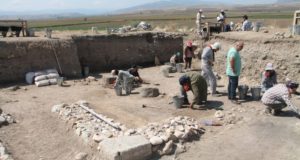
The Texas Department of Transportation ( TxDOT) has discovered more than 150,000
artifacts near downtown Houston. Excavations at Frost Town near Minute Maid Park were initiated in 2016 in association with the planned replacement of aging 1950’s bridge structure, the Elysian Street Viaduct, TxDOT’s Jason W. Barrett, PhD. told Chron.com.
Although the excavations were delayed through 2017, waiting for the bridge to be
demolished, it was resumed and completed in 2018, Barrett said. As well, a smaller project at Frost Town was completed in early 2019, in association with the North Houston Highway Improvement Project (NHHIP) , which involves evaluation
of the I-45 North corridor, according to the NHHIP website.
Among the artifacts discovered in the area were several intact features including house
foundations, cisterns, brick sidewalks, animal burials, and yard decorations, Barrett said. These findings will assist archaeologists in learning more about Frost Town.
The area dates back to 1836 when Jonathan Benson Frost, a veteran of the Republic of
Texas Army, built a house and a blacksmith shop on a small parcel of land adjacent to
Buffalo Bayou, Barrett said.
In 1838, Jonathan’s brother Samuel Frost laid out an 8-block area that became the Frost Town subdivision, with some of its earliest residents being immigrants, mainly from Germany, according to Barrett.
9,000 Years Ago, A Community With Modern Urban Problems
Some 9,000 years ago, residents of one of the world’s first large farming communities were also among the first humans to experience some of the perils of modern urban living.
Scientists studying the ancient ruins of Çatalhöyük, in modern Turkey, found that its inhabitants — 3,500 to 8,000 people at its peak — experienced overcrowding, infectious
diseases, violence and environmental problems. In a paper published June 17, 2019 in the Proceedings of the National Academy of Sciences, an international team of bioarchaeologists report new findings built on 25 years of study of human remains unearthed at Çatalhöyük.
The results paint a picture of what it was like for humans to move from a nomadic
hunting and gathering lifestyle to a more sedentary life built around agriculture, said
Clark Spencer Larsen, lead author of the study, and professor of anthropology at The
Ohio State University.
“Çatalhöyük was one of the first proto-urban communities in the world and the residents experienced what happens when you put many people together in a small area for an extended time, ‘ Larsen said.
“It set the stage for where we are today and the challenges we face in urban living.”
Çatalhöyük, in what is now south-central Turkey, was inhabited from about 7100 to 5950 B.C. First excavated in 1958, the site measures 13 hectares (about 32 acres) with nearly 21 meters of deposits spanning 1,150 years of continuous occupation.
Larsen, who began fieldwork at the site in 2004, was one of the leaders of the team that studied human remains as part of the larger Çatalhöyük Research Project, directed by Ian Hodder of Stanford University. A co-author of the PNAS paper, Christopher Knüsel of Université de Bordeaux in France, was co-leader of the bioarchaeology team with Larsen.
Fieldwork at Çatalhöyük ended in 2017 and the PNAS paper represents the culmination of the bioarchaeology work at the site, Larsen said.
Çatalhöyük began as a small settlement about 7100 B.C., likely consisting of a few mud-
brick houses in what researchers call the Early period. It grew to its peak in the Middle
period of 6700 to 6500 B.C., before the population declined rapidly in the Late period.
Çatalhöyük was abandoned about 5950 BC.
Farming was always a major part of life in the community. The researchers analyzed a
chemical signature in the bones — called stable carbon isotope ratios — to determine that residents ate a diet heavy on wheat, barley and rye, along with a range of non-
domesticated plants.
Stable nitrogen isotope ratios were used to document protein in their diets, which came from sheep, goats and non-domesticated animals. Domesticated cattle were introduced in the Late period, but sheep were always the most important domesticated animal in their diets.
“They were farming and keeping animals as soon as they set up the community, but they were intensifying their efforts as the population expanded,” Larsen said.
The grain-heavy diet meant that some residents soon developed tooth decay — one of the so-called “diseases of civilization,” Larsen said. Results showed that about 10 to 13
percent of teeth of adults found at the site showed evidence of dental cavities.
Changes over time in the shape of leg bone cross-sections showed that community
members in the Late period of Çatalhöyük walked significantly more than early residents.
That suggests residents had to move farming and grazing further from the community as time went on, Larsen said. “We believe that environmental degradation and climate change forced community members to move further away from the settlement to farm and to find supplies like firewood,” he said. “That contributed to the ultimate demise of Çatalhöyük.”
Other research suggests that the climate in the Middle East became drier during the
course of Çatalhöyük’s history, which made farming more difficult.
Findings from the new study suggest that residents suffered from a high infection rate,
most likely due to crowding and poor hygiene. Up to one-third of remains from the Early period show evidence of infections on their bones.
During its peak in population, houses were built like apartments with no space between them — residents came and left through ladders to the roofs of the houses.
Excavations showed that interior walls and floors were re-plastered many times with
clay. And while the residents kept their floors mostly debris-free, analysis of house walls and floors showed traces of animal and human fecal matter.
“They are living in very crowded conditions, with trash pits and animal pens right next to some of their homes. So there is a whole host of sanitation issues that could contribute to the spread of infectious diseases,” Larsen said. The crowded conditions in Çatalhöyük may have also contributed to high levels of violence between residents, according to the researchers.
In a sample of 93 skulls from Çatalhöyük, more than one-fourth — 25 individuals —
showed evidence of healed fractures. And 12 of them had been victimized more than
once, with two to five injuries over a period of time. The shape of the lesions suggested
that blows to the head from hard, round objects caused them — and clay balls of the right size and shape were also found at the site.
More than half of the victims were women (13 women, 10 men). And most of the injuries were on the top or back of their heads, suggesting the victims were not facing their assailants when struck.
“We found an increase in cranial injuries during the Middle period, when the population was largest and most dense,” Larsen said. “An argument could be made that overcrowding led to elevated stress and conflict within the community.”
Most people were buried in pits that had been dug into the floors of houses, and
researchers believe they were interred under the homes in which they lived. That led to an unexpected finding: Most members of a household were not biologically related.
Researchers discovered this when they found that the teeth of individuals buried under the same house weren’t as similar as would be expected if they were kin.
“The morphology of teeth are highly genetically controlled,” Larsen said. “People who
are related show similar variations in the crowns of their teeth and we didn’t find that in people buried in the same houses.”
More research is needed to determine the relations of people who lived together in
Çatalhöyük, he said. “It is still kind of a mystery.”
Overall, Larsen said the significance of Çatalhöyük is that it was one of the first Neolithic ” mega-sites” in the world built around agriculture.
“We can learn about the immediate origins of our lives today, how we are organized into communities. Many of the challenges we have today are the same ones they had in Çatalhöyük — only magnified.”
Other co-authors on the PNAS paper came from Université de Bordeaux, Koç University in Turkey, University of Nevada Reno, University of Zürich-Irchel, University of Liverpool, Johns Hopkins University, University of Arizona, University of Kent and Wilfrid Laurier University in Canada.
Among the funders supporting the project were the John Templeton Foundation, National Geographic Society and the National Science Foundation.
Story Source:
Materials provided by Ohio State University . Original written by Jeff Grabmeier. Note:
Content may be edited for style and length.
Journal Reference:
1. Clark Spencer Larsen, Christopher J. Knüsel, Scott D. Haddow, Marin A. Pilloud,
Marco Milella, Joshua W. Sadvari, Jessica Pearson, Christopher B. Ruff, Evan M.
Garofalo, Emmy Bocaege, Barbara J. Betz, Irene Dori, Bonnie Glencross.
Bioarchaeology of Neolithic Çatalhöyük reveals fundamental transitions in
health, mobility, and lifestyle in early farmers. Proceedings of the National
Academy of Sciences, June 17, 2019; DOI: 10.1073/pnas.1904345116