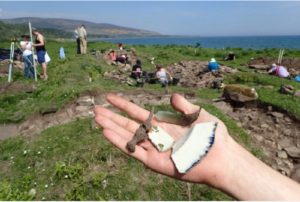
 According to a report in The Scotsman , a team of researchers under the direction of archaeologist Warren Bailie of GUARD Archaeology have returned to the site of the Wilkhouse, an eighteenth-century public house in the Scottish Highlands that served
farmers who were walking with their livestock to market. Coins uncovered at the site suggest the drove road that passed the pub had been in use since the late sixteenth century. Bailie said the pub’s double chimneys, slate roof, and lime-washed walls reflected the “modernity and affluence” that had been growing in the region in the mid-seventeenth century, since drovers’ inns were usually drystone structures with wooden shutters, low walls, central hearths, and thatched roofs. The excavation revealed the remains of meals of rabbit, birds, fish, and whelks, and shards of drinking glasses. An inverted cross found on a hearth stone may have been intended to keep witches from flying down the chimney, Bailie added. The pub fell out of use by 1819, however, due to the Highland Clearances, in which landowners evicted their tenants in order to enclose their fields for more profitable large-scale sheep herding
News
World Migratory Bird Day
 World Migratory Bird Day (WMBD) was initiated in 2006 and is an annual awareness-raising campaign highlighting the need for the conservation of migratory birds and their habitats. 2018 was an important transition year in the history of WMBD – unifying the planet’s major migratory bird corridors, or flyways: the African-Eurasian flyway, the East Asian-Australasian flyway, and the Americas flyways. Celebrated from now on twice a year, on the Second Saturday in May and in October, WMBD aims to reach out to a broader audience and amplify its message for bird conservation.
Every year people around the world take action and organize public events such as bird festivals, education programmes, exhibitions and bird-watching excursions to celebrate WMBD. All these activities can also be undertaken at any time on the year because that countries or regions observing the peak of migrations at different times, but the main days for the international celebrations in 2019 are Saturday 11 May and Saturday 12 October.
The theme for WMBD 2018, which also took place in the “Year of the Bird”, was “Unifying our Voices for Bird Conservation” and focused clearly and strongly on the development of its new identity and the need for people celebrating WMBD around the world to communicate and learn from each other, across borders, within and between the world’s flyways.
After 80 years on loan, stone relief of a lion and bull in combat displayed on UChicago campus
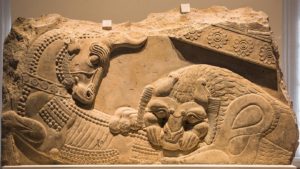 The lion and the bull have been fighting, locked in stone, for nearly 2,500 years—ever since an ancient sculptor carved them into a slab of black limestone and set them into a
monumental staircase at Persepolis, the royal center of the great Achaemenid Empire. The two animals were meant to reflect the prestige of this vast Persian empire, which fell in 330 B.C. when Alexander the Great sacked and burned Persepolis and its opulent palaces. The giant stone relief remained there among the ruins until 1931, when the University of Chicago’s Oriental Institute began a landmark excavation of the site—and gave the lion and bull a second life.
For the past 80 years, the 4,000-pound stone relief was on loan to the Boston Museum of
Fine Arts. But it has returned to the University of Chicago in honor of the OI’s 100th anniversary as one of the world’s foremost research centers on the civilizations of the
ancient Middle East. The rare artifact is available for public viewing at the Oriental
Institute Museum starting on September 28th, when the OI will host a public celebration—the first in a yearlong series of centennial events open to the University community and the general public.
Prof. Christopher Woods, director of the OI, discusses excavation work done in
Persepolis and the significance of the ancient relief.
Video by UChicago Creative
“We are thrilled to have this magnificent relief back in Chicago to help celebrate the OI’s
century of transformative research on the ancient Middle East,” said Christopher Woods,
director of the OI and the John A. Wilson Professor of Sumerology. “The beauty and
majesty of the relief just leaps out at you.”
The relief dates to about the fourth century B.C., when Persepolis stood as the ceremonial
center of the Achaemenid Empire, which spanned much of the ancient Middle East.
“Looking at this monumental imagery gives you insights into the imperial ideology—how the Achaemenid kings conceived of themselves and the identity they wanted to project,” said Woods, a leading scholar of Sumerian language and writing.
“The image of a lion and bull in combat has a long tradition in the ancient Middle East,
stretching back thousands of years,” said Jean M. Evans, chief curator and deputy
director of the OI Museum. “In the relief, these noble and powerful animals are
marshalled to reflect the power and prestige of the empire.” The 4,000-pound stone relief was recently returned to the OI for public viewing.
Photo by Jean Lachat
Rising to power in approximately 550 B.C., the Achaemenid Empire was the largest
empire the world had known; its extensive central administration set the model for later
empires and is an essential piece of understanding the journey of human civilization. But
after just two centuries, Persepolis—and the empire—fell when Alexander the Great’s
armies sacked the city in 330 B.C.
According to Roman historian Plutarch, it took 20,000 mules and 5,000 camels to carry
away the treasure Alexander’s army looted from Persepolis. Left behind, however, were
columns and halls, staircases and gates—all finely carved by the craftsmen of the
Achaemenid royal court.
Many of these were still standing two millennia later, when the OI began a pioneering
excavation that spanned eight years and required hundreds of workmen. Over the multi-
acre site, the excavation uncovered everything from the kings’ cups and bowls to the
treasures looted during the Achaemenid conquests of other kingdoms.
“The beauty and majesty of the relief just leaps out at you.”
—Prof. Christopher Woods, director of the OI
Hundreds of cuneiform tablets, preserved by their baking in the fires that consumed the
rest of the city, filled out the details of life in ancient Persepolis. From them, scholars
learned everything from land deals and taxes to how much haoma, the sacred intoxicating
drink, should be used during religious services.
While much of what was excavated remains on site at Persepolis, several large pieces,
such as the head of a colossal bull that once guarded the Hundred-Columned Hall, in
addition to smaller finds, were given to the OI by Iranian authorities in recognition of the
work that went into uncovering and preserving the ancient site and were shipped to
Chicago, where they have been on display at the OI Museum for nearly a century. The
relief of a lion and bull in combat, however, went on long-term loan to Boston Museum
of Fine Arts. In honor of the OI’s centennial, the Museum made plans to bring the stone relief back to Chicago.
International Day of Non-Violence
 “Gandhi constantly highlighted the gap between what we do, and what we are
capable of doing. On this International Day, I urge each and every one of us to do everything in our power to bridge this divide as we strive to build a better future for all.” — UN Secretary-General António Guterres
The International Day of Non-Violence is marked on 2 October, the birthday of Mahatma Gandhi, leader of the Indian independence movement and pioneer of the philosophy and
strategy of non-violence.
According to General Assembly resolution A/RES/61/271 of 15 June 2007, which established the commemoration, the International Day is an occasion to “disseminate the message of non-violence, including through education and public awareness”. The resolution reaffirms “the universal relevance of the principle of non-violence” and the desire “to secure a culture of peace, tolerance, understanding and non-violence”.
Introducing the resolution in the General Assembly on behalf of 140 co-sponsors, India’s
Minister of State for External Affairs, Mr. Anand Sharma, said that the wide and diverse
sponsorship of the resolution was a reflection of the universal respect for Mahatma
Gandhi and of the enduring relevance of his philosophy. Quoting the late leader’s own
words, he said: “Non-violence is the greatest force at the disposal of mankind. It is
mightier than the mightiest weapon of destruction devised by the ingenuity of man”.
Archaeology: 6th century BCE bronze statuette found on Bulgaria’s Cyricus island
 According sofiaglobe archaeologists have found a bronze statuette of a ram’s head, said to date from the sixth century BCE, on St Cyricus Island off the coast of the town of
Sozopol on Bulgaria’s Black Sea coast. The statuette, the only one of its kind found there to date, was brought by the founders of Apollonia, the ancient name of Sozopol, according to a report by Bulgarian National Television.
Archaeologists have reached a layer that dates from the time of the first Apollonians. The
town was founded in the seventh century BCE by Greek colonists from Miletus.
The head of the dig team, Associate Professor Krustina Panayotova of the National
Archaeological Institute at the Bulgarian Academy of Sciences, said that the statuette was
found in a pit where ritual drinking vessels were found, evidence that the first generations
of Apollonians offered gifts to their gods at the spot.
Although Apollonia has been studied for many years in dozens of archaeological
expeditions, no bronze objects have been found so far. Bronze from later eras has not
been found, even though there were copper mines nearby, used by the first settlers, the
report said.
Panayotova said that bronze was a metal that was much used. It is believed that the statue of Apollo, which was 12 metres high and from which the town took its name, may have been smelted for use to make cannons in later centures.
She said that the ram was a sacrificial animal, offered as a gift to the gods. “It is quite
possible that the statuette was brought here from Miletus.”
Along with the bronze head, many drinking vessels and jars made of fine ceramics have
been found. Apart from the workmanshop, the wild goats painted on them accurately suggest the date, and the place where the first settlers came from, the report said.
Research fellow Professor Margarit Damyanov said that the artefact was northern Ionian.
There was also hand-made ceramics, characteristic of the Thracian style, he said.
“Although attracted by the copper mines and natural resources of the area, the first
settlers in Apollonia apparently worked and lived in harmony with the local Thracians,”
Damyanov said.
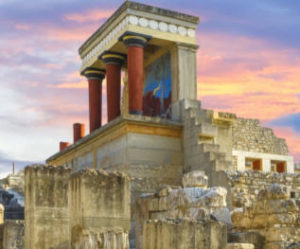
Ancient Tablets May Reveal What Destroyed Minoan Civilization
 By Philippe Bohstrom
The Minoans and their capital Knossos weren’t incinerated by volcanic blast from Thera
or flattened by quake as thought, but tellingly: their writing system changed.
The mystery of what happened to the Minoan civilization has tormented archaeologists
for over a century, and the tale has now taken a new twist. Nothing happened to them, say
archaeologists who have been excavating the island of Crete for over thirty years.
This extraordinary people, who produced palatial architecture unparalleled in the Aegean
region at the time, were not immolated by the volcanic eruption of Thera as once thought,
crushed by earthquake , or squashed by Mycenaean Greece as more recently supposed.
Rather, the Minoans, who had for crushed by earthquake , or squashed by Mycenaean Greece as more recently supposed.
Rather, the Minoans, who had for centuries wielded influence throughout the Aegean, did
experience earthquakes that rattled them, were indeed badly weakened by the volcanic
blast from Thera on the nearby island of Santorini, and did experience the unamiable
attentions of the mainland Greeks.
But although the two cultures appear to have struggled, over time the elite elements of
both became virtually indistinguishable, after 1450 B.C.E., if not earlier. Minoan
influence as such would recede and the by-then-Mycenaeanised islanders would soldier
on until the great collapse of civilization around the Mediterranean Basin, around 1,200
B.C.E. It bears adding that archaeologists had once thought the Minoans must have “come from somewhere else” because of their advancement compared with the surroundings. But genetic analyses in 2017 concluded that both the Minoans and Mycenaeans descended from the stone-age farmers of western Anatolia and the Aegean, plus smidgens of heritage from the Caucasus and Iran. The two were very closely related.
Yet the destruction layers found in the main Minoan city of Knossos weren’t the result of
Theran ash raining down 3,600 years ago but may be debris from Minoan resistance to
Yet the destruction layers found in the main Minoan city of Knossos weren’t the result of
Theran ash raining down 3,600 years ago but may be debris from Minoan resistance to
Mycenaean incursions, or possibly from local rebellions between 1470 to 1450 B.C.E.,
sums up Colin Macdonald, an archaeologist with the British School in Athens.
By the way, the Minoans they didn’t call themselves “Minoans”. That is a latter-day
name awarded to the prehistoric island residents deriving from their legendary king
Minos.
https://www.haaretz.com/archaeology/.premium.MAGAZINE-ancient-tablets-may-
reveal-what-destroyed-minoan-civilization-1.7809371
Educating About Climate Change and Heritage
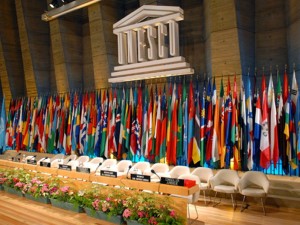 On the occasion of the 74th session of the United Nations General Assembly which taken place in NYC, UNESCO participated in several events of the Climate Summit and highlighted the role of education, science and culture in providing
sustainable responses.
The UNESCO reported that the Director-General supported the call of six South American countries to conserve and protect the Amazon, the world’s first tropical forest, at a high-level meeting on tropical forests: “The notion of common property whose transmission to future generations has been at the very heart of the UNESCO World Heritage Convention since the 1970s and is illustrated in places such as the Amazon but also in the Great Barrier Reef, the African tropical forests and the marine heritage”. The Director-General has therefore called for a massive emergency and investment plan for the areas, which are in the most critical situations, all over the world, by calling for the introduction of global education into school curricula from kindergarten to university.
WCHV and partners have been focusing on education as a major pillar of our
activities since our inception. On our website we have continued to include posts
and articles on heritage education and what schools and communities can teach the
next generation. In addition, we have also created educational videos which we
continue to use as an educational tool.
International Day of Peace
 “Today peace faces a new danger: the climate emergency, which threatens our
security, our livelihoods and our lives. That is why it is the focus of this year’s
International Day of Peace. And it’s why I am convening a Climate Action
Summit.” – UN Secretary-General António Guterres
Each year the International Day of Peace is observed around the world on 21 September.
The General Assembly has declared this as a day devoted to strengthening the ideals of
peace, both within and among all nations and peoples.
The United Nations Member States adopted the 17 Sustainable Development Goals in
2015 because they understood that it would not be possible to build a peaceful world if
steps were not taken to achieve economic and social development for all people
everywhere, and ensure that their rights were protected. The Sustainable Goals cover a
broad range of issues, including poverty, hunger, health, education, climate change,
gender equality, water, sanitation, energy, environment and social justice.
The International Day of Peace (“Peace Day”) is observed around the world each year
on 21 September. Established in 1981 by unanimous United Nations resolution 36/37, the
General Assembly has declared this as a day devoted to “commemorating and
strengthening the ideals of peace both within and among all nations and peoples.” For
the text of the U.N. Resolution,
Furthering the Day’s mission, the General Assembly augmented the original resolution in
2001, fixing the date on 21 September. For the text of this second unanimous UN
resolution,
Peace Day provides a globally shared date for all humanity to commit to Peace above all
differences and to contribute to building a Culture of Peace.
The Getty Trust will invest $100 million in saving antiquities around the world.
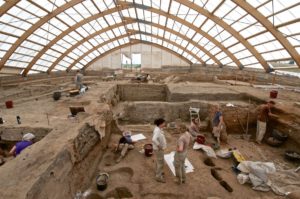 The J. Paul Getty Trust will invest $100 million in the conservation of antiquities from ancient societies across the world, citing threats such as sectarian violence and climate change, officials of the Los Angeles-based organization said Tuesday.
The trust, which operates the Getty Museum, has long focused on Greek and Roman antiquities. This new program, however, is designed to expand the conservation efforts it underwrites to countries where they have not worked before, including Southeast Asia and Central and South America.
Rare and unique Cycladic antiquities unveiled in exhibition series on Greek islands this summer
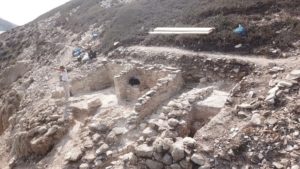
According to rnos news an extensive and extremely interesting series of exhibitions have
been organised on the Cyclades islands this year by the Cyclades Ephorate of Antiquities,
according to ANA.
The exhibitions will feature many unique and rare ancient artefacts, many of which are shown to the public for the first time, as well as new creations that form a link with the past, promising to make the time of holiday-makers on the islands even more memorable. Among these are the exhibitions “From the world of Homer. Tinos and the Cyclades in the Mycenaean era” that runs between July 13 and October 14, which is being held in cooperation with the Piraeus Group Cultural Foundation (PIOP) at its Museum of Marble Craft in the village of Pyrgos, Tinos. A second exhibition, entitled “Look Opposite) is to be inaugurated on July 14 at Archaeological Collection of Koufonisia and will run until September 30, 2019.
“Both exhibitions are extremely important,” noted Dimitris Athanasoulis, Director of the
Cyclades Ephorate of Antiquities, to the Athens-Macedonian News Agency (ANA). “On
the occasion of the founding of the tomb of Agia Thekla in Tinos, we have the first
exhibition for an unknown period of the Cyclades, the Mycenaean period, presenting
great and unknown material,” he added. However, the exhibition on Ano Koufonissi is
also very important, he added, as “unique discoveries from Keros and Daskalio are
revealed for the first time.”
Four-year excavations and research on the spectacular architectural findings of Kavos on
the island of Keros in the Cycladic Islands group confirmed the existence in Early
Cycladic times of a complex, stratified and technically expert society. The sanctuary at Kavos on the islet of Keros was an important regional centre for all the Cycladic Islands, the Ministry of Culture said at the conclusion of the research programme under Cambridge University.
The programme has “revealed impressive architectural remains of a significant Early
Cycladic settlement,” the ministry pointed out. Under the project, excavations were carried out on the small islet of Daskalio, originally connected to the nearby site of Kavos on Keros through a narrow strip of land. The date of Early Cycladic was confirmed scientifically, and the remains of the culture at the time include “impressive staircases, drainage pipes and stone buildings that reveal an advanced urban architecture without precedence for the specific period.”
This year’s results, the ministry announced, feature paths leading to the top of the
settlement, passing by terraces created to support buildings. “The complicated,
interlinked and multi-level architecture shows the existence of a well-organised and well-
built settlement on a steep promontory,” it added. The Daskalio buildings were mostly made of good-quality marble from Naxos island, almost 10 km north of Keros.
According to co-excavator professor Colin Renfrew, Daskalio indicates that the building
techniques that were applied, the existence of huge entrance gates, stone ladders and the
drainage pipes throughout the island show that there must have been a specialist architect
and a central administration to carry out the building programme. He said the complexity
of the construction is only comparable to Knossos on Crete for the same early period, he
said.
The ministry added that materials discovered, including the marble and obsidian, show
that the settlers were expert seamen and trade extended over a wide network reaching
beyond the Cyclades.
Co-director of the site Michael Boyd added that a unique feature of the site includes the
fact that metallurgy played a significant role throughout the life of the settlement. Its
extent and scale prove a constant replenishing of raw materials from western Cyclades
and Attica, and a social structure that trained and passed skills on to newer generations.
The fourth and last excavation period in the “Keros-Naxos Sea Roads” project took place
in September and October 2018 by Cambridge University under the aegis of the British
School at Athens and the supervision of the Antiquities Ephorate of the Cyclades,
represented by Irene Legaki. The four-year project picked up from where the previous
excavation cycle concluded in 2008 at Kavos Daskaliou.