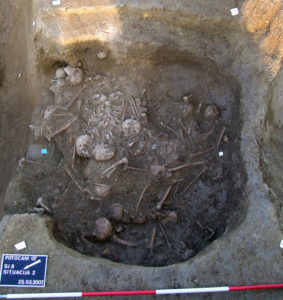
 ZAGREB, CROATIA—According to a Gizmodo report, Mario Novak of Croatia’s Institute for Anthropological Research, Ron Pinhasi of the University of Vienna, and David Reich of Harvard University analyzed the remains and genomes of 38 people of
the Lasinja culture who were buried in a mass grave in what is now eastern Croatia some 6,200 years ago. The Lasinja people, Novak explained, were descended from Anatolian farmers and hunter-gatherers from Western Europe. They raised cattle and other livestock
and used metal, he added. The study suggests that the men, women, and children were executed with different types of weapons and tools before their bodies were disposed of all at once in the pit. Some of the people were related, including a young man, his two daughters, and a nephew, but most of the people were unrelated to each other. No weapons or tools were found in the pit, but the skulls show injuries from blunt force trauma, stabbing, piercing, and cutting. Novak suggests that an increase in population size, combined with climate change and drought, may have brought about conflicts over resources. “But, at this point we cannot tell with certainty,” he said.
News
Human Proteins Detected on Medieval “Birthing Girdle”
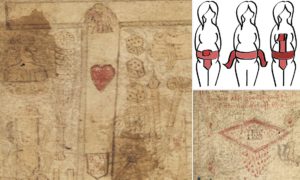 CAMBRIDGE, ENGLAND— Live Science reports that biochemist Sarah Fiddyment of the University of Cambridge analyzed the surface of a medieval birthing girdle—a ten-foot long strip of narrow parchment covered with Christian imagery including the wound on the side of the crucified Christ, dripping blood, crucifixion nails, a sacred heart and
shield, and a human figure that may represent Jesus. Such girdles were made of
parchment or silk and were loaned to women in late pregnancy as a protection from
danger in childbirth by churches and monasteries in exchange for donations. “This
particular girdle shows visual evidence of having been heavily handled, as much of the
image and text have been worn away,” Fiddyment said. “It also has numerous stains and blemishes, giving the overall appearance of a document that has been actively used.”
Fiddyment and her colleagues detected the presence of proteins from honey, cereals,
legumes, and milk, which were all ingredients in medieval treatments for childbirth, in
addition to 55 human proteins found in bodily fluids. “This can provide a further possible
indication that the roll was indeed actively used during childbirth,” she explained.
Birthing girdles fell out of use after the Dissolution of the Monasteries in the mid-
sixteenth century.
The World Engineering Day
 The World Engineering Day for Sustainable Development was proclaimed by UNESCO at its 40th General Conference in 2019. It is celebrated worldwide on 4th March of each year since 2020. The day offers an opportunity to highlight engineers and engineering’s
achievements in our modern world and improve public understanding of how engineering and technology are central to modern life and for sustainable development.
The World Engineering Day 2021 (WED2021), with the theme “Engineering for A Healthy Planet- Celebrating the UNESCO Engineering Report”, will focus on celebrating the launch of the 2nd UNESCO Engineering Report “Engineering for
Sustainable Development: Delivering on the Sustainable Development Goals”. Ten years after the publication of the 1st UNESCO Engineering Report, “Engineering: Issues, Challenges and Opportunities for Development”, the new report highlights the crucial role of engineering in delivering the 2030 Agenda for sustainable development, shows how inclusive and gender equitable engineering profession can bring about new perspectives and thus respond to the shortage of engineers, showcases of engineering innovations for implementation of the SDGs, analyses the progresses in and challenges in engineering education and capacity building, and summarizes the regional trends of engineering development. Finally, it gives recommendations for developing engineering for the SDGs, and calls for global cooperation with multiple stakeholders to promote
development of engineering for the SDGs.
Goose in Ancient Egyptian Painting May Depict Extinct Species
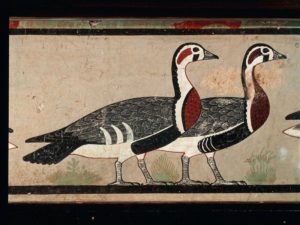 BRISBANE, AUSTRALIA—According to a statement released by the University of Queensland, paleontologist Anthony Romilio suggests that the red-breasted goose painted some 4,600 years ago on the wall of the tomb of Nefermaat and Itet in Meidum, Egypt, could represent an unknown species. Romilio points out that the artwork at the site that depicts other animals is extremely realistic, and while the goose in question resembles the modern red-breasted goose known as Branta ruficollis, no Branta ruficollis remains have been recovered at an Egyptian archaeological site. Romilio thinks the goose species depicted in the ancient painting may have gone extinct. The bones of a bird similar to Branta ruficollis have been unearthed on the island of Crete, he pointed out. “Art provides cultural insight, but also a valuable, graphical record of animals unknown today,” Romilio said. Some of those animals include the aurochs, and species of gazelle, antelope, oryx, and donkey.
10th century Buddha Vihar discovered in Jharkhand’s Hazaribag
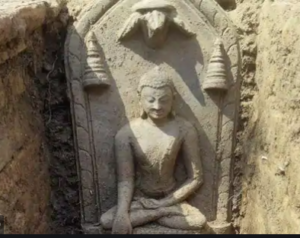 A 10th century structure resembling a small ‘Buddha Vihar’ (Buddhist shrine-cum-monastery) has been discovered during an excavation, being carried out by Archeological Survey of India (ASI), in foothills of Juljul hill at Sadar block of Hazaribagh district, around 110-km from capital Ranchi, ASI officials said on Tuesday.
The ASI identified three mounds in the foothills having links to Buddhism last year. The excavation of the first mound last year led to the discovery of a complete shrine with a central and two subsidiary shrines, just two metres below the surface. However, the excavation work was suspended after two months due to Covid-19 pandemic triggered lockdowns and some other reasons.
In the second round of excavation, beginning the last week of January this year, the
second mound, around 40-meters away from the first mound or central shrine, was
excavated and a small Buddha Vihar like structure was discovered.
“We started excavation in the second mound of the area in January last week, where a
huge structural mound, similar to a small Buddha Vihar, was found with three cells
(rooms). In the west corner of the structure, we found five sculptures of Gautam Buddha
in seated position and one sculpture of Tara, which indicates that it might also be a
centre of Vajrayana,” said Dr Neeraj Mishra, assistant archaeologist at ASI.
Ruins of Gateway unearthed near Persepolis
By Dr. Kaveh Farrokh
The article “Ruins of majestic historical gateway unearthed near Persepolis” by Afshin Majlesi was published in the Tehran Times on February 8, 2021. Kindly note that the article below has been slightly edited with (excepting one image) all images and accompanying captions not having appeared in the original Tehran Times posting.
Readers interested in this topic are also encouraged to consult the following:
-
- Farrokh, K., & Farhid, T. (1396/2018).[استوانه کوروش بزرگ و اسناد “دیگر” در بابل, مصر و ستون سنگی یادبود خانتوس] “Other” Cylinders and Records before and after Cyrus the Great: Kelar, Babylon, Egypt and Xanthus. Studies in Honor of Professor Jalal Khaleghi Motlagh (ed. F. Aslani & M. Pourtaghi), Tehran: Morvarid Publications, pp.379-394. (download full article from Academia.edu)
====================================================================
The ruins of a majestic historical gateway, built upon the order of Cyrus the Great, who was the founder of the mighty Achaemenid Empire (ca. 550 – 330 BC), have been unearthed near the UNESCO-registered Persepolis in southern Iran, as noted by Iranian researchers.
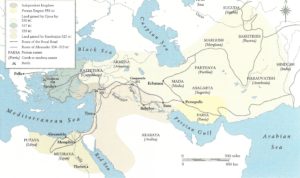 Map of the Achaemenid Empire drafted by Kaveh Farrokh on page 87 (2007) for the book Shadows in the Desert: Ancient Persia at War-Персы: Армия великих царей-سایههای صحرا-: Supervised by a joint mission of Iranian and Italian archaeologists and cultural heritage experts, the dig uncovered vestiges of a massive gateway measuring 30 by 40 meters with a height of approximately 12 meters.
They (archaeologists) succeeded in proving that Cyrus had ordered the construction of the gateway near Persepolis in Tall-e-Ajori and that this magnificent gateway had been put into operation during the reign of his son Cambyses. As quoted by IRNA senior Iranian archaeologist Alireza Askari-Charoudi stated: “The building had a corridor in the center, which was in form of a rectangular room measuring eight by twelve meters, and inside this central room, there were four living chairs. And the central corridor opened on both sides to the Achaemenid campus…”
The discovery was made during the tenth excavation season jointly supervised by the Italian archaeologist Pierfrancesco Callieri from the University of Bologna, and his Iranian counterpart Askari-Charoudi from the University of Shiraz. The first season was held in the Iranian calendar year 1390 (2011). As noted by Askari-Charoudi: “The gateway is made of [brick and] clay materials and the whole exterior has been decorated with painted bricks. The lower parts and the plinth of the walls are decorated with [themes of] lotus flowers, the body, and facade of the walls are embellished with various colored panels of mythical animals, symbols, and belief symbols of ancient Iranians, Elamites and Mesopotamians. More importantly, the central room bears inscriptions in Babylonian and Elamite (cuneiforms).”
As noted by Askari-Charoudi in reference to the age of the monument:
“ The sum of written documents, building materials, motifs used to decorate the facade of the building, the Carbon 14 (C-14) dating method, and some other evidence reveal that this structure was built after 539 BC in honor of the conquest of Babylon by Cyrus the Great.”
The empire, founded by the Persian kings Cyrus and Darius, stretched from the Balkans to Central Asia at its peak . It was the first state model based on diversity and tolerance of different cultures and religions.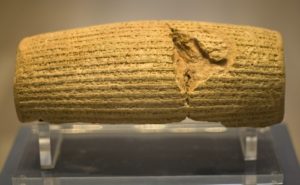
The Cyrus Cylinder housed at the British Museum (Picture Source: Angelina Perri Birney). For more see here …
Once Cyrus and his army entered the city of Babylonian, they did not burn it to the ground (as usually happened with conquered cities at this period) but he freed the population from forced labor obligations, sent back to various shrines statues of gods, and allowed the people who had been brought to Babylon by the Babylonian kings to return to their homes. By this act, he was effectively allowing people to pursue unmolested their own religious practices.
 The West Wall in Jerusalem. After his conquest of Babylon, Cyrus allowed the Jewish captives to return to Israel and rebuild the Hebrew temple. It is believed that approximately 40,000 did permanently return to Israel. For more see here …
The royal city of Persepolis ranks among the archaeological sites which have no equivalent, considering its unique architecture, urban planning, construction technology, and art. Persepolis, also known as Takht-e Jamshid, whose magnificent ruins rest at the foot of Kuh-e Rahmat (Mountain of Mercy), was the ceremonial capital of the Achaemenids. It is situated 60 kilometers northeast of the city of Shiraz in Fars province.
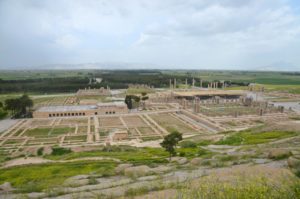 A general view of Persepolis (Courtesy of: Following Hadrian Photography). For more see … Persepolis: A Comprehensive Photographic Overview …
The city was burnt by Alexander the Great in 330 BC apparently as revenge to the Persians because it seems the Persian King Xerxes had burnt the Greek City of Athens around 150 years earlier.
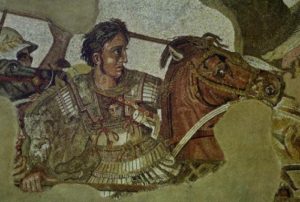 Alexander (356-323 BC) held a deep respect and profound admiration for Cyrus the Great. He assumed the mantle of “the world hero” from Cyrus and attempted to fuse the Iranians and the Greeks into a single and unified realm. For more see here …
The city’s immense terrace was begun about 518 BC by Darius the Great, the Achaemenid king. On this terrace, successive kings erected a series of architecturally stunning palatial buildings, among them the massive Apadana palace and the Throne Hall (“Hundred-Column Hall”). This 13-ha ensemble of majestic approaches, monumental stairways, throne rooms (Apadana), reception rooms, and dependencies is classified among the world’s greatest archaeological sites.
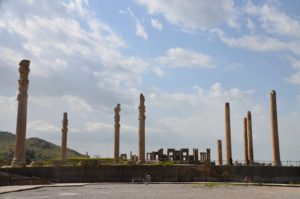 The Apadana, the largest and most magnificent building of Persepolis located on the western side of the platform. It was begun by Darius and finished by Xerxes, and was used mainly for great receptions by the kings (Courtesy of: Following Hadrian Photography). For more see … Persepolis: A Comprehensive Photographic Overview …
Persepolis was the seat of the government of the Achaemenid empire, though it was designed primarily to be a showplace and spectacular center for the receptions and festivals of the kings and their empire.
The site is marked by a large terrace with its east side abutting the Kuh-e Rahmat (“Mount of Mercy”). The other three sides are formed by a retaining wall, varying in height with the slope of the ground from 13 to 41 feet (4 to 12 meters); on the west side, a magnificent double stair in two flights of 111 short stone steps leads to the top. On the terrace are the ruins of several colossal buildings, all constructed of a dark gray stone (often polished to a marble-like surface) from the adjacent mountain.
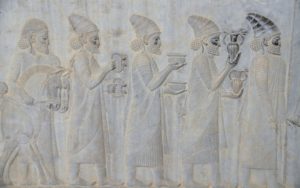 Relief on the southern wall of the east stairway of the Apadana depicting Lydians who offer vases, cups and bracelets and a chariot drawn by horses (Courtesy of: Following Hadrian Photography). Comment by Kavehfarrokh.com: The late Paul Kriwaczek (1937-2011) however had suggested that the above figures may in fact have been “… Hebrews from Babylon” (in “In Search of Zarathustra: The First prophet and the ideas that Changed the World”, London: Weidenfeld & Nicolson, 2002, description of top figure alongside page 117) … For more see … Persepolis: A Comprehensive Photographic Overview …
According to Britannica, the stone was cut with the utmost precision into blocks of great size, which were laid without mortar; many of them are still in place. Especially striking are the huge columns, 13 of which still stand in the audience hall of Darius I (the Great; reigned 522–486 BC), known as the apadana, the name given to a similar hall built by Darius at Susa. There are two more columns still standing in the entrance hall of the Gate of Xerxes, and a third has been assembled there from its broken pieces.
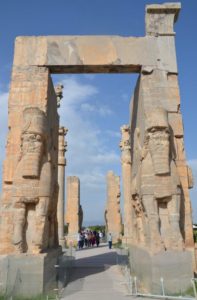 The east side of the Gate of All Nations also known as the Gate of Xerxes which was was protected by two massive winged bulls with human heads called lamasssus (Courtesy of: Following Hadrian Photography). For more see … Persepolis: A Comprehensive Photographic Overview …
In 1933 two sets of gold and silver plates recording in the three forms of cuneiform—ancient Persian, Elamite, and Babylonian—the boundaries of the Persian empire were discovered in the foundations of Darius’s hall of audience. Several inscriptions, cut in stone, of Darius I, Xerxes I, and Artaxerxes III indicate to which monarch the various buildings were attributed.
The oldest of these on the south retaining wall gives Darius’s famous prayer for his people:
“God protect this country from foe, famine, and falsehood.”
There are numerous reliefs of Persian, Median, and Elamite officials, and 23 scenes separated by cypress trees depict representatives from the remote parts of the empire who, led by a Persian or a Mede, made appropriate offerings to the king at the national festival of the vernal equinox.
Related posts:
https://www.kavehfarrokh.com/news/ruins-of-gateway-unearthed-near-persepolis/
International Day of Women and Girls in Science
Women Scientists at the forefront of the fight against COVID-19.
 The outbreak of the COVID-19 pandemic has clearly demonstrated the critical role of women researchers in different stages of the fight against COVID-19, from advancing the knowledge on the virus, to developing techniques for testing, and finally to creating the vaccine against the virus.
At the same time, the COVID-19 pandemic also had a significant negative impact on women scientists, particularly affecting those at the early stages of their career, and thus contributing to widening the existing gender gap in science, and revealing the gender disparities in the scientific system, which need to be addressed by new policies, initiatives and mechanisms to support women and girls in science.
Against this backdrop, this year’s celebration of the Day will address the theme “ Women Scientists at the forefront of the fight against COVID-19 ” and will gather together experts working in fields related to the pandemic from different parts of the world.
The 2021 main event will take place online . A simultaneous interpretation of the debates will be provided in English and French.
On 11 February 2021, the 6th International Day of Women and Girls in Science
Assembly will be held at the United Nations Headquarters virtually. With great
momentum and interest to accelerate progress in achieving the 2030 Development
Agenda and its 17 Global Goals, the 6th International Day of Women and Girls in
Science Assembly theme will be Beyond the Borders: Equality in Science for Society,
with a special focus on the value of the social aspects and cultural dimensions in Science, Technology and Innovation to enhance sustainable development programmes.
Science and gender equality are both vital for the achievement of the internationally
agreed development goals, including the 2030 Agenda for Sustainable Development .
Over the past 15 years, the global community has made a lot of effort in inspiring and
engaging women and girls in science. Yet women and girls continue to be excluded from participating fully in science.
At present, less than 30 per cent of researchers worldwide are women. According
to UNESCO data (2014 – 2016), only around 30 per cent of all female students select
STEM-related fields in higher education. Globally, female students’ enrolment is
particularly low in ICT (3 per cent), natural science, mathematics and statistics (5 per
cent) and in engineering, manufacturing and construction (8 per cent).
Long-standing biases and gender stereotypes are steering girls and women away from
science related fields. As in the real world, the world on screen reflects similar
biases—the 2015 Gender Bias Without Borders study by the Geena Davis Institute showed that of the onscreen characters with an identifiable STEM job, only 12 per cent
were women.
In order to achieve full and equal access to and participation in science for women and
girls, and further achieve gender equality and the empowerment of women and girls, the United Nations General Assembly adopted resolution A/RES/70/212 declaring 11
February as the International Day of Women and Girls in Science .
Painted Terracotta Figurines Discovered in Turkey
 DEMRE, TURKEY—Dozens of terracotta figurines have been discovered on Turkey’s southwestern coast in the ancient Lycian town of Myra by a team of researchers led by Nevzat Çevik of Akdeniz University, according to a Live Science report. The 2,200-year-old sculptures were found along with other objects made of ceramic, bronze, lead, and silver in the remains of the Hellenistic theater, which lay under the town’s larger Roman theater. The sculptures depict men, women, cavalry, animals, and the Greek deities Artemis, Heracles, Aphrodite, Leto, and Apollo. Some of the figures still bear traces of red, blue, and pink paint in different shades, Çevik said. Inscriptions on the backs of some of the statues may records the names of a workshop or artist, he added. The team members also recovered votive plates and incense containers, and think the figurines may have been displayed in a cult area before they were moved to the theater site. To read about recent reanalysis of hundreds of Phoenician ceramic figurines found on the seafloor off the coast of Israel, go to ” Offerings at Sea .”
Two Hand Colored 19th Century Photos of Tiflis (Tbilisi)
By Dr. Kaveh Farrokh
Below are two rare hand-colored photographs of the city of Tiflis (Tbilisi) in Georgia in
the late 19th century. The photos were taken by the Georgian photographer Dmitri
Ivanovich Ermakov. Georgia along with territories in the southern Caucasus had been
conquered by imperial Czarist Russia from Qajar-ruled Iran in the early 19th century. The first war between Qajar-ruled Iran and imperial Russia was fought in 1804-1813. This resulted in Iran’s loss of the Caucasus to the Russians, as ratified by the Treaty of
Gulistan on September 24, 1813 in the village of Gulistan in the khanate in Nakhchevan. As noted by Kaveh Farrokh in the text “ Iran at War 1500-1988 “:
“The Gulistan Treaty … was … one of the most humiliating treaties ever signed by Iran throughout her history. Article 3 forced Iran to relinquish all her Caucasian khanates (except Armenia and Nakhchevan) situated between the western shore of the Caspian Sea and Armenia to Russia. These included the khanates of Karabagh (Qarabagh), Ganja, Sheki, Shirvan, Darband, Mughan, Kuba, Baku, and the northern part of Talysh (Including the strategic fortress of Lankoran). These khanates were situated just north of the Araxes River and were not collectively or individually recognized as being part of the Iranian province of Azerbaijan. The historical Azerbaijan was situated strictly to the south of the Araxes River in Iran. In addition to the khanates, Iran was also forced to renounce all of her claims to Georgia (as well as the territories of Mingrelia, Imeretia, and Abkhazia) and Daghestan…The terms of the Gulistan treaty … especially the catastrophic territorial losses in the Caucasus exacted a particularly heavy blow … not just the diminution of the landmass of the Iranian empire… also involved the surrender of a total of 3,000,000 of her citizens (i.e. Persians, Azarbaijanis and Talysh resident in the Caucasus) to Russian rule. “
[Page 194, 2011]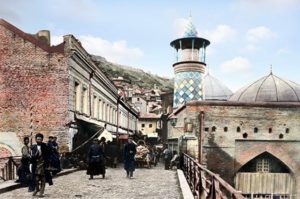
The old bridge-walkway in Tbilisi with the Shiite mosque still evident despite the passage of a number of decades after the imperial Russian conquests (Source: Georgia About ).
The second war between Qajar-ruled Iran and imperial Russia was fought in 1826-1828. As noted by Kaveh Farrokh in the text “ Iran at War 1500-1988 “, this resulted in another defeat for Iran as ratified in:
“… the treaty of Turkmenchai [signed] on February 21, 1828…proved to be even harsher than those of Gulistan in 1813, making it one of the most humiliating Treaties signed by Iran in her history … Article four of the treaty ensured that Iran lost even more territory that she had in the Gulistan treaty. Iran was not only forced to acknowledge her territorial losses as stipulated in the Gulestan treaty, she also had to cede the khanates of Nakhchevan, Yerevan (modern Republic of Armenia), Talysh and other regions such as Mughan and Ordubad to the Russian empire.” [Page 197, 2011]
 Colorized photograph of Shopkeepers selling local wine jugs in Tbilisi in the 19th
century CE (Source: Georgia About ). The style of the shops, their wooden doors and even the display of wares still resembled shops in Iranian territory. Note that this is despite the fact that imperial Russia had been engaged in a decades long anti-Persian cultural campaign in the Caucasus since the late 1820s . These policies continued well into end the Soviet era in 1990.
After the finalization of the Russian conquests of the Caucasus, Tbilisi became the
Imperial Tsarist capital of the Caucasus. Tbilisi become the de-facto base of the viceroy
of the Tsars of Moscow.
1. The Mushtaid (Mojtahed) Garden in Tbilisi
2. Photos of the Atashgah (Zoroastrian Fire Temple) in Tbilisi, Georgia
3. A Collage of Ancient Tbilisi (Tiflis)
4. Updates and Photos from Yerevan State University Conference November 2013
5. Farrokh Lecture on Iran-Caucasus Links at University of Southern California
6. Zoroastrian and Mithraic Sites of the Caucasus
7. Photos of Old Tehran: 1848 to 1864
8. Nowruz Celebrations in the Caucasus
9. Shireen T. Hunter: The New Geopolitics of the South Caucasus
10. New Book: Iranian-Russian Encounters Empires and Revolutions since 1800
https://www.kavehfarrokh.com/heritage/two-hand-colored-19th-century-photos-of-tiflis-tbilisi/
Elimination of a UNESCO World Heritage Skill by the Islamic Government of Iran
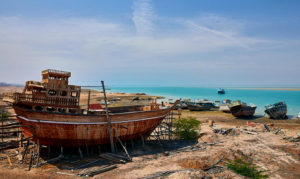 According to Iran’s official publications, the “traditional knowledge of Persian shipbuilding and navigation in the Persian Gulf,” which was included on the UNESCO’s World Heritage List in 2011, will be removed and destroyed with the approval of the cabinet of ministers of the Iran’s Islamic government.
The order was approved under a directive related to the “replacement of traditional vessels with a capacity of less than 50 tons and with the aim of removing smuggling tools from the sea, transferring non-formal sailing and fishing to official and commercial activities”, and according to the government, “boosting shipbuilding activities and maritime safety.”
The construction and building of dinghies or small boats have been practiced by Persian sailors and fishermen for centuries, supporting their livelihood and their families. Under this new directive from the Iranian government the title “Knowledge of dinghy construction of Iranian sailors in the Persian Gulf” will instead be removed from the UNESCO World Heritage List and in practice this knowledge which has
been transferred from generation to generation will be forgotten. Therefore, it is foreseeable that another ancient Iranian skill and practice that is a relic of fishermen and sailors of our land will be forgotten due to the ignorance and profiteering of the Islamic government. It is also quite possible that in a few years the skill and historical knowledge of building dinghies will be presented to the UNESCO by another Persian Gulf country as their own World Heritage skill.
Interestingly, and contrary to this recent order, the officials and the cabinet of the Iranian Islamic government recently sent reports to the UNESCO on the government’s actions to preserve intangible Iranian world heritage. Not surprising from a government which has continuously given false and misleading reports to the UNESCO.
www.savepasargad.com