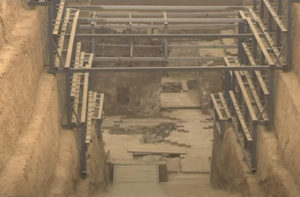
 China Daily reports that a tomb dated to the Sui Dynasty (A.D. 581–618) has been unearthed in central China’s Henan Province. The tomb, which contains a coffin bed and screen made of white marble carved with patterns resembling those found in Zoroastrianism and Buddhism, belonged to a previously unknown couple named Qu Qing. An epigraph found in the tomb records events in the couple’s lives and offers new
information about the development of calligraphy during the Sui Dynasty. “The Qu
family lived in the Longxi area, which occupied the main part of the Silk Road for a long
time, so they were deeply influenced by European, West Asian, and Central Asian
cultures,” explained Kong Deming of the Anyang Institute of Cultural Relics and
Archaeology. White porcelain tomb figures produced at the Xiangzhou kiln in Anyang
were also recovered from the tomb. Kong said the figures will help researchers
understand the development of such porcelain