Anatoli: Heir to an Irano-Greek Legacy
By Dr. Kaveh Farrokh
The article regarding the history of the Lion and the Sun motifs on Iranian flags bears the image below which was originally identified as an Achaemenid seal of King Artaxerxes II (at left) facing the goddess Anahita who sits atop a lion. The seal however was not produced during the Achaemenid era, but after the fall of the Achaaemenids and is traceable to the post-Achaemenid dynasties of Anatolia known as Commagene, Cappadocia and the Pontus.
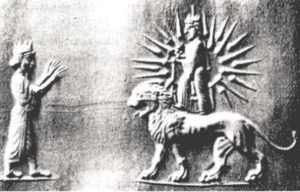 The seal was discovered along the northeastern shore of the Black Sea (Consult Collon, 1987, no. 432) in the region of the ancient Pontus. The seal is in the British museum and not the Hermitage Museum of St. Petersburg as is often assumed.
Before we discuss (or revisit) the themes imprinted upon the plaque, we need to first provide a sketch of the successor states of Anatolia following the fall of the Achaemenids in 333-323 BC.
The Greco-Persian Legacy of Anatolia: An Overview
As Parthia gained prominence on the Iranian plateau and Mesopotamia, Persian culture had (once again) risen in prominence in Anatolia as it had during the Achaemenid era. Despite the fall of the Achamenid Empire a few hundred years before, the legacy of Iranic culture had never departed from eastern and central Anatolia. The Hellenic conquests had certainly resulted in political divisions with different regional monarchies, however the Iranic Culture of Pontus-Cappadocia endured.
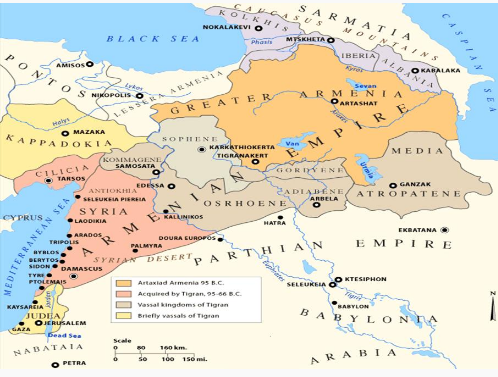 The Kingdoms of Anatolia, Pontus, Commagene and Cappadocia bore a very strong Iranian cultural, artistic and mythological tradition which was combined with that of ancient Greece. The kingdoms were later absorbed by the Roman Empire. Eastern Anatolia to this day endures with a distinct Iranic tradition with its Kurdish population speaking a west Iranian language akin to Persian.
The most famous Pontic leader was Mithradates (Mehrdad ) VI Eupator who was raised in the Greek language but also learned Persian (Bickerman, 1985, p.103; Raditsa, 1985, p.110). Plutarch notes that Mehrdad Eupator appeared in “Persian Dress“.
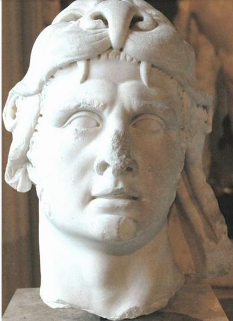 Mithradates (Mehrdad ) VI Eupator (134-63 BC). Mithradates spoke both Persian and Greek and sought to combine the traditions of both Greece and Persia. According to Plutarch, he appeared in “Persian Dress”.
Some Iranian influence even extended to Ionian coast along Aegean. Plutarch had noted that the cultural exchanges taking place in Ephesos (near modern Izmir in western Turkey), were leading to latter’s “barbarization” (Plutarch, Lys. 3). In Lycia, Iranic names become widespread among the nobility (Dandamaev & Lukonin, 1989, p.300). It was this Greco-Iranian legacy that was to inspire Mithradates of Eupador.
However, to characterize those regions as exclusively Iranian is simplistic: Eastern Anatolia bears a powerful Hellenic and subsequent Armenian imprint as well. During the Achaemenid era Greek cities began to be founded along the Black Sea coast just as the Iranian Magi, nobility and settlers were arriving into the region. A similar process of Irano-Greek fusion had been taking place in the ancient Ukraine since at least Median times.
Just twenty years after the passing of the Hellenic conqueror Alexander in 333 BC, two independent Irano-Anatolian monarchies gained power in Anatolia by 305 BC: the Kingdoms of Pontus and Cappadocia. What is especially of interest is that their subjects claimed descent from the Achaemenids of the First Persian Empire (Raditsa, 1985, p.106). Note the contrast to those Iranians west of the Halys River in western Anatolia: these had become Hellenecized after the conquests of Alexander.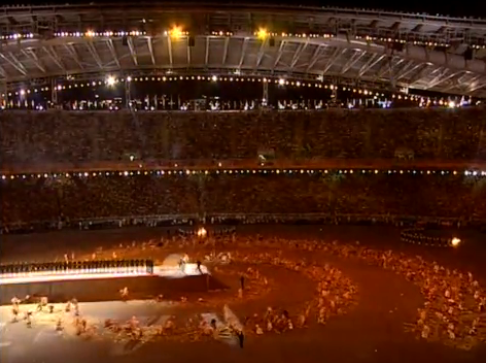 Pontic Greek music performance during the Olympic ceremonies held in Athens, Greece in 2004. The music is of interest in that it contains instruments, percussion and melodies consistent with the Music of northern Iran, the Caucasus and Turkey. The drumming for example is seen in western Iranian folklore music; the genuflect motion is seen in various types of Kurdish dances; and the attire is seen in traditional Georgian and Armenian costume.
The Iranians of Cappadocia fought against Alexander at Gaugamela in 331 BC and continued to resist the Greeks, even after the fall of the Achaemenid Empire (Raditsa, 1985, p.106). Hellenization took longer to find its roots in Cappadocia and began a century after Alexander’s conquests. The Iranian character of Cappadocia recognized as late as the time of Roman Emperor Augustus by the ancient historian Strabo who considered Cappadocia as: “a living part of Persia” (Strabo XV, 3.15).
Cappadocia bore a strong Zoroastrian legacy. Despite Alexander’s conquests of Asia Minor, Cappadocia still had many Iranian temples and Zoroastrian magi by the advent of Parthian rule in Persia (Strabo, XI, 14.16, XV, 733). Remarkable is the term of Grand Magus as being second after the king (Strabo, XII, 2.3). This term is found in Achaemenid, Parthian and Sassanian Persia.
The Mithraic-Zoroastrian temples of Cappadocia also served as centers of worship for the populations of: Armenia and Pontus (Raditsa, 1985, p.107) just as the temples of Media Atropatene did for Medes, Persians, Hyrcanians and other Iranic peoples of the Parthian realm.
By the 1st century BC Antiochus I of Commagne spoke of combining the mythology and cultures of Greece and Persia. His genealogy claimed Iranian descent from the Achaemenids and Greek descent from Alexander.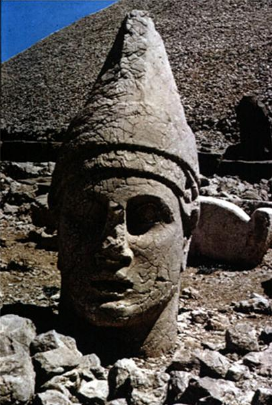 Statue at Nimrud-Dagh (ancient Commagene). Note the combination of tall conical Persian hat (still used by mystic cults and Dervishes) with Greek style of anthropomorphic depiction. Antiochus I (86-38 BC) spoke Greek but dressed in Iranian style and demanded that the local Magi dress like the Persians. The surviving statues and architecture of Nimrud-Dagh shows a clear synthesis of Greek and Persian arts and architecture (Ghirschman, 1962).
The regions of Cappadocia and Pontus failed to attract the same level of Hellenic immigration as those further east and south into Iran and Mesopotamia. As noted by Raditsa:
“…Hellenization in lands like Pontus and Cappadocia meant that the natives Hellenized themselves” (1985, p.112)
Assyriology notes on the Plaque: Heir to a Mesopotamian Tradition
But what of the plaque discussed in the introduction of the article?
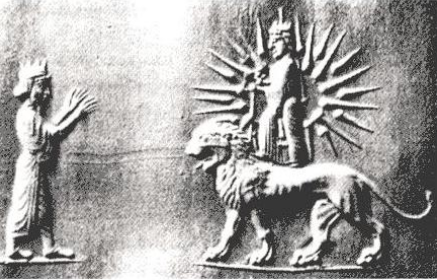 It is interesting that the seal shows the sun emanating 21 rays, the same symbol which is used by various ancient Iranic cults among the Kurds of Iran, Iraq and Turkey. The 21 rays may be related to the festival date of Mehregan (Festival of the Sun-god Mithra) which takes place from the 16th to the 21st of Mehr of the Iranian calendar.
That too is in the post-Achaemenid tradition of arts and its style bears a stronger resemblance to the Achaemenid rather than the Hellenic arts. This was (as noted earlier) found in the site of the ancient Pontus where the imprint of Zoroastrianism was strong.
The plaque represents Anahita superimposed on a solar deity – perhaps the ancient Iranic god Mithras. But is the theme specifically Iranic and/or Zoroastrian? The discipline of Assyriology provides an interesting explanation as to an ancient Mesopotamian tradition that has exerted its own influence upon the Iranian-type seal. Simo Parpola accounts of the seal are as follows:
The Achaemenid seal discovered on the northeast coast of the Black Sea and represents the goddess Anahita, mounted on a lion and surrounded by the divine radiance, appearing to a Persian king. The details of the king’s and the goddess’s dress and crown are Persian, but in all other respects the seal is a faithful reproduction of centuries older Assyrian seals depicting appearances of the goddess Ishtar to members of the imperial ruling class. It thus illustrates not only the adoption of the Mesopotamian concept of “divine radiance” by the Persians,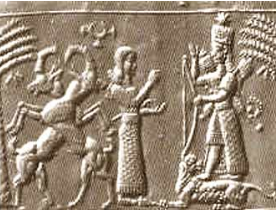 A Neo-Assyrian seal (circa 750-650 BC) of Ishtar (at left) standing with her bow on her mythical lion. She is faced by a worshipper. British Museum. The Assyrian and Mesopotamian tradition in general certainly left a robust legacy on the Achaemenid Persians who succeeded them. Indeed the Aramaic language was the Lingua Franca of the Achaemenid Empire.
Therefore while the Achaemenid (or post-Achaemenid) seal has Iranian mythological themes, its artistic motifs have certainly drawn from an ancient Mesopotamian tradition.
References
Collon, D. (1987). First Impressions: Cylinder Seals in the Ancient Near East. London: British Museum Publications.
Dandamaev, M., & Lukonin, V.G. (1989). The Culture and Social Institutions of Ancient Iran. New York: Cambridge University Press.
Ghirshman, R. (1962). Iran: Parthians and Sassanians. London: Thames & Hudson.
Nissinen, M. (Editor) (2000). Prophecy in Its Ancient Near Eastern Context: Mesopotamian, Biblical, and Arabian. Atlanta, GA: Society of Biblical Literature.
Parpolo, S. (1997). Assyrian Prophecies. Helsinki, Finland:Helsinki University.
https://www.kavehfarrokh.com/news/eastern-anatolia-heir-to-an-ancient-irano-greek-legacy/

 Impact of COVID-19 on the Cultural Sector