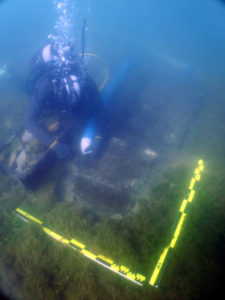
 TANK BAY, ANTIGUA—The Antigua Observer reports that an eighteenth-century shipwreck has been found in the mud at Nelson’s Dockyard, which is situated in English Harbor on the island’s southern coast, as part of a collaborative project between the University of the French West Indies (AIHP GEODE), and the Antigua and Barbuda National Parks. A team led by Jean-Sébastien Guibert of the University of the French West Indies used side-scan sonar equipment and a magnetometer to investigate the underwater site. They found that the wooden hull measures about 130 feet long. “The British were very good at keeping records about what happened at the dockyard and we haven’t found anything relating to it, so it’s a big possibility that it’s not British but something else,” said archaeologist Christopher Waters of the National Parks Authority. It may be the wreckage of the 1762 Beaumont, a heavily armed merchant ship built by the French East India Company. The ship was later sold to a private individual, renamed the Lyon, and was eventually captured off the coast of Virginia during the American Revolution. The ship was likely stripped of any useful or identifying objects by enslaved Africans when it sank, Guibert explained, but the researchers will map the site, compare the wreck’s dimensions to records of Beaumont, and analyze its wooden timbers and ballast stone for clues.
News
Who Were the Anglo-Saxons?
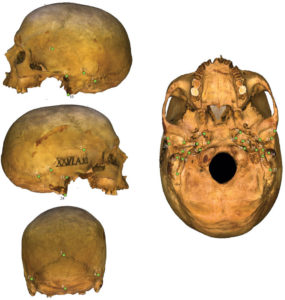 According to a statement released by Simon Fraser University, researchers from Simon Fraser University and the University of Sydney examined remains recovered from Anglo-Saxon cemeteries to try and determine how many Germanic-speaking people from mainland Europe arrived in the British Isles between the fifth and seventh centuries A.D. Historic documents suggest that so many people migrated to the British Isles that they replaced its Romano-British inhabitants. Analysis of the bones, however, indicates that between two-thirds and three-quarters of early Anglo-Saxons came from continental Europe. By the Middle Anglo-Saxon period, only 30 to 50 percent of Anglo-Saxons had ancestors from continental Europe. The researchers suggest that Anglo-Saxon Britain was likely to have been made up of people of different ancestries who adopted Anglo-Saxon culture. Read the original scholarly article about this research in PLOS ONE.
Update from Tulsa’s Oaklawn Cemetery
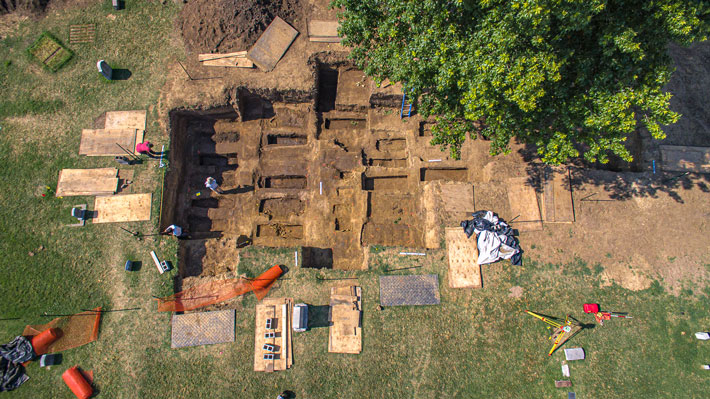 The Washington Post reports that the preliminary analysis of the remains of nine people from an unmarked mass grave in Tulsa’s Oaklawn Cemetery has been completed. The grave is thought to hold some of the victims of the 1921 Tulsa Race Massacre, in which an estimated 300 Black people were killed and 35 blocks in the affluent Black community of Greenwood, also known as “Black Wall Street,” were destroyed. Lead forensic anthropologist Phoebe Stubblefield said five of the nine sets of remains examined belonged to children. The other four individuals have been identified as an older woman and adults in their 30s and 40s. Stubblefield found a bullet lodged in the left shoulder of one of the men, who had suffered multiple projectile wounds. “Ancestry so far, when we can detect it, has been of African descent,” Stubblefield added. DNA analysis may allow the remains to be identified before they are reburied. “This process has been a very sobering and very powerful experience,” commented J. Kavin Ross, a descendant of a massacre victim and chair of the Mass Graves Public Oversight Committee. “We are hopeful for more findings…I’m anxious to give them a proper rest.”
Medieval Church Excavated in Sudan’s Northern State
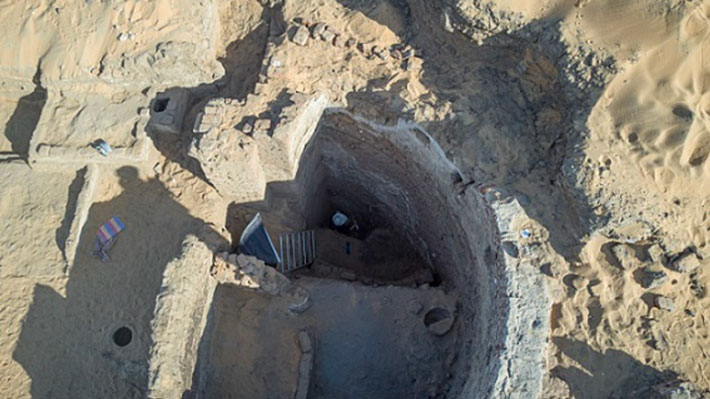 WARSAW, POLAND—Science in Poland reports that researchers led by Artur Obłuski of the University of Warsaw have found the remains of a large medieval church in the center of Old Dongola, Northern State, Sudan. Dongola was the capital of Makura, one of the Christian Nubian kingdoms, Obłuski explained. He suggests the building could have served as the seat of the archbishop of Dongola, who governed the Nubian churches along a 620-mile stretch of the Nile River. The team members have uncovered the church’s apse, an adjacent wall, and the dome of a large tomb. The apse, Obłuski added, is the largest yet found in Nubia, and it was decorated with plaster and paintings of monumental figures. Much of its walls remain buried. It had been previously thought that the city’s medieval cathedral was situated outside the city walls, but this structure resembles the cathedral unearthed in the center of Faras, the medieval capital of the Nubian kingdom of Nobadia. “There may be more paintings and inscriptions under our feet, just like in Faras,” Obłuski said
Rattling Noise Made by Prehistoric Ornaments Investigated
 HELSINKI, FINLAND—According to a statement released by the University of Helsinki, auditory archaeologist Riitta Rainio and artist Juha Valkeapää danced for six consecutive hours while wearing elk tooth ornaments sewn in rows on an apron, and then examined the microscopic wear marks left behind on the teeth as they clattered against each other. The researchers then compared these wear marks to elk teeth recovered from four graves at Yuzhniy Oleniy Ostrov, a Late Mesolithic cemetery in northwestern Russia. More than half of the 177 burials at Yuzhniy Oleniy Ostrov contained elk tooth ornaments. Some of the burials contained more than 300 teeth. The study suggests that the distinctive marks on the prehistoric teeth were made over years or even decades of dancing. Rainio says the rattlers offer a clue to the soundscape experienced by Mesolithic hunter-gatherers.
Roman Basilica Complex Unearthed in Israel
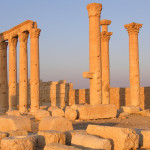
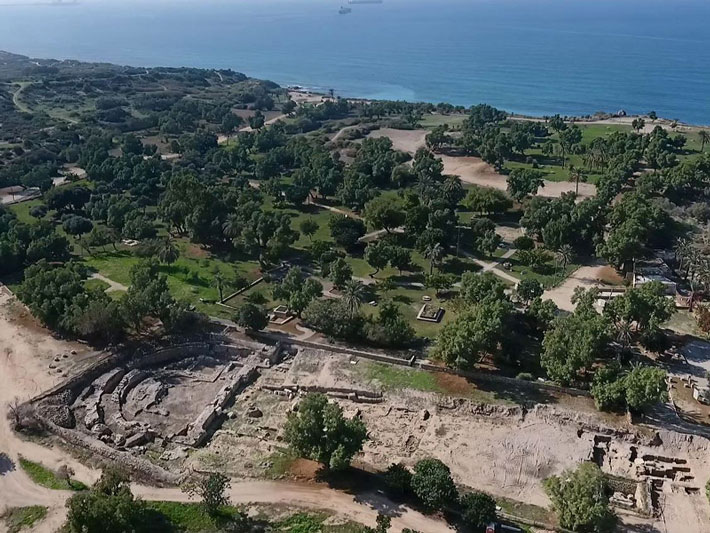 ASHKELON, ISRAEL—According to a statement released by the Israel Ministry of Foreign Affairs, researchers led by Rachel Bar-Natan, Saar Ganor, and Fredrico Kobrin of the Israel Antiquities Authority have uncovered a Roman basilica complex in the ancient city of Ashkelon, which is located along southern Israel’s Mediterranean coastline. Ashkelon residents during the Roman period would have met for social and legal matters, transacted business, and attended performances and religious ceremonies at the basilica complex. The building, which had a roof and walls made of marble imported from Turkey, featured a central hall and two side halls. The central hall was surrounded with rows of marble columns and capitals standing approximately 43 feet tall. The capitals were adorned with plant motifs and eagles, the symbol of the Roman Empire, the researchers explained. The basilica was destroyed by an earthquake in A.D. 363 and abandoned
Additional Burials Found at Mass Grave Site in Tulsa
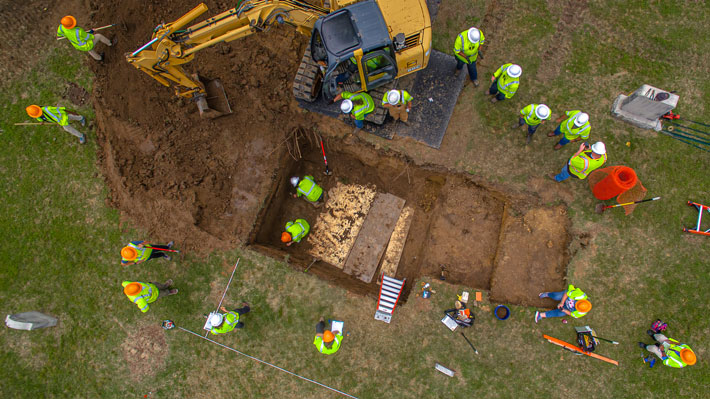 TULSA, OKLAHOMA—State Archaeologist Kary Stackelbeck announced that three additional burials were found at the site of a mass grave at Oklahoma’s Oaklawn Cemetery, according to a KJRH News report. The mass grave is thought to hold the remains of victims of the 1921 Tulsa Race Massacre, according to old funeral home records. An estimated 300 people were killed and 800 wounded on May 31 and June 1 when a white mob attacked businesses, homes, and churches in the area of Tulsa’s prosperous Black Wall Street. DNA testing of the remains will be conducted, Stackelbeck added.
World Environment Day
REIMAGINE. RECREATE. RESTORE.
 For too long, we have been exploiting and destroying our planet’s ecosystems. Every three seconds, the world loses enough forest to cover a football pitch and over the last century we have destroyed half of our wetlands. As much as 50 per cent of our coral reefs have already been lost and up to 90 per cent of coral reefs could be lost by 2050, even if global warming is limited to an increase of 1.5°C.
Ecosystem loss is depriving the world of carbon sinks, like forests and peatlands, at a time humanity can least afford it. Global greenhouse gas emissions have grown for three consecutive years and the planet is one pace for potentially catastrophic climate change.
The emergence of COVID-19 has also shown just how disastrous the consequences of ecosystem loss can be. By shrinking the area of natural habitat for animals, we have created ideal conditions for pathogens – including coronaviruses – to spread.
With this big and challenging picture, the World Environment Day is focus in the ecosystem restoration and its theme is “Reimagine. Recreate.Restore.”
Ecosystem restoration means preventing, halting and reversing this damage – to go from exploiting nature to healing it. This World Environment Day will kick off the UN Decade on Ecosystem Restoration (2021-2030), a global mission to revive billions of hectares, from forests to farmlands, from the top of mountains to the depth of the sea.
Only with healthy ecosystems can we enhance people’s livelihoods, counteract climate change and stop the collapse of biodiversity.
Investing in ecosystems is investing in our future
World Environment Day 2021, which counts with Pakistan as the host country this year for its official celebrations, calls for urgent action to revive our damaged ecosystems.
From forests to peatlands to coasts, we all depend on healthy ecosystems for our survival. Ecosystems are defined as the interaction between living organisms – plants, animals, people – with their surroundings. This includes nature, but also human-made systems such as cities or farms.
Ecosystem restoration is a global undertaking at massive scale. It means repairing billions of hectares of land – an area greater than China or the USA – so that people have access to food, clean water and jobs.
It means bringing back plants and animals from the brink of extinction, from the peaks of mountains to the depths of the sea.
But it also includes the many small actions everyone can take, every day: growing trees, greening our cities, rewilding our gardens or cleaning up trash alongside rivers and coasts.
Restoring ecosystems carries substantial benefits for people. For every dollar invested in restoration, at least seven to thirty dollars in returns for society can be expected. Restoration also creates jobs in rural areas where they are most needed.
Some countries have already invested in restoration as part of their strategies to bounce back from COVID-19. Others are turning to restoration to help them adapt to a climate that is already changing.
Iraq has repeatedly asked Iran to help them restore an Iranian historical monument
 According to the Pasargad Heritage Foundation Recently Mohammad Hassan Talebian, the deputy director of Iran’s Ministry of Cultural Heritage and Tourism, stated at a news conference that the Iraqi government has invited Iran to assist in the repair and conservation of the Kasra Arch.
The statement by Mohammad Talebian seems imply that Iraq has not paid attention to the destruction and damage to the Kasra Arch. However, as WCHV has been following and reporting on this story over the last decade, the Iraqi Cultural Heritage Organization has in fact repeatedly asked Iran for help in the work on the preservation and repair of Kasra Arch. Many Iranian lovers of cultural heritage and abroad have regularly asked for help from the Iranian Cultural Heritage Organization, but the officials of the Cultural Heritage Organization were completely silent in this regard.
In fact, the Pasargad Heritage Foundation has warned the Iranian people, and sent several letters to UNESCO, asking them to pay attention to the dire condition of Kasra Arch. UNESCO has always responded, “We try, but both countries must help.”
Finally, it has been reported that in the same meeting, Mohammad Talebian asked Iraq to renovate the tomb of Muslim Aqeel, one of the Shiite shrines, at the same time as they undertake the repairs to the Kasra Arch.
In the past 42 years, the Islamic Republic of Iran has spent a considerable amount of money on government organizations to renovate and expand Shiite shrines and mosques, while ignoring and neglecting the destruction and deterioration of ancient and non-religious monuments. During this period hundreds of historical buildings have been destroyed.
Additional excerpts from the Pasargad Heritage Foundation reports:
http://worldculturalheritagevoices.org/open-letter-on-the-dire-condition-of-taq-kasra/
Archaeologists find mysterious structure in ‘Land of the Blind’
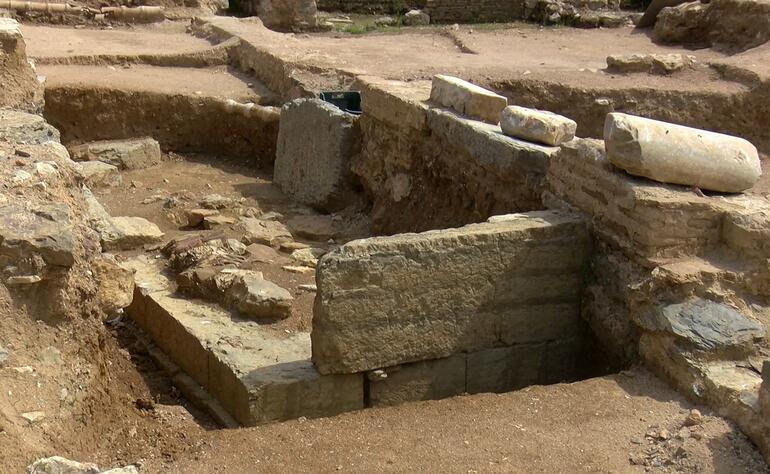 Turkish archaeologists have uncovered the ruins of a structure, estimated to have been built in the 3rd century B.C., during an excavation in Istanbul’s Haydarpaşa, a historic train station on the Asian side.
The structure, discovered at the station’s waiting platforms, covers a large area and is apsidal in form, a feature common in ancient churches.
These remains give significant hints about Khalkedon, the ancient ‘Land of the Blind’ from some 2,500 years ago. While the site’s architecture does not lend any clues to its function, archaeologists believe it was considered sacred.
However, they also estimate that the building is the oldest architectural structure unearthed in these excavations. Speaking to Demirören News Agency, Mehmet Ali Polat, Chief archaeologist of the Haydarpaşa excavation, gave information about the field works and finds.
Remains were found in an area of 350,000 square meters, including the area surrounding the station, said Polat, adding that small finds, pots, coins dating from around 6 B.C. to the modern-day were found, all from various eras.
“This is the northwestern port of the ancient city of Khalkedon, a large structure that could be a warehouse. On the other side of the road, we see a group of buildings that could be a small summer palace,” Polat said.
The Haydarpaşa Train Station was shut down for restorations, in which ancient artifacts were unearthed, and since then, Haydarpaşa has been an excavation site.
The digs, started in 2018 by Turkey’s Culture and Tourism Ministry and Istanbul Archeological Museums, have been done with the utmost care for the last three years.
Digs revealing historical structures shed light on the deep roots of Anatolia and Istanbul, a cradle of civilizations.