 CultureAID (“Culture Active in Disasters”) is an innovative organization created by New York City to help arts organizations cope with disasters and emergencies such as the one the city faced during Hurricane Sandy. As announced just yesterday, NYC has created a response and recovery network to reduce redundant communications, pool available resources and share best practices about emergency preparedness.
CultureAID will provide information, technical and financial assistance and other resources to the city’s cultural community before, during and after disasters, as announced by the Office of Emergency Management commissioner in a statement.
The program was developed in direct response to Hurricane Sandy in October 2012 and to the region’s increasing threat of severe weather and climate change. CultureAID will help the artists and cultural groups that are so vital to NYC’s vibrancy and life.
News
Japanese University Helping to Preserve World Heritage
 As reported by the Asahi Shimbun, Kanazawa University has started working on a project helping to conserve the world-famous Ifugo Rice Terraces in the Philippines from further degradation. It is believed that the World Heritage site is at risk because few local people understand what is entailed to keep the terraces pristine.
Kanazawa University initiated joint training sessions with the University of the Philippines and Ifugao State University. The spectacular rice terraces in the northern Philippine island of Luzon were created some 2,000 years ago. But an exodus of young people to the cities left the area with few people to preserve the complicated agricultural system, making it difficult to find successors for the older generation who can no longer work in the fields.
The terraces located in remote areas of the Philippine Cordillera mountain range in Ifugao province cover about 20,000 hectares, making them among the world’s largest. The sight of tens of thousands of terraces built on mountain slopes at elevations of between 700 meters and 1,500 meters are so impressive that the site became known as “stairs to heaven.”
The rice terraces were inscribed in 1995 on the UNESCO World Cultural Heritage list as “Rice Terraces of the Philippine Cordilleras.” But soon after that the terraces fell into a state of dilapidation as land development projects expanded in surrounding areas and local people spent less and less time attending to the delicate agricultural ecosystem that makes the site the marvel it is today. As a result, the terraces were included on the List of World Heritage in Danger by the agency in 2001. However, thanks to subsequent conservation activities by the local administrations and universities, the terraces were removed from the danger list in 2012. But there is still more work to be done and more local people are needed in order to continue to take care of terraces.
Kanazawa University has now decided to set up a three-year to train local people interested in learning and acquiring the necessary skills and knowledge on how to sustain the rice terraces.
Mbanza Congo Registration for World Heritage Status
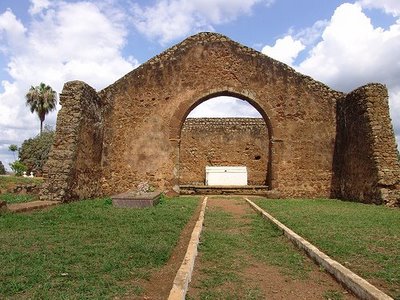 As reported recently by AllAfrica website, in a ceremony attended by government officials as well as UNESCO World Heritage official for the Africa region, the registration was announced.
As stated by the secretary of State for Culture, Cornélio Caley, that the project to register the capital city of the northern Zaire province with UNESCO’s World Heritage list aims, among other purposes, at the rescue of Angola’s African-ness and cultural identity.
The secretary headed a delegation comprising national experts and UNESCO officials for the Africa region stressing that the project “Mbanza Congo” intends to disclose the historical past of this ancient capital of the Congo Kingdom. Secretary Caley spoke at the end of the ceremony of handover by the Government of a facility to serve as an office for the drafting of the application for Mbanza Congo as a World Heritage to be submitted to UNESCO in January 2015.
He added that once the phase of archaeological excavations are completed, the next step will be to gather the elements for all specialists involved like historians, archaeologists, anthropologists and architects, to contribute with ideas to the drafting of the application. At the same time, the foreign experts were asked to help with the discovery of documents related to the history of Mbanza Congo.
Chinese Present A New Hypothesis After Finding Artifacts
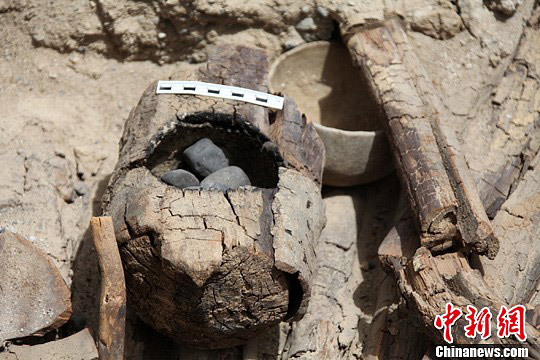 As reported recently by China TV, Chinese archeologists in Northwest China’s Xinjiang Uygyr Autonomous Region have discovered wooden braziers in excavated graves, leading them to believe that the people practiced Zoroastrianism. Zoroastrians buried a burning brazier with the dead to show their worship of fire. Archeologists also found polished stoneware in the mounds as well as eyebrow pencils used most probably by women.
These newly discovered artifacts in this sparsely populated part of Pamir Plateau of China, shows that people lived, battled and created marvelous civilizations according to the researchers. However, the archeologists are also presenting a new hypothesis which remains to be proven. The mounds that are being excavated, they believe point to a civilization that practiced Zoroastrianism which could date back to more than 2500 years ago. Therefore, according to the Chinese researchers’ hypothesis, Zoroastrianism could have also originated in China and not in ancient Persia.
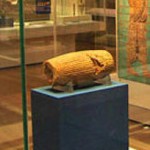
In 2010, as reported by several news outlets, a horse bone bearing cuneiform inscriptions apparently derived from Cyrus Cylinder was also discovered in China along with a second bone inscribed with an as yet unknown text. The bones were acquired by the Beijing Palace Museum in 1985. Their origin is unclear, but Dr. Irving Finkel of British Museum Department of the Middle East has hypothesized that they may reflect a text inscribed or written in another format (perhaps leather or clay), derived from the Cyrus Cylinder’s text, though for some reason only one twenty of the original cuneiform symbols were copied. Finkel suggested that this may indicate that the text (or even the original cylinder itself) was sent around the Persian Empire and was copied to make the bone’s inscription at some point.
If the hypothesis presented by the Chinese archeologists is true, further research is needed to find out why Zoroastrianism prospered in Persia and not in China, as evidenced by extensive monuments, artifacts, history and propagation of the religion in ancient Persia. In addition, further excavations and research in China are essential to show if they find just more than a few buried braziers which could support the new presented hypothesis by the Chinese.
Zoroastrianism and their beliefs could have indeed been transferred from ancient Persia to other parts of the world and borders of the Persian Empire as they did with inscribed cuneiforms.
Newly Discovered Monuments Around Stonehenge
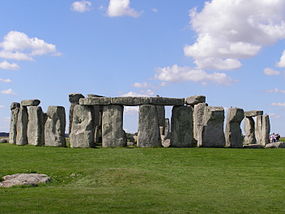 As published and reported by some media outlets and in the September issue of the Smithsonian Magazine, archaeologists have discovered 15 previously unknown monuments buried around Stonehenge. This new finding has added more mystery surrounding Stonehenge. These monuments were found in the first-of-its-kind study and they suggest that other monuments could be hidden underneath the current monuments.
Technology definitely played a major role in the project. Researchers used a variety of techniques including ground-penetrating radar and 3D laser scanning which helped them to create a highly detailed subsurface map of the entire area. According to a release from the Ludwig Boltzmann Institute for Archaeological Prospection and Virtual Archaeology, one of the partners in the study, the technologies are notable for being much less destructive than traditional, digging-based exploratory techniques.
The project has been known as “The Stonehenge Hidden Landscape Project” and it took over four years. One of the new finds is an ancient trough that bisects an East-West ditch known as a “Cursus”. Archeologists believe that the Cursus monument aligns with the sunrise on the Spring and Fall equinoxes, and that the newly discovered trough could have been a means for people to ceremonially process toward the center of Stonehenge to the south.
The new research builds on findings from last October indicating that the area around Stonehenge is the oldest continually occupied region in Britain, going back to as early as 8820 B.C.
Ancient Mayan Cities Found in Mexican Jungle
 Archaeologists from the Research Center of the Slovenian Academy of Sciences and Arts have found two ancient Mayan cities hidden in the jungle of southeastern Mexico, and they believe there are more to be found in the region.
As reported by a number of news outlets, Ivan Sprajc, associate professor at the Research Center of the Slovenian Academy of Sciences and Arts, said his team found the ancient cities of Lagunita and Tamchen on the Yucatan peninsula in April by examining aerial photographs of the region
Archaeologists believe that the two cities reached theirheyday in the Late and Terminal Classic periods (600-1000 AD). At each site, researchers found palace-like buildings, pyramids and plazas. One of the pyramids is almost 20 meters (65 feet) high
Researchers also found a facade featuring a monster-mouth doorway, which probably marked one of the main entrances to the center of the city. “The entrance apparently symbolizes the entrance to a cave and to the underworld. The sites have not been excavated yet.
Last summer, Sprajc discovered another ancient Mayan city, Chactun, 10 km (6 miles) north of Lagunita and 6 km (4 miles) northwest of Tamchen.
UNESCO Strengthens Action for Conflict Zones
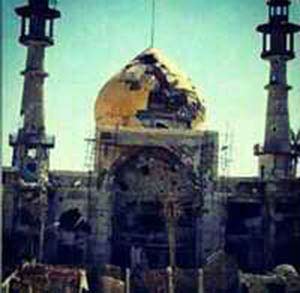 Earlier this month (August 2014), UNESCO announced new strategy and prioritization to safeguard National Heritage sites in the conflict zones. “Recent events in Syria, Iraq, Libya and Mali have highlighted the multiple threats to cultural heritage during crisis, including deliberate attacks, destruction as collateral damage in fighting, the greed of unscrupulous traders and collectors, vandalism of factions that seek to erase the achievements of past cultures.” UNESCO stated.
UNESCO believes that recent events have shown the complexity of any intervention to safeguard cultural heritage. UNESCO in the past has developed a comprehensive set of international instruments to protect cultural heritage. The Convention on the Means of Prohibiting and Preventing the Illicit Import, Export and Transfer of Ownership of Cultural Property (1970) and the World Heritage Convention(1972) provide a solid basis to protect cultural heritage. The Hague Convention for the Protection of Cultural Properties in the Event of Armed Conflict (1954) and its Protocols set further international standards to deal with the specific risks faced by heritage during conflict. In addition, the Statutes of the International Criminal Court have defined the intentional destruction of historical buildings as a war crime.
Recognizing the powerful role of culture in building social cohesion and contributing to reconciliation and peace, the UN Security Council—in its Resolution 2100 on Mali, and Resolution 2139 on Syria–called for the protection of cultural heritage and diversity. The integration of culture in humanitarian, recovery and reconstruction operations provides the challenging opportunity of defining how cultural heritage protection can effectively contribute to the broader UN crisis response as UNESCO states.
History and the events of the last few years have shown that conflicts take a heavy toll on National Heritage. More than three years of conflict have taken a heavy toll on heritage in Syria. This is the reason why UNESCO has launched a web-based international observatory to monitor the situation of cultural heritage in Syria and help international cooperation to protect the country’s heritage.
In their Joint Appeal for the safeguarding of Syria’s cultural heritage, UN Secretary-General Ban Ki-moon, UNESCO Director-General Irina Bokova and then UN and League of Arab States Joint Special Representative for Syria Lakhdar Brahimi stressed this important risk and its devastating implications. Due to the recent upsurge of new conflict in Iraq UNESCO recently organized an Emergency Experts’ meeting for the safeguarding of the Iraq’s cultural heritage, bringing together Iraqi and international expertise to design an Emergency Response Action Plan for the protection of the country’s cultural heritage at risk.
A key lesson learned from the implementation of these international standards at the country level, is that prevention and long-term engagement are essential to mitigate the impact of any crisis as UNESCO states. However, in the case of many of these countries it is essential that beyond country reporting more international partnerships are created for reporting, prevention, documentation and hopefully eventual repair and construction.
Ancient Cemetery Reveals Artifacts
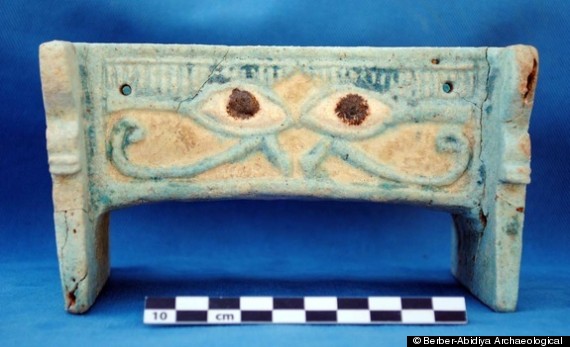 As reported by Huffington Post and other media outlets last week, a 2,000-year-old cemetery has been discovered near the Nile River in Sudan. The cemetery which contains several underground tombs is located near the Nile River in Sudan. Archaeologists excavated several of the underground tombs, finding artifacts such as a silver ring, engraved with an image of a god, and a faience box, decorated with large eyes, which researchers believe protected against the evil eye.
The cemetery dates back to a time when a kingdom called Kush flourished in Sudan. Based in the ancient city of Meroe (just south of Dangeil) Kush controlled a vast territory; its northern border stretched to Roman-controlled Egypt. At times, it was ruled by a queen. Although the Kushites built hundreds of pyramids, this particular cemetery contains no structures on the surface; the tombs are underground.
Even though the villagers discovered the cemetery accidently in 2002 while digging a ditch near the modern-day village of Dangeil, the archaeological excavations have been ongoing since then by Berber-Abidiya Archaeological Project; a collaboration between Sudan’s National Corporation for Antiquities and Museums and the British Museum and the finds have recently been reported in a new book.
The team has discovered a wide range of artifacts meant to aid the deceased in the afterlife, including several large, a silver ring with an image of a horned deity, an interesting “party tray,” which consists of seven bowls attached together; six of the bowls, engraved with an image of a god, and a faience box, decorated with large eyes. The evil eye is a curse believed to be cast by a malevolent glare, usually given to a person when they are unaware. Many cultures believe that receiving the evil eye will cause misfortune or injury.
70,000 Year Old African Settlement Discovered
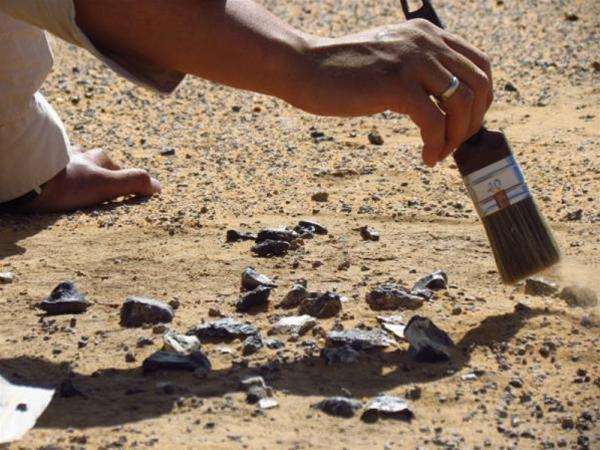 Polish archaeologists from the Institute of Archaeology and Ethnology in Poznań have discovered the remains of a settlement estimated to 70,000 years old during excavations in northern Sudan,. This find, according to the researchers, seems to contradict the previously held belief that the construction of permanent structures was associated with the so-called Great Exodus from Africa and occupation of the colder regions of Europe and Asia (as reported by http://www.archeosudan.org/).
The site which is known as Affad 23, is currently the only one recorded in the Nile Valley which shows that early Homo sapiens built sizeable permanent structures, and had adapted well to the wetland environment. This new evidence points to a much more advanced level of human development and adaptation in Africa during the Middle Palaeolithic.
Another interesting project that researchers are also working on is a list of animal species that these early humans hunted. Despite the relatively simple flint tools produced using the Levallois technique; these humans were able to hunt large, dangerous mammals such as hippos, elephants and buffalo, as well as small, nimble monkeys and cane rats (large rodents that inhabited the wetlands). This year, the researchers intended to precisely date the time period in which the Palaeolithic hunters lived here, using optically stimulated luminescence.
The Polish team is working with scientists from Oxford Brookes University, who are helping to analyze the geological history of the area. The results will help determine climatic and environmental conditions that prevailed in the Central Nile Valley during the late Pleistocene and hope to identify factors that contributed to the excellent state of preservation at the Affad 23 site.
Excerpts with permission from Science and Scholarship in Poland, 70,000 year-old African settlement unearthed. Past Horizon, July 20, 2014. From http://www.pasthorizonspr.com/index.php/archives/07/2014/70000-year-old-african-settlement-unearthed
Many UNESCO Heritage Sites Are At Risk
 World Heritage sites are continuously exposed to natural and man-made disasters which threaten their integrity and may compromise their values. The loss or deterioration of these outstanding properties would negatively impact local and national communities, both for their cultural importance as a source of information on the past and a symbol of identity, and for their socio-economic value.
For example, many sites have been found to be sites at risk and it would surprise anybody to see what sites are on the list. Venice was built on 118 islands was named a UNESCO World Heritage site in 1987. However, the whole city has been listed as one of the UNESCO sites at risk because of rising sea levels due to global warming. Another city and UNESCO sit that will be threatened by rising sea levels is the French port city of Bordeaux, Port de la lune, has a trading and commerce history spanning over 1,000 years. Croatia’s Dubrovnik is a well-preserved medieval walled city situated on the Dalmatian coast. The city became a UNESCO World Heritage site in 1979, but it is believed to be at risk due to rising water levels.
UNESCO has created a strategy focused on preservation of many sites. The Strategy identifies five objectives and related actions. They are structured around the five main priorities for action defined by the Hyogo Framework for Action, the main UN-wide policy on the subject of Disaster Reduction, and are also in line with Article 5 of the World heritage Convention as well as the Strategic Objectives established through the Budapest Declaration. The five key objectives are:
- Strengthen support within relevant global, regional, national and local institutions for reducing risks at World Heritage properties;
- Use knowledge, innovation and education to build a culture of disaster prevention at World Heritage properties;
- Identify, assess and monitor disaster risks at World Heritage properties;
- Reduce underlying risk factors at World Heritage properties;
- Strengthen disaster preparedness at World Heritage properties for effective response at all levels.
Even though these declarations were made several years ago, it is clear that we still need a global strategy that addresses environmental causes and better ways of management and conservation.
Pollution and dumping of toxic chemicals or environmental pollutants are also another cause of damage to heritage sites. Two recent major reports Australian news outlets into health and management of the Great Barrier Reef show that parts of the World Heritage site are still under pressure and the central and southern areas are deteriorating (according to Australia ABC news).
It has also been reported that the UNESCO is concerned about the Abbot Point Port expansion and the plan to dump three million cubic meters of dredge spoil within the marine park.
Better strategies and guidelines as well as advocacies are needed in order to protect more UNESCO World Heritage Member sites as it looks like just inscribing them does not protect them from neglect, damage and deterioration.