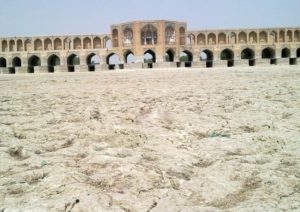
 As far back as a decade ago, the Iranian and international newspapers were reporting on the drought and desertification in Iran. In 2015, the New York Times reported on the problem in an article titled: “The Empty River of Life”
https://www.nytimes.com/2015/05/06/world/middleeast/iran-our-man-in-tehran.html. Now almost at the beginning of the second decade of the 21 st century the desertification across Iran has worsened so much that the consequences could have dire and irreparable consequences for the country. In a new report by Iran International, titled, “Desert Invasion across Iran”, that reality has been witnessed.
It has been reported that Khosrow Shahbazi, the head of Iranian Forest, Rangeland and
Watershed, at a meeting with the Governor of Gilan (a province in the north of Iran by the Caspian Sea) on December 1 st , 2019, stated that about one hundred million hectares of the country’s lands are subject to desertification.
Desertification is a process whereby the biological productivity or ability of the environment to support life such as vegetation is greatly diminished. The scientists have stated that this gradual and drastic decrease in productivity may be due to several factors such as climate change, deforestation, unhealthy grazing, poverty, political instability, unstable irrigation, and inadequate management of water resources (surface and groundwater) or a combination of these factors.
This has happened in many areas of the world including in some countries in Africa. What is for certain based on many reports as well as evidence the environmental policies of Iranian agencies have had major impact on these catastrophic environmental changes.
Iran is a country with varied natural landscapes composed of arid and dry desert ecosystems, as well as plains, grasslands, and forests. However, even the northern forests have been drastically changing. According to Mohammad Darwish, a member of the faculty of forests and rangelands, the forests have been changing due to forest tree disease, man-made deforestation under the pretext of development, increased soil erosion, flooding and land subsidence. Other factors include wood harvesting, the establishment of industrial and mining units, animal husbandry.
De-forestation is more severe in Golestan province, and northern forests follow the path that Zagros began decades ago, despite warnings given by the scientists and environmentalists.
Acoording to Isa Callanti, the head of the Environmental Protection Agency, between 2 to 5 hectares of Zagros forests are drying out annually, but the situation is much worse in rangelands, prairies and drier areas.
The environmentalists believe that dams (built in recent years) are the main culprit in many parts of Iran. For example, the dam built on Zohreh River has been the cause of drying of Hendijan plain. In Sistan and Baluchistan, the sandstorms and the influx of sand have greatly increased due to desertification and the dam on the Helmand River in Afghanistan has been drying up the lakes Sistan and Baluchistan. In another part of the country, excessive grazing and drought has caused the gradual death of semi-green rangelands in Isfahan province. According to statistics available, over 6,000 villages in Iran have been affected by this phenomenon since the past 5 years, reflecting the severity of desertification in Iran.
The rapidly advancing desertification phenomenon has received little attention or consideration from the Iranian governmental agencies while they still continue with poor environmental management decisions which are now negatively and drastically impacting the country with dire environmental consequences.