 A team of scientists, led by the University of Bristol, has found the first evidence that prehistoric babies were fed animal milk using the equivalent of modern-day baby bottles.
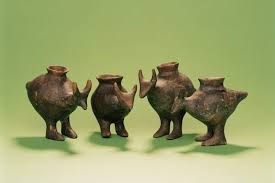
Possible infant feeding vessels, made from clay, first appear in Europe in the Neolithic (at around 5,000 BC), becoming more commonplace throughout the Bronze and Iron Ages.
The vessels are usually small enough to fit within a baby’s hands and have a spout
through which liquid could be suckled. Sometimes they have feet and are shaped like
imaginary animals. Despite this, in the lack of any direct evidence for their function, it
has been suggested they may also be feeding vessels for the sick or infirm.
The researchers wanted to investigate whether these were in fact infant feeding vessels
(baby bottles) so selected three examples found in very rare child graves in Bavaria.
These were small (about 5 — 10 cm across) with an extremely narrow spout.
The team used a combined chemical and isotopic approach to identify and quantify the
food residues found within the vessels. Their findings, published today in the journal
Nature, showed that the bottles contained ruminant milk from domesticated cattle, sheep
or goat.
Read more:
https://www.sciencedaily.com/releases/2019/09/190925131352.htm