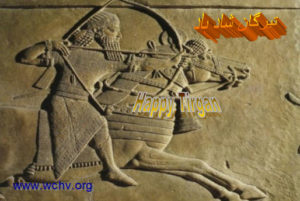
 Tirgan is a major Iranian festival with a history that spans thousands of years. It is held on the 13th day of the month of Tir in the Iranian calendar (equivalent to the 4th of July). In ancient times, it was a ritual to celebrate Tishter, the goddess of rain. In Iranian mythology, it signifies the day when Arash, a national hero, acted to end the long wars between Iran and Turan and to settle a border that was acceptable to both countries. The two parties decided that Arash should ascend to the summit of Mount Damavand and shoot an arrow; wherever the arrow landed was to be the border between the two countries. Arash put all his strength into the arrow and, by sacrificing his life, broadened the Iranian border, giving peace and tranquility to his countrymen. It is interesting to note that his bow and arrow were presented to him by the Goddess Sapandarmazgan, the guardian of productivity and vitality. The myth clearly presents the Iranian love for peace and preservation of the environment. For thousands of years, Iranians have celebrated the occasion with happy festivities and games, instead of mourning for the hero. One tradition for youngsters is to throw water at each other, washing away the pain and sorrow brought to human life by Ahriman.
Festivals
Happy New Year 2017
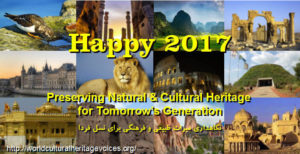 Happy New Year 2017
Yalda, Persian’s Most Beautiful Song in Praise of Light and Love – 2016
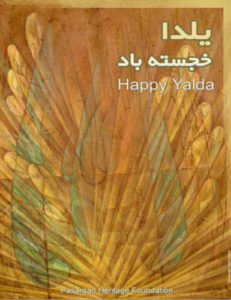 For thousands of years, Iranians have celebrated the last night of winter. They have stayed up through the evening, waiting for the dawn, to witness the birth of the Sun; the source of life which has also been named “Mehr”.
Praising the sun, on the night of the birth of Mithra, celebrating around a cedar tree, adorned with colorful fabrics and stones, which was one of the most important rituals of the ancient Persians. At the time, there were still mysteries of the sun and moon and other natural phenomena for human exploration, and the Persians, like many other people had self-made gods who ruled over all the elements of nature. Man therefore, escaping sadness, darkness, cold, and pain (whether physical or emotional) took refuge in the gods.
Discovering the secrets of nature, and the transition from the myths of the gods did not hurt people’s relationship with the natural elements. Because Persian culture, and even religious orders of Zoroaster (the Persian prophet), were based on love and respect for the land, water, trees, rivers, mountains and their preservation was considered good will.
However, most of our habits and traditions could be updated and modified with time as well as people’s desire and wishes. Therefore, praising the sun, light, love, and life has become a part of Iranian psyche and beliefs in spite of all the objections that historically, under the pretext of religion, has considered these Persian celebrations as blasphemy.
Unfortunately, in the past thirty-four years of clerical rule in Iran, they have not accepted these celebrations. They not only do not accept these traditional festivities as part of national celebration, they are not willing to report and request UNESCO for addition to World Heritage list. The government has simply tried to force innocent people to stop holding these celebrations.
As Persian/Iranian celebrations and festivities have risen from nature and the land, with kindness and love, engraved with anti-discrimination, and interest of/for all people, irrespective of their religion, belief and opinion.
“Yalda” is one such festivity which continues to be even now more than ever, at the center of interest of Iranian people because history has shown that during dark times people have shown interest with the hope and belief that victory can be sealed and reach the world community to end all wars, suffering, discrimination and denial.
This year like many previous years, Pasargad Heritage Foundation, has asked the Iranian public to celebrate the tradition of Yalda by decorating and adorning an evergreen cedar tree and celebrate this glorious Persian feast more and more beautifully and grandly and welcome the everlasting sun of our land in order to conqueror all perpetual darkness.
Let us not forget that the festive night of Winter Solstice, “Yalda,” is one of the few festivals compatible with the tenants of human rights, with this message that “only expressions of joy and love are symbols of light in human life”.
Cyrus The Great Day, October 29
Niel Macgregor Video on Ted Talks: 2600 Years of History in One Object (Click Here)
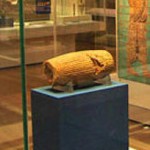
 This year, the twenty-ninth day of October 2016 coincides with the annual celebration of “Cyrus the Great Day” by Iranian people and many friends of culture across the globe. In 2005, the Pasargad Heritage Foundation – the first international NGO for preservation of the cultural heritage of Iran- that introduced the idea. At the time, Cyrus’ mausoleum in Iran- a monument registered on the UNESCO’s world heritage list – was in danger of being inundated and eventually destroyed. However, the hard work of this Foundation and timely intervention of UNESCO, human rights activists and organizations removed the danger and led to a world-wide recognition of Cyrus’ seminal contribution to the survival of our common human civilization. Such recognition has been further evidenced by the exhibition of Cyrus cylinder in a number of museums in major cities in United States of America.
October 29, the “Cyrus the Great Day” and the anniversary of the first declaration of human rights. Twenty six centuries ago, when savagery was the dominant factor in human societies, a civilized and compassionate declaration was written on clay and issued to the “four corners of the world”, addressing important issues relevant to human rights; the very same issues that today we face and could also inspire and mobilize those who believe in human dignity and rights.
This document, known as “The Declaration of Cyrus the Great,” emphasized the removal of all racial discrimination and slavery, and bestowing to all people, freedom to choose their places of residence, and practice their own chosen faith and religion, therefore, attempting to create peace amongst all nations. This Declaration could actually be considered a present from the Iranian people to all humanity, expressed through the words of Cyrus, the founder of the first empire in the Iran. In 1971, the general assembly of the United Nations recognized this declaration as the first Declaration of Human Rights.
www.savepasargad.com
Mehregan, The festivity of love, light and fidelity
By Shokooh Mirzadegi
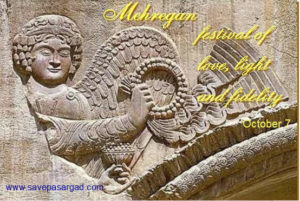 Mehrgan is one of the greatest and most ancient national festivities of Iranian people, observed on October 7, to denote the beginning of autumn. It is an occasion to celebrate love, light and fidelity and Iranians have observed it for thousands of years.
Unfortunately, by the advent of the Islamic Revolution in Iran, all secular and popular festivities were banned and they were not allowed to be observed in public places. Nevertheless, and as far as it is possible, Iranians celebrate the occasion, far more expanded than the pre-revolution times. Outside Iran, millions of Iranians observe it vastly with enthusiasm and perseverance.
In 2010, the Pasargad Heritage Foundation (PHF), an NGO registered in USA, working for preservation of tangible and intangible heritage of Iran, applied to UNESCO for the registration of Mehrgan as a festivity with its roots in the soil of human regards for nature and mankind’s happiness.
This was a symbolic gesture because UNESCO only accepts those applications in this regard that are made by the governments. Thus, PHF has done so with the hope that in the future the road for Mehregan registration by UNESCO is paved and the bureaucratic procedures are facilitated.