 For thousands of years, Iranians have celebrated the last night of winter. They have stayed up through the evening, waiting for the dawn, to witness the birth of the Sun; the source of life which has also been named “Mehr”.
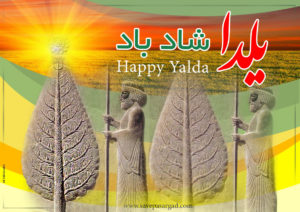
Praising the sun, on the night of the birth of Mithra, celebrating around a cedar tree, adorned with colorful fabrics and stones, which was one of the most important rituals of the ancient Persians. At the time, there were still mysteries of the sun and moon and other natural phenomena for human exploration, and the Persians, like many other people had self-made gods who ruled over all the elements of nature. Man therefore, escaping sadness, darkness, cold, and pain (whether physical or emotional) took refuge in the gods.
Discovering the secrets of nature, and the transition from the myths of the gods did not hurt people’s relationship with the natural elements. Because Persian culture, and even religious orders of Zoroaster (the Persian prophet), were based on love and respect for the land, water, trees, rivers, mountains and their preservation was considered good will.
However, most of our habits and traditions could be updated and modified with time as well as people’s desire and wishes. Therefore, praising the sun, light, love, and life has become a part of Iranian psyche and beliefs in spite of all the objections that historically, under the pretext of religion, has considered these Persian celebrations as blasphemy.
Unfortunately, in the past thirty-four years of clerical rule in Iran, they have not accepted these celebrations. They not only do not accept these traditional festivities as part of national celebration, they are not willing to report and request UNESCO for addition to World Heritage list. The government has simply tried to force innocent people to stop holding these celebrations.
As Persian/Iranian celebrations and festivities have risen from nature and the land, with kindness and love, engraved with anti-discrimination, and interest of/for all people, irrespective of their religion, belief and opinion.
“Yalda” is one such festivity which continues to be even now more than ever, at the center of interest of Iranian people because history has shown that during dark times people have shown interest with the hope and belief that victory can be sealed and reach the world community to end all wars, suffering, discrimination and denial.
This year like many previous years, Pasargad Heritage Foundation, has asked the Iranian public to celebrate the tradition of Yalda by decorating and adorning an evergreen cedar tree and celebrate this glorious Persian feast more and more beautifully and grandly and welcome the everlasting sun of our land in order to conqueror all perpetual darkness.
Let us not forget that the festive night of Winter Solstice, “Yalda,” is one of the few festivals compatible with the tenants of human rights, with this message that “only expressions of joy and love are symbols of light in human life”.
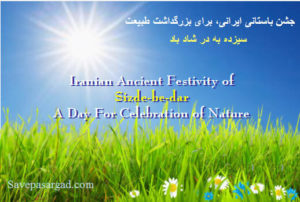 A Day For Celebration of Nature April 1, 2108