Contributed to WCHV.org by manuvera
The article below originally appeared in the Jewish Encyclopedia in 1906 and is available (unedited and full text) on-line. Despite the article’s age, it remains a valuable resource for scholars and laypersons interested in the legacy of Caucasian Jews, many of whom continue to speak Persian and other Iranian dialects.
Kindly note that excepting the two tables displayed in the original Jewish Encyclopedia article, the pictures and captions below do not appear in the original Jewish Encyclopedia article (in-print and on-line versions).
=================================
A division of Russia, bounded on the north by European Russia; on the east by the Caspian sea; on the south by Persia and Asiatic Turkey; and on the west by the Black sea. It consists of six governments, four provinces, and two districts. The Jewish inhabitants, according to the census of 1897, numbered 58,471, or 6.3 per cent of the total population (“Voskhod,” 1902, No. 3). These figures are probably too low.
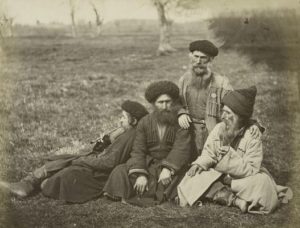 Undated photo (late 19th or early 20th century?) Mountain Jews of the Caucasus conversing and resting (Source: Public Domain). The “Mountain Jews” above are actually the descendants of the Jews of Iran whose origins in that land go back to the pre-Islamic era. Their language is Juhuri which is a Persian-based dialect mixed with Hebrew. Note that these Jews are distinct from the mainly Georgian Jews of the Caucasus being discussed in this article. The Juhuri-speaking Jews are mainly located in the modern-day Republic of Azerbaijan (known as Arran and the Khanates until May 1918) as well as Daghestan.
The exact number of the Caucasian Jews is not easy to determine. Some of them (in the southern provinces) have adopted the Mohammedan religion; while others (in Georgia) have embraced Christianity. They are also often confounded with Jewish immigrants from European Russia. Von der Hoven estimates the number of the native Jews of the Caucasus to be about 100,000 (“Budushchnost,” 1900, No. 52).
Video posted by the Endangered Language Alliance [ELA] of Juhuri instructor Simon Mardkhayev. Speaking in Juhuri (A Persian-based dialect mixed with Hebrew), Mardkhayev is telling a story of hope from his childhood, in the Juhuri language spoken by the Jews of the Republic of Azerbaijan (known as Arran and the Khanates until May 1918) and Daghestan. Recorded at ELA on January 12, 2016.
The following table illustrates the distribution of the Jews of the Caucasus among the various governments, provinces, and districts according to the censuses of 1886 and 1891-92:
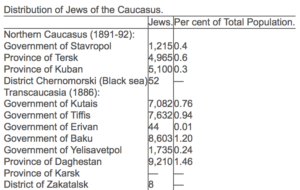 Table showing Distribution of Jews in the Caucasus (Source: Jewish Encyclopedia, 1906).
Supposed Descent from Lost Ten Tribes
Some of the Caucasian Jews claim to be descendants of the Lost Ten Tribes of Israel, which were taken captive by Nebuchadnezzar; while others (particularly the Georgians) are equally certain of their descent from the Israelites who were taken from Palestine by Shalmaneser. It is hard to determine whether this belief is based upon valid tradition or whether it is of later origin, and an attempt, by means of bad philology, to connect the “Habor,” near which river the exiles were settled, with “Iberia,” the name by which the Caucasus is known to classical writers. In the Georgian language the Jews are called “Huria,” a term which is related to “Iberia” (Koch, “Reise Durch Russland,” Preface, p. ix.).
Jewish Type Among Caucasian Peoples
The Russian archeologist and linguist Vsevolod Miller believes that a large Jewish population formerly existed in that part of Media which was later called “Atturpatakan,” and which is at present known under the name of “Azerbeijan,” and that this country was probably the cradle of the Caucasian Jews. He thinks that they have preserved the old Semitic type to a more marked degree than the European Jews. The presence of a distinctive Jewish type among many of the Caucasian peoples has long been noticed by travelers and ethnographers. It is especially interesting, as some of these people, the Armenians, Georgians, and Ossetes, for instance, are not of one and the same race. Baron Peter Uslar suggests that during the past two thousand years Jewish tribes often emigrated to the Caucasus (“Russische Revue,” xx. 42, xxi. 300). Miller is of the opinion that in very remote times they emigrated thither from Media. All the Armenian and Georgian historians speak of the existence of a large Jewish population in Transcaucasia until the beginning of the present era.
When St. Nina came to the city of Urbnis in Georgia from Jerusalem in 314, she is said to have spoken to the Jews in the Hebrew language (“Histoire de la Georgie,” translated by Brosset, I. i. 31, 37, 54, 64, 93, 100, 104-120). When the Persians took possession of Transcaucasia in 366, the Jews adopted the old Persian language, which they called “Parsee” or “Tat,” from which they formed a jargon with an admixture of words taken from the Bible and from languages of local tribes. They write this jargon in Hebrew square characters.
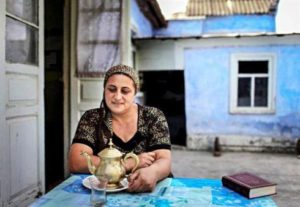 A Daghestani Jewish woman of the Northern Caucasus enjoys Chai (Persian-Turkish for “tea”) outside a local Synagogue (Photo Source: The JC). Daghestani Jews speak a Persian dialect that is often intelligible to the Persian speakers of Iran, Afghanistan and Tajikestan.
From the Arabic writers Mas’udi, Ibn Ḥauḳal, and from the “Derbend Nameh” (a Persian history of Derbend) it is evident that the Arabs, when they conquered Daghestan in the eighth century, found a large number of Jews there. According to Pantyukhov (probably following Quatrefages, “Observations Anthropologiques au Caucase,” Tiflis, 1893, cited in “Archiv für Anthropologie,” xxvii. 448,) the Caucasian Jews may be considered descendants of the Chaldeans (early Babylonians), who originally dwelt on the upper Euphrates and in the vicinity of Lake Van, but who in later, though even still remote, times intermixed with the native Caucasians. In the course of time many of these Jews renounced Judaism and embraced. Mohammedanism. It is probable that the Khevsurs and a portion of the Swanetes and of the Lesghians are of Jewish descent. In the fifth century the rulers of Georgia claimed that their ancestors came from Jerusalem. The Chaldean has little in common with the Arabo-Semitic type. Erekert, as the result of a comparison of the head measurements of the Caucasian Jews with those of the other inhabitants of the districts in which they dwell, gives the following data:
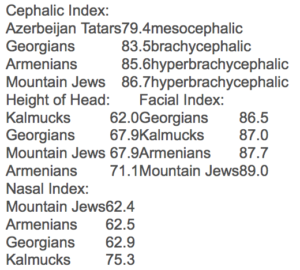 Table showing physical anthropological characteristics of various Caucasian peoples (Source: Jewish Encyclopedia, 1906).
If the shape of the head be taken as a standard of a fine type, the mountain Jew may be considered to rank first among the Caucasian races, which are classified by Erckert in the following order: mountain Jews, Armenians, Kumyks, Georgians, Azerbeijan Tatars, Ossetes, Circassians, Tshechentzy, Lesghians, Nogaians, Kalmucks (“Der Kaukasus und Seine Völker,” pp. 370-377).
The stature of the Jews in the district of Kuba (government of Baku) is 1,618-1,621 mm.; that of the Jews in the government of Kutais, 1,630; of those of Daghestan, 1,644. These three groups exhibit slightly varying types; they have completely adopted the language of the people among whom they live (Pantyukhov, l.c.).
Mountain Jews (“Bergjuden”) are those of the Caucasian Jews who live in villages (“auls”) and some towns of the provinces of Daghestan, Tersk, Kuban, and in the governments of Baku and Yelisavetpol, and who speak an Iranian language, a dialect of the Tat. The Tats themselves are of Iranian origin, but have intermarried with Jews. They speak the same dialect (Tat mingled with Hebrew) as the mountain Jews. They probably arrived in the Caucasus with the Jews in the times of the Achæaemenidæ, having been sent to guard the northern boundary of Persia on the Caspian sea. According to Anisimov, the Tats of today were Jews when they arrived in the Caucasus, and they embraced Mohammedanism only when the Arabs conquered the country. They themselves cherish this belief, and carefully preserve their Hebrew books (Hahn, “Aus dem Kaukasus,” p. 181).
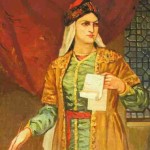
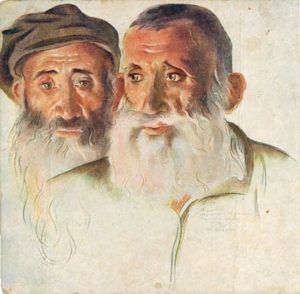 A painting of Iranian speaking Jews of the Eastern and Northern Caucasus, also known as “Mountain Jews” (Photo Source: The Goldstein-Goren Diaspora Research Center).
Ḥasdai ben Isaac, in his letters to the king of the Chazars (about 960), says that, according to a tradition, the Chazars formerly lived in the mountains of Seir (Serir in the eastern Caucasus). Miller is of the opinion that the Jews of the Caucasus introduced Judaism into the kingdom of the Chazars, and that the Jews of Daghestan originated in Azerbeijan. He refers to Esther iii. 8 and to II Kings xvii. 6. He thinks that old Jewish colonies in the Caucasus existed in Tabasseran and in Kaitak, in which region there is a place still called “Shuit-Katta” (Jewish pass). About three hundred years ago many Jews emigrated thence to Majlis, the capital of the Tatars, and a little later to Jangi-kent (= “New Settlement”).
Large Jewish communities existed in the ninth century in Tiflis, Bardaa, Derbend, and other places in the Caucasus. According to Benjamin of Tudela (1160-73), the power of the exilarch extended over all the communities of Armenia, Kota, and Georgia. Guillaume de Rubruquis in 1254 found a large Jewish population in the eastern Caucasus.
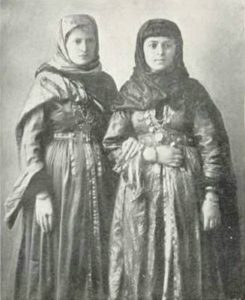 Jewish girls from the Caucasus in 1913 (Photo Source: Public Domain).
The traveler Judah Chorny also concludes that the Jews arrived in the Caucasus before the destruction of the First Temple, and that up to the fourth century of the common era they lived under Persian protection. At the end of the Sassanian dynasty, when Tatar hordes overran Persia, and the CaucasianJews were driven from their homes, the latter came in contact with their coreligionists in Babylonia, and adopted the rabbinical teachings as religious law. Soon they began to study the Talmud, of which they had an intimate knowledge when Eldad ha-Dani (ninth century) visited them. This is also corroborated by Benjamin of Tudela and Pethahiah of Regensburg. In the centuries when the great Talmudic schools flourished in Babylon, many eminent Talmudists lived in Derbent and the ancient Shemacha, in the government of Baku. In many regions in the government of Baku, where at present there are no mountain Jews, ruins of their auls and graves, and traces of irrigation trenches, etc., are to be found. The local Mohammedans still call these ruins by their old Jewish names; e.g., “Chifut Tebe” (Jewish Hill), “Chifut Ḳabur” (Jewish Grave), etc. In some parts of Daghestan the Mohammedan religion has supplanted Judaism; but in many Mohammedan families are to be found Jewish books inherited from Jewish ancestors.
Superstitious Beliefs
The Caucasian Jews can not be classed among the Karaites, as they still adhere closely to the Talmud. There is no question, however, that at the present time their Talmudic knowledge is not extensive and that they have added demonology to Judaism. Owing to this comparative ignorance they are nicknamed by the European Russian Jews “Byky” (oxen). The Jews of Daghestan and Baku believe in good and in evil spirits; e.g., Seer-Ovy (the spirit of the water), Ider, Hudur-bai, Kes-sen-bai, and others. The most venerated is the mighty Num-Negyr (the spirit of travelers and of the family), which name signifies “unutterable” (literally, “do not take a name”). A belief in perpetual warfare between the good and the evil spirits is deep-rooted among the Jews as well as among the Mohammedans of the Caucasus. According to Erckert, the Caucasian Jews in the times of the Seleucids were in communication with Palestine. They helped to spread Christianity in Armenia, Georgia, and the highlands of Albania. The mountain Jews are probably later emigrants, who in the eighth century and at the beginning of the ninth settled in the region north of Derbent. It was not until the end of the sixteenth century that they removed to the neighboring Majlis. Another stream of emigrants may have followed about 1180 from Jerusalem and Bagdad via Persia. Erckert and many others are of the opinion that the Caucasian Jews amalgamated at an early date with the native tribes. It is certain that among the peoples of the Caucasus the Jewish type is everywhere represented, and that even among Christian and Mohammedan tribes many Jewish customs and habits have been preserved to the present day. Among the Ossetes the old Mosaic law of levirate marriage still exists, which, according to Chorny, the mountain Jews also strictly observe. Even the outward appearance and the manner of speech of the Ossetes resemble those of the Jews. Many of their villages bear Hebrew names, and the marriage and funeral ceremonies correspond in many respects with those of the ancient Hebrews. The same may be said about the Tshechentzy.
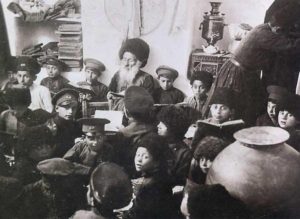 A 1920s photo of a Jewish school in Quba in modern-day Republic of Azerbaijan (known as Arran and the Khanates until 1918) (Photo Source: Public Domain). Quba continues to feature a large Jewish population and is considered ot be among the largest Jewish communities of the former Soviet Union.
The Caucasian Jews differ greatly from the European Jews. Their language, dress, education, employments, and their whole character render them almost a separate people; and they even differ greatly among themselves.
Manners and Customs
The Georgian, Lezghian, and Ossete Jews differ as much from one another as do the countries in which they live. The Jews of Daghestan have nothing in common with the foregoing, either in language, dress, mode of life, or moral views. They differ little from the other warlike mountain tribes among whom they dwell. They only differ from their Mohammedan and Christian neighbors in their adoption of the Tat language. They all dress in the Circassian style, and go about armed with daggers, pistols, and swords; even being armed when they go to bed or when praying in the synagogue. They are skilled horse-men. Their occupations are mostly dyeing, cattle-breeding, gardening, and viticulture. They own small farms, and rent land from their Mohammedan neighbors, by whom they are much oppressed. They raise tobacco, and manufacture excellent weapons. Even their ḥakams know how to handle the spade, the hoe, and the hammer.
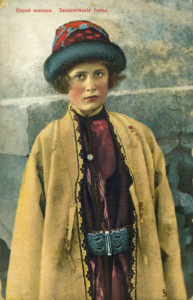 Image of a Bukhara Jew in Central Asia at the turn of the 19th century. The Jews of Bukhara are located in not just in the city of Bukhara but also in other cities of Uzbekistan in Central Asia. Bukhara Jews speak a Jewish vernacular of the Samarkand-Bukhara dialect of the Perso-Tajik language (Photo Source: The Goldstein-Goren Diaspora Research Center).
Owing to their persecutions under Mohammedan rule, the mountain Jews in the Russo-Caucasian wars always sided with the Russians; and the Russian government, after the conquest of the Caucasus, in acknowledgment of their valuable services, granted them equal rights with the other Caucasian tribes. Lately, however, these rights have been curtailed.
Mountain and Georgian Jews
In contradistinction to the mountain Jews, the Georgian Jews have always exhibited great patriotism, and have fought against the Russians. Their love for the fatherland is as proverbial as their bravery in war. Notwithstanding his war-like character, however, the Georgian Jew becomes penitent and humble in the synagogue. Here he may be seen to weep for the unfortunate destiny of his coreligionists scattered over the world. Georgian Jews are found in Tiflis, Kutais, Suran, Karasubazar, and the surrounding villages. Besides the Georgian and mountain Jews, mention should here be made of the Caucasian Subbotniki (Sabbatarians), who are probably descendants of the Chazars. Their type is more Slavonic than Semitic, but their mode of life is Jewish: they not only keep the Sabbath strictly, but also observe all the Mosaic laws and many rabbinical precepts. In Tiflis in 1894 their community numbered thirty families, besides many who lived outside the village and occupied themselves with cattle-breeding, agriculture, and the cultivation of the vine. They have the same prayers as the Russian Jews, but use the Russian language instead of the Hebrew. Some of them send their sons to Wilna for a higher rabbinical education. They consider it a great honor to intermarry with rabbinical Jews; but such marriages are rare. The Georgian and especially the mountain Jews deem it beneath their dignity to intermarry with the Subbotniki.
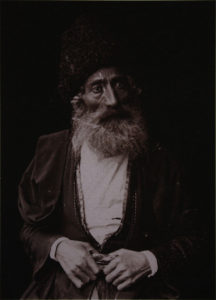 Late 19th century photo of a Jewish man from the Southern Georgian Akhaltsikhe region (Photo Source: Poemas del Rio Wang).
In recent years, with the improvements in communication,outside interest in the Caucasian Jews has become more extensive. Their coreligionists have endeavored to spread culture among them, while the Zionist organizations have established some schools for the rational study of Hebrew. For further details reference may be made to the articles on the respective cities, provinces, and peoples.
Bibliography
Gärber, Izvyestie o Nakhodyashchikhsya s Zapadnoi Storony Kaspiskavo Morya Narodakh. . . . 1760, pp. 305-307;
Radde, Vier Vorträge über den Kaukasus, in Ergänzungsheft zu Petermann’s Geographische Mittheilungen, No. xxxvi., p. 63, Gotha, 1874;
Erckert, Der Kaukasus und Seine Völker, p. 302, Leipsic, 1887;
idem, Die Sprachen, des Kaukasischen Stammes, Vienna, 1895;
Witsen, Noord en Oost Tartaryen, ii. 692, 808, Amsterdam;
Miller, Materialy dlya Izucheniya Yevreisko-Tatskavo Yazyka, St. Petersburg, 1892;
Merzbacher, Aus den Hochregionen des Kaukasus, Leipsic, 1901;
Anisimov, Kavkazskie Yevrei, Moscow, 1888;
Chorny, Sefer ha-Massa’ot, St. Petersburg, 1884;
Vakhouchte Tzarévitsch, Description Géographique de la Georgie, translated from the Georgian by Brosset, St. Petersburg, 1842;
Veidenbaum, Putevoditel po Kavkazu, Tiflis, 1888;
Russische Revue, xx. 42, xxi. 300;
Sbornik Materialov dlya Opisaniya Myestnostei i Plemion Kavkaza;
Van der Hoven, in Budushchnost, 1900, No. 52;
Harkavy, Ha-Yehudim u-Sefat ha-Slavim, pp. 105-109, and his reply to Steinschneider, Hebr. Bibl. ix. 15, 52, in Roman ob Alexandrye, 1892, p. 32, note;
idem, Soobshcheniya o Chazarakh, in Yevreiskaya Biblioteka, vii. 143-153;
idem, in Zapiski Vostochnavo Otdyeleniya Imperatorskavo Russkavo Archeologicheskavo Obshchestva, viii. 247;
idem, in Voskhod, 1896, ii. 35, 36;
Khronika Voskhoda, 1884, No. 44; 1886, No. 48; 1887, No. 20; 1895, No. 33;
Ha-Meliẓ, 1870, Nos. 4, 28-30, and 1895 passim;
Ha-Ẓefirah, 1880, x. 33-54; 1894, No. 94;
R. Andree, Zur Volkskunde der Juden, 1881;
Langlois Collection des Histoires Arméniennes: Faustus de Byzance, i. 274-275;
Hahn, Aus dem Kaukasus, Leipsic, 1891;
Uslar, Drevnyeishiya Izvyestiya o Kavkazye, Tiflis, 1881,
Yevreiskoe Obozryenie, 1884, v. 157;
D’Ohsson, Des Peuples du Caucase, . . . ou Voyage d’Abou-El-Cassim, Paris, 1828.
Related posts:
-
Photographs from Ancient Kahib, Daghestan in the Caucasus
-
Dmitri Ermakov: Chronicler of the Caucasus
-
A Survey and History of the Persian Population of the Caucasus
-
Flags of Nader Shah’s Army Discovered in the Caucasus
-
Dr. Oric Basirov: Origin of Pre-Imperial Iranian Peoples
-
A Glance at the Ancient Lezgians of the Caucasus
-
Article on Persian Heritage journal publishes article on links between Germania and ancient Iranian Peoples
-
Nowruz Celebrations in the Caucasus
-
A Tribute to WAALM’s Jewish Winners of the Persian Lioness Award
-
Farrokh Lecture on Iran-Caucasus Links at University of Southern California
https://kavehfarrokh.com/iran-and-caucasia/iranian-speaking-jewish-peoples-of-the-caucasus/
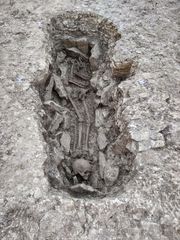
 According independent archaeologists have uncovered part of a cemetery thousands of