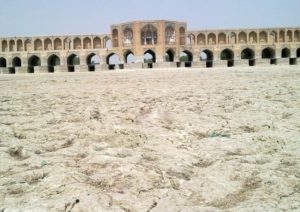
 As far back as a decade ago, the Iranian and international newspapers were reporting on the drought and desertification in Iran. In 2015, the New York Times reported on the problem in an article titled: “The Empty River of Life”
https://www.nytimes.com/2015/05/06/world/middleeast/iran-our-man-in-tehran.html. Now almost at the beginning of the second decade of the 21 st century the desertification across Iran has worsened so much that the consequences could have dire and irreparable consequences for the country. In a new report by Iran International, titled, “Desert Invasion across Iran”, that reality has been witnessed.
It has been reported that Khosrow Shahbazi, the head of Iranian Forest, Rangeland and
Watershed, at a meeting with the Governor of Gilan (a province in the north of Iran by the Caspian Sea) on December 1 st , 2019, stated that about one hundred million hectares of the country’s lands are subject to desertification.
Desertification is a process whereby the biological productivity or ability of the environment to support life such as vegetation is greatly diminished. The scientists have stated that this gradual and drastic decrease in productivity may be due to several factors such as climate change, deforestation, unhealthy grazing, poverty, political instability, unstable irrigation, and inadequate management of water resources (surface and groundwater) or a combination of these factors.
This has happened in many areas of the world including in some countries in Africa. What is for certain based on many reports as well as evidence the environmental policies of Iranian agencies have had major impact on these catastrophic environmental changes.
Iran is a country with varied natural landscapes composed of arid and dry desert ecosystems, as well as plains, grasslands, and forests. However, even the northern forests have been drastically changing. According to Mohammad Darwish, a member of the faculty of forests and rangelands, the forests have been changing due to forest tree disease, man-made deforestation under the pretext of development, increased soil erosion, flooding and land subsidence. Other factors include wood harvesting, the establishment of industrial and mining units, animal husbandry.
De-forestation is more severe in Golestan province, and northern forests follow the path that Zagros began decades ago, despite warnings given by the scientists and environmentalists.
Acoording to Isa Callanti, the head of the Environmental Protection Agency, between 2 to 5 hectares of Zagros forests are drying out annually, but the situation is much worse in rangelands, prairies and drier areas.
The environmentalists believe that dams (built in recent years) are the main culprit in many parts of Iran. For example, the dam built on Zohreh River has been the cause of drying of Hendijan plain. In Sistan and Baluchistan, the sandstorms and the influx of sand have greatly increased due to desertification and the dam on the Helmand River in Afghanistan has been drying up the lakes Sistan and Baluchistan. In another part of the country, excessive grazing and drought has caused the gradual death of semi-green rangelands in Isfahan province. According to statistics available, over 6,000 villages in Iran have been affected by this phenomenon since the past 5 years, reflecting the severity of desertification in Iran.
The rapidly advancing desertification phenomenon has received little attention or consideration from the Iranian governmental agencies while they still continue with poor environmental management decisions which are now negatively and drastically impacting the country with dire environmental consequences.
News
Happy New Year 2020
 Happy New Year
Dear friends, supporters, and members of World Cultural Heritage Voices. On behalf of our colleagues and volunteers at WCHV and on the occasion of the New Year, I would like to thank you for your generous support in 2019, which has been so
instrumental in achieving our goals and mission.
We hope that you, as a valued supporter, friend and member of our organization,
continue to play an active role in supporting us to meet our goals in the coming year.
Sincerely,
Shokooh Mirzadegi
Executive Director
12.27.2019
www.wchv.org
Archaeologists accidentally break eggs that had been going off for 1,700 years
 Archaeologists accidentally broke three Roman eggs that had been going off for 1,700 years.
The excavators unearthed a basket of four chickens’ eggs in a waterlogged pit during a dig in Aylesbury, Buckinghamshire.
Three of the eggs cracked, releasing an overpowering “potent stench”, however the team managed to preserve the fourth one – making it the only complete Roman chicken’s egg found in Britain. Experts from Oxford Archaeology think the waterlogged pit may have been used as a sort of Roman wishing well. Stuart Foreman, dig project manager, said: “There’s a very good reason it’s the first and only find in the UK.”
He added: “In a pit that has been waterlogged for thousands of years you get things that would never survive in a dry environment.
“But it’s incredible we even got one out. They were so fragile.” Alongside the eggs were dozens of coins, shoes, wooden tools and a “very rare” basket.
© Provided by The Independent Edward Biddulph, who spent three years analysing the
find, added: “Passers-by would have perhaps stopped to throw in offerings to make a
wish for the gods of the underworld to fulfil.
“The Romans associated eggs with rebirth and fertility, for obvious reasons.
Read more: https://www.msn.com/en-au/news/techandscience/archaeologists-
accidentally-break-eggs-that-had-been-going-off-for-1700-years/ar-BBXTaJM
Ancient monkey painting suggests Bronze Age Greeks travelled widely
 By Michael Marshall
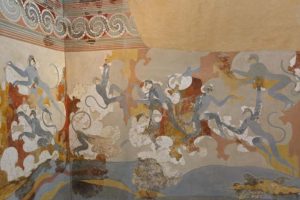
A Bronze Age painting on a Greek island shows a monkey from thousands of kilometres away in Asia. The finding suggests that ancient cultures separated by great distances were trading and exchanging ideas.
The artwork is one of several wall paintings in a building at Akrotiri on the Greek island of Thera (Santorini) in the Aegean Sea. Akrotiri was a settlement of the Minoan civilisation in Bronze Age Greece that was buried by ash from a volcanic eruption in around 1600 BC.
Many of the paintings show monkeys, yet there were no monkeys in Greece at the time.
Most of the monkeys have been identified as Egyptian species like olive baboons. This
makes sense because Egypt was in contact with the Minoan civilisation, which was
spread across several Aegean islands. However, others were harder to identify.
Marie Nicole Pareja at the University of Pennsylvania in Philadelphia teamed up with
primatologists to re-examine the mystery monkey paintings. One stood out. “When they
looked at this wall painting, they all straight away unambiguously said ‘that’s a langur’,”
says Pareja.
The real utopia: This ancient civilisation thrived without war
The team has identified the monkey as a grey langur ( Semnopithecus ). As well as its
distinctive fur, the monkey was depicted holding its tail in a characteristic S shape.
Grey langurs live in southern Asia in what is now Nepal, Bhutan and India – and
particularly in the Indus Valley. During the Bronze Age, the region was home to the
Indus Valley Civilisation, one of the most important societies of that time. Although it
was past its peak, the Indus Valley Civilisation was still advanced for its time, with large
cities and elaborate water supply systems.
Somehow, the artist who painted the monkey picture must have seen a grey langur. But
how? Did Minoan Greeks visit the Indus? “I wouldn’t be surprised if someday in the future we found evidence for that kind of direct contact,” says Pareja, but right now there is none. It is also possible the visit was the other way round, but again there is no evidence. Instead, it may be that Greece and Indus were connected via Mesopotamia, another Bronze Age civilisation centred on what is now Iraq. Langurs may have been imported to Mesopotamia for menageries, where visiting Greeks saw them.
“It’s evidence of this far-reaching trade, these relationships with these far-flung areas,”
says Pareja. Even in the Bronze Age, it seems there was a lot of exchange between
seemingly separate civilisations.
https://www.newscientist.com/article/2227146-ancient-monkey-painting-suggests-
bronze-age-greeks-travelled-widely/#ixzz69cVmypv8
Happy Yalda 2019 – Celebrating Light & Kindness
 Once again, we are on the verge of the Persian celebration of Yalda, a festival that has major significance in Iranian culture. Yalda is the only Iranian festivity that emphasizes the audacious conflict between light and dark emphasizing the beginning of longer days and shorter nights.
For centuries, at the height of the chilly winter nights, there is a new hope in the hearts of the Persians; the hope that Yalda, along with the elements of nature, simply reminds us that just like the end of darkness, it is possible to end sorrow and anguish in the face of the kindness of the sun, which is the eternal gem of our culture. And now everything indicates that once again the force of light, brightness and joy will end the bitter and dark times.
The Pasargad Heritage Foundation, while congratulating you on the occasion of the
Persian Yalda celebration, invites everybody to celebrate this national festivity.
Let’s come along and celebrate Yalda by the Evergreen and with the army of light and
kindness save our land from the evil of darkness.
Happy Yalda
Shokooh Mirzadegi
From the Pasargad Heritage Foundation
Long-distance timber trade underpinned the Roman Empire’s construction
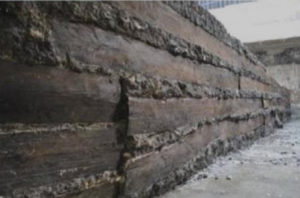 The ancient Romans relied on long-distance timber trading to construct their empire, according to a study published December 4, 2019 in the open-access journal PLOS ONE by Mauro Bernabei from the National Research Council, Italy, and colleagues.
The timber requirements of ancient Rome were immense and complex, with different types of trees from various locations around the Roman Empire and beyond used for many purposes, including construction, shipbuilding and firewood. Unfortunately, the timber trade in ancient Rome is poorly understood, as little wood has been found in a state adequate for analysis. In this study, Bernabei et al successfully date and determine the origin and chronology of unusually well-preserved ancient Roman timber samples.
The twenty-four oak timber planks (Quercus species) analyzed in this study were
excavated during Metro construction in Rome during 2014-2016. They formed part of a
Roman portico in the gardens of via Sannio (belonging to what was once a lavishly
decorated and rich property). The authors measured the tree-ring widths for each plank
and ran statistical tests to determine average chronology, successfully dating thirteen of
the planks.
By comparing their dated planks to Mediterranean and central European oak reference
chronologies, the authors found that the oaks used for the Roman portico planks were
taken from the Jura mountains in eastern France, over 1700km away. Based on the
sapwood present in 8 of the thirteen samples, the authors were able to narrow the date
these oaks were felled to between 40 and 60 CE and determined that the planks all came from neighboring trees. Given the timber's dimensions and the vast distance it travelled, the authors suggest that ancient Romans (or their traders) likely floated the timber down the Saône and Rhône rivers in present-day France before transporting it over the Mediterranean Sea and then up the river Tiber to Rome, though this cannot be confirmed.
The authors note that the difficulty of obtaining these planks—which were not specially
sourced for an aesthetic function but used in the portico's foundations—suggests that the logistical organization of ancient Rome was considerable, and that their trade network was highly advanced.
Bernabei notes: “This study shows that in Roman times, wood from the near-natural
woodlands of north-eastern France was used for construction purposes in the centre of
Rome. Considering the distance, calculated to be over 1700km, the timber sizes, [and] the means of transportation with all the possible obstacles along the way, our research
emphasises the importance of wood for the Romans and the powerful logistic organisation of the Roman society.”
Read more: https://www.scientificamerican.com
Remains found dating back to 7th century
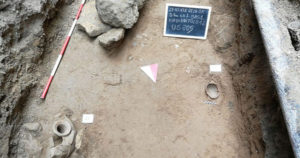 ELA, SICILY—According to a report in The Local, excavation work on Sicily’s southern coast has revealed a small section of a Greek necropolis dating to the seventh century B.C. Among the burials, archaeologist Gianluca Calà has discovered the remains of a newborn and bones from a large animal in a hydria, or ceramic water jug, and a sarcophagus containing an intact skeleton.
Pottery recovered from the graves links them to the earliest Greeks from Rhodes and Crete to settle in Sicily. To read about excavations at the nearby Greek colony of Akragas, go to “Sicily’s Lost Theater.”
Early 20th-Century Message Found at New Jersey University
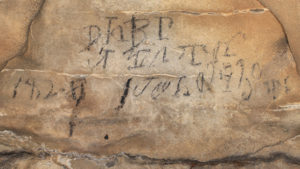 MONTCLAIR, NEW JERSEY—Montclair Magazine reports that demolition laborer Robert Kanaby discovered a message in a bottle dated July 3, 1907, while working in Montclair State University’s mission-style College Hall. He had been using a chipping hammer to break up an 18-inch-thick brick wall when he heard glass break and found the beer bottle in the brick debris. “This is to certify that this wall was built by two bricklayers from Newark, N.J., by the names of William Hanly and James Lennon, members of No. 3 of the B.M.I.U. of America,” the note read. Records from the 1920 Census indicate that a William J. Hanly, aged 33, lived in Newark and was able to write. James Lennon, born in 1875, was listed as living in Newark in the 1930 Census, along with his wife and 16-year-old daughter. The two men are thought to have been Irish immigrants. University officials plan to exhibit the bottle and the note, and they are looking for possible descendants of the two men
Rare Roman Armor Unearthed in Bulgaria
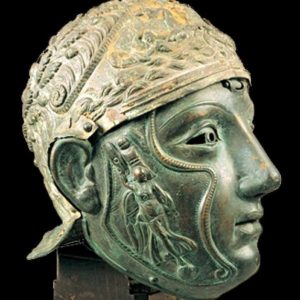 DEBELT, BULGARIA—Archaeology in Bulgaria reports that some 6,000 pieces of chain mail dating to sometime between the fourth and sixth centuries A.D. have been unearthed in the ancient Roman colony of Deultum, which is located near the Black Sea coast in southeastern Bulgaria. The armor, which includes two well-preserved sleeves, was found inside the colony’s fortress, against its north wall. Fragments of wood suggest the armor was stored in wooden chests. When the north wall collapsed during a fire, the armor, made up of rectangular slabs of wrought iron attached to leather garments, was crushed.
So far, analysis of the artifacts suggests the armor had been made by two or three different craftsmen. Conservation of the rare artifacts will be challenging. “This requires an incredible amount of work because every single slab has to be extracted, any corrosion needs to be cleaned up, and then the slab needs to be restored and placed on leather, the way it used to be,” explained Krasimira Kostova of the Deultum-Debelt Archaeological Preserve. Bronze coins, pins, and the bones of large guard dogs were also recovered from the fortress
Human Rights Day
Human Rights Day
10 December
 Where, after all, do universal human rights begin? In small places, close to home — so close and so small that they cannot be seen on any maps of the world. […] Unless these rights have meaning there, they have little meaning anywhere. Without concerted citizen action to uphold them close to home, we shall look in vain for progress in the larger “
Eleanor Roosevelt
Human Rights Day is observed every year on 10 December — the day the United Nations General Assembly adopted, in 1948, the Universal Declaration of Human Rights (UDHR): a milestone document proclaiming the inalienable rights which everyone is inherently entitled to as a human being regardless of race, colour, religion, sex, language, political or other opinion, national or social origin, property, birth or other status. Available in more than 500 languages, it is the most translated document in the world.