
We believe that all cultural, historical and natural heritage, wherever they are should be preserved. LEARN MORE
News

Default Category

For tomorrow when our lions and suns return

I recently read a news report by one of the Iranian news agencies, under the title “Mashq Square’s doors will be opened after 19 years.” As the news reports suggest, Ali Darabi, the Deputy Minister of Cultural Heritage of the Islamic Republic of Iran, has suggested that the project related to Mashq Square that started a few years ago is nearing its final stage. In the first decade or two after the Islamic Revolution, I, like other culture and history enthusiasts and advocates, have been extremely worried about the destruction of the Iranian cultural and historical heritage in the hands of the new government, which had declared its hostility to the non-religious culture and history of Iranians from the beginning as demonstrated in comments like: “What was before Islam was a tyranny, and what was built after Islam with the efforts of the kings, especially the Pahlavi kings, is worthless.”

I have been directly involved in related issues, advocating for preservation and conservation of Iran’s cultural heritage for many years. I am also concerned about the other programs that this anti-culture Iranian government, under the name of restoration, reconstruction, and plans, have had for historical and non-religious Iranian sites. These restorations, reconstructions, and designs have always resulted in leaving the sites in worse conditions, and at times resulting in the loss of the historical identity of a work or a site or its destruction, which I call “dehistoric-ization.” (My emphasis here is on non-religious heritage sites as the government has always allocated very high budgets and carried the restorations of religious sites correctly.)

Some examples include beautiful sites such as the magnificent Sardar-e Bagh-e Melli, or the “Gate of the National Garden,” which has been called a symbol of Tehran for many years and is a great tourist attraction. After the revolution, many revolutionaries wanted to destroy the buildings at the Parade (Mashq) Square, but they were saved from destruction by the efforts of Iran’s cultural heritage advocates. However, some of its symbols, such as the lion and the sun engraved on the tiles around the buildings, were removed.

Mashq Square, also called the Parade Square, was a military shooting range during the Qajar period, and is now one of the national gardens at the gate of the Ministry of Foreign Affairs, a historical and governmental complex. Some of the buildings are from the Safavid era, while some of the streets leading to it and its various features were built during the Qajar period and the first Pahlavi period.

Even now, it is not clear what plans the Ministry of Cultural Heritage of the Islamic Republic of Iran has for the square and its historical and beautiful complex. However, I am certain that they will destroy parts of it which they “dislike,” and build a few museums of “Islamic arts” in place of the destroyed buildings. I am not exaggerating, as it is enough to pay attention to the statement of the Deputy Minister of Cultural Heritage in a recent meeting: “Cultural heritage is important in protecting public rights. We are the guardians of the preservation of cultural heritage. At the same time, preserving public rights and solving their problems is evident in our duties.” For the people who are familiar with the insidious language of this anti-culture group, this means: unauthorized excavations, destruction, changing identities, stealing, removing tiles and historical doors and windows, vandalism, and theft and removal of historical objects, all in the name of “rights.” For 43 years, the public has had no rights except to misery and poverty and the destruction of its cultural values.

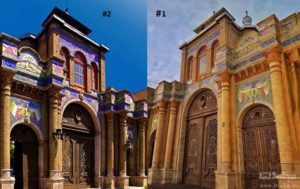
Earlier today, when I was looking at the photos of the front of the National Garden, one of the remaining works of the Mashq Square in Tehran, with great regret, I noticed some changes which could be the result of previous “repairs.” I hope that I am wrong, as I have not been in Iran for four decades. Those who are there and who pay attention to these things must know better, in order to inform others:

The first photo of the head in the National Garden in Mashq Square: two flags with two lions and two suns

The second photo of the head in the national garden in Mashq Square: two flags without two lions and two suns

Some people make excuses for illegally changing the flag of Iran, but is it possible to find an excuse for changing the historical monuments of a land, which also belong to all of humanity? It is important for us to document the destruction and mutilation of Iranian cultural sites for the record and also with the hope that they may be restored in the future.

August 22, 2022

Icom condemns Russia’s ‘deliberate destruction’ of Ukrainian heritage and plans stricter code of ethics

The International Council of Museums (Icom) has condemned Russia for the “deliberate destruction of Ukrainian cultural heritage” whilst voting to strengthen its Code of Ethics. The comment was made in a statement published on Icom’s website on 19 August, publicising the executive board’s unanimous decision to establish a new ethics protocol. Announced during the Icom General Assembly in Prague this week—the largest gathering of museum professionals in the world—Icom said the revised protocol would allow the organisation to more readily “address conflicts”.

The news comes as Anastasiia Cherednychenko, the vice-chair of Icom Ukraine, claimed that Russia had committed “cultural genocide” in Ukraine and that Icom Russia had subsequently violated Icom’s code of ethics as a result, during a panel discussion at the Prague conference.

After, Icom Ukraine released an open letter addressed to Icom’s president Alberto Garlandini, saying: “Russia is deliberately destroying and robbing Ukrainian museums and moving their collections to Russian territory while Russian Icom members participate in Russia’s manipulative projects that run against the founding principles of Icom.” Icom Ukraine went on to say that the international museum community was “complicit in these violations” if it did not take measures against Icom Russia.

Senior representatives of the Ukrainian Ministry of Culture—led by Cherednychenko—called for Icom Russia to be expelled from the council because of the invasion. A strengthening of the code of ethics is needed in order to do so, the letter adds: “Unfortunately, the rules developed and adopted by all Icom members no longer work. Silently watching the aggressor’s actions or merely expressing concern does not help; moreover, that gives the green light to those who might be tempted to violate the rules in the future. Therefore, we request that Russia’s membership in Icom is terminated.” Since its founding in 1946, Icom has never expelled a national committee.

Icom’s leadership responded by overwhelmingly voting in favour of establishing a new protocol on the ethical code. The review will be “given priority by the Icom Standing Committee for Ethics (Ethcom) immediately following” the conference in Prague, the statement said.

Study Investigates Rate of Parasite Infections in a Medieval City

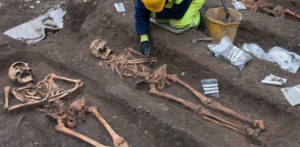
CAMBRIDGE, ENGLAND—According to a statement released by the University of Cambridge, friars living in Cambridge during the medieval period were almost twice as likely to be infected with intestinal parasites than the city’s general population. Research team member Tianyi Wang used a microscope to look for surviving parasite eggs in soil samples taken from the areas around the pelvises of people who had been buried in a local parish church cemetery, and from the cemetery at the site of the city’s medieval Augustinian friary. (The remains of monks were identified by the metal belt buckles associated with their order.) The study determined that 58 percent of the monks were infected with worms, compared to 32 percent of the townspeople. Roundworm was the most common parasite detected, but whipworm infection was found as well. Both of these parasites are spread through poor sanitation, Wang explained. Yet most people living at the time were likely to use cesspit toilets, while most Augustinian monasteries were equipped with water-rinsed latrines and handwashing facilities. Team leader Piers Mitchell concluded that the monks may have facilitated infection through using their own feces to fertilize their vegetable gardens, or by purchasing fertilizer that contained human or pig excrement. Read the original scholarly article about this research in the International Journal of Paleopathology.

Olmec Contortionist Reliefs Uncovered in Mexico

VILLAHERMOSA, MEXICO—According to a Live Science report, archaeologists in the Mexican state of Tabasco have recovered two circular Olmec reliefs dating to between 900 and 400 B.C. that depict local rulers engaging in a form of ritual contortion. In these rituals, researchers say, practitioners adopted a stance or seating position that reduced oxygen flow to the brain, inducing a trancelike state. The 3-D limestone reliefs, which each measure some four-and-one-half feet in diameter and weigh more than 1,500 pounds, show the rulers grimacing with their mouths open and their arms crossed. In both reliefs, they are surrounded by Olmec motifs associated with elite rulership, maize, and jaguars. The reliefs were initially discovered on private land in 2019 near the town of Tenosique in the southern part of Tabasco and, according to researchers from Mexico’s National Institute of Anthropology and History (INAH) who were among scholars called in to analyze them, they are similar to contemporaneous examples found elsewhere in the region. Archaeologist Tomás Pérez Suárez of the Center for Mayan Studies at the National Autonomous University of Mexico said that Olmec people of the period are thought to have believed that participating in contortion rituals that led to trancelike states left participants with special powers

International Day for the Remembrance of the Slave Trade and its Abolition

On the night of 22 to 23 August 1791, in Saint Domingue, today the Republic of Haiti, saw the beginning of the uprising that would play a crucial role in the abolition of the transatlantic slave trade.

It is against this background that the International Day for the Remembrance of the Slave Trade and its Abolition is commemorated on 23 August each year. It was first celebrated in a number of countries, in particular in Haiti (23 August 1998) and Gorée Island in Senegal (23 August 1999).

This International Day is intended to inscribe the tragedy of the slave trade in the memory of all peoples. In accordance with the goals of the intercultural project “The Routes of Enslaved Peoples”, it should offer an opportunity for collective consideration of the historic causes, the methods and the consequences of this tragedy, and for an analysis of the interactions to which it has given rise between Africa, Europe, the Americas and the Caribbean.

Warning by cultural heritage experts about the future of restoration and the maintenance of historical monuments

A group of cultural heritage specialists and experts from national and world heritage organizations have published an open letter warning about the future of restoration, maintenance, and protection of the most important historical monuments. They specifically point out their concerns regarding the status and work conditions of individuals working on heritage.

According to reports by the Iranian news agencies, national heritage employees consistently receive their salaries late and are worried about their employment status and contracts. Most of them complain about their low salaries, lower than that of ordinary workers.

www.savepasargad.com

Archeologist who discovered Tutankhamun’s tomb may have stolen treasure, new evidence suggests

Howard Carter discovered the tomb in Egypt’s Valley of the Kings in 1922

The archaeologist who discovered Tutankhamun’s tomb in the early 1900s may have helped himself to some of the Egyptian pharoah’s treasures, new evidence suggests.

Howard Carter found Tutankhamun’s tomb in November 1922, while on a digging expedition in the Valley of the Kings. He wrote in his diary at the time that the chamber was filled with a “wonderful medley of extraordinary and beautiful objects heaped upon one another.”

Now a previously unpublished letter has emerged, which alleges that Mr Carter could have stolen some items from the site.

Mr Carter had shown Sir Alan a “whm amulet”, which had been used for offerings to the dead, and apparently assured him that it had not come from Tutankhamun’s tomb, The Guardian reported.

However Sir Alan was told by the then British director of the Egyptian Museum in Cairo that the amulet matched others found in the tomb and likely had been stolen.

He enclosed the director’s verdict in a letter to Mr Carter. It read: “The whm amulet you showed me has been undoubtedly stolen from the tomb of Tutankhamun.”

International Tourism Registers 250 Million International Arrivals in First Five Months of 2022

In the first five months of this year, international tourism has seen a strong return, with almost 250 million international arrivals recorded, according to the recent UNWTO World Tourism Barometer.

The same source reveals that for a period from January to May 2021, over 77 million arrivals were recorded, which means that the sector has recovered almost half or 46 per cent of the pre-pandemic levels of 2019, SchengenVisaInfo.com reports.

In this regard, the Secretary General of UNWTO, Zurab Pololikashvili, has said that tourism recovery has increased the pace in many parts of the world, facing the challenges that stand in its way.

In addition, he advised being careful about the economic problems and geopolitical challenges that may affect this sector in the remaining part of 2022 and beyond.

Europe welcomed more than four times as many international arrivals as in the first five months of 2021 (+350 per cent), boosted by strong intra-regional demand and the removal of all travel restrictions in many countries,” the statement issued by the UNWTO reads.

Europe also saw a particularly strong performance in April at +458 per cent, thus reflecting a busy Easter period. Meanwhile, in America, arrivals doubled by +112 per cent. However, the strong rebound is measured against weak results in 2021, while arrivals remain 36 per cent and 40 per cent below 2019 levels in the two regions, respectively.

Other regions that saw strong growth are also the Middle East, with +157 per cent, and Africa, with +156 percent remaining 54 per cent and 50 per cent below 2019 levels, respectively. Asia and the Pacific almost doubled arrivals with +94 per cent. However, the numbers were 90 per cent below 2019, as some borders remained closed to non-essential travel.

Quarry Discovered Under Ancient Church in Jerusalem

JERUSALEM, ISRAEL—The Jerusalem Post reports that traces of a fourth-century A.D. rock quarry were uncovered at the site of the Church of the Holy Sepulchre, a Christian site built on top of the Roman emperor Hadrian’s temple of Capitoline Jupiter. Francesca Romana Stasolla, Beatrice Brancazi, and Stefano De Togni of the Sapienza University of Rome and their colleagues found the remains of the quarry while they were systematically restoring pavement stones in the ancient structure. Stasolla said that the quarry is marked by deep, uneven cuts, so that the builders in A.D. 326, during the reign of the emperor Constantine (r. A.D. 306–337), had to level the surface with soil mixed with ceramic materials to allow for water drainage. The quarried stones were then used to construct the early church

Workshop and Elite Woman’s Burial Uncovered at Palenque

CHIAPAS, MEXICO—According to a statement released by Mexico’s National Institute of Anthropology and History (INAH), preparations for the construction of visitor resources have uncovered a stone workshop and a cemetery at Palenque, a Maya city in southern Mexico. Tools for hunting, food preparation, and ritual sacrifices were constructed in the workshop between A.D. 600 and 850. More than 2,000 artifacts were recovered from the workshop, said Diego Prieto Hernández, director general of INAH. In the cemetery, researchers uncovered the remains of a woman who died around A.D. 800. Her remains show cranial deformation and inlays of precious stones in her teeth. The burial could offer insights into the role of women in ancient Maya society, Hernández explained.