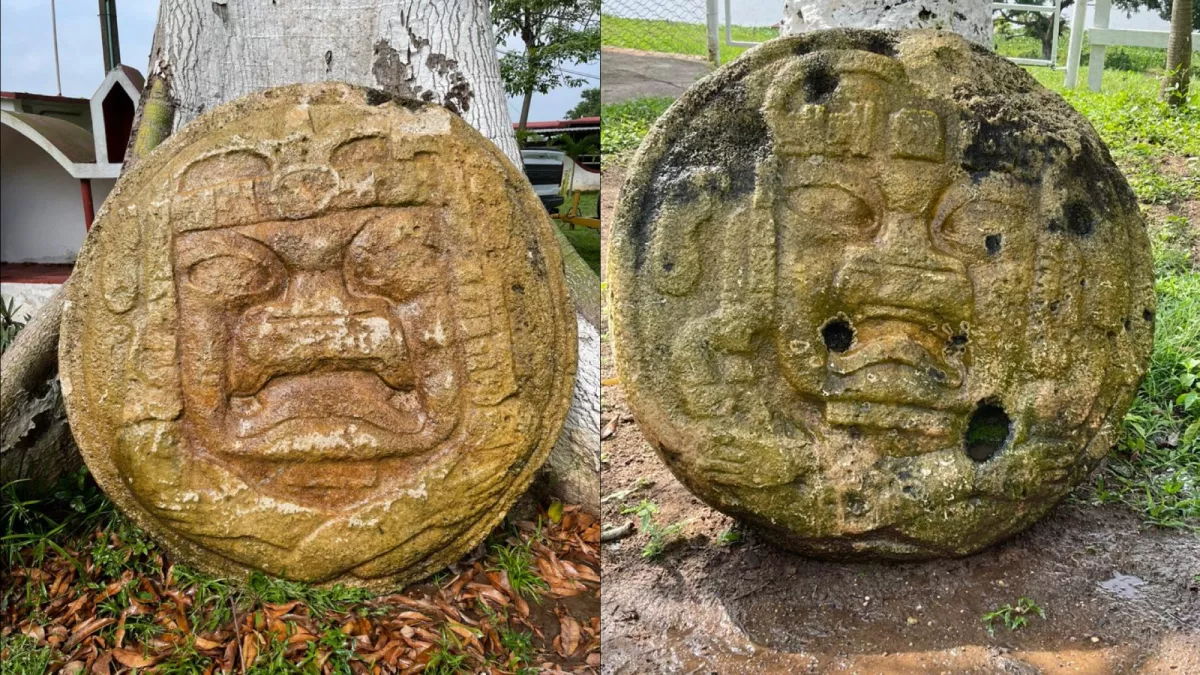
 VILLAHERMOSA, MEXICO—According to a Live Science report, archaeologists in the Mexican state of Tabasco have recovered two circular Olmec reliefs dating to between 900 and 400 B.C. that depict local rulers engaging in a form of ritual contortion. In these rituals, researchers say, practitioners adopted a stance or seating position that reduced oxygen flow to the brain, inducing a trancelike state. The 3-D limestone reliefs, which each measure some four-and-one-half feet in diameter and weigh more than 1,500 pounds, show the rulers grimacing with their mouths open and their arms crossed. In both reliefs, they are surrounded by Olmec motifs associated with elite rulership, maize, and jaguars. The reliefs were initially discovered on private land in 2019 near the town of Tenosique in the southern part of Tabasco and, according to researchers from Mexico’s National Institute of Anthropology and History (INAH) who were among scholars called in to analyze them, they are similar to contemporaneous examples found elsewhere in the region. Archaeologist Tomás Pérez Suárez of the Center for Mayan Studies at the National Autonomous University of Mexico said that Olmec people of the period are thought to have believed that participating in contortion rituals that led to trancelike states left participants with special powers
News
International Day for the Remembrance of the Slave Trade and its Abolition
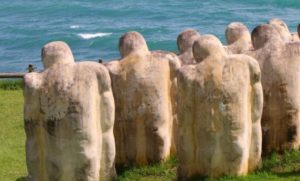 On the night of 22 to 23 August 1791, in Saint Domingue, today the Republic of Haiti, saw the beginning of the uprising that would play a crucial role in the abolition of the transatlantic slave trade.
It is against this background that the International Day for the Remembrance of the Slave Trade and its Abolition is commemorated on 23 August each year. It was first celebrated in a number of countries, in particular in Haiti (23 August 1998) and Gorée Island in Senegal (23 August 1999).
This International Day is intended to inscribe the tragedy of the slave trade in the memory of all peoples. In accordance with the goals of the intercultural project “The Routes of Enslaved Peoples”, it should offer an opportunity for collective consideration of the historic causes, the methods and the consequences of this tragedy, and for an analysis of the interactions to which it has given rise between Africa, Europe, the Americas and the Caribbean.
Warning by cultural heritage experts about the future of restoration and the maintenance of historical monuments
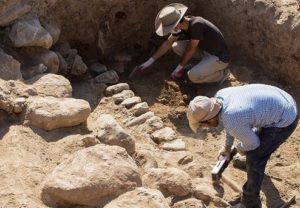 A group of cultural heritage specialists and experts from national and world heritage organizations have published an open letter warning about the future of restoration, maintenance, and protection of the most important historical monuments. They specifically point out their concerns regarding the status and work conditions of individuals working on heritage.
According to reports by the Iranian news agencies, national heritage employees consistently receive their salaries late and are worried about their employment status and contracts. Most of them complain about their low salaries, lower than that of ordinary workers.
Archeologist who discovered Tutankhamun’s tomb may have stolen treasure, new evidence suggests
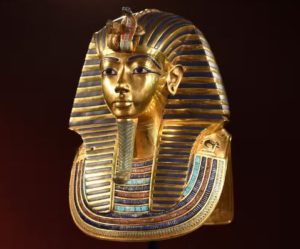 Howard Carter discovered the tomb in Egypt’s Valley of the Kings in 1922
The archaeologist who discovered Tutankhamun’s tomb in the early 1900s may have helped himself to some of the Egyptian pharoah’s treasures, new evidence suggests.
Howard Carter found Tutankhamun’s tomb in November 1922, while on a digging expedition in the Valley of the Kings. He wrote in his diary at the time that the chamber was filled with a “wonderful medley of extraordinary and beautiful objects heaped upon one another.”
Now a previously unpublished letter has emerged, which alleges that Mr Carter could have stolen some items from the site.
Mr Carter had shown Sir Alan a “whm amulet”, which had been used for offerings to the dead, and apparently assured him that it had not come from Tutankhamun’s tomb, The Guardian reported.
However Sir Alan was told by the then British director of the Egyptian Museum in Cairo that the amulet matched others found in the tomb and likely had been stolen.
He enclosed the director’s verdict in a letter to Mr Carter. It read: “The whm amulet you showed me has been undoubtedly stolen from the tomb of Tutankhamun.”
International Tourism Registers 250 Million International Arrivals in First Five Months of 2022

In the first five months of this year, international tourism has seen a strong return, with almost 250 million international arrivals recorded, according to the recent UNWTO World Tourism Barometer.
The same source reveals that for a period from January to May 2021, over 77 million arrivals were recorded, which means that the sector has recovered almost half or 46 per cent of the pre-pandemic levels of 2019, SchengenVisaInfo.com reports.
In this regard, the Secretary General of UNWTO, Zurab Pololikashvili, has said that tourism recovery has increased the pace in many parts of the world, facing the challenges that stand in its way.
In addition, he advised being careful about the economic problems and geopolitical challenges that may affect this sector in the remaining part of 2022 and beyond.
“Europe welcomed more than four times as many international arrivals as in the first five months of 2021 (+350 per cent), boosted by strong intra-regional demand and the removal of all travel restrictions in many countries,” the statement issued by the UNWTO reads.
Europe also saw a particularly strong performance in April at +458 per cent, thus reflecting a busy Easter period. Meanwhile, in America, arrivals doubled by +112 per cent. However, the strong rebound is measured against weak results in 2021, while arrivals remain 36 per cent and 40 per cent below 2019 levels in the two regions, respectively.
Other regions that saw strong growth are also the Middle East, with +157 per cent, and Africa, with +156 percent remaining 54 per cent and 50 per cent below 2019 levels, respectively. Asia and the Pacific almost doubled arrivals with +94 per cent. However, the numbers were 90 per cent below 2019, as some borders remained closed to non-essential travel.
Quarry Discovered Under Ancient Church in Jerusalem
 JERUSALEM, ISRAEL—The Jerusalem Post reports that traces of a fourth-century A.D. rock quarry were uncovered at the site of the Church of the Holy Sepulchre, a Christian site built on top of the Roman emperor Hadrian’s temple of Capitoline Jupiter. Francesca Romana Stasolla, Beatrice Brancazi, and Stefano De Togni of the Sapienza University of Rome and their colleagues found the remains of the quarry while they were systematically restoring pavement stones in the ancient structure. Stasolla said that the quarry is marked by deep, uneven cuts, so that the builders in A.D. 326, during the reign of the emperor Constantine (r. A.D. 306–337), had to level the surface with soil mixed with ceramic materials to allow for water drainage. The quarried stones were then used to construct the early church
Workshop and Elite Woman’s Burial Uncovered at Palenque
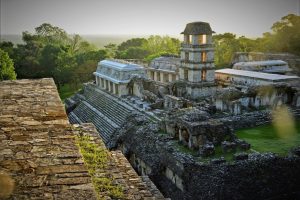 CHIAPAS, MEXICO—According to a statement released by Mexico’s National Institute of Anthropology and History (INAH), preparations for the construction of visitor resources have uncovered a stone workshop and a cemetery at Palenque, a Maya city in southern Mexico. Tools for hunting, food preparation, and ritual sacrifices were constructed in the workshop between A.D. 600 and 850. More than 2,000 artifacts were recovered from the workshop, said Diego Prieto Hernández, director general of INAH. In the cemetery, researchers uncovered the remains of a woman who died around A.D. 800. Her remains show cranial deformation and inlays of precious stones in her teeth. The burial could offer insights into the role of women in ancient Maya society, Hernández explained.
Human Remains Recovered at Waterloo Battlefield
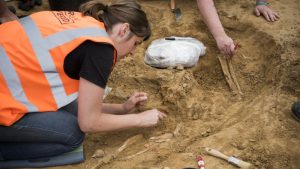 WALLONIA, BELGIUM—The Brussels Times reports that a human skeleton, amputated limbs, the remains of at least three horses, and ammunition boxes have been found in a ditch at the site of an allied field hospital during the Battle of Waterloo, which was fought on June 18, 1815 by a French army commanded by Napoleon Bonaparte, an army made up of soldiers from Britain and its allies, and a Prussian army. Additional amputated limbs were uncovered nearby during excavations conducted in 2018. “Dead soldiers, horses, amputated limbs, and more would have been quickly buried in a desperate attempt to contain the spread of disease around the hospital,” said archaeologist Véronique Moulaert of the Walloon Heritage Agency. Only one other complete skeleton has been found near the battlefield. Most of the human remains from the bloody battle are thought to have been exhumed and ground into agricultural fertilizer in the nineteenth century. Behind what had been Napoleon’s front line, a metal detector survey has revealed more than 20 musket balls thought to have been left behind by fighting between French and Prussian troops.
World Population Day
A world of 8 billion: Towards a resilient future for all – Harnessing opportunities and ensuring rights and choices for all

In 2011, the world reached a population of 7 billion. This year, the number will hit 8 billion, prompting the attendant responses. Some will marvel at the advancements in health that have extended lifespans, reduced maternal mortality and child mortality and given rise to vaccine development in record time. Others will tout technological innovations that have eased our lives and connected us more than ever. Still others will herald gains in gender equality.
But progress is not universal, throwing inequality into razor-sharp relief. The same concerns and challenges raised 11 years ago remain or have worsened: Climate change, violence, discrimination. The world reached a particularly grim milestone in May: More than 100 million forcibly displaced worldwide.
In an ideal world, 8 billion people means 8 billion opportunities for healthier societies empowered by rights and choices. But the playing field is not and has never been even. Based on gender, ethnicity, class, religion, sexual orientation, disability and origin, among other factors, too many are still exposed to discrimination, harassment and violence. We do ourselves no favors when neglecting those left behind.
Let no alarmist headline distract from the work at hand: investing in human and physical capital for inclusive, productive societies that uphold human and reproductive rights. Only then can we tackle the enormous challenges facing our planet and forge a world where health, dignity and education are rights and realities, not privileges and empty promises. In a world of 8 billion, there must always be space for possibility.
UN Secretary-General António Guterres
Background
World Population Day, which seeks to focus attention on the urgency and importance of population issues, was established by the then-Governing Council of the United Nations Development Programme in 1989, an outgrowth of the interest generated by the Day of Five Billion, which was observed on 11 July 1987.
By resolution 45/216 of December 1990, the United Nations General Assembly decided to continue observing World Population Day to enhance awareness of population issues, including their relations to the environment and development.
The Day was first marked on 11 July 1990 in more than 90 countries. Since then, a number of a number of UNFPA country offices and other organizations and institutions commemorate World Population Day, in partnership with governments and civil society.
The complicity of the Ministry of Cultural Heritage, Tourism and Handicrafts of the Islamic Government of Iran with the illegal auctions of Iranian historical heritage
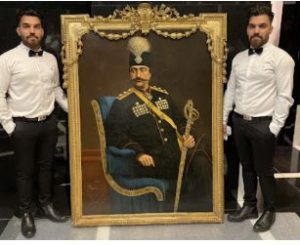 Recently, a “National Auction” was held in Tehran, an auction which was strongly protested against by the Iranian cultural advocates. It has been reported that a number of these auctions have been held in cooperation with the Ministry of Culture and Islamic Guidance, during which exquisite historical and cultural works of Iranian national heritage have been sold and then sent to buyers outside of Iran. In fact, this week brought forth the seventh round of these auctions, in which 40 works of art and artifacts were sold in an auction called “Iranian and Islamic classics”.
After seven of these auctions selling many pieces of cultural and national heritage and the protests of many cultural advocates, Morteza Adibzadeh, a director of museums and historical properties in Iran, reacted online and announced, “No permission has been issued by the General Directorate of Museums .
However, the Ministry of Culture and Islamic Guidance has said, “These auctions were licensed by the Ministry of Cultural Heritage, and it was with such a license that we had promised to send them abroad in our catalogs.” It is clear that the Ministry of Cultural Heritage, which for 40 years has allowed such destruction, unauthorized excavations, and the illegal removal of cultural and historical works of Iranians, has once again denied that it has given permission to auction, sell, and remove these national heritage and cultural works and artifacts which belong to the whole nation.
Adibzadeh told reporters that “the only thing that can be done now is to prevent these works from going abroad” and in this way, the buyers from these seven series of illegal auctions will not be able to get their hands on the purchased works. In order to get these sold items out of Iran, the buyers have to resort to smugglers who also work under the supervision of people affiliated with the Islamic government in Iran.
Source: www.savepasargad.com