We believe that all cultural, historical and natural heritage, wherever they are should be preserved. LEARN MORE
News

Default Category

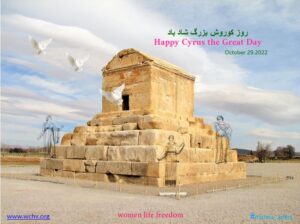
Cyrus the Great Day – 2022

The “Day of Cyrus the Great” Coincides with Call for Freedom in Iran

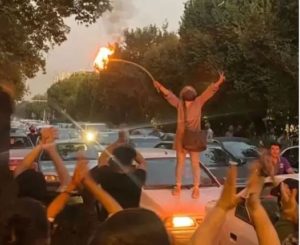
We are standing on the threshold of the “Day of Cyrus the Great”, and this year coincides with one of the most amazing uprisings for freedom in the world by the country women and men of Cyrus the Great. An uprising by women as the standard-bearers, and the youth as its brave soldiers. Soldiers who, like their historical fathers and leaders, intend to end the dark era of suffering and discrimination they have experienced in the hands of a brutal and oppressive government, and give peace, happiness and prosperity to the people of their land.

We at the Pasargad Heritage Foundation, as admirers of Cyrus the Great, as we have said many times, say that for us (as for many) Cyrus was neither a saint, nor an angel, nor the first ancient emperor. Cyrus’ importance as a historical figure is not because his name appears in holy books like the Bible, Torah and Quran. Cyrus is praiseworthy for his contributions and his decrees on human rights and freedom. He gave as binding laws for human rights not only for the people of his homeland, but also the people of other lands and the people with different religion and believes.

One of the most important and beautiful parts of the Cyrus’ Charter, especially these days when the children of Iran are being killed by the soldiers of the criminal leaders of Islamic government, is where it says:

“My very friendly soldiers were marching inside Babylon, I did not let anyone (anywhere) be intimidating in all the lands of Sumer and Akkad.”

The words of a powerful and mindful leader whose government was not based on fear, but based on wisdom and love.

Considering the historical facts, we cannot be indifferent to Cyrus the Great as a person of universal value, regardless of our belief and creed, religion or non-religion. We cannot be Iranian and not respect him. We cannot accept human rights but ignore his charter.

Pasargad Heritage Foundation, as the organization that proposed the designation of “Great Cyrus Day”, with respect for freedom fighters and especially the wise and brave women of Iran, calls on the people of the world to remember and support the nationwide uprising of the people of our land. As Cyrus the Great’s entry into Babylon was the day of saving the people from the hands of the oppressors, may this Cyrus’ day be the day of driving out the oppressors and opening the doors of freedom, happiness and peace for the people of Iran.

Happy Cyrus day

Sincerely

Shokooh Mirzadegi

Spokesperson of “Pasargad Heritage Foundation”

October 2022

www.savepasargad.com

Women’s Rights are Human Rights: Woman, Life, and Freedom

by Sahar Panahi.

The protests in Iran over the last four weeks after the arrest and killing of a 22 year old young Kurdish Iranian woman, Mahsa Amini, by elements of Iranian government, who are called the “morality police”, show no signs of ending. In fact, the small demonstrations that started almost a month ago have now grown and spread to hundreds and thousands of people and to every city in Iran resembling a new Iranian uprising. The protests have also grown in major cities across the world including in London, Paris, Frankfurt and Stockholm, in support of the protests in Iran. The demonstrators in Iran are calling out the Iran’s Islamic Government which has been in power over the last four decades for its atrocities and oppression of the Iranian public and its practices which include imprisonment, torture and rape of the Iranian women and men.

Amnesty International states that women’s rights are human rights. These simply include the right to live free from violence and discrimination; to enjoy the highest attainable standard of physical and mental health; to be educated; to own property; to vote; and to earn an equal wage. However, we know that across the globe many women and girls still face discrimination on the basis of sex and gender. Gender inequality underpins many problems which disproportionately affect women and girls, such as domestic and sexual violence, lower pay, lack of access to education, and inadequate healthcare. For Iranian women these conditions have worsened every year since the Islamic government came to power in Iran. Iranian women who could choose to dress as they wished and attain high educational degrees before the Islamic revolution in 1979 have been forced to take a back sit to their brothers and sons. The morality police can indiscriminately stop women on the street for just wearing a lipstick and punish them as they wish. This happened to Mahsa Amini. Under the Islamic regime standards of living have greatly fallen for the middle class, hard working Iranians and most people cannot afford even food and basics in their everyday lives. Women are disproportionately affected by social and economic pressures.

The women and Men on the streets of Iran are shouting: “Woman, Life, Freedom”, while asking for complete change in the government of Iran and removal of a political regime which has brought nothing except misery and oppression to Iranians over the last forty years with inflations rates of over 50% at times and sanctions due to policies of its government. This has been a government which on one hand kills its own people including tens of children and young people over the last month and on the other sends drones to Russia to kill Ukrainians in the unjust war of aggression of Russia and illegal occupation of Ukraine. Iran’s morality police, Basigis and Pasdaran (two military and security elements of the regime) who are killing the demonstrators on the streets of Iran with live ammunitions are part of the Iranian Islamic government. It is absolutely meaningless for Western governments to sanction these groups while they receive their orders from the leaders of the Islamic government.

Perhaps, it’s time for the international community, and especially, the European Union, the United Kingdom and the United of States of America to start looking at the facts and suffering of Iranian people and start supporting freedom, life and women’s rights in Iran.

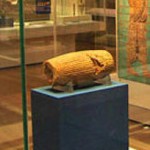
Women’s rights are the fundamental human rights that were enshrined by the United Nations for every human being on the planet nearly 70 years ago. Over 2500 years ago, Cyrus the great, the first great king of Persia announced the first declaration of human rights. Cyrus ordered slaves to be freed, declared that all people had the right to choose their own religion, and established racial equality. Cyrus’ decrees were recorded on a baked-clay cylinder in the Akkadian language with cuneiform script, which today is called the Cyrus’ Cylinder. In fact, this ancient record has now been recognized as the world’s first charter of human rights and its provisions are recognized to be similar to the first four Articles of the Universal Declaration of Human Rights. Today, Iranian women are not just asking for their own rights. They are also asking for the rights of every Iranian citizen to live under a government that cares for Iran and Iranian people. Iranian people are asking for freedom and life without the Islamic government.

International Day of Awareness on Food Loss and Waste Reduction

Stop Food Loss and waste, for the people, for the planet

Reducing food losses and waste is essential in a world where the number of people affected by hunger has been slowly on the rise since 2014, and tons and tons of edible food are lost and/or wasted every day.

Globally, around 14 percent of food produced is lost between harvest and retail, while an estimated 17 percent of total global food production is wasted (11 percent in households, 5 percent in the food service and 2 percent in retail).

The International Day of Awareness of Food Loss and Waste is an opportunity to call to action both the public (national or local authorities) and the private sector (businesses and individuals), to prioritise actions and move ahead with innovation to reduce food loss and waste towards restoring and building back better and resilient-ready, food systems.

Check how you can help us through FAO, the leading agency for this International Day, and discover what you can do. Take action, start something. Stop food loss and waste. For the people. For the planet.

HISTORY

Food loss has been around since the beginning of time as things like spoilage couldn’t be well controlled then. Now we have the means to control a large part of spoilage but are still having food loss and wastage due to many reasons, from negligence to lack of the technical know-how, lots of things contribute to food loss and wastage.

Around 14% of food produced in the World is lost between harvest and retail, while an estimated 17% of total global food production is wasted, which comprises 11% in households, 5% in the food service, and 2% in retail. This amounts to global losses in agriculture of about 1.2 billion tonnes per year causing monetary losses in the field worth more than 350 million dollars annually. Saving just one-fourth of the food currently lost or wasted in the World could help feed 870 million people who are living in hunger as well as fight climate change as food loss and waste is responsible for about 8% of global greenhouse gas (G.H.G.) emissions, leading to a depletion of the ozone layer and causing climate change.

Food loss and waste greatly undermine the sustainability of our food systems as when food is lost or wasted, all resources used to produce it — including water, land, energy, labor, and capital go to waste. It also negatively impacts food security and food availability and contributes to increasing the cost of food. With all these, The Food and Agriculture Organization of the United Nations (F.A.O.) was established in 1945 to defeat hunger in the World and they have made several strides towards achieving this, including meeting up in December 2019 to collectively establish a day for the International Day of Awareness of Food Loss and Waste, of which September 29 was chosen.

Gold Mask Found in Shang Dynasty Tomb in Central China

ZHENGZHOU, CHINA—A 3,000-year-old gold funeral mask has been recovered from a Shang Dynasty noble’s tomb in central China, according to a Live Science report. Huang Fucheng of the Zhengzhou Municipal Institute of Cultural Heritage and Archaeology said the mask measures about seven inches long and almost six inches wide, making it big enough to have covered an adult’s face. More than 200 artifacts, including ornate daggers, axes, wine vessels, smoking pipes, and goblets made of bronze and jade were also recovered from the tomb, which covers more than 108,000 square feet. Gold objects are rare at Shang Dynasty sites, and may indicate a link to another early Chinese state where gold was more common. “Where does the raw gold come from?” asked Chen Lüsheng of the National Museum of China. “Why did the tomb occupant choose to be buried with gold, while other top elites chose only bronzes and jades?” Gold has been found in small amounts in the region, he added, but it may have been imported as an exotic metal from the Yangtze River Valley to the south. 

Greek Coin Recovered in Croatia

ZAGREB, CROATIA—Total Croatia News reports that a Greek coin dated to the end of the fourth century B.C. was discovered by hikers on a forest road in eastern Croatia’s Papuk Mountain after a heavy rainfall. The silver coin shows Zeus enthroned with a bird on one side, and bears an image of Alexander the Great on the other. Pottery fragments were also found. A nearby settlement where approximately 500 people lived along a trade route has been dated to the seventh century B.C. “This shows continuity on the political, economic, and cultural scene of over 300 years, which few can boast of today, let alone back then,” commented archaeologist Hrvoje Potrebica.

Pakistan’s Mohenjo-Daro Damaged by Heavy Rain

ISLAMABAD, PAKISTAN—Al Jazeera reports that 55 inches of rain in southeastern Pakistan have caused significant damage to Mohenjo-Daro, a 4,500-year-old city of the Indus Valley civilization that was discovered in 1922 and named a UNESCO World Heritage Site in 1980. “The original structure is safe by and large, including the stupa at the site,” said Abdul Fatah Shaikh, director of archaeology and museums for Sindh province. “However, the protective layer, also called mud slurry, that we deployed suffered a lot of damage, causing exposure of the original walls.” The ancient city’s drainage and water management systems helped to protect the site from accumulating standing water, he added. Conservation work has begun to protect the ancient structures from irreparable damage

Hundreds of Monumental “Kites” Spotted in Arabian Desert

According to a statement released by the University of Oxford, some 350 monumental structures known as “kites” have been spotted in northern Saudi Arabia and southern Iraq with satellite imagery. Michael Fradley of Endangered Archaeology in the Middle East and North Africa (EAMENA) and his colleagues used open-source satellite imagery to look for the star-shaped structures, which consist of long, low stone walls, in the eastern Nafud Desert. The walls are thought to have been built as early as 8000 B.C., when the region was wetter and greener, to guide fast-moving game into a head enclosure where it could be captured or killed. Fradley explained that the heads of some of these kites measure more than 300 feet wide, while the guiding walls can run for more than two miles. The kites were probably built and rebuilt over generations, and may have also served as an expression of status and identity, and a way to mark territory. Further research will explore who built the kites, where they lived while building them, and how the game was used. Read the original scholarly article about this research in The Holocene.

International Day of Democracy 15 September

Secretary-General’s message for 2022

Today marks the 15th anniversary of the International Day of Democracy.

Yet across the world, democracy is backsliding.

Civic space is shrinking.

Distrust and disinformation are growing.

And polarization is undermining democratic institutions.

Now is the time to raise the alarm.

Now is the time to reaffirm that democracy, development, and human rights are interdependent and mutually reinforcing.

Now is the time to stand up for the democratic principles of equality, inclusion, and solidarity.

And stand with those who strive to secure the rule of law and promote the full participation in decision-making.

This year, we focus on a cornerstone of democratic societies – free, independent, and pluralistic media.

Attempts to silence journalists are growing more brazen by the day – from verbal assault to online surveillance and legal harassment – especially against women journalists.

Media workers face censorship, detention, physical violence, and even killings – often with impunity.

Such dark paths inevitably lead to instability, injustice and worse.

Without a free press, democracy cannot survive. Without freedom of expression, there is no freedom.

On Democracy Day and every day, let us join forces to secure freedom and protect the rights of all people, everywhere.

António Guterres

INTERNATIONAL DAY OF DEMOCRACY HISTORY

On November 8, 2007, the UN general assembly made September 15th the International Day of Democracy. The assembly invited individuals and organizations to commemorate the day. It also called on governments to share experiences of promoting democracy. The first International Day of Democracy was celebrated in 2008 by 46 national parliaments. This date marked the 20th anniversary of the first International Conference of New or Restored Democracies.

Roman mosaic of Medusa found in good shape and returned to Italy

Hidden for decades, a mosaic that is a “key part of Rome’s history” was located and returned to the Italian government, the Federal Bureau of Investigations said in a news release on Friday.

In 2020, an attorney contacted the FBI Art Crime Team on behalf of an anonymous client who was in possession of an enormous “mosaic of the mythological figure Medusa,” the FBI said.

The mosaic had been cut into 16 pieces, each weighing between 75 to 200 pounds, and had been individually stored in pallets kept inside a Los Angeles storage unit since the 1980s, according to the FBI.

“The client had no documentation — known in the art world as provenance — so they could not sell the pieces,” the FBI wrote. “Selling art without provenance is the equivalent of trying to sell a car when you don’t have its title.”

It is unclear how the anonymous client came into possession of the artwork, or how long it had been in the US, although the FBI says, “it may have been lost for as long as 100 years.”

Two special agents — Elizabeth Rivas and Allen Grove — worked to discover the origin of the mosaic so that it could be returned to its rightful owners.

Italian police force confirmed the mosaic was Italian and had “been entered into cultural property records in 1909,” the FBI said. “The only modern record of the mosaic’s existence was a 1959 newspaper ad that appeared to show it for sale in the Los Angeles area.”

“The mosaic was handcrafted from an age where people put an amazing amount of care and effort into it. It really speaks to the ingenuity and creativity of the time,” Grove said. “It’s not meant to be in Los Angeles. The mosaic belongs to the people of Rome. It allows us to understand a bit about the history of humans 2,000 years ago.”

Officials from Italy traveled to Los Angeles to inspect the mosaic and help plan the best way to get it back to Rome.

To ensure the artifact arrived in Italy without damage, the anonymous client covered the costs of the specialized shipping crates that were then sent through diplomatic channels. The artwork arrived safely in April, the FBI confirmed.

Art experts in Italy are currently in the process of cleaning and restoring the mosaic. While some of the storing pallets had been infested with termites, the artwork pieces were “largely intact thanks to the climate-controlled facility they’d been kept in,” the FBI said.

There is an ongoing effort in the US to repatriate cultural artifacts being sold, often illegally, to private collectors or museums.

Dozens of ancient artifacts investigators believe to have been looted were seized from the New York Metropolitan Museum of Art. Officials have also returned stolen antiquities worth nearly $14 million to Italy in July, including dozens of artifacts seized from US billionaire Michael Steinhardt.

In 2021, the Met returned three African art objects, including a pair of 16th-century Benin brass plaques, to Nigeria. The move came after European museums started facing mounting pressure to return the irreplaceable artifacts plundered during colonial times.

The-CNN-Wire & 2022 Cable News Network, Inc., a Warner Bros. Discovery Company. All rights reserved.