We believe that all cultural, historical and natural heritage, wherever they are should be preserved. LEARN MORE
News

Default Category

Study Offering New Insights on the Origins of Maya Civilization

maya

A recent study published in the April 26th issue of Science magazine reports on the results of new discoveries from Ceibal, Guatemala and prompting archeologists to reconsider the origins of the Maya civilization, which flourished in Mesoamerica for centuries. A team of archeologists led by Dr. Takashi Inomata from University of Arizona, dated early ceremonial structures at the site and concluded that the Maya culture had multiple influences.  For example, they suggest that the formal plazas and pyramids at Ceibal, an ancient Maya site in Guatemala, probably arose from broad cultural exchanges that took place across southern Mesoamerica from about 1,000 to 700 BCE. These new findings from the excavations challenge two prevailing theories on how the ancient Maya civilization began, suggesting its origins are more complex than previously thought. Until now, two theories have dominated the debate concerning the origin of the Maya civilization: one suggesting that the Maya developed almost entirely on their own in what is now southern Mexico, Guatemala, and Belize, and another suggesting that the older Olmec civilization was the Maya’s dominant cultural influence. The new findings, however, mean that neither of these theories can tell the full story of the Maya. Dr. Inomata and his team provide radiocarbon dating measurements taken from some of the ceremonial constructions at Ceibal that predate the growth of La Venta, a major center of the Olmec, by as much as 200 years.

Minaret of Iconic Umayyad Mosque has been Destroyed

Minaret Umayyad Mosque

As reported by several news agencies yesterday, one of Syria’s UNESCO world heritage sites was destroyed in fighting yesterday (April 24th, 2013).  The minaret of the famed 11th century Umayyad Mosque collapsed Wednesday amid fighting between government troops and Syrian rebels in the ancient city of Aleppo while each side accused the other side for this destruction.

UNESCO Director-General Irina Bokova, in an official statement said: “This is like blowing up the Taj Mahal or destroying the Acropolis in Athens.

The mosque which had earlier been damaged during fighting in the ancient city in October 2012 has an impressive history that dates back at least to Hellenistic times, and is believed that it served as a temple to the Aramaic god of rain. Later, it became a Roman temple, then a church. And early in the 8th century, a mosque – one of the most important sites in the Muslim world today.

Modern Aleppo, Syria’s commercial capital has been badly affected by Syria’s civil war. As reported by National Public Radio and many other agencies, the city now suffers from shortages of water, flour and electricity and widespread destruction. Disease is rampant because of festering piles of garbage.  Syria is home to six sites on the UNESCO World Heritage Sites list and most have been damaged as a result of continued fighting.

Symposium: The Legacy of Cyrus the Great and the Cyrus Cylinder

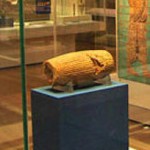
Cylider-EnglandOn April 26th and 27th, 2013, the Smithsonian’s Museums of Asian Art in Washington D.C., is holding a symposium focused on the legacy of Cyrus the great and the Cyrus Cylinder which is now on a exhibit tour in the U.S.

On Friday, April 26th the symposium starts with a talk by John Curtis, British Museum.  Mr. Curtis was the Keeper of the Department of the Middle East at the British Museum 1989–2011, and is currently Keeper of Special Middle East Projects. He is particularly interested in Iraq and Iran and has published widely on those subjects. His recent books include Forgotten Empire: the World of Ancient Persia (2005) and An Examination of Late Assyrian Metalwork (2013). He is a Fellow of the British Academy and a Corresponding Member of the Archaeological Institute of America.  Mr. Curtis will talk about the significance of the Cyrus Cylinder and also looking at the life of the Cylinder since 1971, and what it represents for different constituencies at the present time.

On Saturday, April 27th, 2013, the Symposium includes a number of longer talks as well as presentations of shorter papers.  The invited speakers include scholars from University College London, German Archaeological Institute,  Columbia University, University College Dublin, Stanford University,  and Brandeis University.

The Cyrus Cylinder was discovered at Babylon in 1879. Scholars soon realized its inscription corroborated with the biblical account of how the Jews brought to Babylon by Nebuchadnezzar were repatriated by Cyrus and allowed to start building the Second Temple. While the Cylinder does not mention the Jews by name, it does refer to the restoration of sacred statues to various shrines together with the people from those shrines.  It also gives a detailed account of Cyrus’s capture of Babylon.  From the beginning, the Cylinder was celebrated as an important historical document. It did not acquire its present iconic status until the late 1950s, however, when it began to be described as the First Charter of Human Rights.

For more information visit the Smithsonian’s Museums of Asian Arthttp://www.asia.si.edu/events/cyrus-symposium/agenda.asp

Endangered Iranian Forests

forest destroy 1It is widely believed by the experts and activists that the decisions and actions made by the Iranian government over the last three decades and especially the last eight years have greatly damaged the conditions of the Iranian forests and have put them in danger of destruction.

These actions include the followings:

–          Iranian government has allowed exploration for oil in the Kavir Desert National Park which is a protected National Park and is believed to be the original habitat for the Persian Cheetah.

–          The government has allowed building roads through Cloud Forest. Cloud Forest is one of the most unique forests in Iran.  In the last three decades, deforestation has destroyed the soil in the Iranian forests and created drought.

–           The government has allowed the extraction and exploitation of mines in environmentally protected areas with major and distinct wildlife. This has happened in many cases while the while the individual or people are not under the law entitled or allowed to start a mine.

–          The government has allowed building houses and apartment complexes in many areas of forests that should have been protected.

These decisions have resulted in the gradual destruction of forests, and extinction of animals and plant species in many areas in Iran.

Attacks on Sufi Shrines

Damage is seen at the burnt out Saida Manoubia shrine in the governorate of Manouba, west of the capital, in TunisAs reported by several news agencies and the National Public Radio (NPR-U.S.), over the last several months, Islamists in Tunisia have attacked almost 40 Sufi shrines and greatly damaged and/or destroyed them.  Previously, Islamists had destroyed several Sufi tombs in the city of Timbuktu in Mali as reported by the New York Times as well as here on WCHV website.  In fact, earlier this year, in February 2013, the U.S. State Department called on Tunisian leaders to implement a plan to protect the country’s religious and historic sites, denouncing a wave of recent attacks on Sufi shrines.


The Sufis are a relatively small sect of Islam that historically, has remained apolitical. They live and have spread over a vast geographic area that stretches from western Africa to South East Asia.  Sufis are best known for their embrace of mysticism and spirit of tolerance and their practices are seen as idolatry to Muslims who practice a more rigid and puritanical form of Islam.

Sufis as a group are not playing leading roles in any of the recent upheavals in the Arab world, but their shrines have become targets of many attacks.  Many Sufis gather at these shrines for prayer and meditation. In Libya last summer, a Sufi grave site in Tripoli was bulldozed, leading to the resignation of Libya’s interior minister.  But periodic attacks have been carried out elsewhere, including Pakistan, where dozens have been killed while visiting shrines as reported by NPR.

New concerns for the ancient city of Pompeii

Pompeii_Garden_of_the_Fugitives_If you are a world traveler and have made a list of World Cultural Heritage sites to visit, you have undoubtedly included a visit to the ancient city of Pompeii on that list. However, new concerns for those who love Pompeii and also for Italian government regarding the up-keeping and preservation of Pompeii have risen. Last month, a former restorer of Pompeii, Marcello Fiori was arrested on corruption charges and there are also five other people under investigation.

Italy declared a state of emergency at Pompeii in 2008 putting it under special administration until July 2010 after many historians and archeologists complained about the poor upkeep of the site. The result of the changes was to hire Mr. Fiori and a number of other personnel changes. At that time, The UNESCO mission found many major issues and concerns and concluded that even though a management plan had drawn up, it was not used and rather focusing on the areas of concerns and preservation, funds were diverted to other purposes. Last months, Italian investigators charged Mr. Fiori and the director of restoration, Luigi D’Amora, for awarding irregular contracts to a company called Caccavo which had charged the government and the commission very inflated prices for their work.

In the last five years UNESCO has identified new problems and as it was reported in the Art Newspaper, there are major concerns about lack of maintenance including several areas of deterioration, collapse of columns, inappropriate restoration ­methods and a general lack of qualified staff.” The fact that restoration projects are outsourced and the quality of the work of the contractors is not being assessed is another major concern. In addition, it has been known for a long time that an efficient drainage system is lacking, ­leading to water infiltration and excessive moisture that gradually degrades the structural condition of the buildings as well as their decor.

In 2010, UNESCO sent a mission supervised by Christopher Young, the head of world heritage and international policy at English Heritage.  He was assisted by two Paris-based specialists representing the International Council on Monuments and Sites: Jean-Pierre Adam, a professor at the Ecole du Louvre, and Alix Barbet, the director of research at the Centre National de la Recherche Scientifique. Their report, which has had virtually no international press coverage, was submitted to UNESCO’s World Heritage Committee in Paris in June 2011. It covers Pompeii and the nearby sites of Herculaneum and Torre Annunziata, on the ­outskirts of Naples.

The eruption of Vesuvius in 79 AD killed Pompeii’s inhabitants but preserved their buildings. The city was covered with ash, and it was only after its rediscovery in 1748 that excavations began. In 1997, UNESCO designated it a World Heritage Site. Pompeii attracted more than 2.3 million visitors in 2010.

Azerbaijan Republic’s Ancient Settlement

settlementA new settlement that dates back to the Middle Bronze Age in the 3rd millennium BC has been found in Azerbaijan as reported by the Archaeological Expedition of National Academy of Sciences of Azerbaijan (ANAS).


It has been proposed that there had been a continuous residence in the settlement found in Aghgabirli territory of Kichik Dahna village of Shaki region about 2000 years, from the end of the 3rd millennium BC until the beginning of the 1st millennium BC. The settlement consists of two cultural layers. It shows that the site had been flooded at least twice. However, the site had been relocated for a short period of time. Ceramics, pottery pots, human and animal bones, stone tools, various agricultural tools made from limestone, different types of stone graters and mortars have been found.

Reconstruction of Kasubi Tombs

Kasubi_Tombs_large

The Kasubi Tombs in Kampala, Uganda, is the site of the burial grounds for four kabakas (kings of Buganda), and listed on UNESCO World Heritage Site.  In March 2010, fire destroyed a major part of the buildings. However, earlier this month, a little under two years later, UNESCO signed the Plan of Operation with the Government of Uganda for the project “Technical and financial assistance for the reconstruction of Muzibu-Azaala-Mpanga, architectural masterpiece of the Tombs of Buganda Kings at Kasubi, Uganda, World Heritage property in Danger”.  The project is generously being supported through the Japanese Funds-in-Trust. The project aims to set up an efficient risk prevention scheme at the site, with all necessary equipment and support for the cost of qualified supervision for the reconstruction of the destroyed roof. The proposal was prepared as a result of the missions conducted to the property by the UNESCO World Heritage Centre and the experts made available by the Government of Japan through the Japanese Funds-in-Trust for the Preservation of the World Cultural Heritage.   The site which was listed on the World Heritage List in 2001, includes four royal tombs within the Muzibu-Azaala-Mpanga, the main building, which is a masterpiece of Ganda traditional architecture. 

Vandalism at Tomb of Cyrus

pasargad-nowruz1392-viraniOn the first day of the Iranian New Year, as it has become customary over the last few years, thousands of Iranian people gathered at the tomb of Cyrus. This year in an act of vandalism, one suspect (or persons) threw a hand grenade into the Tomb.  This vicious act structurally damaged the 2500 years old tomb, which is one of the world’s unique Cultural Heritage sites.

Unfortunately, the police officers on site and in the vicinity did not respond to the incident.

For several years, Iran’s historical and cultural heritage dated before Islam has suffered negligence by the Iranian Islamic government.

Another location is Pasargadae, a unique complex of historical and archeological sites in danger of destruction.

Built Heritage 2013: Monitoring Conservation Management

In November 2013, an international conference will be held in Milan, Italy, focusing on bringing together different professionals to discuss significant conservation projects and safeguarding architectural heritage around the world.  The Built Heritage Conference will offer an opportunity for brain-storming and exchange, where important case studies will be discussed and will offer an overview of strategies, cutting-edge technologies, conservation practice, and protection.  Speakers have been invited from across a number of countries including Italy, Greece, and the United of States of America.

For more information visit: http://www.bh2013.polimi.it/index.htm