We believe that all cultural, historical and natural heritage, wherever they are should be preserved. LEARN MORE
News

Default Category

Thousands of Persian Cultural Heritage Documents Missing

scroll-590x312

Forty-seven thousand books, documents and maps relating to ancient monuments, along with thousands of pieces of historic photographs, documents and handmade historical artifacts from the Center of Cultural Heritage have disappeared as one of the former employees of the center has reported to WCHV.  


Reportedly, the missing documents were ordered to be transferred to Shiraz, a city in Fars Province, Iran.  According to the reports, only one of the center’s staff actually traveled with the documents to Shiraz.In addition (as reported), it looks like that the irresponsible mishandling of the situation by the staff of the Islamic Republic of Iran’s Cultural Heritage Organization has resulted in worsening the situation.  


What is most disturbing is that many of the missing books and documents were not even digitally recorded and did not contain barcodes, therefore making it impossible to determine which books and documents have now been lost.

Aborigines Ask to be included in Australia’s Heritage

australia

As recently reported Aborigines have claimed that Australia’s cultural heritage recognition has been greatly dominated by the country’s colonial past.  Earlier this year, UNESCO recognized and designated a number of sites in Australia as “outstanding universal value”.  Among the sites added to the World Heritage List this year are Sydney’s 19th century Hyde Park Barracks and Tasmania’s Port Arthur penal settlement.

The move has actually outraged Aboriginal activists, who have claimed that their own cultural heritage is in danger of being destroyed since the sites are also in need of protection and that very few of their sites have been nominated by the Australian government.  The activists also claim that this suggests a strong ethnocentric bias towards everything Anglo-Saxon and a prejudice or ignorance about the Aboriginal past and a lack of understanding of its value to the county’s history.

It has also been reported that Aborigines representatives wrote to UNESCO calling on it to deny approval to the “white Australian sites” while the country’s indigenous heritage was in danger of extinction.  But, when UNESCO released the list, it said that the sites were the best surviving examples of large-scale convict transportation and the colonial expansion of European powers through the presence and labor of prisoners and that they deserved to be conserved while sites like 20,000-year-old rock art in the Northern Territory, a recently-discovered treasure trove of ancient artifacts outside Hobart and scarred trees in New South Wales, which were used by indigenous tribes during coming of age ceremonies have not been recognized or listed.

Australia’s activists believe that the lack of Aboriginal sites on the list could be blamed on the fact that there were no indigenous members of Parliaments (MPs) in federal parliament and no indigenous people on the board that decides on the country’s UNESCO nominations as reported by the Telegraph.

Maya Carvings Found in Guatemala

maya1

When Maya archaeologist Francisco Estrada-Belli and his team accidentally found an enormous frieze which measures nearly 26 feet by 7 feet in a tunnel in Guatemala, they realized that they had found one of the best preserved examples of its kind.  The looters had come close to it but had not seen it. The frieze which was discovered last month (July 2013) in the buried foundations of a rectangular pyramid in Holmul is so amazingly preserved that only a small corner of it shows any damage.  In fact, despite being mostly faded away now, traces of red, blue, green, and yellow paint are still visible on the frieze.

As described in The National Geographic Magazine the section of the temple at Holmul where the frieze was found dates back to about A.D. 590, which corresponds to the Maya classical era, a period defined by the power struggles between two major Maya dynasties: Tikal and Kaanul.  The two kingdoms competed with one another for resources and for control of other, smaller Maya city-states. An inscription on the newly discovered frieze reveals that the temple was commissioned by Ajwosaj, ruler of a neighboring city-state called Naranjo, which archaeologists know from other discoveries was a vassal city of the Kaanul kingdom.

The excavations at Holmul were supported by the National Geographic Society/Waitt Grants Program and the findings were reported in the National Geographic magazine.

Looting of Ancient Treasures in Egypt

APTOPIX Mideast EgyptAs reported in a number of international news agencies many demonstrators have looted and damaged the ancient Egyptian statues in the upper Egyptian city of Al-Minya as well as over thousands of treasured historical artifacts in the museums. One of these looted sites has been the Malawi National Museum.  In fact, it has been reported that the statutes that were too heavy to carry out of the museum were deliberately damaged or destroyed.

UNESCO has now stated that it will put all the stolen artifacts on its Red List to prevent illegal trading of the antiquities in the international market.  It has also been reported that Muslim Brotherhood supporters allegedly broke into the Malawi museum following the crackdown by security forces on two protest camps near the Rabaa al-Adawiya mosque in Cairo . The mosque was also completely destroyed.

Ancient Church Found in Denizli, Turkey


As recently reported by Anadolu Agency, a church which is believed to date back 1,500 years was discovered in the ancient city of Tripolis in the Aegean province of Denizli’s Buldan district.

image001

Pamukkale University has been working on the archaeological excavations over the last two years. The university is located in the Lycian city of Tripolis, which was located at the junction point of Phrygia, Karia and Lydia in the Hellenistic period. The city was surrounded with walls in the early Roman period.

In fact, one of the most intriguing facts is that the georadar technology which is now used in many archeological excavations, revealed a marketplace in good condition last year. Then earlier this year during excavations next to the marketplace, the church was found. The church which is in good condition except for the roof, has been cleaned and its roof will be covered with wooden materials ( just like the original roof) before being opened to visitors and tourists

Mayan Pyramid Destroyed in Belize

image001


One of the biggest Mayan pyramids in Belize has been all but destroyed by ‘ignorant’ builders who ravaged the ancient structure for crushed rock to fill in a new road.
The construction workers used bulldozers and diggers to claw at the sloping sides of the 100ft tall pyramid, which is part of the Nohmul complex – the most important Mayan site in northern Belize and one which dates back at least 2,300 years.

Syria’s Sites Placed on World Heritage Endangered List

800px-Ancient_Aleppo_from_CitadelAs of late last month (June 2013) six sites in Syria have been put on the “UNESCO’s world heritage endangered list”. The ongoing conflict and civil war in Syria has continued to take innocent lives as well as created major risks to Syria’s cultural heritage resulting on significant destruction and damage to many sites and cities.

The six new endangered sites include the Ancient City of Damascus; Site of Palmyra; Ancient City of Bosra; Ancient City of Aleppo; Crac des Chevaliers and Qal’at Salah El-Din; and Ancient Villages of northern Syria. 

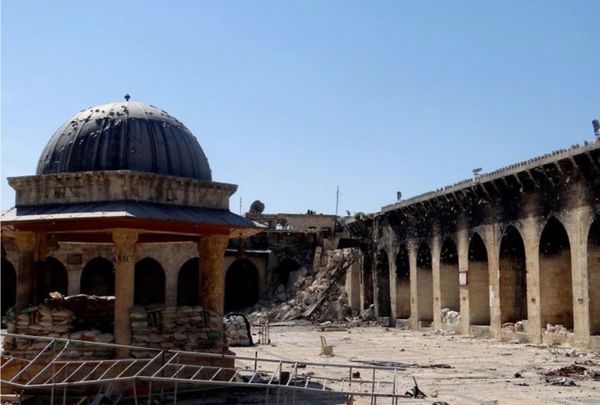
Since the fighting began in 2011, many sites have been destroyed. In fact, WCHV and other online sites reported on the minaret of one of the Syria’s most famous mosques, the Great Mosque at the heart of the ancient city of Aleppo, which was completely destroyed. In addition, the city’s souk, which was considered to be the world’s most extensive covered market, suffered major damage during the fighting.

In a news release by the UNESCO in June 2013, the officials stated:  “The danger listing is intended to mobilize all possible support for the safeguarding of these properties, which are recognized by the international community as being of outstanding universal value for humanity as a whole”.  This decision was made as part of the Committee’s work in reviewing of the state of conservation of World Heritage sites already inscribed on the World Heritage List.

Renovated third tallest Buddha statue

BuddhaThe third tallest Buddha statue in the North-Western Gansu province of China will be thrown open for public viewing, after two years of maintenance by archaeologists.

The giant statue is awaiting for final check and clearance from the cultural heritage inspectors before being open to public view.

The statue dates from the Tang Dynasty (618-907), is expected to be open to visitors in early August in the Bingling Temple Grottoes.

Restoration has taken approximately 2 years after damage over the centuries.  Repairs were made to the head, face, hands and clothes, as well as reinforcements to the base of the statue.

The Chinese government put the temple under historical protection in 1961 and have applied to UNESCO for World Heritage site status.


Suspicious Removal of Trees on a Major Road of Tehran

vali e asr

According to the news released by human rights group (HERANA), Tehran municipality has cut down a vast number of old trees that were planted 70 years ago along the longest street in the Middle East. These trees had contributed to the beauty and attraction of this long and straight way connecting the mountainous north of the Iranian capital to the central rail station in the south.

The street and its trees were a creation of Reza Shah Pahlavi and were originally named after him. The Islamic Revolution of 1978 brought a host of new names to the Iranian avenues and streets and Pahlavi Street was renamed as Vali-e-Asr.
The motivation behind this devastating action is not yet clear but a theory suggests that the innocent trees were in the sight line of numerous cameras that the anti-riot police has planted all over the city, especially in crowded and busy locations such some parts this old roadway.

Bombs Dropped on Australia’s World Heritage Site

reefUS fighter jets have dropped four unarmed bombs on the World Heritage-listed Great Barrier Reef Marine Park, the jewel in the environmental crown of America’s strongest ally in the Asia Pacific.

According to a statement released Saturday by the US 7th Fleet, cited by the Associated Press, the bombing by two AV-8B Harrier jets was part of a training exercise gone wrong. , the two jets were meant to drop the bombs on Queensland’s Townshend Island bombing range, but aborted the mission when hazards were reported in the area.

The jets, from the 31st Marine Expeditionary Unit and launched from aircraft carrier USS Bonhomme Richard, were taking part in Talisman Saber 2013, according to the US Navy’s website.

A joint investigation by the US Navy and Marine Corps had been launched.

(2013). Retrieved July 22, 2013, from http://www.globalpost.com