Professors Curatolia and Scaria: Dome Architecture and Europe
By Dr. Kaveh Farokh
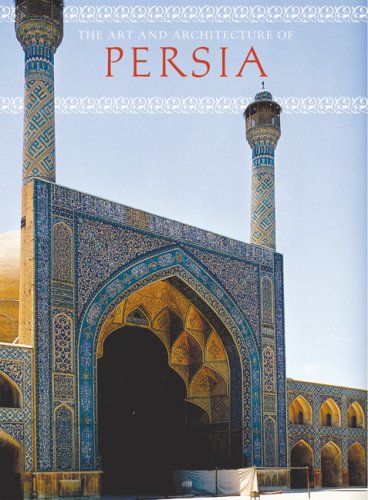
As noted by Professors Curatola and Scarcia a common theory postulates that:
“…domed spaces in Christian buildings in Europe derive from the Armenian model, which, in turn, comes from Sassanian Persia: This can be attributed to geographic proximity and also to the fact that for long periods Armenia was contained within Eranshahr. “ (Curatola & Scarcia, page 92, 2007).
Numerous examples of the earliest church architecture can be seen in Armenia and Iran today:
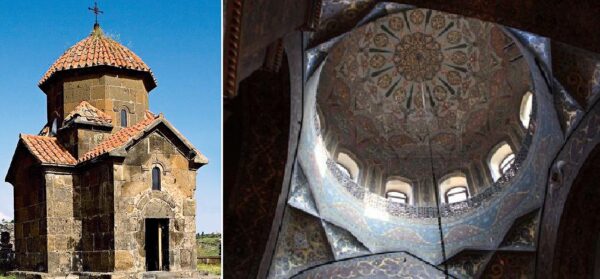
[Click to Enlarge]Armeno-Sassanian style Domed Christian churches of Armenia (1) Karmravor built in the 7th century (Source: WowArmenia.Com) (2) interior dome at the Echmiadzin Cathedral (original vaulted basilica built in 301-303 AD) (Source: 123RF.com). Iran and Armenia have enjoyed a profound thousands-year long symbiosis at the cultural, linguistic, and artistic-architectural levels – for more see Iran and Caucasia…. (Pictures used in Kaveh Farrokh’’s lectures at the University of British Columbia’s Continuing Studies Division and Stanford University’s WAIS 2006 Critical World Problems Conference Presentations on July 30-31, 2006).
Sassanian Iran was to leave a profound legacy on Romano-Byzantine architecture during its tenure in 224-651 AD.
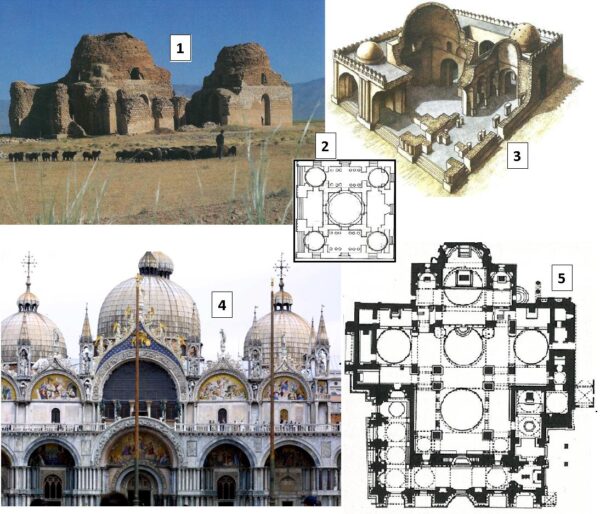
[Click to Enlarge] The Sarvistan palace built in the 300s AD [1], floor plan of Sarvistan by Nik Spatari [2] reconstruction of Sarvistan by Oscar Reuther, “Sasanian Architecture,” in Survey of Persian Art, Figure 152). [3] the Basilica di S. Marco in Veneziana built in the time period of 1100-1300 AD [4] and floor plan of the Basilica di S. Marco (Pictures used in Kaveh Farrokh’’s lectures at the University of British Columbia’s Continuing Studies Division and Stanford University’s WAIS 2006 Critical World Problems Conference Presentations on July 30-31, 2006; Picture 3 originally posted in Iran Chamber Society). Consult also Spatari, 2003, pp, 270-271, 284-289 (Calabria, L’enigma Delle Arti Asittite: Nella Calabria Ultramediterranea, Author: Nik Spatari, Publisher: Italy: MUSABA, Date: 2003, ISBN: 8887935300).
Armenia, Georgia and the Caucasus in general have undergone a profound cultural synthesis which has spanned for thousands for years. As noted by Professor Mark Whittow of Oxford University:
“The oldest outside influence in Trans-Caucasia is that of Persia (p.203)…many of its populations, including Armenians and Georgians, as well as Persians and Kurds, the Transcaucasus had much closer ties with the former Sassanian world to its south and east than with the world to the west (p.204)”. [Whittow, Mark, The Making of Byzantium: 600-1025, Berkley: University of California Press, p. 203-204].
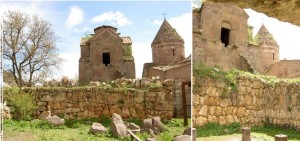
[Click to Enlarge] Pictures of a Medieval Armenian Church at Goshavank
sent to Kavehfarrokh.com by Professor George Nercessian. This was built on the remains of cyclopean walls, where a Zoroastrian fire temple (Armenian Atrushan =Iranian Atar-Roshan) originally stood. There are many similar sites in Armenia where Churches were built on top of Zoroastrian fire temples (Pictures courtesy of Professor George Narcessian). For more on the topic of Armenian-Zoroastrian fire temples consult CAIS: The Armenian Fire Temple of Ani and Payvand News of Iran: The Northernmost Zoroastrian Fire Temple in the World (in the Republic of Georgia).
Goshavank was named after the 12th century philosopher and theologian Mkhitar Gosh who is buried not far from the Church. “Vank” is Armenian for “Cathedral”, therefore Goshvank can be translated as “Cathedral of Gosh”.
For more on Iran-Caucasus links see: Iran and Caucasia…
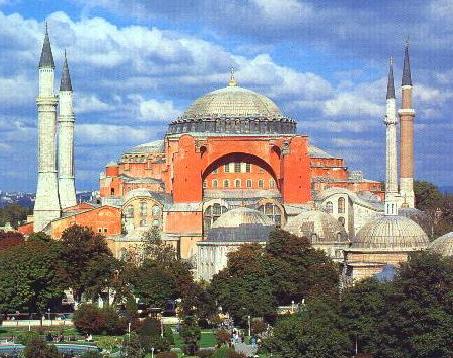
The domed architectural style was to attain its own unique style in the Romano-Byzantine Empire, as exemplified by the Holy church of Orthodox Christendom, the Haghia Sophia:
CREATOR: XV Version 3.10a Rev: 12/29/94 Quality = 75, Smoothing = 0
Haghia Sophia (Greek: Sacred Wisdom) Church in modern Istanbul (ancient Constantinople), Turkey.(Source: Turkey Vacation Places)
The site of Haghia Sophia was actually home to three different churches over the centuries. The first was the “Megale Eklesia” (Greek: Great Church) completed by the early 360s but this was completely burnt down and destroyed in the riots of 404. A second church was inaugurated by 415 however this too feel victim to fire in 532 and was destroyed. However, Emperor Justinian I (r. 527-565) ordered a new structure to be built on February 23, 532 – literally just days after the second church had been destroyed. The structure was finally inaugurated in late December 537 with further construction continuing after Justinian’s time.
Note that “Istanbul” is derived from the Greek terms “Es tan Polis” [to the city]. Turkey has done an exemplary job in preserving world heritage Classical sites such as Ephesos, Troy, Cappadocia and Haghia Sophia.
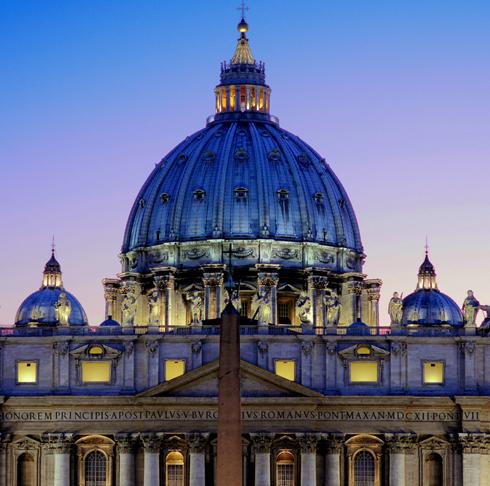
The dome of St Peter’s Basilica in Rome, Italy. This essentially bridged the architectural gap between between the Renaissance and Baroque styles (Source: Rough Guides). The original structure was built in 319-333 and then rebuilt-repaired in the mid-15th century.
For more in Iran-Europe links see: Arthurian and European Culture and Ancient Iran (Eire-An)…
Related posts:
- Lecture: Influence of Sassanian Architecture upon European and Wider Civilization
- Zoroastrian and Mithraic Sites of the Caucasus
- UBC Lecture (November 29, 2019): Civilizational Contacts between Ancient Iran and Europe
- Master Builders: Influence of Sassanid Architecture Reached far Beyond their Borders
- Italian AGON Journal article: Ties of Greco-Roman civilization with ancient Iran
- Nik Spatari: Castle of Ardashir and Rome’s Basilica di Massenzio
- Photos of the Atashgah (Zoroastrian Fire Temple) in Tbilisi, Georgia
- Tehran’s Armenian Church of Saints Teddy and Bartholomew
- The Drafsh Kaviani Emblem and its connections to the European-Gothic Cross
- Kaveh Farrokh Presentation at University of Yerevan November 2013
Kaveh Farrokh Presentation at University of Yerevan November 2013
|February 9th, 2012|Europa and Eire-An (Ancient Iran/Persia), Iran and Europe, Sassanians|