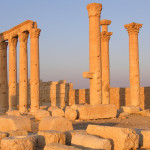
The article below has been edited by Shapour Suren-Pahlav of the CAIS website in London. As noted by Suren-Pahlav: “Large portion of this essay has been excerpted from “The Origin of Chess; Some Facts to Think About” by Ricardo Calvo, 1996.”
============================
The Origin of Chess
Chess is one of humanities popular pastimes and has been described not only as a game, but also as an art, a science and a sport. Chess is sometimes seen as an abstract war-game and a ‘mental martial art. And teaching and playing chess have been advocated as a way of enhancing mental prowess.
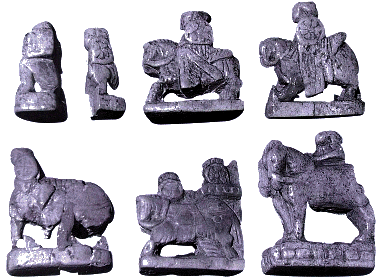
Seven piece ivory set (7th century CE) (Source: CAIS).
It is very unlikely that Chess, almost as it is played today suddenly came into existence or invented by one person. The idea of it being a combination of elements from other board-games has merit. Since almost all known board games have religious backgrounds the astrological component is entirely possible, even though one prefers the version that all elements come from other games, as the basis for the counters. Iran as the area of origin is highly possible, especially because of the two excavated debated pieces from the second century CE, which were found in the area of Iranian cultural domination.
However:
“chess is an ancient game which is first mentioned in documents dating back to the early years of the 7th century CE. and associated with North West India and Iran. Before the 7th century the existence of chess in any land is not demonstrable by a single shred of contemporary evidence” (Fiske, the Nation).
Claiming the glory
Various scholars have proposed various origins for chess: Bidev states that “chess comes from China”, while Samsin suggests that there was hybridisation of Eastern and Western games in the post Alexander kingdom of Bactria in c180-50BCE. Josten is geographically between the two of them, favoring the Kushan empire in ca. 50BCE – 200CE.
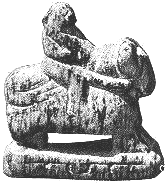
A Knight chess-piece (7th c. CE) from Afrasiab (Source: CAIS).
However, possibly the strongest – or perhaps most vociferous – arguments have come from those who consider that chess originated in the Indian subcontinent in around 600CE. This view was propagated by Murray and van der Linde in the late 19th – early 20th centuries, and has subsequently been supported by Averbak.
This brief paper examines some etymological, literary and archaeological evidence for the Iranian origin of chess – and so suggests that the question of the origin of the famous game is still unanswered.
Etymological evidence
Various names have been, and are now, used for chess-like games. Indian Chaturanga, for example, is a chess-like game, but it is played on an eight by eight board (rather than the modern chess twelve by twelve board) and it uses slightly different pieces and rules to those in the modern game. It has been suggested to be a proto-game for chess, of Indian origin.
The word chaturanga means ‘quadripartite’ or ‘army’ which reflects the four components in Vedic army platoons, which are themselves reflected in the types of pieces used in the game. Ricardo Calvo notes that the first unmistakable reference to the game of chaturanga is in the Harschascharita by the court poet Bina, writing between 625 and 640CE. The word’s early literary use and its origin in the ancient language of Sanskrit have been suggested to provide supporting evidence for the Indian origin of chess. Murray specifically suggested that the Sasanian-Pahlavi word chatrang – used for a game equivalent to the current chess – was derived from chaturanga. However, one of the most etymological evidences can be identified in the terminology of chess pieces which are Persian such as Rook.
Rook which is a Western derivative of Rukh is another term for Iranian mythical bird Sên-Murv, and Simurgh in New Persian. In ancient Iranian literature (Avestan) Sên-Murv identified as Homâ and in Arabic introduced as Rukh. The Simurgh or Rukh, was depicted as a winged gigantic creature in the shape of a bird, that could carry an elephant or a camel. The functionality of the Rook piece in game of chess and its iconography in Iranian world is quite significant. The bird which Iranian believed imparted fertility to the land and the union between the earth and the sky. In India, the piece is more popularly called haathi, meaning “elephant“.
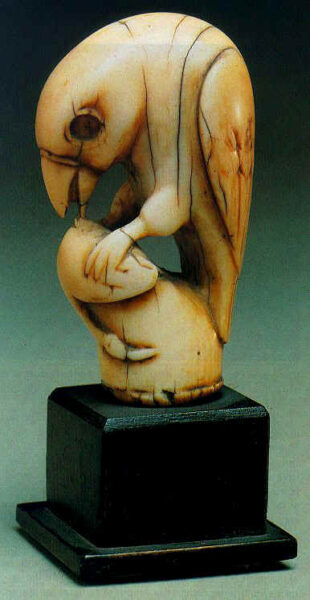
Rukh piece found in Ferghana 8th to 10th centuries CE (Source: CAIS).
Another hint is the nomenclature of the pieces, persistently related to different sorts of animals rather than to components of an army: In the “Grande Acedrex” of King Alfonso of Castile (1283) lions, crocodiles, giraffes etc. play over a board of 12×12 cases with peculiar jumping moves, and the invention of it is connected to the same remote period in India as normal chess. They are very atypical in any context referring to India (see De Gruyter in bibliography).
Other chess terminologies are also deeply rooted in Persian language, such as “checkmate” (the English rendition of shāh māt, which is Persian for “the king is frozen“) as well as “bishop” and “queen” pieces.
“Bishop” chess piece which is a western innovation, derived from the elephant, most likely in the 15th century – it is from the Persian pīl meaning “the elephant”. In Europe and the western part of the Islamic world people knew little or nothing about elephants, and the name of the chessman entered Western Europe as Latin alfinus and similar, a word with no other meaning.
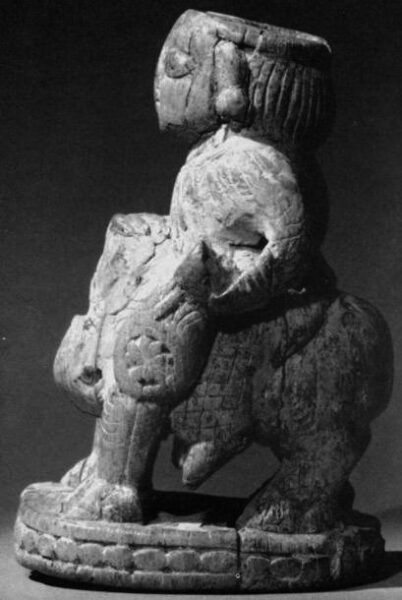
Vazir (Bishop), found in Saqqizabad, Iran 7th to 8th centuries CE (Source: CAIS).
This word “alfil” is in fact is an Arabic loanword from Persian pīl < fil , and in turn the Spanish word alfil would most certainly have been taken from Arabic. Chess was introduced into Spain by Ali ibn-Nafi the famous Persian poet, musician and singer (also known as Zaryāb or Ziryab, “gold finder”) in the 9th century – it is described in a famous Libro de los juegos the 13th century manuscript covering chess, backgammon, and dice
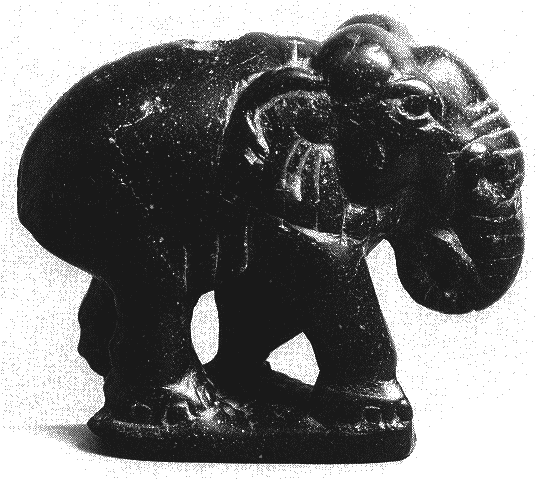
Elephant in carved dolomite-stone circa 7th century CE (Source: CAIS).
Some argue that since one of the pieces are being referred to as “elephant”, must of an Indian origin – on the other hand, elephants are not at all exclusive to India (Gowers, p.173 ff; Walbank, p. 205-6.). However, Iranians were the first nation that introduced cavalry and they had also foot-soldiers, chariots and elephants as well as river and battle-ships. In Egypt, the Ptolemaic Kings obtained elephants regularly from Somalia. Strabo (16,4,5) mentions the foundation of several cities in Africa with the main purpose of hunting elephants (Gowers, p.173 ff; Walbank, p. 205-6.). The English name “bishop” is a rename inspired by the conventional shape of the piece.
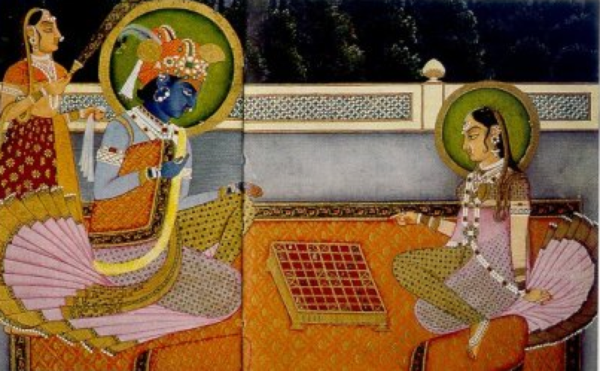
An Indian manuscript depicting Krishna and Radha playing chaturanga on an 8×8 Ashtāpada (Source: CAIS).
The chess piece known as “queen” is (Persian) farzīn also vizier. It became (Arabic) firzān, which entered western European languages as forms such as alfferza, fers, etc – then later it was replaced by “queen” – possibly brought to West by British during the British rule of India; the Indian equivalent of “queen” is rani.
Historical and Literary Evidence
Pre-Islamic written references to Chess or its development have all point out to it Iranian origin, in particular to two Persian records of about 600CE. These documents have solidly connected chess with the last period of the Sasanian rulers in Iran (224-651 CE).
The “Karnamak-ī Ardeshīr-ī Pāpakān” (the Book of Deeds of Ardeshir-e Pāpakān), a treatise about the founder of Sasanian dynasty, mentions the game of “chatrang” as one of the cultural accomplishments of the Ardeshir as a young prince. It has a proving force that a game under this name was popular in the period of redaction of the text, supposedly during the reign of Khosrow II, Parviz (r. 590-628 CE) – the work could have been composed as early as 260 CE.
The third and final Pahlavi text is known as Khūsraw ud Rēdag (Khosrow and the Page). It mentiones together with other games in chapter 15 of the (ud pad Čatrang ud new-ardaxšî r ud haštpay kardan az hamahlan fraztar hom “and in playing Chess, backgammon and the hashtpay, I am superior to my comrades” (Unvala, p. 16; Monchi-Zadeh, 1982, p. 65; Panaino, 1999, p. 51). It seems the story was taken place at the court of Khosrow I, Anūshakrūwān (Immortal Soul – r. 488–531 CE) and states that chess is one of the cultural disciplines that a noble should learn.
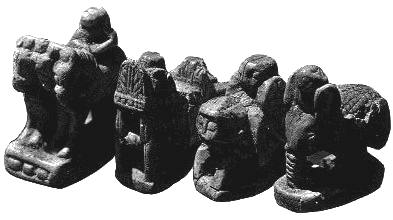
Chess pieces found at Afrasiab, ivory 7th-8th centuries CE (Source: CAIS).
Ferdowsi the greatest of Iranian epic-poets wrote also about it in the 10th century, but his sources are solid and form a continuous chain of witnesses going back to the middle of the 6th Century in Iran. He describes chess as arriving from Hind. According to Iranian historical sources this name “Hind” was not used for India until after the 11th century. Here “Hind” means Eastern-Province of Iranian Empire including modern Sistan va Baluchestan province, and while during the Achaemenid dynastic era it was extended to Khuzestan province.
As Bidev, the Russian chess historian pointed out, nobody could possibly generate the rules of chess only by studying the array position at the beginning of a game. On the other hand, such an achievement might be made by looking at Takht-ī Nard (backgammon), which is another Iranian game-invention – the use of dice also favors its Iranian origin. The world oldest pair of dice was discovered in Dahān-e Gholāmān located in in southeastern Iranian province of Sistan, which date back to the Achaemenid dynastic period or possibly even earlier (see below).
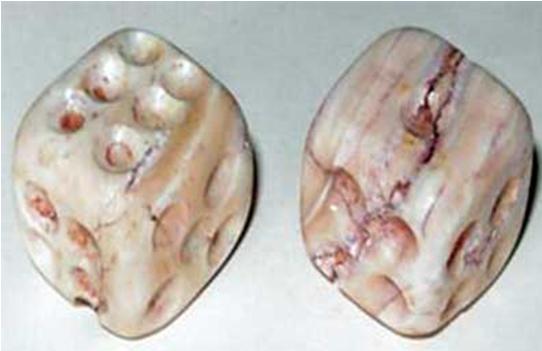
Ancient dices discovered at the Burnt-City. At present experts are (a) attempting to determine why the game was played with sixty pieces and (b) working to decode the rules of the game. Iranians call Backgammon “Takht-e Nard”. For more see here…
Archaeological Evidence
The oldest clearly recognisable chessmen have been excavated in ancient Afrasiyab (ancient Samarqand), in Iranian cultural domains contrasts with the absence of such items in India. Afrasiab was under thy Islamic rule since 712, but were essential a Persianate land and society by origin. Some other old pieces, possibly Chess pieces, are the occasionally named chess pieces of an elephant and a zebu bull kept in Tashkent. They were excavated in 1972 at Dalverzin-Tepe (see figure below following this paragraph), an ancient citadel nowadays in Southern Uzbekistan, and stem from the 2nd century. The Russian Chess history expert Linder feels that they are not Chess pieces, but belonged to a forerunner of Chess. They could mean an earlier than previously assumed existence of Chess.
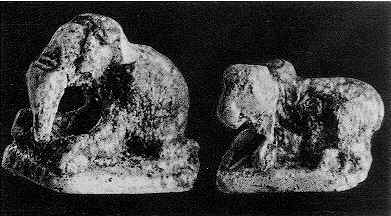
Elephant and Bull (or Knight or Vizier ?), ivory , dated as early as 2nd c., found at Dalverzin-Tepe. Their use is unknown, some scholars think they can be game pieces (Source: CAIS).
However, there are no chessmen there from early times in India, and only in the 10th century appears an indirect mention from Mas’udi: “The use of ivory
[in India] is mainly directed to the carving of chess – and nard pieces“. Some experts believe that old Indian chess pieces may be discovered one day. So far, this is mere speculation.
Next group of chess pieces (three chessmen) comes from Nishapur (see below), and another ivory set was discovered though belonging to later times, 9th or 10th century. These are not idols anymore and are carved following the abstract pattern which has been characterised as “Arabic“.
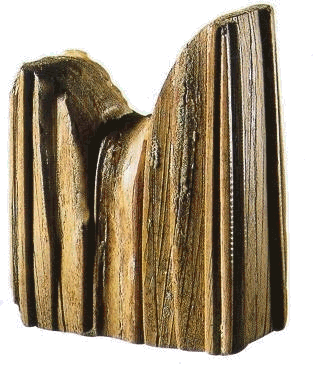
A Rukh from Nishapur, 9th century CE (Source: CAIS).
Introduction of Chess into India by Muslims
Games upon the “ashtapada” board of 8×8, with dice and with two or more players may have served as “proto-chess“, but the two types of games already differ too strongly in their nature and philosophy to make the evolution of “Chaturanga” into “Shatransh” a simple question of direct parentage via the Persian “Chatrang“.
Muslim writers stated quite frequently that they took the game of “shatranj/sh” from the Iranians, who called it “chatrang“. This happens in the middle of a political-cultural revolution, which has been analyzed in historical texts.
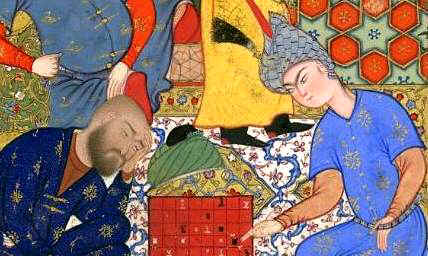
Jami’s 15th century Persian manuscript of Haft Awrang depicting two Persian chess players (Source: CAIS).
The ruling Umayyads were overthrown by a certain Abul-Abbas, who initiated a new era around the year 750 – transferring the Islamic political centre from Damascus to former Iranian territory and Baghdad, which still was under Iranian cultural influence. The Abbasid caliphs culturally and quasi ethnically of Iranian origin – so Iranian dominance became clearly the focal point in the cultural renaissance which took place inside the Arabic trunk. Large number of the previous knowledge from ancient Iran, Greece, Byzantium, Egyptian and Middle East civilizations was compiled and translated into Arabic. The new information absorbed in a scientific body which followed its further path towards the West. Chess was only a part of this knowledge, packaged together with earlier mathematical, astronomical, philosophical or medical achievements.
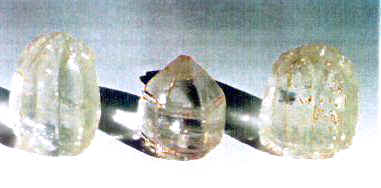
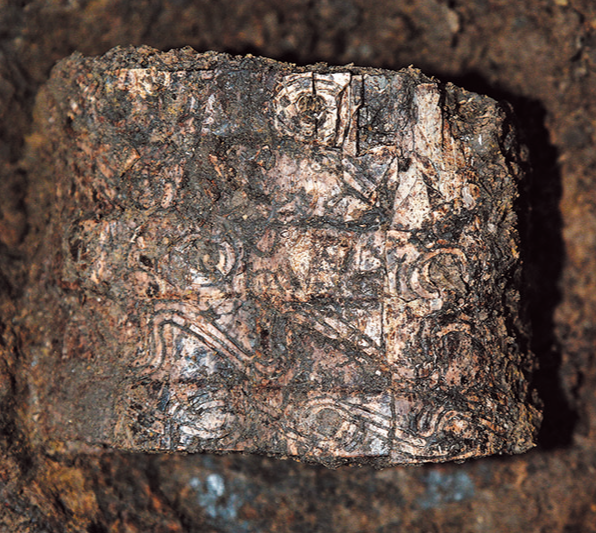
Rock crystal CE 800 (possibly chess pieces) found at Basra (Source: CAIS).
However, we know that while chess flourished in Baghdad in the 9th century, the earliest reliable account of chess-playing in India date only from the 11th century.
Bibliography
M. Unvala, The Pahlavi Text “King Husrav and his Boy,” published with its Transcription, translation and copious notes, Paris, n.d.
Ricardo Calvo; Origin of Chess (http://www.mynetcologne.de/~nc-jostenge/calvo.htm).
De Gruyter, “Hasb” in The Encyclopaedia of Islam, Leyden-New York (1967).
William Gowers, “African Elephants and Ancient Authors”, African Affairs, 47 (1948) p.173 ff.
D. W. Fiske, The Nation, 1900.
Frank W. Walbank, “Die Hellenistische Welt”, DTV 1983 p. 205-6.
Harold J.R. Murray, A History of Board-games Other Than Chess, Oxford University Press Reprints (1952).
D. Monchi-Zadeh, “Xus-rôv i Kavâtân ut Rêtak,” in Monumentum Georg Morgenstierne, vol. II. Acta Iranica 22, Leiden, 1982, pp. 47-91.
H. J. R. Murray, A History of Chess, Oxford University Press Reprints (1913).
N. Bland, On the Persian Game of Chess, JRAS 13, 1852, pp. 1-69
Henry A. Davidson, A Short History of Chess, David Mckay Co (1980)
Abu Rayhan Biruni, Ketāb tahqīq mā le’l-Hend, Alberuni’s India, 2 vols., London 1888-1910, I, pp.183-85
Panaino, A., La novella degli Scacchi e della Tavola Reale. Un’antica fonte orientale sui due gixochi da tavoliere piuà diffusi nel mondo euroasiatico tra Tardoantico e Medioevo e sulla loro simbologia militare e astrale. Testo pahlavi, traduzione e commento al Wiz-arišn î Chatrang ud nihišn î new-ardaxšî r “La spiegazione degli scacchi e la disposizione della tavola reale,” Milano, 1999.
Harry Golombek, Chess: A History, Putnam Pub Group (1976).
Ann C. Gunter, Art from Wisdom: The Invention of Chess and Backgammon, Oxford University Press (1991)
Thieme, “Chess and Backgammon (Tric-Trac) in Sanskrit Literature,” Indological Studies in Honor of W. Norman Brown, ed. E. Bender, New Haven Connecticut (1962)
Raymond D. Keene, Chess: An Illustrated History, Simon & Schuster (1990).
David H. Li, Who? Where? When? Why? How? The Genealogy of Chess (http://www.mynetcologne.de/~nc-jostenge/index.htm).
Abul Qasem Ferdowsi, The Shahnameh: (The Book of Kings): 5 (Vol 5) (Persian Text Series. New Series, No 1), Edited by Djalal Khaleghi-Motlagh, Mazda Publisher (1997).
I. M. Linder, The Art of Chess Pieces, Moscow, 1994.
Alfred L. Paul, “The Origin of Chess”, Western Chess Chronicle Vol. 1 July, 1936 No. 9 (http://www.chessdryad.com/articles/wcc/transcribed/origin.htm)
Sam Sloan, The Origin of Chess, Sloan Publishers (1985)
C.J. Brunner, “The Middle Persian Explanation of Chess and Invention of Backgammon,” The Journal of the Ancient Near Eastern Society of Columbia University, Vol. 10 (1978)
A. van der Linde, Geschichte und Literatur des Schachpiels (1874)
David Levy, Oxford Encyclopaedia of Chess Games, Oxford University Press (1981)
David Smith, Ratnakara’s “Haravijaya” (Oxford University South Asian Studies Series), OUP India (1986)
Related posts:
-
- The Sassanian Game-board of ‘Hashtpay’
-
- Discovery of 3000 year old Board Games and Compass at Kharq Island
-
- Fall 2019 Iranian Studies Initiative Lectures at the University of British Columbia
-
- The Ancient Ruler of the Burnt City
-
- Burnt City: World’s oldest “Backgammon” Game?
-
- Eva Bosch: World’s First Invention of Animation in Iran
-
- UNESCO: Recognition of Polo (Chogan) as a Sport Originating In Iran
-
- Toyoko Morita: Iranian arrivals to ancient Japan
-
- Farroukh Jorat: Iranian Elements in the Culture of the Ancient Slavs
-
- Chinese-Iranian Relations in Pre-Islamic Times
————————————————–
https://www.kavehfarrokh.com/ancient-prehistory-651-a-d/sassanians/chess-iranian-or-indian-invention/

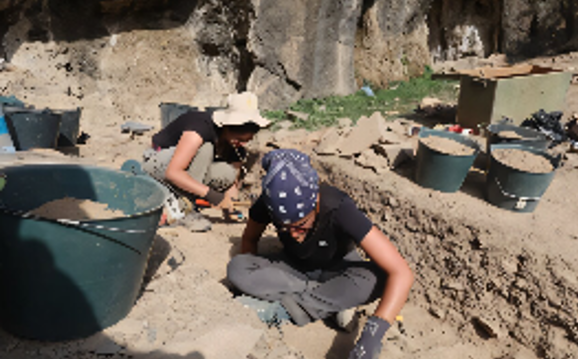 ZERAVSHAN VALLEY, TAJIKISTAN—Haaretz reports that a team of archaeologists from the National Academy of Sciences of Tajikistan and Hebrew University excavated a rock shelter in Tajikistan’s Zeravshan Valley. The researchers have found it was inhabited by perhaps three different human species from the Middle to the Upper Paleolithic, or 150,000 to 20,000 years ago. Known as the Soii Havzak rock shelter, the site is an area of Central Asia long thought to have been sparsely inhabited during the Paleolithic era, but the team discovered it holds multiple layers of human occupation rich in bones, stone tools, and charcoal. The finds are still being analyzed, but the team believes that Neanderthals, Denisovans, and modern humans may have all stopped at the rock shelter while migrating to other regions. “It turns out that the Zeravshan Valley, known primarily as a Silk Road route in the Middle Ages, was a key route for human expansion long before that,” says archaeologist Yossi Zaidner of Hebrew University. Read the original scholarly article about this research in Antiquity. For more on early humans in Central Asia, go to “Denisovans at Altitude,” one of ARCHAEOLOGY’s Top 10 Discoveries of 2019.