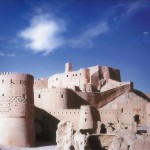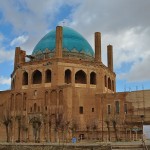
Last year a number of historical houses in the ancient city of Yazd were destructed upon the orders of the representative of Ayatollah Khamenei. The reason was to make space for new religious gathering sites. The protests of friends of historical sites got nowhere and the Cultural Heritage Organization (CHO) whose mission is to preserve historical sites kept silent. Now, we have received new news that yet another historical site that was situated behind Molla Esmail Mosque is has been destroyed. This time CHO has risen its voice but to explain why this has happened. It has announced that “It was suppose to build an office for the Leader’s Representative behind this mosque but they have destroyed a historic house by mistake. We have sent a letter to the Friday Imam so that they rebuild the house as it was before!”
Wolfram Kleiss An overview of Sassanian Fortifications
By Dr. Kaveh Farrokh
The article below “Fortifications” by Wolfram Kleiss in the Encyclopedia Iranica was originally published on December 15, 1999 and last Updated on January 31, 2012. Kleiss provides an overview of the fortified passages and defenses of the Sassanians, some of which can be traced back to the Achaemenid era.
This article is available in the print volumes of the Encyclopedia Iranica (Vol. X, Fasc. 1, pp. 102-106).
Kindly note that the article below contains pictures and captions that do not appear in the Encyclopedia Iranica version.
==============================
The present article deals with the fortified passages and defenses that are implied under the term bārū. Certain passes in Persia still feature barriers going back to the Achaemenid period. An example is the stone wall at the Kotal-e Sangar in Fārs, which bars the way from Persepolis and Bīšāpūr to Ḵūzestān on the saddle (not a real pass) between the Mamassanī plain (plain of Deh-e Now) and the Fahlīān plain, and which is identical with the medieval and modern caravan route (today’s modern highway between Shiraz and Ahvāz). The rubble wall that by now has almost entirely disappeared was originally 1,230 m long and extended between both sides of the saddle’s rugged, steeply rising rock faces. The construction has been associated with a wall mentioned by Arrian (Anabasis 3.17), which the Uxians are said to have erected as a customs-barrier on the road between Ḵūzestān and Fārs, and around which Alexander had made a great détour on his expedition from Susa to Persepolis before taking it by surprise (Stein, pp. 39-44; Kleiss, p. 213, fig. 1).
Another wall (Kleiss, p. 214, Fig. 2) was built on top of the pass 36 km east of Farrāšband and 28 km west of the modern city of Fīrūzābād in the province of Fārs. It overlooks the road between the Sasanian settlements around Farrāšband and the Sasanian round city of Gōr (q.v.) with the bridge over the river west of Fīrūzābād, and is, at the same time, a barrier similar to the one in the Qalʿa-ye Doḵtar area north of Gōr (present-day Fīrūzābād, q.v.), a fortification at the northern access to the plain of Fīrūzābād (Huff). The barrier on the pass extends over a length of about 200 m in a fairly straight line from northwest to southeast in the shape of a ruined rubble wall that was once of considerable height. On the eastern side of the wall lies a heap of stones, the remains of a small halting-place or a tower, the exact measures of which are unknown. The dating of the barrier is unclear; perhaps it was built in the Sasanian period and continued being used in the Islamic period.

Cultural Heritage Cleansing in Iraq and Syria
In an article published online on CNN.com last month, Irina Bokova, the Director General of UNESCO talks about the destruction of cultural heritage by ISIS and related security issues.
Bokova writes: “The pillage of the Mosul museum by the so-called Islamic State of Iraq and Syria displayed a violence rarely seen since the destruction of the Buddhas of Bamyian. The bulldozing of the archaeological site of Nimrud marked a new step in the cultural cleansing underway in Iraq. These acts are a deliberate attack against civilians, minorities, heritage sites and traditions. In the minds of terrorists, murder and destruction of culture are inherently linked.”
Bokova points out that the true nature of this conflict is a war against people. By destroying culture and cultural heritage sites these terrorist groups are attempting to crush free thinking and to ensure oppression through domination. The Islamist terrorists forbid girls to go to school, kill journalists and vandalize and destroy museums. They destroy all symbols that embody freedom of thought and respect for cultural diversity.
In her excellent article, Bokova writes that when culture is under attack, we must respond with more knowledge, and with ever greater effort to work to explain the importance of humanity’s shared heritage. Bokova also asks all young people, especially in Iraq and elsewhere to claim their national heritage as their own
Articles such as Bokova’s article importantly point out that terrorists are using destruction of national heritage as a way to destabilize populations, spread terror, and encourage violence and threaten the security of the country and the region.
To read this article go to: http://edition.cnn.com/2015/03/07/opinions/bokova-isis-artifacts-destruction/
ISIS Rampages Across Nineveh, Destroying Christian Churches
The Middle East Media Research Institute (MEMRI) produced a photo gallery of the Islamic State’s church vandalism, reprinted by the UK’s Daily Mail. The photos show “ISIS terrorists toppling crosses, smashing Christian relics with hammers, and erecting the black flag of ISIS on churches in Iraq.” Collecting the images wasn’t difficult — ISIS has been triumphantly posting them on its website.
As the Daily Mail explains, ISIS believes “ancient relics promote idolatry that violates their fundamentalist interpretation of Islamic law.” This has the useful (for them) side effect of allowing them to obliterate cultural resistance through genocide and vandalism. The Vatican’s representative at the U.N., Archbishop Silvano Tomasi, accused the Islamic State of perpetrating genocide just yesterday, as part of a rare Vatican endorsement of military force.
Destruction of thousands of books and manuscripts in Mosul libraries
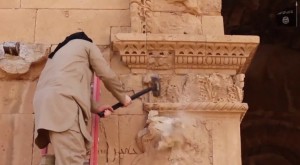
According to recent reports Mosul’s central library has been ransacked by ISIS and 100,000 books and manuscripts have been burnt. The extremists group has released a video purportedly showing its fighters using sledgehammers to smash ancient artifacts in Iraq’s northern city of Mosul.
The five-minute video shows a group of bearded men in a museum using hammers and drills to destroy several large statutes, including one depicting a winged-bull Assyrian protective deity that dates back to 9th century BC.
ISIS, Islamic State has destroyed a number of shrines, including Muslim holy sites as well as Christian places of worship and history including biblical manuscripts.
UNESCO announces the winning center design in Afghanistan
As reported by a number of news outlets, a proposal to carve a cultural centre out of the landscape has won the UNESCO design contest for a Bamiyan Valley site where two seventh-century statues of Buddha were destroyed by Taliban militants. Out of many applicants and design presentations, UNESCO picked and has now named an Argentina-based team led by architect Carlos Nahuel Recabarren as the winner of the competition. UNESCO had asked entrants to design a building for the edge of a valley in the central highlands of Afghanistan – a key Buddhist site on the ancient Silk Road trading route.
The winning proposal which is named “Descriptive Memory” presents the concept of “The Eternal Presence of Absence” and aims to envision a public park that extends out to meet the rooftops of a sunken building complex. These structures will surround a public plaza with a reflective pool on one side. The winning team has stated their design thinking in a statement that reads; “Our proposal tries to create not an object-building but rather a meeting place; a system of negative spaces where the impressive landscape of the Buddha Cliffs intertwine with the rich cultural activity that the centre will foster”.
It has been reported that the foothills of the cliffs along the valley feature several caves dating from between the third and fifth century, which were used as Buddhist monasteries, chapels and sanctuaries. The cliffs themselves once housed two giant seventh-century carvings of Buddha, standing at 55 meters and 35 meters high, but these were destroyed by Taliban forces in 2001.
Following an intervention to prevent an unauthorized team of German archaeologists from reconstructing the statues, UNESCO teamed up with the Afghan government’s Ministry of Information and Culture to launch a competition for a new building on the site at the end of 2014. Then, the winning design was anonymously selected from 1,070 proposals by a jury of seven experts, including Architecture for Humanity co-founder Cameron Sinclair and the Cooper Union’s acting dean Elizabeth O’Donnell. The jury praised the concept for its well-conceived plan, sensitive site strategy, and choice of brick as building material, elegant curving passageways, and appropriate consideration of scale. The financial support has been contributed by the Republic of Korea and the project will immediately move towards construction on a budget of $2.5 million. In addition to the activities surrounding the building of this site, the Afghan government plans to launch a national program to support cultural diversity, which will include a nationwide archaeological survey and targeted activities to safeguard minority rights across the country.
Destruction of Cultural Heritage and Book Burning by Extremists
On Tuesday last week, UNESCO voiced concerns over reports of mass book-burning in Iraq, saying that it is the most “devastating” of such actions in history if confirmed.
Recent reports from Iraq show that books on philosophy, law, science and poetry have been torched by the armed extremists who are targeting cultural heritage. UNESCO Director-General Irina Bokova said that it was part of a campaign of “cultural cleansing”, adding that “Such destruction is a cruel reminder that the nations of the world must remain united to combat such fanaticism today,” Bokova added.
Islamist State extremists currently hold the city of Mosul, the second-largest city in Iraq and have been destroying cultural and national heritage sites in both Iraq and Syria.
Mystery mummies uncovered in Russia
As reported in several news outlet as well as the Siberian Times, a team of archeologists have uncovered mummies which are believed to have connections to ancient Persia. Archaeologists have resumed excavations at Zeleniy Yar, a remote site near the Arctic Circle known to the indigenous Nenets people as “the end of the earth”. In a previous excavation, the team had found a dozen mysterious mummies who appear to have been foreign to the region, and whose artifacts can be traced back to ancient Persia, nearly 6,000 kilometres (3,700 miles) away. For now, scientists are undertaking genetic testing to determine the actual origins of the mummies.
About a decade ago another team of Russian archaeologists discovered 34 shallow graves and mummified corpses in what appears to be a necropolis dating back 800 years. However, excavations stopped after the local people expressed concerns that the work was disturbing the souls of their ancestors, a plea which has been ignored by the current team of researchers, headed by Alexander Pilipenko, research fellow of Institute of Cytology and Genetics, part of the Siberian Branch of the Russian Academy of Sciences.
The finding was extremely rare as the team explains that the mummies were found in a well-preserved state, seemingly by accident, and wearing copper masks. Seven male adults, three male infants, and one female child were discovered, buried among jewelry and other artifacts. Their skulls are shattered or missing, while the skeletons were smashed. Five mummies are covered in copper, as well as reindeer, beaver, wolverine, or bear fur. One of the mummies is a red-haired male, protected from chest to foot by copper plating. In his resting place, were an iron hatchet, furs, and a head buckle made of bronze depicting a bear.
Researchers believe that the mummification of the bodies was not intentional but was caused by a combination of the copper, which prevented oxidation of the remains, and a drastic change in temperatures in the centuries after the group was buried. The scientists also believe that the condition and orientation of the remains reflect some type of religious ritual. However, such burial rituals are unknown to experts and not typical of others in the region, which suggests that the mummies belong to a foreign race of people. Indeed, the artifacts suggest this possibility. Some of the items found at the site, including bronze bowls, originated in Persia and dating from the 10th or 11th centuries. The discovery adds to the evidence that Siberia was not an isolated wasteland but a crossroads of international trade and cultural diversity.
New tomb found in Egypt
A team of Czech archeologists have discovered the tomb of Queen Khentakawess III’s tomb in Egypt.
Archaeologists unearthed the tomb of a previously unknown queen. The tomb was found in Abu-Sir, south-west of Cairo, and is thought to belong to the wife or mother of Pharaoh Neferefre who ruled 4,500 years ago. Egyptian Antiquities Minister Mamdouh el-Damaty said that her name, Khentakawess III, had been found inscribed on a wall in the necropolis as reported by BBC. The tomb was discovered in Pharaoh Neferefre’s funeral complex. Abu-Sir was used as an Old Kingdom cemetery for the ancient Egyptian capital of Memphis.
The archeologists and experts at the Egyptian Antiquities Ministry believe that the discovery could shed light on certain unknown aspects of the Fifth Dynasty, which along with the Fourth Dynasty, witnessed the construction of the first pyramids.
7,000-year-old skeleton found in Iran
A team of archeologists have found A human skeleton in Tehran suggesting that life in the city dates back to the 5th millennium B.C. Archaeologists found the 7,000-year-old skeleton in an excavation in Molavi Street in the south of Tehran and they believe that the human bones belong to 5,000 year B.C.
Previously, the oldest archaeological findings ever found in Tehran belonged to city’s Qeytarieh hills, which dated back to the first millennium B.C. Many other historic items, most of them belonging to the previous centuries, have also been excavated in the site, which is located around Tehran’s Grand Bazaar according to several news agencies in Iran.
The excavated skeleton will be on display in Iran’s national museum after some scientific tests are completed.