As reported earlier this week by the Guardian newspaper, Greek and Roman antiquities and prehistoric artwork are under threat from Islamic State extremists in Libya. The leading world museums experts and the UN have warned that the Islamists terrorist ISIS, have made major inroads across Libya which is split between rival governments and plagued by weapons smuggling and people smuggling. These terrorists have also destroyed temples and ancient sites in Iraq and Syria, and experts believe they are also selling plundered antiquities on the illegal market as reported in the past.
The International Council of Museums has already released a list of cultural treasures in peril and appealed to Interpol, customs officers and art traders to watch out for looted Libyan goods. Among the threatened artwork are sculptures and mausoleum carvings in Cyrene, a one-time Greek colony, the Roman-era trading centre of Sabratha, and a desert region that is home to stone paintings or carvings dating back 12,000 years. It has been extremely difficult to keep track of Libya’s treasures because it has become so dangerous there since the 2011 fall of the late dictator Muammar Gaddafi. The UNESCO’s red list of threatened sites also includes sculptures, mausoleum busts and medieval artefacts, including coins decorated with a flower that is now extinct. The head of UNESCO, says the destruction and looting of archaeological sites in the Middle East should be considered a war crime.
It is also believed that these terrorists finance themselves (in addition to other means) by selling artifacts directly and by taxing criminal gangs that dig up archaeological sites in its territory.
Record Rise In Museum Prices
In the last few months,Turkish officials have enacted sweeping hikes in the price of admission to museums and ancient sites despite a drop in the number of visitors this year as reported by the Hurriyet Dailey News. This has naturally made some tourism operators worried that the rise will further detract visitors.
The entrance price for Ephesus, Topkapı Palace and Hagia Sophia have all increased from 30 to 40 Turkish Liras. One of the five most visited cities in world, Antalya, saw a decline in tourist numbers for the first time this year.
For 2016, ticket prices have been increased for most ancient sites and museums operated by the Turkish Travel Agencies’ Union (TÜRSAB). The rise at Olympos has hit 400 percent, with the five-lira price skyrocketing to 20 liras. Many experts believe that the rises are inexplicable at a time when the tourism sector in Turkey needs a boost. The new ticket prices will go into effect on Jan. 4, 2016.
Night of Union Ceremony For Rumi In Konya
Thirteenth-century mystic Mevlana Jalaladdin Rumi was celebrated on the 742nd anniversary of his death in the Central Anatolian province of Konya earlier this month (December, 2015).
Jalāl ad-Dīn Muhammad Rūmī, also known as Jalāl ad-Dīn Muhammad Balkhī, Mawlānā/Mevlânâ, Mevlevî/Mawlawī, and more popularly simply as Rumi, was a 13th-century Persian poet, theologian, and Sufi mystic.
Newest Photos from Lake Urmia
Lake Urmia, once ranked as the sixth largest saltwater lake in the world, and the largest in the Middle East in 2003, is now almost 88% dried up. Due to poor water management, aggressive agricultural policies, and careless construction of dams and bridges and the total negligence of the Environment Organization of Iran.
Destruction of Sasanid Remains
A large collection of historical heritage of Iran is on the verge of annihilation by a newly-built dam. Iranian news agencies have reported that the flooding of the “Langir Dam” in Ilam, a Kurdish city of Iran, has began. The resulting lake would drown many invaluable Sasanid remains such as a summer palace, some tribal structures, three large sites, tile-making kilns, etc.
The authorities in Cultural Heritage Organization say that the flooding has begun without their permission but some cultural activists do not believe that such a major work by the contractors could be implemented without government authorities’ consent.
Vandalized Stone relief
According to a cultural activist in Hamedan, Iran, certain parts of a bas-relief belonging to the period of the Parthian Dynasty in ancient Iran (247 BC – 224 AD) has been chipped and fragmented by unknown people.
The scene on the bas-relief depicts a man, leaning on a cushion, holding a goblet. He is wearing Mithraism hat, belt and outfit.
It seems that unknown people have unsuccessfully tried to clear around the bas-relief with explosive material.
This ancient work was registered as a national heritage in 2014. No relevant authority has shown any reaction to this unfortunate incident.
The notable fact is that the villagers living around this site had seen this bas-relief for centuries without attempting to destroy or disfigure it, but only one year after its registration as a national artifact those who are either known as “unauthorized excavator,” or the smuggler of antiques, appear on the site with explosives and no one seems to care!
Discovery of a 2,400 year old Ancient Shrine in Cairo
A team of Egyptian and German archaeologists discovered the remains of a limestone colonnade and a well-preserved ceiling in Cairo’s modern district of Mataria. The 2,400-year-old building is thought to have been a shrine that was surrounded by a mud brick wall and located in the ancient capital city of Heliopolis, or Iunu. “The shrine belonged to the 30th Dynasty Pharaoh Nectanebo I (379 B.C. – 360 B.C.),” Antiquities Minister Mamdouh el-Damaty announced in a press conference reported in The Cairo Post. Nectanebo I founded the 30th Dynasty, which was the last Egyptian royal family to rule Egypt before it was conquered by Alexander the Great in 332 B.C.
Suspect in destruction of Timbuktu mausoleums sent to ICC
As reported by the Associated Press (AP), the main suspect in the destruction of Mali’s historic city of Timbuktu has been arrested and been sent to the International Criminal Court (ICC). This is the first time that a suspect is being tried and sent to ICC for war crime, for deliberately destroying religious or historical monuments and a World Heritage Site.
Mali’s government asked the court in 2012 to investigate crimes committed on its territory, and the prosecutors opened an investigation in 2013. However, this individual is the first suspect detained but the government of Mali believes that he is not the only person responsible for the destructions of the Heritage sites. The officials have announced that they believe that this is the start of a trial against the people who destroyed the Timbuktu mausoleums, and they expect other individuals will be tried too.
The suspect is charged in the destruction of 10 historic buildings, including mausoleums and a mosque in Timbuktu. Niger sent him to the court based on an arrest warrant issued a week ago and he was transferred to The Hague early Saturday. No date was immediately set for his arraignment.
The entire city of Timbuktu is listed as a World Heritage Site by UNESCO. At the peak of its influence in the 15th and 16th centuries, Timbuktu counted 180 schools and universities that received thousands of students from all over the Muslim world.
Islamic extremists who overran Timbuktu in 2012 destroyed 14 of the city’s 16 mausoleums, one-room structures that house the tombs of the city’s great thinkers. The extremists condemned the buildings as totems of idolatry. The 14 mausoleums have since been restored by the United Nations.
The militants were driven out after nearly a year by a French military intervention.
“Today’s arrest signals that there will be a price to pay for destroying the world’s treasures,” said Corrine Dufka of Human Rights Watch’s Africa division, as stated in the AP article.
Satellite Confirms Palmyra’s Temple of Bel has Been Destroyed
A week after reports of destruction by Islamic State militants in the ancient city of Palmyra in Syria, the most recent reports verify that ISIS militants has destroyed temple of Bel.
The Syrian Observatory for Human Rights, an activist and monitoring group based in Britain said Sunday that ISIS militants has destroyed the nearly 2,000-year-old temple. The Temple Bel was an ancient stone ruin located in Palmyra. The temple was dedicated to the Semitic god Bel, worshipped at Palmyra in triad with the lunar god Aglibol and the sun god Yarhibol, and it formed the center of religious life in Palmyra and was dedicated in 32 CE.
Earlier today as reported by BBC and a number of other sites, the satellite images confirm that a temple in the ancient Syrian city of Palmyra has been destroyed, the United Nations says.
Baal Shamin Temple in Palmyra Destroyed by Isis

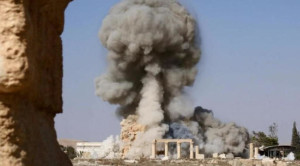
The Islamic State group on Tuesday August 25 2015 published images showing the destruction of the Baal Shamin temple in Syria’s Palmyra, after international condemnation of the act.
The series of images showed militants placing barrels and small containers, presumably containing explosives, into the temple, as well as similar containers placed on parts of its columns.
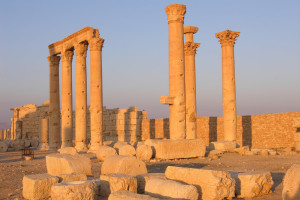
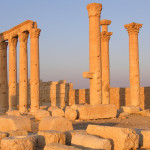
The Temple of Baalshamin was an ancient temple in the city of Palmyra, Syria, dedicated to the Canaanite deity Baalshamin. The temple’s earliest phase dates to the late 2nd century BC. It was rebuilt in 131 AD, while the altar before the temple is dated to 115 AD. With the advent of Christianity in the 5th century AD, the temple was converted to a church. Uncovered by Swiss archaeologists in 1954–56, the temple was one of the most complete ancient structures in Palmyra.
In 1980, the structure was designated by UNESCO as a World Heritage Site. As UNESCO puts it, “the art and architecture of Palmyra, standing at the crossroads of several civilizations, married Graeco-Roman techniques with local traditions and Persian influences.”
The head of the UN’s cultural watchdog, Irina Bokova, called the act a “new war crime and an immense loss for the Syrian people and for humanity.”
Palmyra ancient ruins are a UNESCO World Heritage site and IS’s capture of the town on May 21 raised concerns the group would lay waste to it as it has done with heritage sites under its control elsewhere.