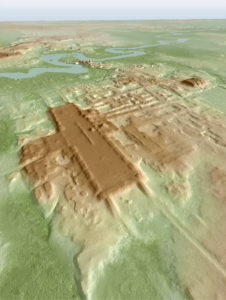
 From the ground, it’s impossible to tell that the plateau underfoot is something extraordinary. But from the sky, with laser eyes, and beneath the surface, with radiocarbon dating, it’s clear that it is the largest and oldest Mayan monument ever discovered.
Located in Tabasco, Mexico, near the northwestern border of Guatemala, the newly
discovered site of Aguada Fénix lurked beneath the surface, hidden by its size and low
profile until 2017. The monument measures nearly 4,600 feet long, ranges from 30 to 50 feet high and includes nine wide causeways. The monument was discovered by an international team led by University of Arizona professors in the School of Anthropology Takeshi Inomata and Daniela Triadan, with support from the university’s Agnese Nelms Haury program and under the authorization of the National Institute of Anthropology and History of Mexico.
They used lidar — or light detection and ranging — technology, which uses laser-emitting
equipment from an airplane. Laser beams penetrate the tree canopy, and their reflections off the ground’s surface reveal the three-dimensional forms of archaeological features. The team then excavated the site and radiocarbon-dated 69 samples of charcoal to determine that it was constructed sometime between 1,000 to 800 B.C. Until now, the Maya site of Ceibal, built in 950 B.C., was the oldest confirmed ceremonial center. This oldest monumental building at Aguada Fénix turned out to be the largest known in the entire Maya history, far exceeding pyramids and palaces of later periods.
The team’s findings are published today in the journal Nature.
“Using low-resolution lidar collected by the Mexican government, we noticed this huge
platform. Then we did high-resolution lidar and confirmed the presence of a big building,” Inomata said. “This area is developed — it’s not the jungle; people live there —
but this site was not known because it is so flat and huge. It just looks like a natural
landscape. But with lidar, it pops up as a very well-planned shape.”
The discovery marks a time of major change in Mesoamerica and has several
implications, Inomata said.
First, archaeologists traditionally thought Maya civilization developed gradually. Until
now, it was thought that small Maya villages began to appear between 1000 and 350
B.C., what’s known as the Middle Preclassic period, along with the use of pottery and
some maize cultivation.
Second, the site looks similar to the older Olmec civilization center of San Lorenzo to the west in the Mexican state of Veracruz, but the lack of stone sculptures related to rulers and elites, such as colossal heads and thrones, suggests less social inequality than San Lorenzo and highlights the importance of communal work in the earliest days of the Maya.
“There has always been debate over whether Olmec civilization led to the development of the Maya civilization or if the Maya developed independently,” Inomata said. “So, our
study focuses on a key area between the two.”
The period in which Aguada Fénix was constructed marked a gap in power — after the
decline of San Lorenzo and before the rise of another Olmec center, La Venta. During
this time, there was an exchange of new ideas, such as construction and architectural
styles, among various regions of southern Mesoamerica. The extensive plateau and the
large causeways suggest the monument was built for use by many people, Inomata said.
“During later periods, there were powerful rulers and administrative systems in which the people were ordered to do the work. But this site is much earlier, and we don’t see the evidence of the presence of powerful elites. We think that it’s more the result of
communal work,” he said.
The fact that monumental buildings existed earlier than thought and when Maya society
had less social inequality makes archaeologists rethink the construction process.
“It’s not just hierarchical social organization with the elite that makes monuments like this possible,” Inomata said. “This kind of understanding gives us important implications
about human capability, and the potential of human groups. You may not necessarily
need a well-organized government to carry out these kinds of huge projects. People can work together to achieve amazing results.”
Inomata and his team will continue to work at Aguada Fénix and do a broader lidar
analysis of the area. They want to gather information about surrounding sites to
understand how they interacted with the Olmec and the Maya.
They also wants to focus on the residential areas around Aguada Fénix.
“We have substantial information about ceremonial construction,” Inomata said, “but we
want to see how people lived during this period and what kind of changes in lifestyle
were happening around this time.”
Source: University of Arizona
Archives
Study explores how Native Americans used sea otters
 University of Oregon scientists are probing archaeological evidence for how indigenous peoples used sea otters, and their findings could help Alaskans confront growing numbers of the mammals and Oregonians who want to reintroduce them on the coast.
Before fur traders decimated sea otter populations from Alaska to Oregon, ancestors of at least one Alaskan indigenous population, the Tlingit, hunted the mammals for their pelts but probably not for food, according to a study by anthropologist Madonna Moss.
Her research, published in April in American Antiquity, took on questions about
traditional use by native populations amid calls to expand harvesting. Since their
reintroduction in the 1960s, the population of sea otters has spiraled.
Only Alaska Natives living along the coast are permitted under federal law to hunt sea
otters for subsistence and with little waste. They use the pelts for clothing, bedding, hats
and other regalia.
Some environmentalists have challenged the right of Alaska Natives to hunt sea otters
without eating their meat. Conservationists want to show that native populations regularly did so as part of their case for allowing larger-scale harvesting for consumption.
The idea comes amid rising tensions. Sea otters have altered ecosystems, making it more difficult for commercial fisherman to catch abalone, clams, Dungeness crabs, red sea urchins and other invertebrates the otters consume. From 1996 to 2005, the industry was reported to have experienced an economic loss of $11.2 million.
The research by Moss, however, speaks only for Tlingit ancestors.
Numerous indigenous populations from Alaska to California hunted sea otters for
thousands of years, Moss said. As sea otters recolonize their historic range through
population growth or additional reintroduction, such as along the Oregon coast where the mammals are rarely seen, she said, finding out whether other native populations ate sea otter meat is worthy of attention.?
Read more: https://phys.org/news/2020-06-explores-native-americans-sea-
otters.html
Lady in the Well
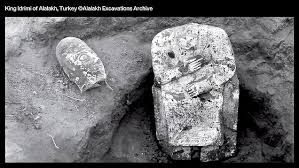 Recording dailysabah.com The bones of a woman of Central Asian descent found at the bottom of a deep well after a violent death in an ancient city in Turkey are helping
scientists understand population movements during a crucial juncture in human history.
Researchers have dubbed her the “lady in the well” and her bones were among 110
skeletal remains of people who lived in a region of blossoming civilization running from
Turkey through Iran between 7,500 and 3,000 years ago. The study provided the most
comprehensive look to date of genetics revealing the movement and interactions of
human populations in this area after the advent of agriculture and into the rise of city-
states, two landmarks in human history.
The remains of the “lady in the well,” found in the ruins of the ancient city of Alalakh in
southern Turkey, illustrated how people and ideas circulated through the region.
The international team of researchers showed populations from Anatolia and the
Caucasus started genetically mixing around 6,500 B.C. and that small migration events
from Mesopotamia 4,000 years ago brought more genetic mixture to the region. DNA
from the lone ancient woman revealed proof of long-distance migration during the late
Bronze age about 4,000 years ago from Central Asia to the Mediterranean Coast.
Her DNA showed she hailed from somewhere in Central Asia – perhaps 2,000 miles
(3,200 km) or more away. She died at about 40 to 45 years of age, the researchers said,
probably between 1625 B.C. and 1511 B.C. Her body bore signs of multiple injuries.
“How and why a woman from Central Asia – or both of her parents – came to Alalakh is
unclear,” said Ludwig Maximilian University Munich archaeologist Philipp
Stockhammer, co-director of the Max Planck-Harvard Research Center for the
Archaeoscience of the Ancient Mediterranean and co-author of the study published in the journal Cell. “Trader? Slaves? Marriage? What we can say is that genetically this woman is absolutely foreign, so that she is not the result of an intercultural marriage,” Stockhammer added. “Therefore, a single woman or a small family came this long distance. The woman is killed. Why? Rape? Hate against foreigners? Robbery? And then her body was disposed in the well.”
World Environment Day
 Time for nature
The foods we eat, the air we breathe, the water we drink and the climate that makes our planet habitable all come from nature. For instance, each year, marine plants produce more than a half of our atmosphere’s oxygen, and a mature tree cleans our air, absorbing 22 kilos of carbon dioxide, releasing oxygen in exchange. Despite all the benefits that our nature give us, we still mistreat it.That is why we need to work on that. That is why we need this Observance.
World Environment Day is the most renowned day for environmental action. Since 1974, it has been celebrated every year on 5 June: engaging governments, businesses,
celebrities and citizens to focus their efforts on a pressing environmental issue.
In 2020, the theme is biodiversity – a concern that is both urgent and existential. Recent
events, from bushfires in Brazil, the United States, and Australia to locust infestations
across East Africa – and now, a global disease pandemic – demonstrate the
interdependence of humans and the webs of life, in which they exist.
But, do we really know its importance ? Maybe our biodiversity trivial will help.
Background
World Environment Day was established by the United Nations General Assembly in
1972 to mark the opening of the Stockholm Conference on the Human Environment.
Another resolution, adopted by the General Assembly the same day, led to the creation
of UNEP. It is hosted every year by a different city and commemorated with an international exposition through the week of June 5.
World Environment Day is celebrated in many ways in countries such as Kenya, New
Zealand, Poland, Spain and the United States. Activities include street rallies and
parades, as well as concerts, tree planting, and clean-up campaigns. In many countries,
this annual event is used to enhance political attention and action towards improving
the environment. This observance also provides an opportunity to sign or ratify
international environmental conventions
The Sassanian Game-board of ‘Hashtpay’
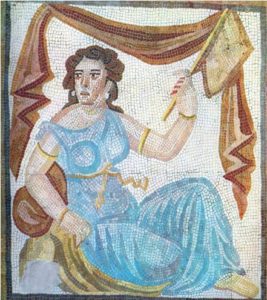
The Sassanian Game-board of ‘Hashtpay’
By: Dr. Kaveh Farrokh
he article below is written by Antonio Panaino and originally posted in the CAIS website hosted by Shapour Suren-Pahlav in London, England. Readers are also encouraged to consult/click the link “The Sassanian Era” (or click image below …)
========
Name of a game from the Sassanian era which has not been precisely identified. The haštpay [hštp’y] “eight feet” (more likely than aštapad) is mentioned together with other games in chapter 15 of the Xusraw ud Redag (ud pad Chatrang ud new-ardaxšî r ud haštpay kardan az hamahlan fraztar hom “and in playing chess, backgammon and the haštpay I am superior to my comrades” (Unvala, p. 16; Monchi-Zadeh, 1982, p. 65; Panaino, 1999, p. 51). Its name, as in the case of chess (Pahl. Ch < Skt. caturanµga-), is an Indian borrowing; it derives from Sanskrit astapada- (cf. pali atthapada), originally referring to a game-board of 8 x 8 little squares. Such a board was used for various games (Murray, 1913, pp. 35-40; 1952, pp. 129-36), one of them played, according to the Balabharata (II, 5, pp. 10-13), with red and white pieces and a pair of dice. In many other sources the astapada- was doubtless the chessboard and its name strictly associated with this game (MacDonell, p. 122; Jacobi, p. 228; Thomas, 1898, pp. 272; 1899, pp. 365; Thieme, 1984, p. 208).
 A conjectural drawing by Ashkan H. (اشکان.ح) of a possible configuration of the Hashtpay game-board (Source: Public Domain).
From the Xusraw ud Redag it is clear that the Sassanian haštpay was distinguished from other popular games like chess and the variety of backgammon represented by new-ardaxšî r. The haštpay could perhaps be associated, according to Semenov (pp. 16-20, 131; but see Panaino, 1999, pp. 153-56, 189), with a game-board (with three lines of eight squares) recently discovered in Paikend and with another one represented on a later Sassanian silver cup with a different but apparently comparable form.
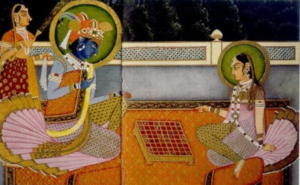 An Indian manuscript depicting Krishna and Radha playing chaturanga on an 8×8 Ashtāpada (Source: CAIS). For more see “Chess: An Indian or Iranian invention” …
Bibliography
Jacobi, “Über zwei ältere Erwähn-ungen des Schachspiels in der Sanskrit-Litteratur,” ZDMG 50, 1896, pp. 227-33.
A. MacDonell, “The Origin and Early History of Chess,” JRAS, 1898, pp. 117-41.
Monchi-Zadeh, “Xus-rôv i Kavâtân ut Rêtak,” in Monumentum Georg Morgenstierne, vol. II. Acta Iranica 22, Leiden, 1982, pp. 47-91.
J. R. Murray, A History of Chess, Oxford 1913. Idem, A History of Board-Games other than Chess, Oxford 1952.Panaino, La novella degli Scacchi e della Tavola Reale. Un’antica fonte orientale sui due gixochi da tavoliere piuà diffusi nel mondo euroasiatico tra Tardoantico e Medioevo e sulla loro simbologia militare e astrale. Testo pahlavi, traduzione e commento al Wiz-arišn î Chatrang ud nihišn î new-ardaxšî r “La spiegazione degli scacchi e la disposizione della tavola reale,” Milano, 1999.
L. Semenov, Studien zur sogdischen Kultur an der Seidenstrasse, Wiesbaden, 1996.
Thieme, “Chess and Backgammon (Tric-Trac) in Sanskrit Literature,” in E. Bender, Indological Studies in Honor of W. Norman Brown, New Haven, 1962, pp. 204-16, reprinted in Kleine Schriften, Wiesbaden, 1984, pp. 413-25.
W. Thomas, “The Indian Game of Chess,” ZDMG, 52, 1898, pp. 271-72; 53, 1899, pp. 364-65.
M. Unvala, The Pahlavi Text “King Husrav and his Boy,” published with its Transcription, translation and copious notes, Paris, n.d.
Related posts:
-
Azerbaijan Republic acknowledges Historical Legacy of Polo Game
-
Viking-era Sassanian and Arab-Sassanian Silver Coins Found in Sweden
-
Lecture: Influence of Sassanian Architecture upon European and Wider Civilization
-
UNESCO: Sassanian Archaeological Landscape of the Fars Region
-
Documentary Film Production: the UNESCO Sassanian Fortress in Darband
-
Translation of Professor Katarzyna Maskymiuk’s Sassanian Military History Book into Persian
Arson Attack at the Tomb of Esther and Mordechai
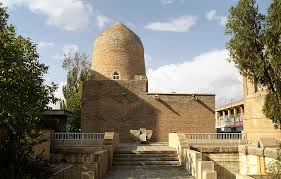 On Friday, May 15, 2020, the National Director of the Anti-Defamation League (ADL), 1 Jonathan Greenblatt, announced on Twitter that the tomb of Esther and Mordechai in Hamadan, Iran had been set afire overnight.
Two days later, the Hamadan prosecutor told reporters that “the case of the fire at the tomb of Esther and Mordechai is under investigation.” At the same time, the director general of Hamadan’s cultural heritage announced that “only minor damage was caused to the holy site by the fire.” In addition to the statements of officials in Hamadan, all different forms of contradictory information have been announced by the government official and state news agencies about this incident.
Based on the fact that many Iranian cultural and historical heritage sites have undergone damage and experienced negligence after the Islamic Revolution, it is quite
possible that none of the information heard from the officials of the Islamic government
or their news agencies is true. It is plausible that those who set fire to the tomb have
been supported by authorities of the Islamic Republic.
In addition to the conflict that the Islamic Republic has with non-religious cultural and
historical heritage or non-Shiite religious sites, these historical monuments have
become a means of political exploitation against the people of Iran and foreign
countries. It is clear that what has occurred to the tomb of Esther and Mordecai is an act
of revenge against Israel and the United States.
The tomb of Esther and Mordecai, which has religious significance for Jewish people in
addition to its heritage and historical significance, has repeatedly been the target of
threats by agents linked to the Iranian government in recent years. The tomb has been
in Hamadan for hundreds of years and has always been respected by Iranian people.
Furthermore, it is also quite unfortunate that the United Nations Educational, Scientific
and Cultural Organization (UNESCO)’s representatives based in Iran have not objected
to the Iranian government’s strategic negligence of cultural heritage and historical sites.
———————————————————————————————————————
——————
1 The Anti-Defamation League (ADL) is a leading anti-hate organization. Founded in 1913 in response to an escalating climate of anti-Semitism and bigotry, its timeless mission is to protect the Jewish people and to secure justice and fair treatment for all.
World Day for Cultural Diversity for Dialogue and Development
 By dint of coordinated action, original initiatives and creativity, this imposed downtime has made it possible to see what is one of humanity’s riches: our diversity.
UNESCO Director-General Audrey Azoulay :: Read message Impact of COVID-19 on the Cultural Sector.
Cultural events cancelled, cultural institutions closed, community cultural practices
suspended, empty UNESCO World Heritage sites, heightened risk of looting of cultural
sites and poaching at natural sites, artists unable to make ends meet and the cultural
tourism sector greatly affected… The impact of COVID-19 on the cultural sector is being
felt around the world. This impact is social, economic and political – it affects the
fundamental right of access to culture, the social rights of artists and creative
professionals, and the protection of a diversity of cultural expressions.
The unfolding crisis risks deepening inequalities and rendering communities vulnerable.
In addition, the creative and cultural industries (CCI) contribute US$2,250bn to the
global economy (3% of GDP) and account for 29.5 million jobs worldwide. The
economic fall-out of not addressing the cultural sector – and all auxiliary services,
particularly in the tourism sector – could also be disastrous. (source ” Culture & COVID-19: Impact and Response Tracker – Issue 2 “)
Culture: A Source of Resilience
During this time of mass confinement, billions of people are turning to culture as a source of comfort, well-being and connection. There has been a surge in the creation of, and access to, cultural content online – from virtual visits to museums and galleries, streaming of films and even community choirs via social media – showing its fundamental role as a source of resilience for communities. Major crises throughout history have often given rise to a renaissance of culture and an explosion of new forms of creativity, so vital for human progress.
When Cadaver Dogs Pick Up a Scent, Archaeologists Find Where to Dig
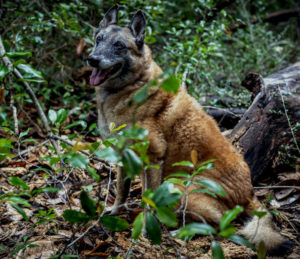 Recent research highlights the power of the canine nose to uncover buried remains from ancient human history On a sunny summer day in Croatia several years ago, an archaeologist and two dog handlers watched as two dogs, one after another, slowly worked their way across the rocky top of a wind-scoured ridge overlooking the Adriatic Sea.
Bodies had lain in beehive-shape tombs on this necropolis, part of the prehistoric hill fort of Drvišica, since the Iron Age. The two dogs, trained to detect human remains, were searching for scents that were thousands of years old.
Panda, a Belgian Malinois with a “sensitive nose,” according to her handler, Andrea
Pintar, had begun exploring the circular leftovers of a tomb when she suddenly froze, her nose pointed toward a stone burial chest. This was her signal that she had located the scent of human remains.
Ms. Pintar said the hair on her arms rose. “I was skeptical, and I was like, ‘She is kidding me,’” she recalled thinking about her dog that day. Archaeologists had found fragments of human bone and teeth in the chest, but these had been removed months earlier for analysis and radiocarbon dating. All that was left was a bit of dirt, the stone slabs of the tomb and the cracked limestone of the ridge.
Human-remains detection dogs, or cadaver dogs, are used worldwide on land and water. Well-trained dogs help find the missing and dead in disasters, accidents, murders and suicides. But the experiment in Croatia marked the start of one of the most careful
inquiries yet carried out of an unusual archaeological method. If such dogs could
successfully locate the burial sites of mass executions, dating from World War II through
the conflicts in the Balkans in the 1990s, might they be effective in helping
archaeologists find truly ancient burials?
On the scent of new tombs
Panda wasn’t kidding. Neither was Mali, the other Belgian Malinois trained by Ms. Pintar
and her husband, Christian Nikolić. Each dog gave her final indications that day by either sitting or lying inside the flattened circle of the tombs, their noses pointing toward the burial chests within. In some cases they leapt into the small burial chests before offering an alert.
The dogs’ archaeological expedition had been initiated by Vedrana Glavaš, an
archaeologist at Croatia’s University of Zadar. She already knew a great deal about the necropolis at Drvišica, having fully excavated and analyzed the contents of three tombs
there. Inside each were rough limestone burial chests. She and her team recovered amber beads, belt buckles, bronze pins, teeth and phalanges. Each chest once held at least two bodies, which radiocarbon dating confirmed were 2,700 years old. The skeletal material was highly fragmented, however, and is still being analyzed.
But were there other tombs on the site, and could the dogs help locate them?
After that first preliminary search and its surprising result, Dr. Glavaš had beers at a local pub with the dogs’ handlers. They decided to hold off any discussion for a few weeks. That “test run” was the beginning of a careful study on whether human-remains detection dogs could be an asset to archaeologists. Setting up a controlled study was difficult. Dr. Glavaš had to learn the scientific literature, such as scent theory, far outside the standard confines of archaeology; the same was true for Ms. Pintar and the field of archaeology.
The training challenges were also difficult. Ancient human remains probably present a
different and fainter scent profile than more recently deceased cadavers, especially as
decades turn into centuries and then millenniums. False negatives seemed likely to occur.
“I think dogs are really capable of this, but I think it’s a logistical challenge,” said Adee
Schoon, a scent-detection-animal expert from the Netherlands who was not involved in
the study. “It’s not something you can replicate again and again. It’s hard to train.”
And, as Dr. Schoon noted, dogs are “great anomaly detectors.” Something as subtle as
recently disturbed soil can elicit a false alert from a dog that is not rigorously trained.
Nonetheless, the team returned to the necropolis for the first controlled tests in September 2015, and again a full year later. Both times, they used all four of Ms. Pintar and Mr. Nikolić’s cadaver dogs: Panda, Mali, a third Belgian Malinois and a German shepherd. They worked them on both known and double-blind searches, in areas where nobody knew if tombs were located.
Archaeologists discover 2000-year-old unique complex by the Western Wall
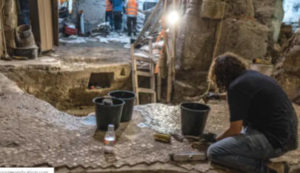 A unique system of underground rooms dating back to 2000 years ago were discovered by a group of archaeologists just adjacent to the Western Wall in the Old City of
Jerusalem, under the lobby of the Western Wall tunnels in the “Beit Straus” complex.
The rare discovery sheds light on Jewish life in the holy city ahead of the destruction of the Second Temple, as explained in a joint announcement by the Israel Antiquities Authority and the Western Wall Heritage Foundation ahead of Jerusalem Day.
The complex features two rooms and an open courtyard and contained several every-day objects. The researchers suggested several possible purposes for the spaces, from food storage to residential place.
The structure was sealed later in the Byzantine period under the floors of a large building about 1,400 years ago and was left untouched for centuries .
“This is a unique finding,” said Dr. Barak Monnickendam-Givon and Tehila Sadiel,
directors of the excavation on behalf of the Israel Antiquities Authority, according to a
press release. “This is the first time a subterranean system has been uncovered adjacent to the Western Wall. You must understand that 2,000 years ago in Jerusalem, like today, it was customary to build out of stone. The question is, why were such efforts and resources invested in hewing rooms underground in the hard bedrock?”
Historic shipwreck uncovered on Victorian beach
 By Nadia Dimattina • Reporter
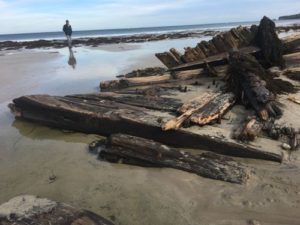
The largest section of Inverloch’s historic shipwreck has been revealed, with more than 30 centimetres of sand eroding away to uncover more of the wreckage.
On December 12, 1863, the Amazon departed Melbourne for Mauritius with a cargo of salted meats. Only four days later it washed up on Inverloch surf beach, after encountering a storm on Bass Strait.
Since then, the 157-year-old shipwreck has slowly been uncovered due to erosion.
The Inverloch shipwreck is being uncovered by sand erosion on a country Victorian beach. (9News) “There has been a lot of locals walking on the beach trying to keep themselves fit and healthy, and everyone is just amazed with what they are seeing,” secretary of Amazon 1863 Project Inc, Karyn Bugeja said.
“At the moment there is more uncovered and it is telling a completely different story to what we thought up until 48 hours ago.”
“We always thought we were looking at the keel of the ship but Heritage Victoria have confirmed it is the stem of the ship which is the bow at the front, which is where the figure head would have been placed,” Ms Bugeja said.
The ship, the Amazon, departed Melbourne on December 12, 1863. (9News)
The Amazon 1863 Project Inc. was formed in November, with a group of budding maritime archaeologists working with Heritage Victoria to collect and conserve items that have been detached from the wreckage.
Related
• Lost wreck of freighter sunk by Japanese submarine discovered off NSW coast
• Plagued Artania ship sets sail from Western Australia
• Ghost ship washes up on Irish coast
“I don’t think people are aware of the value of the shipwreck, it is the most significant shipwreck on Victoria’s coast and it is the only wooden shipwreck so we have to respect it and appreciate what we have in Inverloch,” Ms Bugeja said.
The committee is working to create a children’s book to tell the story of the shipwreck discovery.
It washed up at Inverloch just four days later. (9News)
“We want to teach people about the story of the Amazon and its demise and sort of more importantly why we should appreciate and respect such items of heritage value.”
“The text is pretty much formalised and illustrations are being done at the moment and we hope later in the year it will be published,” Bugeja said.
“A lot of people know nothing about this shipwreck, so talking about where it came from, what kind of ship it was, where it came from and what happened to it, how it ended up on the beach, ” chairperson Trilby Parise said.
The largest section so far has been uncovered recently. (9News)
Ms Parise said the long-term plan is to showcase some of the preserved artefacts in a museum.
“We can’t preserve every piece of the shipwreck, that is just not going to happen, so we have to be really careful about which pieces get chosen and what is significant enough to go through the preservation process,” she said.
The community is being urged to stay away from the shipwreck in order to preserve it.
“We would just encourage people that the only thing they take away are photos and memories,” Ms Bugeja said.
https://www.msn.com/en-au/news/australia/historic-shipwreck-uncovered-on-victorian-beach/ar-BB13Gl6J