 It is with great sadness that we learned today of the passing of Dr. Hormoz Hekmat, one of the most prominent experts of contemporary Iranian culture and an advisor and supporter of the Pasargad Heritage Foundation.
Dr. Hekmat was a member of the board of trustees of the Iran Studies Foundation and a supporter and advisor to the Pasargad Heritage Foundation and the World Cultural Heritage Voices (WCHV).
He was a prolific writer, a philanthropist, and a lover of Iran. Dr. Hekmat worked tirelessly for preservation of Iranian history and culture.
Friends and members of the Pasargad Heritage Foundation express their sincere
condolences to Dr. Hekmat’s family, friends and loved ones.
He will forever be in our hearts and memories, and we will always celebrate his life.
World Cultural Heritage Voices
July 2, 2020
http://worldculturalheritagevoices.org/
Archives
Day of the Seafarer 2020
 Seafarers are on the frontline of the COVID-19 pandemic, playing an essential role in maintaining the flow of vital goods, such as food, medicines and medical supplies.
However, the crisis has led to difficult working conditions for seafarers, including
uncertainties and difficulties about port access, re-supply, crew changeovers and
repatriation.
This year, the Day of the Seafarer campaign calls on Member States to recognize seafarers as key workers – and to provide them with the support, assistance and travel options open to all key workers during the pandemic.
The 2020 Day of the Seafarer campaign pays tribute to seafarers, acknowledging their
sacrifice and the issues they face. Many seafarers have been away from home for months and are unsure when they will be able to return home due to travel restrictions.
The campaign also seeks to raise awareness of the work achieved by seafarers in response to the pandemic and to thank them for their contribution. Everyone is invited to recognize that the ability of seafarers to deliver vital goods is central to responding to, and eventually overcoming, this pandemic.
The campaign encourages everyone to treat seafarers with the respect and dignity they
deserve so that they can continue to provide their vital services to keep world trade
moving.
Spain Has Been Hit by Yet Another Bungling Restorer, Who Turned Beautiful Painting Into an Unrecognizable Blob
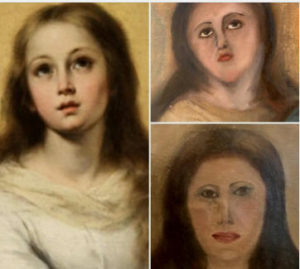 According art net news an attempt to restore a copy of baroque artist Bartolomé Esteban Murillo’s The Immaculate Conception of Los Venerables has turned its beatific Virgin Mary into a misshapen lump with red lips.
Immediately drawing comparisons to the viral “ Beast Jesus ” restoration fail of 2012 , this latest attempt by an amateur restorer is prompting experts in Spain to call for more stringent regulations.
The anonymous owner of the marred Murillo work paid €1,200 ($1,350) for it to
be cleaned by a furniture restorer, Europa Press reported , and was outraged
when not one, but two attempts resulted in a complete disfiguration.
María Borja, a vice president of the Valencia chapter of the Professional
Association of Conservative Restorers of Spain, told the outlet that while a
handful of these incidents come to wide attention because of social media, “there
are a multitude of situations where the works are intervened by people without
training… possibly causing irreversible change.”
Although the organization’s fundamental objectives include language that
advocates for the preservation of cultural heritage, such as paintings, there is no
specification for a professional conservation restorer to be commissioned.
Speaking to the Guardian , former association president Fernando Carrera, who
is a professor in conservation and restoration, said “I don’t think this guy—or
these people—should be referred to as restorers… they’re bodgers who botch
things up. They destroy things.”
“Can you imagine just anyone being allowed to operate on other people? Or
someone being allowed to sell medicine without a pharmacist’s license?” Carrera
added, noting that while he understands restorers are not as critical to society as
doctors, “we need to focus society’s attention on this… this is our history.”
Other failed conservation attempts in recent history include the refurbishment of
a 500-year-old statue of St. George at the Church of San Miguel de Estella in
Navarre, Spain, which resulted in a Disneyfied makeover; the statue of Santa
Barbara at Brazil’s Santa Cruz da Barra Chapel; and the 15th-century statue of
Virgin Mary that was “restored” by a local woman in Asturias, Spain.
Why Did India’s 50,000-Year-Old Lonar Lake Suddenly Turn From Green to Pink?
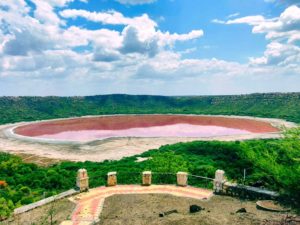 According prevention the crater-made Lonar Lake located in west-central India has bewildered residents and researchers after the water miraculously changed colors from its typical green to pink. The change in hue started in early
June before finalizing to a reddish pink in just a matter of days.
NASA Earth Observatory captured images of the nearly 50,000-year-old lake on May 25 and then again on June 10 of this year, displaying a before-and-after of the color modification. Scientists aren’t completely sure why the crater lake in the state of Maharashtra suddenly turned pink, but they have a few theories.
There have been such instances in other parts of the world,” Sanjay Rathod,
Maharashtra’s State Forest Minister told The Hindu . “In a lake in Iran, the water
turns reddish due to increase in salinity. We are still studying the phenomenon,
but it is certain that no artificial occurrence resulted in the change in color.”
While these theories have not been confirmed—at least not yet, anyway—the
Maharashtra Forest Department has sent water samples to two labs in Nagpur
and Pune, and are waiting for the results.
Jiroft and the Aratta Kingdom
 Jiroft and the Aratta Kingdom
The article “Jiroft and the Aratta Kingdom” below by Richard Covington was originally posted in the CAIS website. Kindly note that the version below has been slightly edited and also features three photos and accompanying captions not displayed in Covington’s original article in CAIS. Kindly note that the version printed below has been edited in Kavehfarrokh.com. Readers may also be interested in the following resources (click link or image underneath the link):
Ancient Iran: Neolithic to Pre-Achaemenid eras
========================
It was around two o’clock on a mild mid-February afternoon that colleagues called head archeologist Professor Yousef Madjidzadeh to look at some telltale markings in a dusty trench. It was the last day of the six-week digging season at the Jiroft archeological site in the southeast Iranian desert, and Madjidzadeh was jotting down notes before closing up for the year. The Iranian-born archeologist, who has been excavating at Jiroft for two years, has become increasingly convinced that the remains of this 4500-year-old city hold the key to a Bronze Age kingdom whose existence promises to rewrite at least a chapter or two of the history of the ancient Middle East.
“I took the pick in my hand and started to help dig out what turned out to be a remarkably well-preserved stamp-seal impression,” Madjidzadeh recalls, now back at his home in the Mediterranean port city of Nice, France.
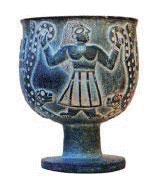
Cup retrieved from Jiroft (Source: CAIS).
Painstakingly extracting the five-centimeter- (2″-) long rectangle from the trench wall’s packed clay, the archeologist turned it to the sunlight. Amid faintly inscribed lines and images of human and animal figures, he was amazed to discover what appeared to be an unfamiliar form of writing. To Madjidzadeh, the seal impression came as his first evidence that this ancient city’s society was literate.
“To be able to say that Jiroft was a historic civilization, not a prehistoric one, is a great advance,” he says. “Finding writing on that seal impression brought tears to my eyes. Never mind that we can’t read it—that’ll come later.”
Though others have downplayed Madjidzadeh’s declarations that Jiroft was more than a regional culture, archeologists generally agree, he says, that a distinct civilization is characterized by unique monumental architecture and by its own form of writing. “This past winter, we found both,” he beams.
Gray-bearded, easy-going and energetic in his mid-60’s, Madjidzadeh is feeling the glow of vindication. A few years after Iran’s 1979 revolution, he was dismissed as chairman of the department of archeology at Tehran University. After years of self-imposed exile in Nice with his French-born wife, he returned during the intellectual thaw that followed the 1997 election of President Mohammad Khatami.
The discovery of the Jiroft site came by accident. In 2000, flash floods along the Halil River swept the topsoil off thousands of previously unknown tombs. Seyyed Mohammad Beheshti, deputy head of Iran’s Cultural Heritage and Tourism Organization (ICHTO), asked Madjidzadeh to begin excavations because of the archeologist’s long-standing bullishness on Jiroft’s significance.
As the author of a three-volume history of Mesopotamia and a leading Iranian authority on the third millennium BC, Madjidzadeh has long hypothesized that Jiroft is the legendary land of Aratta, a “lost” Bronze Age kingdom of renown. It’s a quest that he began as a doctoral candidate at the University of Chicago, when in 1976 he published an article proposing that Aratta, which reputedly exported its magnificent crafts to Mesopotamia, was located somewhere in southeastern Iran.
According to texts dating from around 2100 BC, Aratta was a gaily decorated capital with a citadel whose battlements were fashioned of green lapis lazuli and its lofty towers of bright red brick. Aratta’s artistic production was so highly regarded that about 2500 BC the Sumerian king Enmerkar sent a message to the ruler of Aratta requesting that artisans and architects be dispatched to his capital, Uruk, to build a temple to honor Inanna, the goddess of fertility and war. Enmerkar addressed his letter to Inanna: “Oh sister mine, make Aratta, for Uruk’s sake, skillfully work gold and silver for me! (Make them cut for me) translucent lapis lazuli in blocks, (Make them prepare for me) electrum and translucent lapis!” prayed the Sumerian ruler.
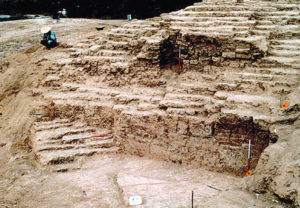 Excavations at Jiroft’s Konar Sandal A, one of the site’s two major mounds, are revealing the base of what may have been one of the world’s largest ziggurats. (Source: Mohammad Eslami-Rad /Gamma in CAIS).
“When one imagines that Uruk was the heart of the Sumerian civilization and that its king is asking another ruler about 2000 kilometers (1200 mi) distant to send his artisans, one realizes that the quality of their work must have been extraordinary,” says Madjidzadeh. “The craftsmen must have been known all over. Today there is no doubt in my mind that Jiroft was Aratta.” A handful of colleagues agrees, including the French epigrapher François Vallat, who compares Jiroft to the Elamite kingdom of southwestern Iran.
So far, however, there is no proof, and others are less sure.
“When you start reconstructing actual geographical regions based on legend and mythology, you’re always in deep water,” says Abbas Alizadeh, an Iranian-born archeologist at the Oriental Institute of the University of Chicago. “Some scholars think Aratta is in Azerbaijan. Others say Baluchistan or the Persian Gulf. It’s a murky business.”
Yet even if Jiroft turns out not to be Aratta, it is nevertheless a pivotal clue to a better understanding of the era when writing first flourished and traders carried spices and grain, gold, lapis lazuli and ideas from the Nile to the Indus. Although not on a par with the more influential civilizations of Mesopotamia, Egypt and the Indus Valley, “Jiroft is obviously a very important archeological complex,” says Holly Pittman, an art historian at the University of Pennsylvania who is one of a growing number of non-Iranian scholars who are being allowed into the country. “It’s an independent, autochthonous Bronze Age civilization with huge numbers of settlements of all different sizes that we have only just begun to explore.” By comparison to the research documenting other third-millennium civilizations, these are indeed very early days, she explains. “We don’t yet have enough material to compare it to Mesopotamia. But you have to remember that 500 teams of archeologists have been digging in Mesopotamia for 100 years. In Jiroft, we’ve had two seasons with one team of fewer than 30 scientists.”
Even so, among the spectacular finds so far are the remains of a city a kilometer and a half (.92 mi) in diameter, an unusual two-story citadel surrounded by a fortress wall 10.5 meters (34′) thick, and a ziggurat resembling Sumerian ones that is among the largest in the ancient world—17 meters (54′) high and 400 meters (1280′) on each side at the base. The team has also uncovered 25 stamp and cylinder seal impressions from two to five centimeters (7/8″–2″) long that depict bulls, ibex, lions, snakes, human figures—and writing.
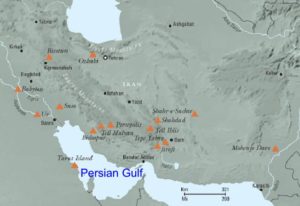 Major archeological sites from the fourth and third millennia BC (Source: CAIS).
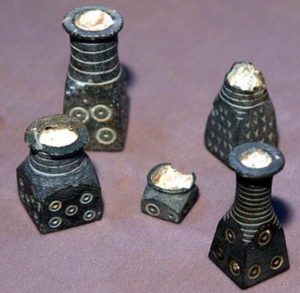
Perhaps the most impressive discoveries have been staggering numbers of carved and decorated vases, cups, goblets and boxes made of a soft, fine-grained, durable gray-greenish stone called chlorite. Literally tens of thousands of pieces have been found, but the vast majority have been looted from their original tombs by local farmers, who were the first to stumble across the gargantuan honeycomb of gravesites uncovered by the floodwaters of 2000.
“Thousands of people were digging,” Madjidzadeh explains, and antiquities dealers swooped in behind them to buy up the finds by the dozens. Farmers often sold chlorite vases worth tens of thousands of dollars on the international market for a few sacks of flour. Ultimately, in the fall of 2002, the Iranian authorities stepped in to halt the looting and seize hundreds of contraband artifacts.
The Jiroft artifacts are a “missing link” in understanding the Bronze Age, Madjidzadeh says, because they help explain why so many incised chlorite vessels, all with remarkably similar imagery, have turned up at widely separated ancient sites, from Mari in Syria to Nippur and Ur in Mesopotamia, Soch in Uzbekistan and the Saudi Arabian island of Tarut, north of Bahrain. Until now, the principal center of production of these vessels was a mystery. Although some of them were probably manufactured locally, the sheer volume of artifacts at Jiroft argues that the most prolific chlorite workshops of all were there. (See sidebar, page 8.)
Jiroft artisans fashioned pieces with what seems strange and enigmatic iconography. Some were encrusted with lapis lazuli from Afghanistan, carnelian from the Indus Valley, turquoise, agate and other semiprecious, imported stones. “The artists had such a naturalistic way of rendering images,” says Yousef Madjidzadeh, foreground. “It was a style that was not seen anywhere else in that era.” (Source: CAIS). “There must certainly have been a school of stonecarvers, because you see such an aesthetic unity of these objects throughout the kingdom. This high-level artistic quality did not suddenly appear from nowhere,” he maintains. “The traditions must have taken 300 to 400 years to develop.”
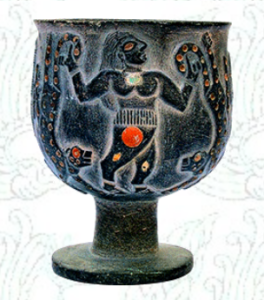
Carved into one gray chlorite cup, mythic creatures with human heads and torsos and bulls’ legs hold panthers upside-down by their tails. On the surface of a stone weight shaped roughly like a ladies’ handbag, two horned scorpion-men appear to swim toward each other. “Hunters who were believed to be as powerful as bulls or as agile as lions entered into legend, and their images became animalized as bull-men and lion-men,” the archeologist suggests in explanation.
Round chlorite boxes are decorated with representations of curved gates, woven reed walls, ziggurats and other architectural details that hint at what Jiroft’s buried buildings probably looked like.
Along with the chlorite objects are also pink and orange alabaster jars, white marble vases, copper figurines, beakers and a striking copper basin with a eagle seated in its center, as well as realistic carved stone impressions of heraldic eagles, scorpions and scorpion-women.
Many of the scenes on the Jiroft vessels bear a strong resemblance to the gods, beasts and plants portrayed on Sumerian statues, plaques and cylinder seals. “Jiroft leads me to imagine that Iran had a far greater influence on Mesopotamian culture than I previously thought,” observes Jean Perrot, the grand old man of Middle Eastern archeology in France.
To Carl Lamberg-Karlovsky of Harvard University, who excavated a site named Tepe Yahya some 90 kilometers (50 mi) from Jiroft in the 1970’s, what is particularly remarkable about the Jiroft finds is that so many thousands of brand-new, empty chlorite vessels were manufactured for no other apparent purpose than to be buried in tombs to honor the dead. “The fact that not a single one of them contains even a trace of oils, perfumes, foodstuffs or drugs, nor shows any other sign of use, is very curious,” he marvels.
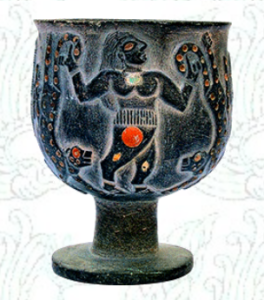 Chlorite cup from Jiroft, c. 3rd millennium BCE (Source: CAIS). Chlorite vessels similar to the stunning examples recently unearthed at Jiroft in southeastern Iran have been found from the Euphrates to the Indus, as far north as the Amu Darya and as far south as Tarut Island, on the Persian Gulf coast of Saudi Arabia. Iranian-born archeologist Professor Yousef Madjidzadeh speculates that some of these objects were in fact imported from Jiroft, which he is convinced is the legendary third-millennium-BC city of Aratta. Other archeologists, however, dispute this conclusion, maintaining that the vases, bowls and cups from Mesopotamian and Indus Valley sites were manufactured locally. What is clear is that Jiroft traders brought lapis lazuli from Afghanistan and carnelian from the Indus to decorate the ornate vessels they manufactured.
Despite the crackdown on pillaging and the hiring of a dozen armed guards, theft at Jiroft still continues. This winter, while working on the city mounds, Madjidzadeh received a tip that looters were digging at gravesites six kilometers (3.7 mi) away. Racing to the cemetery with one of the guards, he caught sight of several dozen looters, who escaped on foot when they saw Madjidzadeh coming. One of his laborers later told him that it was rumored the looters had managed to spirit away a priceless golden fish figure. One looted gravesite reportedly yielded an astonishing 200 artifacts, including 30 finely crafted chlorite vessels.
“Was it the tomb of the lord of Aratta?” asks Madjidzadeh sadly. “Because all the objects were ripped out of context and have disappeared, we’ll never know—even if they turn up in the antiquities market.”
On his days off, the archeologist travels to surrounding villages to give lectures about the significance of Jiroft and its irreplaceable artifacts.
“I show photos of the objects and our excavations and tell the villagers in simple language that all these works belonged to your grandparents, your ancestors,” he explains. “‘They are your heritage. You don’t sell your heritage. If we put these cups and vases in a museum, they will attract tourists. This will bring more money than selling the pieces once or twice. You and your children will benefit from the tourists and education.’ Little by little, people understand more about the cultural value of the finds.”
On the international art market, it’s a different story. Museums and private collectors have been quick to recognize the cultural, esthetic and, in particular, monetary worth of artifacts that Madjidzadeh is sure were stolen from Jiroft.
“I scour the Internet, auction catalogues and brochures and have been shocked to see museums in Switzerland, Japan, Turkey, Pakistan and elsewhere buying these objects,” he says.
Protecting Jiroft is an overwhelming task, for Madjidzadeh and his team have uncovered more than 250 separate sites across an area about the size of Austria or South Carolina. In the forested mountains 150 kilometers (90 mi) north of Jiroft, other archeologists have discovered copper mines that likely produced the ore for the copper and bronze artifacts unearthed in Jiroft’s gravesites. But so far, no one has pinpointed the chlorite mines.
French geomorphologist Éric Fouache, the team’s expert on reading the strata underlying the archeological sites, has discovered something else, however, which gave the Jiroft region a crucial advantage over Mesopotamia: water. A network of artesian wells supplied abundant water for irrigation and drinking even when the Halil River ran dry. With these sources of water, the inhabitants developed an agriculture based on calorie-rich date palms rather than the cereals of the Tigris and Euphrates delta, says Fouache. Palm groves also provided shade for extensive gardening.
“So it’s very possible the Jiroft people developed agriculture more easily than the Mesopotamians,” asserts the scientist.
Next year, Fouache plans on probing deeper to locate earlier remains buried by the region’s frequent tectonic upheavals. “Based on aerial photographs showing traces of past ground shifts, we expect to find older settlements not visible from the surface,” he says.
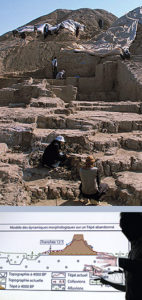 Top: An Iranian archeologist and local workers dig on the west side of Jiroft’s second mound, Konar Sandal B. Above: A slide of the cross section of a third-millennium-BC tell—a mound created by centuries of habitation—helps geomorphologist Éric Fouache explain that the region’s many artesian wells made Jiroft’s development possible. (Mohammad Eslami-Rad / Gamma in CAIS).
The primary Jiroft site consists of two mounds a couple of kilometers apart, called Konar Sandal A and B and measuring 13 and 21 meters high (41′ and 67′), respectively. It was at Konar Sandal B that the archeologists dug out the seal impressions bearing writing. So far, the archaeologists have excavated around nine vertical meters (28′) of Konar Sandal B, discovering vestiges of a monumental, two-story, windowed citadel whose base covers nearly 13.5 hectares (33 acres). Madjidzadeh speculates that this imposing edifice once housed the city’s chief administrative center and perhaps a temple and a royal palace.
Finding the structure’s façade was difficult enough, but locating an entrance took the team weeks of digging through clay packed hard by millennia of rain-wash. “The mud is like stone,” Madjidzadeh complains. “You can hardly get a pick into it.”
This winter they stumbled across what appears to be the city’s main gateway, a squared-off earthen portal that closely resembles architectural details depicted on several chlorite vases. The team has also uncovered a second wall and vestiges of a third, with trenches exposing both private houses and another sizeable public building—perhaps a trading center.
“We know it’s another monumental building because the bricks are larger than the bricks used in private homes,” says Madjidzadeh.
According to the archaeologist, the enormous ziggurat at Konar Sandal A was a tremendous feat of engineering that required four to five million bricks. Like its Sumerian counterparts, it was probably a sacred structure, a bridge between earth and sky, and it was probably topped by a room where the city’s protective god could woo his mortal consort, usually the wife or daughter of the ruler.
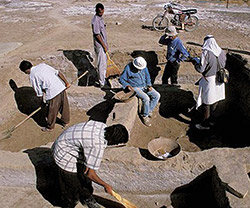 Madjidzadeh, in white hat at center, examines objects found near Konar Sandal B in a trench overseen by Romain Pigeaud of the Paris National Museum of Natural History. (Mohammad Eslami-Rad / Gamma in CAIS).
Although very little is known of the beliefs and rituals of Jiroft’s inhabitants, Madjidzadeh is convinced that the practice of burying the dead with a relative fortune in artefacts points to a well-organized religion with a priestly class that could command the efforts of craftsmen. Since the ancient Mesopotamian epic of Gilgamesh mentions scorpion-men similar to ones carved on Jiroft’s stone vases, the archeologist also suggests that parts of the Gilgamesh narrative circulated in Jiroft and may even have had their origins there.
Another of the recent season’s top finds was the discovery by Marjan Mashkur, an Iranian researcher based in Paris, of shark bones and shells from the Persian Gulf, 200 kilometers (120 mi) south. To Madjidzadeh, this find confirms that Jiroft merchants plied well-worn trade routes that led to the Persian Gulf and on to Mesopotamia, dealing in chlorite vessels, lapis lazuli and other precious stones, and commodities fabricated in Jiroft.
Even at this relatively early stage, Madjidzadeh believes he has enough evidence to turn some of the fundamental precepts of Middle Eastern archaeology on their head. The fabulous royal treasure excavated in the 1920’s by Leonard Wooley at the Sumerian capital of Ur, including the iconic, shell-encrusted ibex standing to nibble the leaves of a gold tree, may ultimately be traced back to the workshops of Jiroft, he says. So might chlorite vessels from Uruk, Mari and Soch.
“We’re not sure what gold pieces might have come from Jiroft,” says Pittman, “but some of the chlorite pieces in Mesopotamia may well prove to have been exported from this region of southeastern Iran.”
“Three years ago, I would have agreed with the common assertion that Mesopotamia was the cradle of civilization,” Madjidzadeh says. “Now I’m changing my mind to Jiroft, which, in its heyday, was just as important and as extensive as Sumerian civilization.”
For some in the field, this comparison sets off alarm bells.
Lamberg-Karlovsky is one of the skeptics. While the Harvard professor acknowledges the importance of the discovery of Jiroft and its chlorite vessels, he warns against hyperbole. “To imply that Jiroft is the most ancient Oriental civilization is way off the mark,” he argues. “In terms of actual material recovered so far, there is nothing earlier than 2500 BC, which is a thousand years later than the southern Mesopotamian world.”
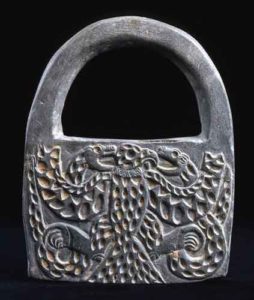 “Handbag” looking artifact with decorative motifs excavated from Jiroft (Source: Iran Atlas). The artefact may have been a weight standard for measurements.
Madjidzadeh, however, maintains that pottery found at Jiroft compares to shards from Tepe Yahya dated to 2800 BC. In addition, he reasons, it would have taken nearly half a millennium for Jiroft’s artisans to develop the degree of skill that attracted King Enmerkar’s envy in 2500 BC, an inference that pushes back the establishment of Jiroft to about 3000 BC. Unfortunately, carbon dating of the vases and pots—the most reliable technique for gauging the age of artifacts—is not possible at Jiroft, since there have been absolutely no traces of organic residue in any of the materials unearthed so far. The Harvard archaeologist and others deprecate Madjidzadeh’s contention. “These are very tenuous conclusions,” says Lamberg-Karlovsky. “To try to put Jiroft on the same level as the Sumerian, Egyptian and Indus Valley civilizations, or even as the Bactrian material of central Asia, is to exaggerate and distort the archaeological record. Jiroft is just not in the same ballpark.”
Based on his own chemical analyses of chlorite pieces from Tarut, Mesopotamia and elsewhere, Lamberg-Karlovsky states that the stone finds in those places were mined locally. He is thus wary of claims that Jiroft pottery was widely exported.
“It’s very significant that Jiroft was the center of production for huge numbers of chlorite vessels, but to say that the vessels found in Mesopotamia, the Arabian Peninsula and the Iranian plateau came from Jiroft is patently false,” he declares.
Madjidzadeh counters that chlorite vessels may indeed have been produced elsewhere—but by itinerant artisans and stonecutters originally from Jiroft or local craftsmen imitating Jiroft styles.
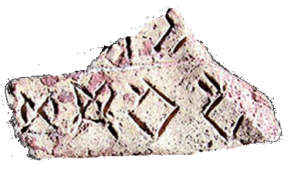 Partial brick with unique script from Jiroft (Source: Iran Atlas).
For Rémy Boucharlat, chief of the French Center for Scientific Research in Tehran, it’s possible that Jiroft exported chlorite vessels to Mesopotamia and beyond. “Yet we still don’t know if the Mesopotamians carved their own imagery on unfinished stone or whether the iconography originated in Jiroft,” he says.
The Oriental Institute’s Alizadeh agrees that Jiroft artisans could well have traveled to Mesopotamia and other areas in the Middle East, but he too deflates some of Madjidzadeh’s more grandiose claims, including the assertion that Jiroft’s civilization predates Sumer’s. After examining the writing on the seal impression uncovered in February, the Chicago archaeologist now doubts its authenticity. Compared to the sophisticated systems of writing that already existed in the region by 2500 BC, the Jiroft artifact presents “an extremely vague series of scratches,” he says.
“There’s great excitement about Jiroft because of the prodigious number of chlorite vessels found there, but the problem is that we don’t know anything about the makers of these objects,” argues Alizadeh. “What is significant is the similarity to designs found in Elamite culture, but to call Jiroft a civilization is not exactly true at this point. Possessing a major manufacturing workshop does not qualify the site as a civilization.”
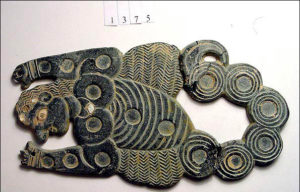 Artefact excavated at Jiroft featuring a scorpion with a human head (Source: Iran Atlas).
Perhaps more exciting than the beautiful chlorite bowls, vases and cups, which after all reveal little information about the ancient inhabitants of Jiroft, says Boucharlat, are the newly excavated settlements and buildings. “We’re now entering a second phase of discoveries, one that goes beyond fine objects to a knowledge of the culture and its relatively high level of social organization and technical proficiency,” he explains.
Regardless of what impact the site ultimately makes on Middle Eastern archaeology, there is no doubt that Jiroft is serving as a pilot program for Iranian professors and graduate students to work alongside international—mainly American and French—colleagues.
“Before the 1979 revolution, there was tremendous collaboration between Iranian and foreign archeologists,” notes Pittman, who first came to excavate in Iran more than 25 years ago. “We’re trying to pick up where we left off.”
As Madjidzadeh explains, “One of my conditions for inviting foreign archaeologists to participate at Jiroft is that they accept Iranian students for training at their universities to learn updated techniques and western methods of teaching.” Now, however, the obstacles to such exchanges are not only on the Iranian side. Despite the University of Pennsylvania’s eagerness to train Iranian researchers, the US government has so far refused to grant them visas.
“It’s immensely frustrating,” Pittman admits. “Until the geopolitical fireworks calm down a bit, we’re not going to have any luck training them here in the US. And training the next generation of archaeologists is the most urgent need by far for the country’s heritage.”
With more archaeologists, Iran could again become a hotspot for the study of ancient civilizations. Certainly Madjidzadeh, who earns less in Iran than a skilled laborer does in France and who pays his own airfares between Nice and Tehran, is not in his profession for money. Ironically for an archaeologist once hounded out of the country, local officials in the town of Jiroft are planning to name a square after him.
“I go to Iran because I love archaeology and I love to help the nation,” he says. “It’s a part of my life I could never change even if I wanted to.”
Related posts:
-
Petroglyphs hold clues to 14,000 years of human life in Iran
-
Sandstorm in Southern Iran exposed Lost Ancient City and Relics
-
Sheda Vasseqhi PhD Study: Positioning of Iran And Iranians In Origins Of Western Civilization
-
Viking-era Sassanian and Arab-Sassanian Silver Coins Found in Sweden
-
UBC Lecture (November 29, 2019): Civilizational Contacts between Ancient Iran and Europe
https://kavehfarrokh.com/heritage/jiroft-and-the-aratta-kingdom/
About historic statues
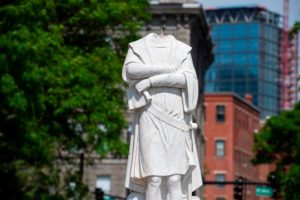 According to the United Nations Educational, Scientific and Cultural Organization (UNESCO), the destruction or devastation of any part of the world’s cultural and natural heritage (anywhere in the world) causes severe impoverishment to the heritage of all nations of the world. In fact, it destroys parts of the human experience and deprives all generations including the future generations from learning about historical and cultural events of our common history (negative or positive). The voice of the World Cultural Heritage (WCHV) Foundation, which aims to preserve the cultural and historical heritage of nations, opposes any kind of destruction of historical monuments.
This is the text of the 1972 Convention:
https://whc.unesco.org/archive/convention-en.pdf
Cathartic acts of rage, or the rewriting of history? How statues became political lightning rods
 Updated 11:09 AM ET, Sun June 14, 2020
(CNN) – Statues are products of one era built to endure into others. They loom over streets and squares while the views of those who pass by change, from generation to generation. Most people, most of the time, are indifferent to these persons of stone and bronze. Not now.
From Richmond, Virginia, to Bristol in England, statues of men who championed or
traded in slavery centuries ago are being torn down. The soul-searching about race
prompted by the death of George Floyd in Minneapolis has extended into how the history of racial persecution and prejudice is remembered. It is a heated debate that reaches far beyond the legacy of slavery.
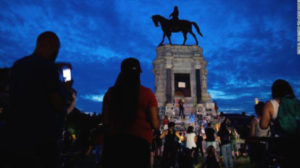
Statues of the Confederate Gen. Robert E. Lee in the US and the 17th century British
slave-trader Edward Colston were obvious targets for anti-racism protesters. So were
those of King Leopold of Belgium, who presided over the most atrocious cruelty in
Belgian-run Congo in the late 19th century. His statue in Antwerp was set on fire and
doused in paint last week.
Few today would defend commemorating or honoring figures like Colston or Leopold.
They profited from cruelty and persecution, and hundreds of thousands of Africans died
in the process. Similarly, there are moments in history where destroying icons has been part of a popular urge for liberation. During the 1956 uprising in Hungary, crowds tore down the huge bronze statue of Joseph Stalin, a gift to the Soviet leader on his 70th birthday. In 2003, Iraqis toppled a statue of President Saddam Hussein in Baghdad, helped by US Marines.
But most historical figures are not so easily categorized and condemned. Now British
wartime leader Winston Churchill and Italian explorer Christopher Columbus are among
those in the cross-hairs of some protesters.
Churchill’s statue in Westminster, defaced with the words “was a racist” last week, was
covered up ahead of this weekend’s protests. British Prime Minister Boris Johnson, who
wrote a biography of Churchill, was furious — saying on Twitter that his predecessor was
a hero and had saved “this country — and the whole of Europe — from a fascist and racist tyranny.”
Johnson acknowledged that Churchill had “sometimes expressed opinions that were and are unacceptable to us today,” but said he was averse to tampering with history. “The statues in our cities and towns were put up by previous generations,” he tweeted.
“They had different perspectives, different understandings of right and wrong. But those
statues teach us about our past, with all its faults. To tear them down would be to lie
about our history, and impoverish the education of generations to come.”
American comedian Trevor Noah has a different take: “The bubonic plague was a major
event in history, but we don’t go around putting up statues of rats,” he wrote. Setting aside the likes of the nurse Florence Nightingale (whose statue lies not far from
that of Churchill), most of the great figures of the past are not beyond reproach —
especially by today’s standards.
Robert Shrimsley wrote in the Financial Times: “Many great historic figures carry serious baggage. George Washington and Thomas Jefferson owned slaves. Where does the historic cleansing stop?”
Most would probably agree that Churchill led resistance to the Nazis heroically, but some remember him also as a white supremacist. In 1937, when addressing the fate of
indigenous peoples in Australia and America: “I do not admit that a wrong has been done to these people by the fact that a stronger race, a higher-grade race, a more worldly wise race to put it that way, has come in and taken their place.”
In the United States, statues of Columbus have been damaged or torn down by protesters in the past few days because of his brutal suppression of indigenous people when exploring the New World.
In Richmond, Virginia, the local Indigenous Society tweeted: “Christopher Columbus
was a murderer of Indigenous people, mainstreaming the genocidal culture against
Indigenous people that we still see today. “
But the governor of New York, Andrew Cuomo, has resisted the removal of the
Columbus statue in Manhattan, saying he understood “the feelings about Christopher
Columbus and some of his acts which nobody would support, but the statue has come to represent and signify appreciation for the Italian-American contribution to New York.”
There is a substantial difference between honoring titanic figures, despite their sins and
prejudices, and honoring others — such as those who wanted to perpetuate slavery —
because of what they did. Referring to statues in the US Capitol of Confederate figures,
the Democratic leader of the House, Nancy Pelosi, said they “pay homage to hate, not
heritage.”
Statues as rallying cries
There’s another argument about memorials to controversial figures: that they encourage
extremism and violence. A distant descendant of General Lee, the Reverend Robert W. Lee, said this week that the general’s statue in Richmond had become an idol of white
supremacy and should be removed.
It was plans to remove another statue of Lee that provoked white supremacists to descend on Charlottesville, Virginia, three years ago for the “Unite the Right” rally. It was the third such rally that year and led to widespread clashes in which one person was killed. A statue had become a political lightning rod.
On Saturday, Churchill’s statue opposite the Houses of Parliament became a rallying
point for far-right protesters who came to “defend” it — and look for a fight with Black
Lives Matter activists. As British comedian Danny Wallace noted in disbelief: “The man
who stopped us all from having to salute like a Nazi is celebrated by men doing Nazi
salutes.”
In Italy, dictator Benito Mussolini’s crypt in the town of Predappio has seen annual
pilgrimages by the far-right, just as far-right activists in Spain were drawn to the
mausoleum of Francisco Franco before his remains were moved last year.
By contrast, West Germany moved in 1949 to banish any remembrance of Nazism.
Swastikas were criminalized, statues and monuments destroyed. Executed Nazis were
buried in unmarked graves so they would not become Nazi shrines. Even monuments to the war dead were forbidden.
A new generation of German politicians was taking the first steps towards a democratic
era. But it took another generation for a full reckoning with the horrors of Nazism to take
place.
Learning, and healing
Rather than demolish, there are ways to reimagine statues as part of history. The statue of Colston was retrieved from the River Avon to be put on display in a museum, where his true role will be detailed. The spray-paint and rope-marks that preceded the statue’s
immersion will not be removed, and it will be surrounded by Black Lives Matter
placards.
Rather than history being erased, another layer is being added, which will probably
educate future generations about the horrors of slavery in a way the statue never could
before. Responding to demands for the removal of a statue of British imperialist Cecil Rhodes in Oxford, the university’s Vice-Chancellor Louise Richardson said “that hiding our history is not the route to enlightenment.” But she added: “We need to understand this history and understand the context in which it was made and why it was that people believed then as they did.” The Mayor of Louisville in Kentucky, Greg Fischer, has been trying to get a statue of a Confederate soldier removed for two years. Not to erase history, he said, but because moving these statues, “allows us to examine our history in a new context that more accurately reflects the reality of the day, a time when the moral deprivation of slavery is clear.”
A week ago a local judge agreed with the mayor, and the statue was removed.
Rome has plenty of monuments and buildings from the fascist era, some of them
architectural masterpieces. One of them is the former home of the Italian Youth of the
Littorio, inaugurated in 1937 to celebrate Mussolini’s brutal colonization of Ethiopia.
Inside is a massive map of the cities and territories seized, along with a big “M” for
Mussolini. Last year a group of artists painted questions across it: “Is my skin a
privilege?” “Who is civilized?” “Is white a neutral color?”
History is much more complex than carvings that remember a handful of influential men,
mute monoliths above a plaque of few words. But democracies work by consensus: If
anyone can simply demolish any public monument they choose it denies us, and more
importantly later generations, the chance to learn from history.
Colston was a towering figure in Bristol. In the words of its Mayor, Marvin Rees, who is
black: “As a city we all have very different understandings of our past. The only way we
can work together on our future is by learning the truth of our beginnings.”
https://lite.cnn.com/en/article/h_103865364f164dafd64025db47fefd64
Here Are 8 Monuments That Have Been Attacked Since Charlottesville
 By Jarrett Stepman
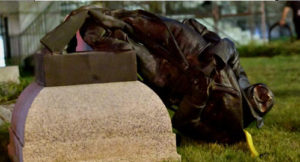
Since the awful riot that took place at the base of a Gen. Robert E. Lee statue in Charlottesville, Virginia, earlier this month, activists and vandals have responded throughout the country by looking for 100-year-old monuments to destroy.
While it may be bad enough to strip down history, the process should rightly remain in the hands of local communities and be done through a legal and democratic process.
Many of these statues are indeed of great men, but what truly makes America great is that we are a nation of laws and not men.
The monuments targeted for destruction are not just of Confederates—they are of
Founders, explorers, emancipators, and religious men as well.
While polls have shown that most Americans want to keep the Confederate statues,
lawless mobs and vandals have decided for us that history must be destroyed and
dumped, perhaps literally, into the ash heap of history.
https://www.dailysignal.com/2017/08/22/8-monuments-attacked-since-charlottesville
Archaeologist sinks teeth into understanding cultural identity, interactions in ancient Nile River Valley
 by Madison Sanneman, Purdue University
One way we can identity whether an individual is from a particular area is from elements that are in the ground; plants and animals that we consume are incorporated into our
skeletal and dental tissues,” said Michele Buzon, professor of anthropology at Purdue
University.
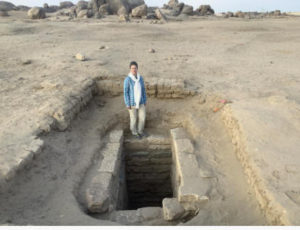
Buzon is a bioarchaeologist who has excavated in the Nubian region of modern-day Sudan, to better understand interactions between Egyptians and Nubians.
“I have been using the element strontium in tooth enamel in order to see if the individuals buried at the sites I am excavating were born and raised in the local area or if they are immigrants that were raised somewhere else,” she said.
Buzon, who also is known in the archaeology world for excavating the burial of an
ancient horse and uncovering evidence of Egyptians and Nubians creating new
communities together, spent January and February excavating at the site of Tombos in
northern Sudan with her research team, aided by a grant from the College of Liberal Arts Exploratory Research in the Social Sciences grant. A photo gallery featuring nearly two dozen images from Buzon’s recent excavation are featured online .
She’s excavated this site for ten seasons, and this recent trip focused on studying the
alkaline-earth metal called strontium. The element has similar physical and chemical
properties to calcium.
Buzon is looking into how the element varies depending on geographical location. Since
2004, she and her team have been collecting samples of strontium from soil, plants and
animal remains to determine the element’s local signature. They then compare the
strontium isotope values in dental enamel from the tombs they excavate to the local range to see if the individual grew up in the area.
“Part of this project is to understand variability in different places in the Nile Valley
because we would like to be able to see if we can identify where somebody might have
come from, if their strontium doesn’t match the local area,” Buzon said. “We are using
these plant samples from various places in the Nile Valley to get a better sense of the
local signature and see how much they might vary from place to place.”
To measure the element in humans, the surface of the tooth is cleaned and between 10
and 20 milligrams of enamel is extracted. The enamel is then ground up, dissolved and cleaned chemically before it is processed to measure the element’s isotope ratio. Buzon
has been working with Antonio Simonetti, an associate professor of engineering at the
University of Notre Dame.
Buzon’s current strontium project, which started in 2019 and will last through 2022, is
funded by the National Science Foundation, one of the largest federal agencies that
provides money for archaeology and anthropology. She was first funded by the NSF as a Ph.D. student at the University of California, Santa Barbara. The initial grant was from
2003-2004 and was awarded as an aid for her dissertation. Other grants she received from the NSF were for a 2009-2012 study to examine the identities of individuals during the development of the Napatan State and for 2014-2018 research to look at the impact of the Egyptian New Kingdom Empire in Nubia. She also was funded by the National
Geographic Society Committee for Research and Exploration in 2009.
Her work with the isotope’s variability can aid in understanding migration and how
climate change may have affected strontium over time. There are many challenges that
come with studying ancient civilizations, but now researchers have to look into how
climate change may impact how they study societies in the past.
“There have been some changes in climate, temperature and humidity and also how much dust is coming from the Sahara and moving across the desert,” Buzon said. “Some researchers have hypothesized that when sediments are coming in from another area, it could change the strontium isotope signature. This project is one way we can see if there is a change in the strontium isotope signature of a particular area because of factors that may have been affecting climate.”
While Buzon has spent 20 years excavating in the Nile Valley, she is partnering with a
new team of scientists to tell a more complete story with the help of plants. Maha
Kordofani, Sudanese botanist and professor at the University of Khartoum, is assisting
the team in identifying the types of plants collected. Working with local scientists is just
one of the ways Buzon and her team are engaging with the community.
“As anthropologists it’s important to think about other cultures coming in and
documenting the history that is not their own and what that means for telling someone
else’s story, so I think it’s very important to involve the local community—the
descendants of people we’re researching in telling the story together,” Buzon said.
The research team involves the local community by providing information on its recent
findings. The team has hosted end-of-the-season and women’s talks, and engaged with
the community to see what topics they would be interested in learning more about. Buzon and her team also have worked with the local schools to provide teaching materials and informational posters for the students. This past season, the team hosted a tour for a fifth grade class to allow the students to see the process of archaeology first hand.
“For us we want to try to provide for the community in terms of education and what their
interests are and really make this feel like a partnership. We want this to be a joint project in terms of what we’re learning about the past in Sudan and how to protect these sites and cultural heritage so that more people can learn from this information,” Buzon said.
https://www.purdue.edu/newsroom/releases/2020/Q2/archaeologist-sinks-teeth-into-
understanding-cultural-identity,-interactions-in-ancient-nile-river-valley.html
Thracian pit sanctuary found in Bulgaria’s Bourgas
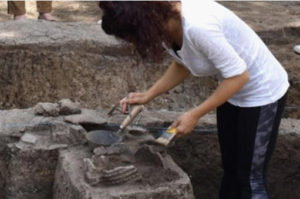 A Thracian pit sanctuary estimated to date from the fifth to the fourth century BCE has been found by archaeologists in Bulgaria’s southern Black Sea city of Bourgas, the
municipality said on June 10.
The find was made in the Izgrev complex in the city after archaeological excavations at
the site began on May 26 2020. The archaeological work precedes the planned construction of a residential building at the site in Bourgas’s Nikola Petkov Boulevard.
Bulgarian news agency BTA said that the find had been made after its correspondent in
Bourgas had noticed apparently ancient objects at the site and had alerted the Interior
Ministry regional directorate in the city.
Currently, 14 ritual pits are being studied and at least 10 more have been found.
Items found include fragments of ceramic vessels, including bowls and amphorae. There are human and animal bones in the pits, as well as coal. No finds of metal objects have been made at this stage.
Read more:
https://sofiaglobe.com/2020/06/10/archaeology-thracian-pit-sanctuary-found-in-
bulgarias-bourgas/