We believe that all cultural, historical and natural heritage, wherever they are should be preserved. LEARN MORE
Archives

Study explores how Native Americans used sea otters

University of Oregon scientists are probing archaeological evidence for how indigenous peoples used sea otters, and their findings could help Alaskans confront growing numbers of the mammals and Oregonians who want to reintroduce them on the coast.

Before fur traders decimated sea otter populations from Alaska to Oregon, ancestors of at least one Alaskan indigenous population, the Tlingit, hunted the mammals for their pelts but probably not for food, according to a study by anthropologist Madonna Moss.
Her research, published in April in American Antiquity, took on questions about
traditional use by native populations amid calls to expand harvesting. Since their
reintroduction in the 1960s, the population of sea otters has spiraled.

Only Alaska Natives living along the coast are permitted under federal law to hunt sea
otters for subsistence and with little waste. They use the pelts for clothing, bedding, hats
and other regalia.

Some environmentalists have challenged the right of Alaska Natives to hunt sea otters
without eating their meat. Conservationists want to show that native populations regularly did so as part of their case for allowing larger-scale harvesting for consumption.

The idea comes amid rising tensions. Sea otters have altered ecosystems, making it more difficult for commercial fisherman to catch abalone, clams, Dungeness crabs, red sea urchins and other invertebrates the otters consume. From 1996 to 2005, the industry was reported to have experienced an economic loss of $11.2 million.

The research by Moss, however, speaks only for Tlingit ancestors. Numerous indigenous populations from Alaska to California hunted sea otters for thousands of years, Moss said. As sea otters recolonize their historic range through population growth or additional reintroduction, such as along the Oregon coast where the
mammals are rarely seen, she said, finding out whether other native populations ate sea otter meat is worthy of attention.?

Read more: https://phys.org/news/2020-06-explores-native-americans-sea-
otters.html

Seventh-Century Shipwreck Excavated in Israel

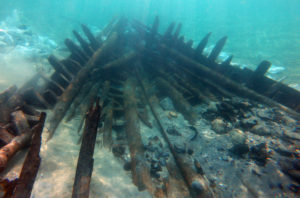
Exploration of a 1,300-year-old shipwreck just off the coast of Israel is offering new insights into life in the region at a time of transition from Byzantine to Islamic rule, according to a report from The Jerusalem Post. Researchers from the University of Haifa’s Leon Recanati Institute for Maritime Studies began excavating the wreck in 2016. They have found that its cargo included more than 100 amphoras filled with products including olives, dates, figs, fish, pine nuts, grapes, and raisins. The researchers believe the ship made stops in Cyprus, Egypt, and possibly at a port along the coast of Israel before it sank. The size and richness of its cargo appear to contradict the generally accepted belief that commerce in the eastern Mediterranean was limited during the transition from Byzantine to Islamic rule in the seventh to eighth century A.D. The excavations have also turned up several Christian crosses and the name of Allah written in Arabic. “We do not know whether the crew was Christian or Muslim, but we found traces of both religions,” said University of Haifa archaeologist Deborah Cvikel. Given that the wreck occurred close to shore and that no human bones have been found, the researchers believe everyone on board survived the ship’s sinking

‘Stories of Freedom’: Refugee photographer Farzad Ariannejad’s exhibition in the Netherlands

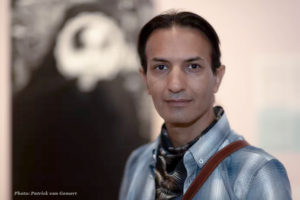
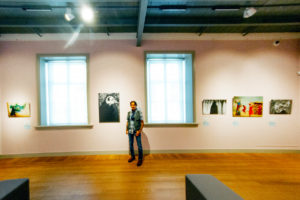
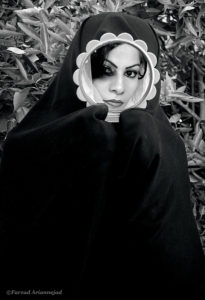
Award-winning photographer Farzad Ariannejad fled his homeland, Iran, in search of freedom and safety, and his photographs can now be seen at the Stedelijk Museum Zutphen in the Netherlands. The exhibition Stories of Freedom is a collaboration between the Stedelijk Museum Zutphen and the Buddy to Buddy foundation. “What does freedom mean to you?” is the central question of the exhibition, which opened on July 18th, 2020.
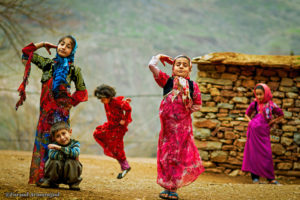
Ariannejad’s work focuses on the lives of people, especially women, in Iran. The photographs cover the people of Iran as well as the curtailing of women’s rights and the limiting of their activities. One of the photographs features a woman in a black hijab with her back to the viewer, in front of a shop window full of dolls in white veils. “For me, freedom is living the way you want, in which no one limits you or decides for you how you should live,” Ariannejad explains through interpreter and museum volunteer Darya Pourtavakol. He did not experience that freedom in Iran. “I got in trouble there by taking my pictures. I was arrested there by the regime.”
Ariannejad fled with his wife from Iran and now lives in the Netherlands. Through friends, he discovered the Buddy to Buddy foundation, which helps to relieve isolation among refugees by linking them to people in the area. There he met Merel Hubatka, project leader at the foundation, as well as a city poet and author who was considering a new exhibition at the time.
Farzad Ariannejad has worked as a volunteer with the Pasargad Heritage Foundation and WCHV since 2010. He has been practicing photography and working as a social documentary photographer since 1997.
Ariannejad has won several international awards including the Asahi Shimbun gold medal at the 78 th International Photographic Salon of Japan in 2018, a bronze award at the PX3 in France in 2018, 1st place at the Monochrome Photography Awards in England in 2017, and the Photographer of the Year award from the Pasargad Heritage Foundation in 2011 for his photographs of Iran’s natural heritage sites. He has shown his works at many exhibitions around the world including in the Netherlands, Venice, Los Angeles, and at the University of Maryland in 2009.

Anatolia: Heir to an Irano-Greek Legacy

Anatolia: Heir to an Irano-Greek Legacy

by manuvera

The article regarding the history of the Lion and the Sun motifs on Iranian flags bears the image below which was originally identified as an Achaemenid seal of King Artaxerxes II (at left) facing the goddess Anahita who sits atop a lion. The seal however was not produced during the Achaemenid era, but after the fall of the Achaaemenids and is traceable to the post-Achaemenid dynasties of Anatolia known as Commagene, Cappadocia and the Pontus.
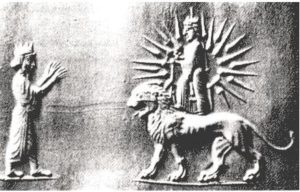
The seal was discovered along the northeastern shore of the Black Sea (Consult Collon, 1987, no. 432) in the region of the ancient Pontus.  The seal is in the British museum and not the Hermitage Museum of St. Petersburg as is often assumed.

Before we discuss (or revisit) the themes imprinted upon the plaque, we need to first provide a sketch of the successor states of Anatolia following the fall of the Achaemenids in 333-323 BC.

The Greco-Persian Legacy of Anatolia: An Overview

As Parthia gained prominence on the Iranian plateau and Mesopotamia, Persian culture had (once again) risen in prominence in Anatolia as it had during the Achaemenid era. Despite the fall of the Achamenid Empire a few hundred years before, the legacy of Iranic culture had never departed from eastern and central Anatolia. The Hellenic conquests had certainly resulted in political divisions with different regional monarchies,

Anatolia: Heir to an Irano-Greek Legacy

by manuvera

The article regarding the history of the Lion and the Sun motifs on Iranian flags bears the image below which was originally identified as an Achaemenid seal of King Artaxerxes II (at left) facing the goddess Anahita who sits atop a lion. The seal however was not produced during the Achaemenid era, but after the fall of the Achaaemenids and is traceable to the post-Achaemenid dynasties of Anatolia known as Commagene, Cappadocia and the Pontus.

The seal was discovered along the northeastern shore of the Black Sea (Consult Collon, 1987, no. 432) in the region of the ancient Pontus.  The seal is in the British museum and not the Hermitage Museum of St. Petersburg as is often assumed.

Before we discuss (or revisit) the themes imprinted upon the plaque, we need to first provide a sketch of the successor states of Anatolia following the fall of the Achaemenids in 333-323 BC.

The Greco-Persian Legacy of Anatolia: An Overview

As Parthia gained prominence on the Iranian plateau and Mesopotamia, Persian culture had (once again) risen in prominence in Anatolia as it had during the Achaemenid era. Despite the fall of the Achamenid Empire a few hundred years before, the legacy of Iranic culture had never departed from eastern and central Anatolia. The Hellenic conquests had certainly resulted in political divisions with different regional monarchies, however the Iranic Culture of Pontus-Cappadocia endured
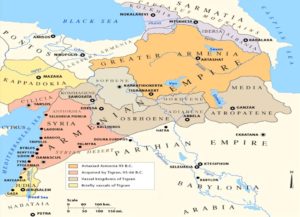
The Kingdoms of Anatolia, Pontus, Commagene and Cappadocia bore a very strong Iranian cultural, artistic and mythological tradition which was combined with that of ancient Greece. The kingdoms were later absorbed by the Roman Empire. Eastern Anatolia to this day endures with a distinct Iranic tradition with its Kurdish population speaking a west Iranian language akin to Persian.

The most famous Pontic leader was Mithradates (Mehrdad ) VI Eupator who was raised in the Greek language but also learned Persian (Bickerman, 1985, p.103; Raditsa, 1985, p.110).  Plutarch notes that Mehrdad Eupator appeared in “Persian Dress“.
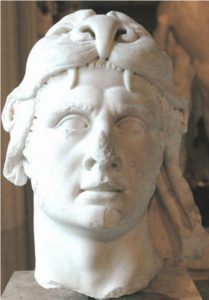
 

Mithradates (Mehrdad ) VI Eupator (134-63 BC). Mithradates spoke both Persian and Greek and sought to combine the traditions of both Greece and Persia. According to Plutarch, he appeared in “Persian Dress”. 

Some Iranian influence even extended to Ionian coast along  Aegean. Plutarch had noted that the cultural exchanges taking place in Ephesos (near modern Izmir in western Turkey), were leading to latter’s “barbarization” (Plutarch, Lys. 3).  In Lycia, Iranic names become widespread among the nobility (Dandamaev & Lukonin, 1989, p.300). It was this Greco-Iranian legacy that was to inspire Mithradates of Eupador.

However, to characterize those regions as exclusively Iranian is simplistic: Eastern Anatolia bears a powerful Hellenic and subsequent Armenian imprint as well. During the Achaemenid era Greek cities began to be founded along the Black Sea coast just as the Iranian Magi, nobility and settlers were arriving into the region. A similar process of Irano-Greek fusion had been taking place in the ancient Ukraine since at least Median times.

Just twenty years after the passing of the Hellenic conqueror Alexander in 333 BC, two independent Irano-Anatolian monarchies gained power in Anatolia by 305 BC: the Kingdoms of Pontus and Cappadocia. What is especially of interest is that their subjects claimed descent from the Achaemenids of the First Persian Empire (Raditsa, 1985, p.106). Note the contrast to those Iranians west of the Halys River in western Anatolia: these had become Hellenecized after the conquests of Alexander.

Pontic Greek music performance during the Olympic ceremonies held in Athens, Greece in 2004. The music is of interest in that it contains instruments, percussion and melodies consistent with the Music of northern Iran, the Caucasus and Turkey. The drumming for example is seen in western Iranian folklore music; the genuflect motion is seen in various types of Kurdish dances; and the attire is seen in traditional Georgian and Armenian costume.

The Iranians of Cappadocia fought against Alexander at Gaugamela in 331 BC and continued to resist the Greeks, even after the fall of the Achaemenid Empire (Raditsa, 1985, p.106). Hellenization took longer to find its roots in Cappadocia and began a century after Alexander’s conquests. The Iranian character of Cappadocia recognized as late as the time of Roman Emperor Augustus by the ancient historian Strabo who considered Cappadocia as: “a living part of Persia” (Strabo XV, 3.15).

Cappadocia bore a strong Zoroastrian legacy.  Despite Alexander’s conquests of Asia Minor, Cappadocia still had many Iranian temples and Zoroastrian magi by the advent of Parthian rule in Persia (Strabo, XI, 14.16, XV, 733). Remarkable is the term of Grand Magus as being second after the king (Strabo, XII, 2.3). This term is found in Achaemenid, Parthian and Sassanian Persia.

The Mithraic-Zoroastrian temples of Cappadocia also served as centers of worship for the populations of: Armenia and Pontus (Raditsa, 1985, p.107) just as the temples of Media Atropatene did for Medes, Persians, Hyrcanians and other Iranic peoples of the Parthian realm.

By the 1st century BC Antiochus I of Commagne spoke of combining the mythology and cultures of Greece and Persia. His genealogy claimed Iranian descent from the Achaemenids and Greek descent from Alexander.
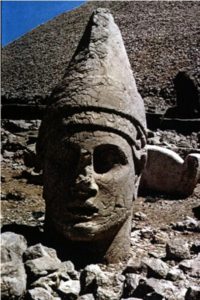
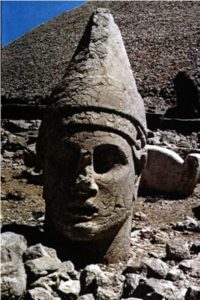
Statue at Nimrud-Dagh (ancient Commagene). Note the combination of tall conical Persian hat (still used by mystic cults and Dervishes) with Greek style of anthropomorphic depiction.  Antiochus I (86-38 BC) spoke Greek but dressed in Iranian style and demanded that the local Magi dress like the Persians. The surviving statues and architecture of Nimrud-Dagh shows a clear synthesis of Greek and Persian arts and architecture (Ghirschman, 1962).  

The regions of Cappadocia and Pontus failed to attract the same level of Hellenic immigration as those further east and south into Iran and Mesopotamia. As noted by Raditsa:

“…Hellenization in lands like Pontus and Cappadocia meant that the natives Hellenized themselves” (1985, p.112)

Assyriology notes on the Plaque: Heir to a Mesopotamian Tradition

But what of the plaque discussed in the introduction of the article?
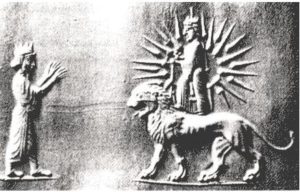
 

It is interesting that the seal shows the sun emanating 21 rays, the same symbol which is used by various ancient Iranic cults among the Kurds of Iran, Iraq and Turkey. The 21 rays may be related to the festival date of Mehregan (Festival of the Sun-god Mithra) which takes place from the 16th to the 21st of Mehr of the Iranian calendar.

That too is in the post-Achaemenid tradition of arts and its style bears a stronger resemblance to the Achaemenid rather than the Hellenic arts. This was (as noted earlier) found in the site of the ancient Pontus where the imprint of Zoroastrianism was strong.

The plaque represents Anahita superimposed on a solar deity – perhaps the ancient Iranic god Mithras. But is the theme specifically Iranic and/or Zoroastrian? The discipline of  Assyriology provides an interesting explanation as to an ancient Mesopotamian tradition that has exerted its own influence upon the Iranian-type seal. Simo Parpola accounts of the seal are as follows:

The Achaemenid seal discovered on the northeast coast of the Black Sea and represents the goddess Anahitamounted on a lion and surrounded by the divine radiance, appearing to a Persian king. The details of the king’s and the goddess’s dress and crown are Persian, but in all other respects the seal is a faithful reproduction of centuries older Assyrian seals depicting appearances of the goddess Ishtar to members of the imperial ruling class. It thus illustrates not only the adoption of the Mesopotamian concept of “divine radiance” by the Persians,
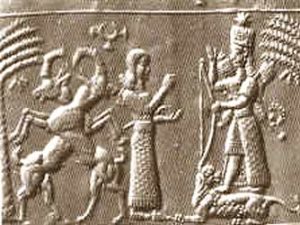
A Neo-Assyrian seal (circa  750-650 BC) of Ishtar (at left) standing with her bow on her mythical lion. She is faced by a worshipper. British Museum. The Assyrian and Mesopotamian tradition in general certainly left a robust legacy on the Achaemenid Persians who succeeded them. Indeed the Aramaic language was the Lingua Franca of the Achaemenid Empire.

Therefore while the Achaemenid (or post-Achaemenid) seal has Iranian mythological themes, its artistic motifs have certainly drawn from an ancient Mesopotamian tradition.

References

Collon, D. (1987). First Impressions: Cylinder Seals in the Ancient Near East. London: British Museum Publications.

Dandamaev, M., & Lukonin, V.G. (1989). The Culture and Social Institutions of Ancient Iran. New York: Cambridge University Press.

Ghirshman, R. (1962). Iran: Parthians and Sassanians. London: Thames & Hudson.

Nissinen, M. (Editor) (2000). Prophecy in Its Ancient Near Eastern Context: Mesopotamian, Biblical, and Arabian. Atlanta, GA:  Society of Biblical Literature.

Parpolo, S. (1997). Assyrian Prophecies. Helsinki, Finland:Helsinki University.

Related posts:

  1. Fezana Journal article on Ancient Iranian Women

  2. UBC Lecture (November 29, 2019): Civilizational Contacts between Ancient Iran and Europe

  3. The Nozhat ol Majales: A major document proving the Persian legacy of Azarbaijan and Arran

  4. M. L. Chaumont: Greek Historian Arrian (2nd century CE)

  5. Tajik speakers of China: Heir to an Ancient Tradition

  6. Azerbaijan Republic acknowledges Historical Legacy of Polo Game

  7. Challenging the Core of Greek and Iranian Identities

  8. Persian Influence on Greek Thought

  9. Nowruz in Georgia and the Georgian Legacy in Iran

  10. New Course: Persia and World Civilization: A Silent Legacy

http://kavehfarrokh.com/news/eastern-anatolia-heir-to-an-ancient-irano-greek-legacy/

International Day of Friendship, July 30th

Our world faces many challenges, crises and forces of division — such as poverty, violence, and human rights abuses — among many others — that undermine peace,
security, development and social harmony among the world’s peoples.
To confront those crises and challenges, their root causes must be addressed by
promoting and defending a shared spirit of human solidarity that takes many forms — the simplest of which is friendship.
Through friendship — by accumulating bonds of camaraderie and developing strong ties of trust — we can contribute to the fundamental shifts that are urgently needed to achieve lasting stability, weave a safety net that will protect us all, and generate passion for a better world where all are united for the greater good.

Background
The International Day of Friendship was proclaimed in 2011 by the UN General
Assembly with the idea that friendship between peoples, countries, cultures and
individuals can inspire peace efforts and build bridges between communities.
The resolution places emphasis on involving young people, as future leaders, in
community activities that include different cultures and promote international
understanding and respect for diversity.
To mark the International Day of Friendship the UN encourages governments,
international organizations and civil society groups to hold events, activities and
initiatives that contribute to the efforts of the international community towards promoting
a dialogue among civilizations, solidarity, mutual understanding and reconciliation.
The International Day of Friendship is an initiative that follows on the proposal made by
UNESCO defining the Culture of Peace as a set of values, attitudes and behaviours that
reject violence and endeavour to prevent conflicts by addressing their root causes with a view to solving problems. It was then adopted by the UN General Assembly in 1997.

Remains Repatriated to Oneida Indian Nation

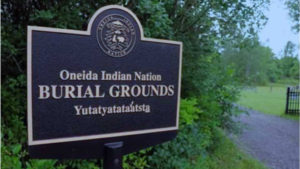
VERONA, NEW YORK—According to a Rome Sentinel report, bone fragments held in the archives at Colgate University’s Longyear Museum of Anthropology will be handed over to the Oneida Indian Nation. The ten fragments, identified during a recent inventory, are thought to be the remains of at least six different people. The bones were unearthed in the twentieth century by members of the New York State Archaeological Association at various sites in the ancestral Oneida homelands, and were acquired by the museum between 1959 and 2000. “We are grateful for the return of these remains, and truly appreciate Colgate University for coming forward with this discovery so that our ancestors may receive a proper re-internment at our burial grounds,” said Ray Halbritter, Oneida Indian Nation Representative. The Longyear Museum repatriated additional items to the Oneida Nation in 1995 and 2003. To read about Native American sites on an island in the Hudson River, go to ” Off the Grid: Rogers Island, New York .”
https://www.archaeology.org/news/8872-200722-oneida-remains-repatriated

Ancient Greek Temples Had The First Disabled Access Ramps

Study Finds: Ancient Greek Temples Had The First Disabled Access Ramps

Ancient Greeks had the first disabled access to buildings around 2,400 years ago, according to a new study.

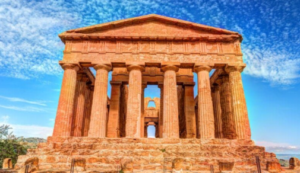
Archaeologists say 11 small stone ramps at a healing sanctuary originally built in the 6th century BC helped the mobility-impaired.

Several Ancient Greek temples and other buildings, some older than the 4th century BC, were likely also built with disabled access in mind.

Many Ancient Greek temples had ramps, although these have often been ignored by archaeologists, who assumed them to be sacrificial altars for animals.

But they sometimes served as disabled access – especially at healing sanctuaries, where the disabled visitors prayed and presented carvings to the gods with the hope of recovery.

The US study presents the earliest know evidence of ancient societies adapting architecture to meet the needs of disabled people.

‘Archaeologists have long known about ramps on ancient Greek temples, but have routinely ignored them in their discussions of Greek architecture,’ said Dr Debby Sneed from California State University in Long Beach, US.

‘The likeliest reason why ancient Greek architects constructed ramps was to make sites accessible to mobility impaired visitors.

‘Even without a framework of civil rights as we understand them today, the builders of these sites made architectural choices that enabled individuals with impaired mobility to access these spaces.’

Dr Sneed, sole author of the study, formed her conclusions when re-evaluating the geographical distribution of ramps in ancient Greece, which are common but have been neglected in prior research.

Ramps are often missing in plans in scholarly articles and student text books, despite being common at healing sanctuaries where large numbers of visitors came in search of help from the healing god Asclepius.

The clearest case of a sanctuary adapted for disabled access is the Sanctuary of Asclepius at Epidaurus, an ancient city in the modern-day region of Peloponnese.

The Sanctuary of Asclepius, which was initially built in the 6th century BC, was a vast site containing temples and hospital buildings devoted to its healing gods and became on of the most important healing sanctuaries in Ancient Greece.

Renovations starting in 370 BC expanded the site but also focused on increasing disabled access – 11 stone ramps installed on nine structures during the renovations.

Meanwhile, at the smaller sanctuary of Asclepius in Corinth, also in modern-day Peloponnese, great care was given to the access ramps, which feature ‘fine masonry’.

A large number of carved dedications to the god represent legs and feet, suggesting people requested healing in this part of the body.

‘This is now the earliest evidence we have to show that ancient societies were not only capable of giving active and conscious attention to the needs to their disabled community members but that they sometimes chose to expend considerable resources and labour in order to make certain spaces more inclusive of a wide range of body types,’ said Dr Sneed.

Sources indicate disabilities were common in Ancient Greece and tests detail a range of conditions that restricted mobility.

Historical documents report examples of this, including the Athenian statesman Miltiades (554-489 BC), who is credited with winning the Battle of Marathon in 490 BC.

He suffered a leg injury and had to be carried on a litter – a vehicle carried by porters – for the rest of his life.

The majority of adults in ancient Greece, comprising citizens, slaves, and foreigners, men and women, likely either experienced disability themselves, or encountered it through a member of their household or community.

Archaeological evidence taken from grave sites also suggests disability was common in Ancient Greece.

As much as 60 per cent of individuals excavated from a Classical-period cemetery at the site of Amphipolis, an ancient city in Northern Greece, had osteoarthritis.

This familiarity with disability is also reflected in Greek mythology – Hephaestus, one of 12 Olympian gods and the patron god of craftsmen, had a mobility impairment.

Some ramps in Ancient Greece are thought to have simple and practical functions, such as helping deliver supplies by cart, but they’re more common at healing sanctuaries, where many major and minor buildings had ramp access.

This is evidence that they were not simply built for carts but helped the mobility-impaired.

‘More than 2,000 years ago, ancient Greeks spent time and money building ramps to aid individuals who could not easily ascend or descend stairs, and all without targeted legislation requiring them to do so,’ said Dr Sneed.

‘It is hoped that this research may stimulate further investigations into accessibility at other sites in the Classical world and beyond.’

The study has been published in Antiquity.

Katja Sporn, head of the German Archaeological Institute’s Athens department, expressed doubt about the theory, however.

She told Science that ramps are found predominantly in the Peloponnese, which is the heartland of Ancient Greece, which could make them a regional and brief architectural trend that had more than one purpose.

‘It helps everyone, also disabled people, walk into temples better, but that you would only do it for disabled people I don’t find convincing,’ she said.

https://english.alsiasi.com/index.php/2020/07/22/study-finds-ancient-greek-temples-had-the-first-disabled-access-ramps/

Turkish Islamist tyrant’s obscene bid to turn the Hagia Sophia into a mosque

By Toufic Baaklini
From 1915 to 1923, the Ottoman Empire, the forerunner of modern Turkey,
systematically killed more than 2 million Christians — 1.5 million Armenians and half a
million Syriacs, Assyro-Chaldeans, Greeks and Maronites. During that period, half the
populations of Tur Abdin and Mount Lebanon, among the Middle East’s final Christian
strongholds, were slaughtered or died of famine.
To this day, the Turkish government denies this genocide. Now, what remains of the
country’s Christian heritage is under attack from President Recep Tayyip Erdogan. The
latest assault: The Islamist strongman wants to convert the Hagia Sophia, his nation’s
most recognizable landmark, from a museum to a mosque. The move would all but
complete the erasure of Turkey’s Christian heritage that began with a genocide a century ago.
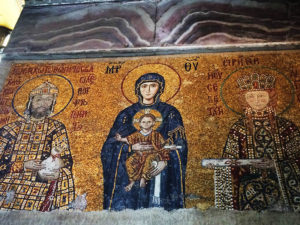
Consecrated as a Byzantine cathedral in the 6th century, the Hagia Sophia (“Holy
Wisdom”) was once Christianity’s largest cathedral and the historic seat of the Orthodox
patriarch of Constantinople, as Istanbul was known for much of the last two millennia.
Eastern Christians for centuries viewed the cathedral as an unparalleled pilgrimage
destination. Its relics included supposed pieces of the original Cross of Jesus Christ, as
well as the lance that pierced the Nazarene’s side. Pilgrims sought healing from these and other items. You might say the Hagia Sophia was the Saint Peter’s Basilica of Eastern Christianity.
In 1453, following the defeat of historic Byzantium, the Ottomans converted the
cathedral into a mosque as a symbol of their dominion over Turkey’s indigenous
Christians. In the process, they desecrated and plastered over the early Christian icons,
mosaics and frescos — though some pieces remain.
In 1934, Mustafa Kemal Ataturk, the secularist founder of modern Turkey, converted the
Hagia Sophia from a mosque into a museum, as “a monument for all civilization.” This
allowed people of all faiths to marvel at the Christian icons and the sheer beauty of the
site without a religious litmus test to enter.
Erdogan, however, is unapologetically nostalgic for the days of the Ottoman Empire. His
plan to convert the Hagia Sophia into a mosque is of a piece with his Islamist vision for
the country, a vision that sits uncomfortably with the Hagia Sophia, a gigantic monument to what used to be called Christendom — right at the heart of Turkey’s most important city.
He mustn’t be allowed to go forward.” Clear statements from Secretary of State Mike Pompeo and Ambassador-at-Large for Religious Freedom Sam Brownback supporting the preservation of the Hagia Sophia as a museum are encouraging. But they lack the weight of the Oval Office. Now is the time for President Trump to recognize Turkey’s barbarous recent history — and to compel Erdogan to respect the heritage of his country’s indigenous Christian population.
Trump has made religious pluralism a centerpiece of his foreign policy . The seriousness of that commitment stands or falls in Turkey, a country that has become increasingly hostile to religious liberty. It’s why Trump should press Turkey to honor the status quo of the Hagia Sophia. This would follow his successful application of pressure on Ankara to secure the release of American pastor Andrew Brunson, a former prisoner of conscience in Turkey.
Last fall, Congress made history with bipartisan recognition of the Armenian Christian
Genocide. Ankara wasn’t pleased, but Team Trump must follow suit: Recognizing the
Armenian Christian Genocide would be another major religious-liberty victory for this
president — not to mention the right thing to do.
Beyond these historic and cultural issues, the United States should more broadly reassess its relationship with Turkey — a move that is long overdue.
The world’s most notorious genocide denier, Erdogan, is also infamous for imprisoning
journalists and public intellectuals. Turkey’s egregious human-rights violations also
include the ethno-sectarian expulsion of Syriacs in northern Syria and the destruction of
more than 500 Greek Orthodox churches in Turkish-occupied areas of Cyprus.
At one point, Turkey was a reliable, pro-Western ally. But that is no longer the case, and
the American people are always better off when foreign policy deals with reality as it is,
rather than as we would wish it to be.
Persuading Turkey to maintain the Hagia Sophia’s status quo would be a monumental
step in the right direction — and cement the president’s legacy as a stalwart advocate of religious pluralism in the Middle East.

https://nypost.com/2020/07/07/turkish-islamist-tyrants-obscene-bid-to-turn-hagia-sophia-
into-mosque/

Turkey’s president reconverts Istanbul’s Hagia Sophia into a mosque and declares it open to worship

Turkey’s high administrative court threw its weight behind a petition brought by a religious group and annulled the 1934 Cabinet decision that turned the site into a museum. Within hours, Erdogan signed a decree handing over Hagia Sophia to Turkey’s Religious Affairs Presidency.
A woman wrapped in a Turkish national flag gestures outside the Hagia Sophia on July 10, 2020 in Istanbul as people gather to celebrate after a top Turkish court revoked the sixth-century Hagia Sophia’s status as a museum.
Erdogan has demanded that the hugely symbolic world heritage site should be turned back into a mosque despite widespread international criticism, including from the United States and Orthodox Christian leaders. The move could also deepen tensions with neighboring Greece.
Cypriot Foreign Minister Nikos Christodoulides, a Greek Cypriot, posted on his official Twitter account that Cyprus “strongly condemns Turkey’s actions on Hagia Sophia in its effort to distract domestic opinion and calls on Turkey to respect its international obligations.”

World Population Day

“The 2030 Agenda for Sustainable Development is the world’s blueprint for a better future for all on a healthy planet. On World Population Day, we recognize that this mission is closely interrelated with demographic trends including population growth, ageing, migration and urbanization.”

UN Secretary-General António Guterres

World Population Day, which seeks to focus attention on the urgency and importance of
population issues, was established by the then-Governing Council of the United Nations
Development Programme in 1989, an outgrowth of the interest generated by the Day of
Five Billion, which was observed on 11 July 1987.
This year’s World Population Day calls for global attention to the unfinished business of
the 1994 International Conference on Population and Development . Twenty-five years
have passed since that landmark conference, where 179 governments recognized that
reproductive health and gender equality are essential for achieving sustainable
development.
In November, UNFPA, together with the governments of Kenya and Denmark, will be
convening a high-level conference in Nairobi to accelerate efforts to achieve these unmet goals. On World Population Day, advocates from around the world are calling on leaders, policymakers, grassroots organizers, institutions and others to help make reproductive health and rights a reality for all.

Why Do We Mark International Days?
International days are occasions to educate the public on issues of concern, to mobilize
political will and resources to address global problems, and to celebrate and reinforce
achievements of humanity. The existence of international days predates the establishment of the United Nations, but the UN has embraced them as a powerful advocacy tool. More information available here .