 Recently, Chief Justice Sadegh Jafari Chegni of Shush in Khuzestan Province, stated that his office was submitting an inhumane tradition called “Khoon Bas” to the Iranian Heritage Office for registration of the practice as an “intangible cultural heritage” of Iran.
“Khoon Bas” is a medieval custom for some tribes in different countries, including medieval Iran. This custom was performed after a clash between two tribes involved in war and bloodshed.
Tribal elders would then give one or more daughters from the victim’s tribe (from infancy) to the tribe that won the war, in order to stop the process of bloodshed and to put an end to any future conflict or revenge. However, the pardoned girl or girls who were married to the men of the slain tribe no longer had any rights, and were in fact sexually, physically, and mentally abused as slaves.
This awful and inhumane custom gradually disappeared and became illegal during the Pahlavi era. Unfortunately, after the Islamic Revolution, it was re-enacted because it was supported by Iranian government officials, similar to issues such as female circumcision, concubines, or religious prostitution, and other cruel and anti-woman rituals.
The officials of the Islamic government intend to register these kinds of customs as “Iranian cultural heritage” and intend to send them to the United Nations Educational, Scientific and Cultural Organization (UNESCO) to be placed on the world’s list of intangible cultural heritage.
Fortunately, recent protests by men and women who love Iranian culture and are against the registration of such horrific rituals have led to UNESCO formally asking the Cultural Heritage Organization of the Islamic Republic to stop the registration of such inhumane and anti-woman practices.
Yesterday however, the Chief Justice of Shush continued to stand by his previous statements and called UNESCO’s reaction “narrow-minded.”
Archives
International Day for the Remembrance of the Slave Trade and its Abolition
 The night of 22 to 23 August 1791, in Santo Domingo (today Haiti and the Dominican Republic) saw the beginning of the uprising that would play a crucial role in the abolition
of the transatlantic slave trade.
It is against this background that the International Day for the Remembrance of the Slave Trade and its Abolition is commemorated on 23 August each year.
This International Day is intended to inscribe the tragedy of the slave trade in the
memory of all peoples. In accordance with the goals of the intercultural project “The
Slave Route”, it should offer an opportunity for collective consideration of the historic
causes, the methods and the consequences of this tragedy, and for an analysis of the
interactions to which it has given rise between Africa, Europe, the Americas and the
Caribbean.
The Director-General of UNESCO invites the Ministers of Culture of all Member States
to organize events every year on that date, involving the entire population of their country and in particular young people, educators, artists and intellectuals.
International Day for the Remembrance of the Slave Trade and its Abolition was first
celebrated in a number of countries, in particular in Haiti (23 August 1998) and Goree in
Senegal (23 August 1999). Cultural events and debates too were organized. The year
2001 saw the participation of the Mulhouse Textile Museum in France in the form of a
workshop for fabrics called “Indiennes de Traite” (a type of calico) which served as
currency for the exchange of slaves in the seventeenth and eighteenth centuries.
Circular CL/3494 of 29 July 1998 from the Director-General to Ministers of Culture
invites all the Member States to organize events to mark 23 August each year.
Artifacts Revealed in Attic of Tudor Manor House
 NORFOLK, ENGLAND— The Guardian reports that artifacts dating back to the Tudor
period were discovered during roof repairs at eastern England’s Oxburgh Hall, which was built in the late fifteenth century by the devout Catholic Bedingfeld family. In 1559, Sir Henry Bedingfeld refused to sign the Act of Uniformity, which outlawed the Catholic
Mass. As a result, the Bedingfelds were persecuted and ostracized by the Tudor court. A complete personal prayer book with a gilded leather binding, found in an attic void by a builder, may have been concealed by the family. Among debris in a rat’s nest found
under floorboards in the northwest corner of the attic, archaeologist Matt Champion
recovered more than 200 well-preserved pieces of textiles such as silks, satin, leather,
velvet, wool, and embroidery dating to the late Tudor, Elizabethan, and early Georgian
periods, and scraps of handwritten music dated to the sixteenth century. Fragments of
pages from the hidden book were also found in the nest. Under the floorboards near the
attic’s south-facing windows, Champion found document fragments, evidence of wax
seals, and hundreds of pins, indicating that the well-lit area was used for sewing and
writing in the eighteenth century."
1,200-Year-Old Soap Factory Unearthed in Negev Desert
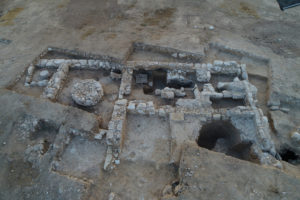 The Times of Israel reports that a 1,200-year-old soap factory has been unearthed in the Negev Desert by a team of Israel Antiquities Authority researchers, with the assistance of local high school students. Archaeologist Elena Kogen-Zehavi said the large, pillared structure where the olive oil–based soap was made dates to the Islamic Abbasid period, after the Arab conquest of the region. Turning olive oil and the ashes of the saltwort plant into hard cakes of soap was a complicated process, she explained. First, the liquid mixture was cooked for about seven days, and was then transferred to a shallow pool, where the soap hardened for another ten days, until it could be cut into bars, which dried for another two months. So much soap could have been produced at the site, Kogen-Zehavi added, that it was probably exported to Egypt and other parts of the Arab world.
To read about how the ancient village of Ein Gedi endured from the seventh century B.C. to the Byzantine period, go to ” Letter from the Dead Sea: Life in a Busy Oasis .”
Saudi Arabia’s Stone Structures Investigated
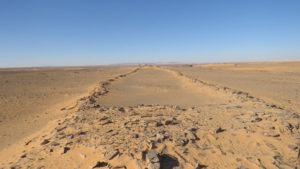 According to a statement released by the Max Planck Institute for the Science of Human History , an international team of researchers analyzed satellite imagery and conducted field surveys to document hundreds of massive rectangular stone structures in northwestern Saudi Arabia, and discover more than one hundred additional structures.
Known as “mustatils,” the rectangular monuments are thought to have been constructed
by pastoralists for ritual use. Most of them consist of two large platforms connected by
long, low, parallel walls, and some locations have multiple structures built right next to
each other. Few artifacts have been found at the mustatils. Bones of wild animals and
what may have been wild aurochs or early domesticated cattle were found inside one of
the platforms. Charcoal from this site has been dated to 7,000 years ago, when the region was covered with grasses, dotted with lakes, and vulnerable to drought. Researcher Huw Groucutt explained that the very act of building mustatils probably helped to bond pastoralists living in such a challenging environment
World Humanitarian Day 19 August
 Providing life-saving support during the pandemic.
On World Humanitarian Day (WHD) August 19, the world commemorates humanitarian workers killed and injured in the course of their work, and we honour all aid and health
workers who continue, despite the odds, to provide life-saving support and protection to people most in need.
This year World Humanitarian Day comes as the world continues to fight the COVID-19 pandemic over recent months. Aid workers are overcoming unprecedented access hurdles to assist people in humanitarian crises in 54 countries, as well as in a further nine countries which have been catapulted into humanitarian need by the COVID-19 pandemic.
This day was designated in memory of the 19 August 2003 bomb attack on the Canal
Hotel in Baghdad, Iraq, killing 22 people, including the chief humanitarian in Iraq, Sergio
Vieira de Mello. In 2009, the United Nations General Assembly formalized the day as
World Humanitarian Day.
Medieval Bridges, Artifacts Found in a Polish Lake
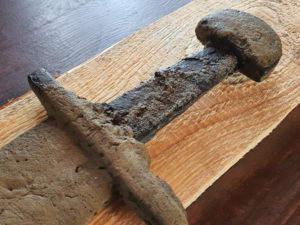 According to a report in The First News , archaeologists from Nicolaus Copernicus University and the Museum of the First Piast at Lednica used photogrammetry to map the bottom of west-central Poland’s Lake Lednica. Located between the city of Gniezno, site of the country’s first capital, and Poznań, the seat of the country’s first Christian bishop, the lake is remembered as the site of the Christian baptism of Duke Mieszko I, who ruled Poland from about 960 to 992. The study revealed the remains of wooden shore fortifications dated to the time of Mieszko I, and two medieval wooden bridges. Artifacts discovered under the remains of the bridges include an intact tenth-century sword and remains of its leather scabbard. X-rays revealed that the sword was decorated with a Christian symbol known as the Jerusalem cross. Two axes, a spearhead, arrowheads, crossbow bolts, a sickle, ceramics, and animal bones were also found. One of the axes, resembling a Scandinavian style, was inlaid with silver decorations.
3,000-Year-Old Horse Harness Unearthed in Scotland
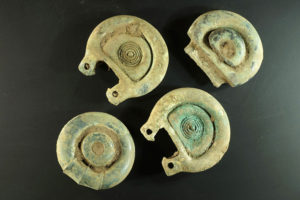 BBC News reports that metal detectorist Mariusz Stepien discovered a hoard of Bronze
Age artifacts in southern Scotland. “I was over the moon, actually shaking with happiness,” Stepien said of the find. The archaeologists who excavated the site recovered an intact horse harness, complete with leather straps, rings, and buckles; a sword in its scabbard; chariot wheel axle caps; and a rattle pendant thought to have been hung from the harness for decoration. “There is still a lot of work to be done to assess the artifacts and understand why they were deposited,” Emily Freeman of the Crown Office’s Treasure Trove Unit commented
https://www.archaeology.org/news/8947-200811-scotland-intact-harness
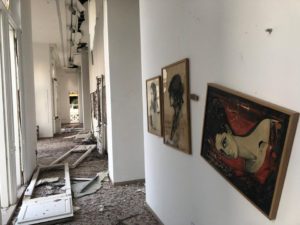
Several galleries and museums have been destroyed in Beirut
 By: Rebecca Anne Proctor
5th August 2020 08:08 BST
Two powerful explosions at the Port of Beirut on early Tuesday evening left more than 70 people dead and over 4,000 injured. Initially, Lebanese state-run National News
Agency reported that a fire broke out near the Beirut Port. According to Lebanon’s Prime Minister, an investigation is underway concerning an estimated 2,750 tons of the
explosive ammonium nitrate that has been stored at the site for six years.
The damage rocked an already fragile Beirut to its core and wreaked havoc on the city’s
renowned art scene. Major art galleries, including Marfa Gallery, located close to
Beirut’s Port, and Galerie Tanit were completely destroyed. Galerie Tanit had hosted a
vernissage on Monday evening for the Lebanese artist Abed Al Kadiri’s solo exhibition
Remains of the Last Red Rose scheduled to be on view until 25 September. Opera
Gallery’s sleek Beirut branch, located in the city’s downtown district overlooking the
seafront, has also been decimated.
 The blasts sent ripples of destruction throughout the city. Galerie Sfeir-Semler, located in the desolate district of Karantina, and Galerie Janine Rubeiz in the Raouché area, have also been damaged. “One of my employees is in intensive care and the gallery has been damaged,” said gallery owner Saleh Barakat. “We barely had the time to close the open vitrines to protect the artworks and are now in the hospital to be with our colleague.”
https://www.theartnewspaper.com/news/beirut-explosion
Discover statues of gods of love and beauty
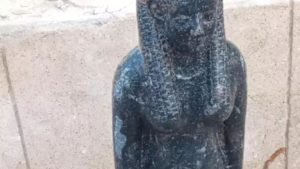 According to an ANSA report, a team of archaeologists from Egypt’s Ministry of Antiquities conducting rescue excavations on private land south of Cairo have uncovered black and pink granite statues and carved blocks dating to the reign of Ramesses II (r. ca. 1279–1213 B.C.). The finds include statues of the god Ptah, the lion-headed goddess Sekhmet, and Hathor, the goddess of beauty and love who was also regarded by the ancient Egyptians as the symbolic mother of the pharaohs. Another sculpture depicts the pharaoh himself alongside two deities. Mostafa Waziri of the Supreme Council of Antiquities said that carved limestone blocks dating to the Coptic period indicate later reuse of the site. Excavations will continue until the area has been surveyed entirely.