
We believe that all cultural, historical and natural heritage, wherever they are should be preserved. LEARN MORE
Archives

World Migratory Bird Day

Birds Connect Our World
The Convention on Migratory Species (CMS), the African-Eurasian Waterbird Agreement (AEWA) and Environment for the Americas (EFTA) have joined forces to
strengthen global recognition and appreciation of migratory birds. This year the theme of World Migratory Bird Day is “Birds Connect Our World” and was chosen to highlight the importance of conserving and restoring the ecological connectivity and integrity of ecosystems that support the natural movements of migratoy birds and that are essential for their survival and well-being.

Ecological Connectivity and its importance
Connectivity is essential for migratory species, and important for a wide variety of
ecological functions. It describes the natural and necessary movement of species and the flow of natural processes that sustain life on Earth. With 1 million species facing the risk of extinction within our generation, connectivity has become a central topic for
biodiversity and sustainability. Migratory species move across the globe, running,
swimming, or in the case of birds flying, connecting countries, people and continents
through their migration routes. This migration can only be accomplished when animals
are able to access the different sites and habitats that they rely upon along their pathways.
These pathways transcend national borders, national plans and conservation priorities of any single country. Migratory birds connect countries and their conservation requires
cooperation between countries and across national boundaries.

Connectivity and Birds
The flyways used by migratory birds connect different habitats. Often, these long-haul
flight paths cross inhospitable terrain, such as deserts and open seas. Suitable habitats for wintering, as stop-over,staging and breeding sites are crucial for the survival of these
birds. The ecological connectivity of these sites is important to the survival of migratory
birds, but this it is being threatened by habitat loss and degradation. The loss or
degradation of a critical stop-over site for migratory birds can have a devastating effect
on the survival chances of migratory birds and lead to a defragmentation that can have a devastating effect on populations. Other threats, such as poisoning, unsustainable use, collisions with man-made objects and climate change are also having a negative impact on migratory birds around the world.

International Chernobyl Disaster Remembrance Day

An explosion at the Chernobyl Nuclear Power Plant in 1986 spread a radioactive cloud
over large parts of the Soviet Union, now the territories of Belarus, Ukraine and the
Russian Federation. Nearly 8.4 million people in the three countries were exposed to the radiation.

The Soviet Government acknowledged the need for international assistance only in 1990. That same year the General Assembly adopted resolution 45/190 , calling for
“international cooperation to address and mitigate the consequences at the Chernobyl
nuclear power plant.” That was the start of the United Nations’; involvement in the
Chernobyl recovery. An Inter-Agency Task Force was established to coordinate the
Chernobyl co-operation. In 1991 the UN created the Chernobyl Trust Fund – currently
under the management of the Office for the Coordination of Humanitarian Affairs
( OCHA ). Since 1986, the UN family of organizations and major NGOs have launched
more than 230 different research and assistance projects in the fields of health, nuclear
safety, rehabilitation, environment, production of clean foods and information.

In 2002 the United Nations announced a shift in the Chernobyl strategy, with a new focus on a long-term developmental approach. UNDP and its regional offices in the three affected countries took the lead in the implementation of the new strategy. There is still a great deal of work that needs to be done in the affected region. To provide support to international, national and public programmes targeted at the sustainable development of these territories, in 2009 UN launched the International Chernobyl Research and Information Network (ICRIN) .

On 8 December 2016 the United Nations General Assembly adopted a resolution designating 26 April as International Chernobyl Disaster Remembrance Day.
In its resolution, the General Assembly recognized that three decades after the disaster
there remains persistent serious long-term consequences and that the affected
communities and territories are experiencing continuing related needs. The General
Assembly invites all Member States, relevant agencies of the United Nations system and other international organizations, as well as civil society, to observe the day.

An open letter to: Secretary of State for the United States of America

Your Excellency Mr. Mike Pompeo, Secretary of State for the United States of
America

Yesterday, the 22 rd of April 2020, in a conversation on Fox TV, you erroneously called the Persian Gulf by another name.

I am sure you are also familiar with historical and geographical information regarding the countries of the world because of your very important position representing the USA, and that you know the real names of important regions and areas of the world.
The name ‘Persian Gulf’ has been written on many inscriptions, historical texts, and ancient world maps. Many of these can be seen in the world’s major museums.

In addition, the name of the Persian Gulf is clearly on the map of the United Nations and used by all the countries around the world.

I am sure you agree that the cultural and historical values of millions of Iranians have been violated, neglected, and destroyed by the religious and oppressive government in Iran. Therefore, we greatly hope that countries that consider themselves friends and supporters of Iranian people do not forget the rich history of Iran and will defend Iranian heritage.

With respect and regards,
Shokooh Mirzadegi
Executive Director of the Pasargad Heritage Foundation, Denver, Colorado
April 24, 2020
www.savepasargad.com

Archaeological community warns of looting and destruction of Iranian cultural heritage during coronavirus pandemic

Translated by: WCHV

As expected, heritage experts and lovers of culture have repeatedly warned the Iranian Ministry of Cultural Heritage, Tourism and Handicrafts about the protection of historical heritage during the coronavirus pandemic, with increasing reports of the destruction and looting of historical Iranian buildings and sites. This situation is believed to be due to the
closure of historical sites by government officials to prevent further spread of COVID-19.

The Iranian government has continued to attribute such acts of destruction to the work
of “ordinary people” and blames the looting of historical monuments on profiteers or
“illegal diggers.” It seems unlikely that during these difficult times of the coronavirus
pandemic, even those unaware of the need to preserve cultural heritage would want to
destroy the historical sites. One wonders if there are people who have a long-standing
grudge against Iranian cultural heritage. What is also strange is that these so-called
“unauthorized diggers” seem to have tractors and drilling equipment, yet somehow still
go undetected.

A letter, addressed to Ali Asghar Monsan, Minister of Cultural Heritage and Tourism,
said, “As we all know, in order to combat the spread of the coronavirus in coming
weeks, the Cabinet has come up with a variety of plans and ‘social distancing’ has been
implemented. Therefore, many government agencies and organizations have been shut
down or are working on a part-time basis. These measures, which help to prevent the
spread of COVID-19, could also provide opportunities for looters to steal cultural
artifacts and damage and destroy some cultural heritage sites. The lack of adequate
monitoring of historical and cultural sites and cultural relics are detrimental to our
homeland.”

“Unfortunately, both online and in the media, there have been unpleasant news
regarding destruction and damage to the structures and boundaries of some historical
and cultural monuments throughout the country, especially in the provinces of
Kermanshah, Fars, and others, which is of great concern to us.” The letter continued.

The letter also addresses another important issue, which has been a major concern for
cultural heritage experts for years and that has been ensuring the safety of experts and
those who take care of the national heritage sites.
From: www.savepasargad.com

Egypt’s Min. of Tourism & Antiquities announces archaeological discovery at Saqqara

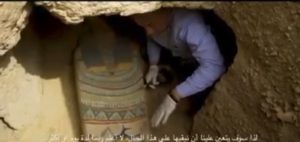
CAIRO – 19 April 2020: Egypt’s Ministry of Tourism and Antiquities announced a new archaeological discovery on April 18, for the first time via the internet. A shaft measuring 120 x 90 centimeters 11 meters deep has been found, at the bottom of which five sealed stone coffins/sarcophagi, four niches in a room containing wooden coffins and Late Period human burials were uncovered.

A massive anthropoid wooden coffin bearing hieroglyphs written in yellow pigment was
discovered in one of these niches.

Other objects were discovered around this coffin, including: 365 faience ushabti figurines, some of which bear hieroglyphs texts, a small wooden obelisk about 40 centimeters tall, all four of its sides bearing painted scenes depicting the goddesses Isis and Nephthys, and the god Horus; wooden statues of the god Ptah-Sokar-Osiris; three pottery canopic jars in which the viscera removed during mummification were kept, in addition to many other artifacts.

All the small artifacts were removed from the shaft so they can undergo restoration
before being stored.

The discovery is located at the sacred animal necropolis in Saqqara. In this place many
announcements of archaeological discoveries were made along the past two years, by
experts of the Supreme Council of Antiquities.

The most important of these discoveries were the gorgeously decorated tomb of Wahti
and the cachette of the sacred birds and animals from which many animal
mummies—some extremely rare—were brought to light.

Work began in this area in April 2018, and it is still ongoing. In April 2020, the project is
now in its third season.

On April 18 within the celebrations of the World Heritage Day, Egypt’s Ministry of
Tourism and Antiquities lit the Pyramids of Giza with the slogans launched by
International Council on Monuments and Sites (ICOMOS ) which are Shared Cultures,
Shared Heritage, Shared Responsibility.

The ministry was keen to launch this event from the Giza Pyramids area as it is included in the UNESCO World Heritage List.

Egypt’s minister of Tourism and Antiquities Khaled El-Enany and Egypt’s minister of
information Osama Heikal.

Ministry of Tourism and Antiquities organised a lot of events to celebrate the World
Heritage Day.

Egypt’s minister of Tourism and Antiquities Khaled El-Enany took us in a tour inside the
awe-inspiring tomb of Wahti in Saqqara.

Uncovered in 2018, Wahati tomb is considered one of the most important discoveries of
the decade.

The tomb belonged to a Fifth Dynasty High-Priest of ‘Purification’, making it an
especially apt and timely reminder that cleansing and protecting that which we hold dear is an innate human desire that stretches back through millennia.

World Heritage Day falls on April 18 every year. It is tailor made to increase awareness
about the vitality of cultural heritage and find ways to protect and preserve our heritage.

In 1982 the International Council of Monuments and Sites suggested celebrating heritage on April 18, and it was approved by the General Assembly of UNESCO in 1983.

Also in celebration of World Heritage Day, Ministry of Tourism and Antiquities
launched a drawing competition for children aged 6-12.

The children are supposed to Chose one of the seven World Heritage Sites found in
Egypt, draw a picture of it and write a short essay to describe it. Each kid will send a
photo of his/her drawing,essay and personal data on this email: moa.cultural.develop@gmail.com.

The ministry will organise an online gallery for the drawings and chose three winners.
The last day to submit the drawings is 15 May 2020.

World Creativity and Innovation Day

This day is the day to celebrate your creativity and new ideas! It has been celebrated in over 46 countries since 2002. People in businesses, organizations, schools, and communities take part in this day to generate new ideas for a brighter future.

Marci Segal, a creativity specialist, came up with the idea for World Creativity and
Innovation Day. After reading a newspaper headline, “Canada in Creativity Crisis,” Segal decided to do something about it. With the help of her colleagues, she organized the first World Creativity Day to encourage people to use creativity to make the world a better place.

There are many ways to celebrate this day, so just use your imagination!

Exeter to repatriate Blackfoot regalia to Siksika Nation

By: Simon Stephens
Material will be cared for by Blackfoot Crossing Historical Park Exeter City Council has voted to return material held by its Royal Albert Memorial Museum (Ramm) to the Siksika Nation in Canada.
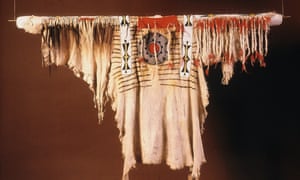
The regalia, which includes a buckskin shirt, pair of leggings, a knife with feather bundle, two beaded bags and a horsewhip, once belonged to Chief Crowfoot, a Blackfoot leader in the late 19th-century.
The Blackfoot Crossing Historical Park (BCHP) made a formal request for Ramm to
repatriate the Crowfoot regalia in 2015. The BCHP visitor centre focuses on Siksika
cultural heritage and the preservation of their way of life. The area is of great spiritual
significance to the Siksika Nation and BCHP is built on the site of the signing of an
important treaty in 1877. It is also the place where Crowfoot died.
After initial dialogue with BCHP, Ramm approached Chief Ouray Crowfoot in January
2020. Chief Crowfoot, a Siksika Nation chief, confirmed that the Siksika Tribal Council,
as the elected representatives of the community, would be prepared to take ownership of the regalia.
The Siksika Nation will lend the regalia to the BCHP, which will care for the regalia.
Chief Crowfoot will visit Exeter for an official ceremony to hand over the regalia once
Covid-19 restrictions have lifted. Chief Crowfoot said: “As a direct descendant of the Great Chief Crowfoot, I am pleased that the regalia will be returned to its rightful home, the Siksika Nation. The returning of this regalia will contribute to healing and reconciliation and the Great Chief’s spirit can rest easy once all his belongings are gathered from the four corners of Mother Earth and returned back to his home.”
Councillor Rachel Sutton, Exeter City Council’s portfolio holder for climate and culture,
said: “When considering the claim for repatriation, the council recognised that the
original injustices still reverberate today with First Nation Canadians. Giving back
Crowfoot’s regalia returns control to the Siksika Nation over their cultural identity,
dignity and authority and is the right thing to do.”
The Crowfoot regalia are thought to have been acquired from Chief Crowfoot by Cecil
Denny, a British-born policeman and one of the signatories of the 1877 treaty. Crowfoot
played a key role in the treaty signing, which he believed would help protect Blackfoot
lands and traditional ways of life, but the terms of the treaty were broken by the Canadian administration. The regalia were loaned to Ramm by Denny’s sister in 1878 and the museum bought the items in 1904.

Archaeologists Solve Mystery of Prehistoric Stone Balls

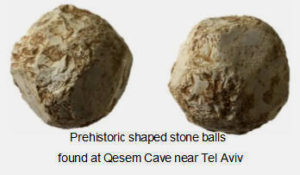
Stone artifacts painstakingly shaped into spheres were part of the daily lives of early humans for more than two million years. They have been unearthed by archaeologists in East Africa, humanity’s ancestral home, and they litter prehistoric sites across Eurasia from the Middle East to China and India. Yet experts have been puzzled by their function since the early days of research into our evolutionary history.

Now, an international team of archaeologists led by Tel Aviv University archaeologist researcher Ella Assaf, has produced evidence that these enigmatic artifacts were used for a very specific purpose: breaking the bones of large animals to extract the nutritious marrow inside.

The study, published last week in the journal PLOS ONE, highlights how an elegant technological solution that allowed hominins to increase their calorie intake endured for hundreds of thousands of years and continued to be used even as our ancestors developed new techniques and created more complex societies.

The researchers analyzed shaped stone balls, also called spheroids, found in Qesem Cave, a prehistoric site just east of the modern city of Tel Aviv that was inhabited from 400,000 to 200,000 years ago. The discovery of around 30 of these artifacts in this particular cave was a puzzle wrapped in an enigma for archaeologists. Not only did the function of the spheres remain obscure, but their presence there was considered anachronistic, because these artifacts are usually found at much older sites.

Mastery of fire

Qesem Cave was uncovered during road works in the year 2000. Since then, excavations led by Tel Aviv University archaeologists Avi Gopher and Ran Barkai has uncovered a treasure trove of hundreds of thousands of flint tools and animal bones as well as 13 hominin teeth, belonging to the as-yet-unidentified group that lived at the site. 

Whoever they were, these distant ancestors of ours were relatively ahead of their time in much of the behavior they displayed, experts say. The people of Qesem Cave (whose modern name somewhat appropriately means “magic” in Hebrew) were among the first hominins to master controlled fire to cook meat, and they learned how to preserve food for a rainy day. 

UNESCO: The Parthian Fortresses of Nysa

UNESCO: The Parthian Fortresses of Nysa 

by Kaveh Farrokh

http://kavehfarrokh.com/wp-content/uploads/2018/11/1-Section-of-Nysa-architecture.jpg

April 4, 2020/in Archaeology, Architecture, Heritage, Military History 1900-Present, Parthian Military History, Parthians, UNESCO /by Kaveh Farrokh

The article Parthian Fortresses of Nysa” was originally posted by UNESCO. The photographs inserted below are from the Meros.org venue, with the descriptive captions and map of the Parthian Empire provided by Kavehfarrokh.com. The version printed below has also been slightly edited.

====================================================

Nisa was the capital of the Parthian Empire, which dominated this region of central Asia from the mid 3rd century BCE to the early 3rd century CE. As such it formed a barrier to Roman expansion, whilst at the same time serving as an important communications and trading centre, at the crossroads of north-south and east-west routes. Its political and economic power is well illustrated by the surviving remains, which underline the interaction between central Asian and Mediterranean cultures.

http://kavehfarrokh.com/wp-content/uploads/2018/11/1-Section-of-Nysa-architecture.jpgMap of the Parthian Empire in 44 BCE to 138 CE (Picture source: Farrokh, page 155, Shadows in the Desert: Ancient Persia at War-Персы: Армия великих царей-سایه‌های صحرا). See also Military History and Armies of the Parthians

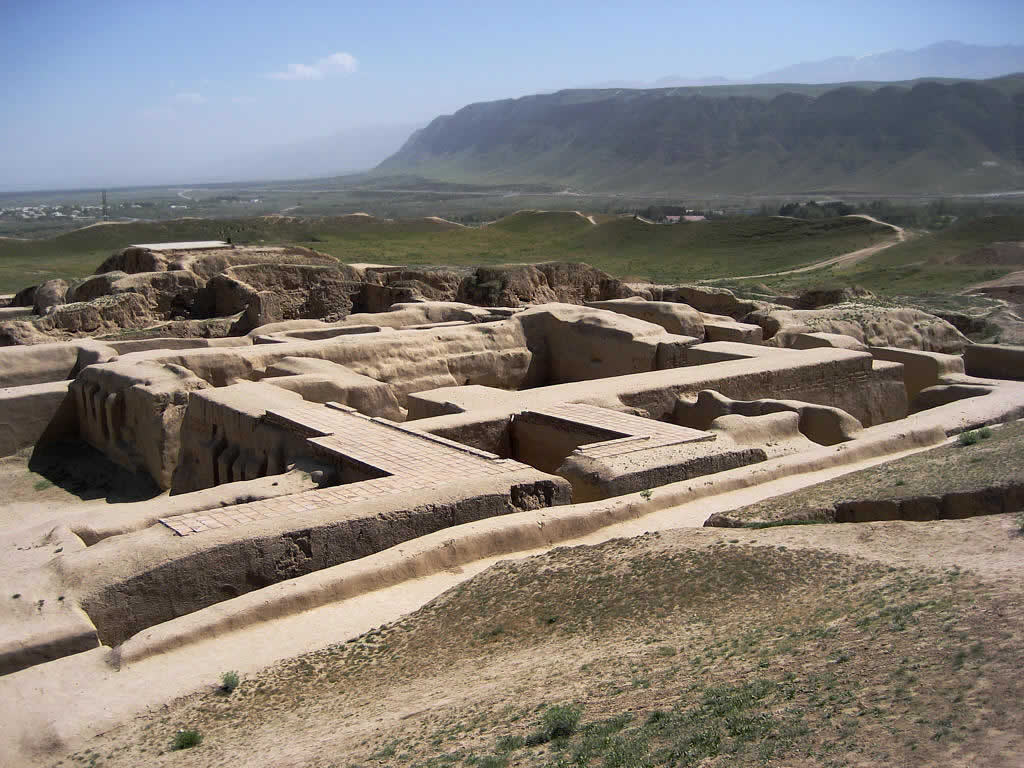
The Parthian Fortresses of Nisa consist of two tells of Old and New Nisa, indicating the site of one of the earliest and most important cities of the Parthian Empire, a major power from the mid 3rd century BC to the 3rd century AD. They conserve the unexcavated remains of an ancient civilization which skillfully combined its own traditional cultural elements with those of the Hellenistic and Roman west. Archaeological excavations in two parts of the site have revealed richly decorated architecture, illustrative of domestic, state and religious functions. Situated at the crossroads of important commercial and strategic axes, this powerful empire formed a barrier to Roman expansion while serving as an important communication and trading centre between east and west, north and south.

http://kavehfarrokh.com/wp-content/uploads/2018/11/1-Section-of-Nysa-architecture.jpgA close-up of one of the sections of Nysa’s enduring Parthian system of architecture (Meros.org).

UNESCO Criteria

Criterion (ii): Nisa is situated at the crossroads of important commercial and strategic axes. The archaeological remains vividly illustrate the significant interaction of cultural influences from central Asia and from the Mediterranean world.

Criterion (iii): The Parthian Empire was one of the most powerful and influential civilizations of the ancient world, and a brilliant rival of Rome which prevented the expansion of the Roman Empire to the east. Nisa, the capital of the Parthian Empire, is the outstanding symbol of the significance of this imperial power.

http://kavehfarrokh.com/wp-content/uploads/2018/11/1-Section-of-Nysa-architecture.jpgA walled structure of one the chambers at Nysa(Meros.org). Later Sassanian architecture would also display especially thick walls and depending on the region, either bricks or stones could be used in their construction. For more on Parthian and Sassanian military architecture, consult Chapter 13 “Military Architecture”  in Armies of Ancient Persia: The Sassanians (2017).

The integrity and authenticity of the property, and also of the surrounding landscape, in terms of the size of the two tells and the siting of the capital at the foot of the Kopet-Dag mountains, are unquestionable. The two tells do not in any sense represent the original appearance of the Parthian capital, but their present appearance is due solely to natural erosion.

http://kavehfarrokh.com/wp-content/uploads/2018/11/1-Section-of-Nysa-architecture.jpgA meandering pathway towards a Nysa structure(Meros.org).

The site is gazetted as one of the 1,300 historical and cultural monuments of Turkmenistan. Nisa is also one of the eight State Historical and Cultural Parks (SHCP) that have been created to protect the most significant sites in Turkmenistan. A buffer zone has been established. The property comes within the provisions of the Bagyr town development plan. Serious efforts are still needed to set up an efficient preventive maintenance scheme that will ensure the survival of recently excavated parts of the site. A five-year plan has been formulated for 2006-2010, in order to ensure a better balance between the different activities (e.g. archaeology vis-à-vis conservation) and to combine and harmonize all the existing documents and strategies relating to the site.

Related posts:

  1. UNESCO: Sassanian Archaeological Landscape of the Fars Region 
  2. UNESCO: Takht-e Soleiman 
  3. Journal Article: A Unique Parthian Sword 
  4. Presentation on Parthian-era Warrior Women in Eleventh Annual ASMEA Conference Nov 1-3, 2018 
  5. Parthian horses and Parthian Horse Archers 
  6. Professor Shapour Shahbazi: The Parthian Army 
  7. Parthian site in Andika, Khuzestan discovered by Karamian Archaeological Team 
  8. Structure of the Parthian Army (2016) – (۱۳۹۵) ساختار ارتش اشکانیان 
  9. Preserving the Buddhist Stupa Structure in Topdara, Afghanistan 
  10. Documentary Film Production: the UNESCO Sassanian Fortress in Darband 


http://kavehfarrokh.com/military-history-1900-present/unesco-the-parthian-fortresses-of-nysa/