 Archeologists hail extraordinary find of suspected ‘Hun woman’ with a jet gemstone buckle on her beaded belt.
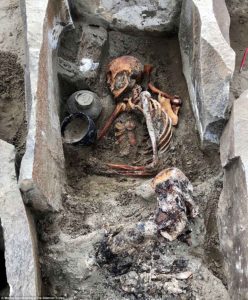
The ancient woman was buried wearing a silk skirt with a funeral meal. Picture: Marina Kilunovskaya
After a fall in the water level, the well-preserved mummy was found this week on the shore of a giant reservoir on the Yenisei River upstream of the vast Sayano-Shushenskaya dam, which powers the largest power plant in Russia and ninth biggest hydroelectric plant in the world.
The ancient woman was buried wearing a silk skirt with a funeral meal – and she took a pouch of pine nuts with her to the afterlife.
In her birch bark make-up box, she had a Chinese mirror.
Near her remains – accidentally mummified – was a Hun-style vase.
‘The lower part of the body was especially well preserved.’ Pictures: Marina Kilunovskaya
A team of archeologists from St Petersburg’s Institute of History of Material Culture (Russian Academy of Sciences) working on the shoreline in Tyva Republic spotted a rectangle-shaped stone construction which looked like a burial.
‘The mummy was in quite a good condition, with soft tissues, skin, clothing and belongings intact,’ said a scientist.
Natalya Solovieva, the institute’s deputy director, said: ‘On the mummy are what we believe to be silk clothes, a beaded belt with a jet buckle, apparently with a pattern.
Archeologist Dr Marina Kilunovskaya said: ‘During excavations, the mummy of a young woman was found on the shore of the reservoir.
‘The lower part of the body was especially well preserved …
‘This is not a classic mummy – in this case, the burial was tightly closed with a stone lid, enabling a process of natural mummification.’
Astonishingly, the grave’s contents were preserved despite being underwater for long periods since the dam became operational in the 1980s.
Scientists believe the woman was buried between 1,900 and 2,000 years ago though further tests are needed to date remains.
A Hun-style vase was found near her remains, leading archaeologists to speculate she was a member of the nomadic group, who dominated much of central Europe and Asia between the fourth and sixth centuries AD.
The Huns established their short-lived empire after spreading rapidly from China, and are believed to have contributed to the collapse of the western Roman Empire during the fifth century.
By The Siberian Times reporter
https://siberiantimes.com