 The ancient Romans relied on long-distance timber trading to construct their empire, according to a study published December 4, 2019 in the open-access journal PLOS ONE by Mauro Bernabei from the National Research Council, Italy, and colleagues.
The timber requirements of ancient Rome were immense and complex, with different types of trees from various locations around the Roman Empire and beyond used for many purposes, including construction, shipbuilding and firewood. Unfortunately, the timber trade in ancient Rome is poorly understood, as little wood has been found in a state adequate for analysis. In this study, Bernabei et al successfully date and determine the origin and chronology of unusually well-preserved ancient Roman timber samples.
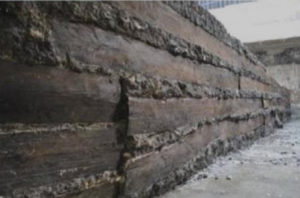
The twenty-four oak timber planks (Quercus species) analyzed in this study were
excavated during Metro construction in Rome during 2014-2016. They formed part of a
Roman portico in the gardens of via Sannio (belonging to what was once a lavishly
decorated and rich property). The authors measured the tree-ring widths for each plank
and ran statistical tests to determine average chronology, successfully dating thirteen of
the planks.
By comparing their dated planks to Mediterranean and central European oak reference
chronologies, the authors found that the oaks used for the Roman portico planks were
taken from the Jura mountains in eastern France, over 1700km away. Based on the
sapwood present in 8 of the thirteen samples, the authors were able to narrow the date
these oaks were felled to between 40 and 60 CE and determined that the planks all came from neighboring trees. Given the timber's dimensions and the vast distance it travelled, the authors suggest that ancient Romans (or their traders) likely floated the timber down the Saône and Rhône rivers in present-day France before transporting it over the Mediterranean Sea and then up the river Tiber to Rome, though this cannot be confirmed.
The authors note that the difficulty of obtaining these planks—which were not specially
sourced for an aesthetic function but used in the portico's foundations—suggests that the logistical organization of ancient Rome was considerable, and that their trade network was highly advanced.
Bernabei notes: “This study shows that in Roman times, wood from the near-natural
woodlands of north-eastern France was used for construction purposes in the centre of
Rome. Considering the distance, calculated to be over 1700km, the timber sizes, [and] the means of transportation with all the possible obstacles along the way, our research
emphasises the importance of wood for the Romans and the powerful logistic organisation of the Roman society.”
Read more: https://www.scientificamerican.com