Shokooh Mirzadegi
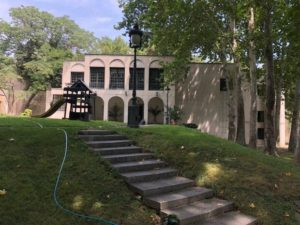 A few weeks after the closure of the ninety “Nature Schools” by the order of the ayatollahs and the Iranian Department of Environment, the Iranian Cultural Heritage Organization has ordered the dissolution of a major environmental training center.
The center which is known as the “Cultural Heritage Higher Education Center”, is located at Niavaran Palace. The center was also before the Iranian revolution where Prince Reza Pahlavi and many children of the Royal court’s staff went to school, but after the Revolution (1979) the school was taken over by Muslim revolutionaries. In 1985, the school was assigned to the Iranian Cultural Heritage Organization until 1989, when with the efforts of some professors interested in cultural heritage, the school was dedicated and became a center for training specialists in the three areas of cultural heritage, handicrafts and tourism.
The Cultural Heritage Higher Education Center, unlike most government-run schools, has been able to train skilled experts in archeology, anthropology, museums, conservation and restoration work since its inception. This has been due to the fact that the teachers are knowledgeable and experts in the areas they are teaching and the subject matter.
In 2010, the head of the Ahmadinejad Cultural Heritage Organization, Esfandiar Rahim Mashaei, decided to dissolve the center and as a result they stopped accepting new students from 2013. With Rahim Mashaei’s departure from the Heritage Organization, and again with the efforts of the university professors, in 2015, students were again admitted to the center. But, at times, the dissolution of the center was raised by officials of the Cultural Heritage Organization, and, in contrast, many efforts were made to maintain the center. Former and present professors and students have repeatedly emphasized that Iran’s cultural heritage requires efficient and professional forces that grow in such scientific centers.
In August 2018, before Ali Asghar Mounsan was appointed head of the Cultural Heritage Organization, it seemed likely that the center would remain viable. Iran’s cultural heritage stakeholders had appealed to Tehran University to move the center under the auspices of the university and they had agreed.
However, despite all the goodwill and interest shown by Tehran University officials, this issue was dismissed due to Mounsan’s opposition to a clause in the draft agreement. The center was finally ordered to evacuate the facility in July, earlier this year.
Why did the government officials try actively to dissolve the center?
For many years the status of most universities in the country has deteriorated due to the dominance of religious laws over education in Iran. As a result the degrees in humanities subjects from Iranian universities are no longer accepted by many European and American countries and most of the advanced countries of the world. In such circumstances, the dissolution of a center which offered educational opportunities, in line with scientific standards followed and practiced internationally is truly regrettable. I have researched and contacted some of the former students and professors of the center and the staff of the Heritage Organization, and have concluded that for the Islamic State, two major reasons are sufficient to announce the end of this center:
1. The first thing that worries the Islamic State is the fact that the teaching standards were mostly based on international scientific standards. One of the leading professors of technical urbanization, architecture and restoration, Dr. Mohammad Mansour Flamaki, stated in an interview with one of Iranian outlets: “The Cultural Heritage Center is doing very well.” He stated that he believes the students at the center are different from students at other Iranian universities, and that students at are “free-thinkers”, something that he does not think exists at other universities. Mr. Flamaki added: “Students at other universities are not completely free-thinkers as they are educated under the rigors of hard, old, and untransformed education, but students at Cultural Heritage Center are nurtured and taught with different standards.”
2. Another case concerns corruption and profit driven actions which has great presence in Iran’s government and government agencies. One person close to the head of the Cultural Heritage Organization has reportedly said: “The land and the campus where the center is located have drawn attention from some high-ranking government officials and they have some plans for the area which will soon be disclosed.”
It is noteworthy that reports indicate that the reason Mounsan objected to the possible partnership between the Cultural Heritage Center and the University of Tehran was because under the partnership and agreement, the University of Tehran would have had full access to the land and the campus.
It is clear that dissolution of the center by the Rouhani government will cause tremendous loss for Iranian youth who will no longer have the opportunity to study at such exceptional center, therefore depriving Iranian cultural and historical heritage community from future skilled and trained professionals.
August 2019

 World Migratory Bird Day (WMBD) was initiated in 2006 and is an annual awareness-raising campaign highlighting the need for the conservation of migratory birds and their habitats. 2018 was an important transition year in the history of WMBD – unifying the planet’s major migratory bird corridors, or flyways: the African-Eurasian flyway, the East Asian-Australasian flyway, and the Americas flyways. Celebrated from now on twice a year, on the Second Saturday in May and in October, WMBD aims to reach out to a broader audience and amplify its message for bird conservation.