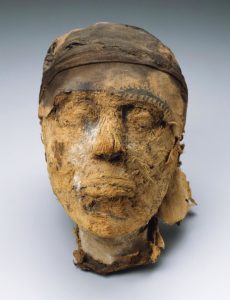
 In 1915, a team of American archaeologists excavating the ancient Egyptian necropolis of Deir el-Bersha blasted into a hidden tomb. Inside the cramped limestone chamber, they were greeted by a gruesome sight: a mummy’s severed head perched on a cedar coffin.
The room, which the researchers labeled Tomb 10A, was the final resting place for a governor named Djehutynakht (pronounced “juh-HOO-tuh-knocked”) and his wife. At some point during the couple’s 4,000-year-long slumber, grave robbers ransacked their burial chamber and plundered its gold and jewels. The looters tossed a headless, limbless mummified torso into a corner before attempting to set the room on fire to cover their tracks.
The archaeologists went on to recover painted coffins and wooden figurines that survived the raid and sent them to the Museum of Fine Arts, Boston in 1921. Most of the collection stayed in storage until 2009 when the museum exhibited them. Though the torso remained in Egypt, the decapitated head became the star of the showcase. With its painted-on eyebrows, somber expression and wavy brown hair peeking through its tattered bandages, the mummy’s noggin brought viewers face-to-face with a mystery.
To read the entire New York Times article………https://www.nytimes.com/2018/04/02/science/mummy-head-fbi-dna.html
News
World Health Day April 7
 World Health Day is celebrated every year on the founding day of the World Health Organization. Established in 1950 this event has a theme each year to draw attention to a current world health issue. The WHO puts together regional, local, and international events on this day related to that theme. Local governments also tend to jump on this band-wagon, after all, global health means everyone! On this day you may take some extra steps to care for your health, consider getting a gym membership (and going!), starting a diet, or starting multi-vitamins!
Even better, get involved with the local events or organize one yourself! Spreading the news of health and threats to the same can be an excellent way to celebrate this holiday, and inform others of the important issue of global health. Themes throughout the years have varied, but always covered important issues of the day, covering everything from the Global Polio Eradication, staying active while aging, even road safety. All of these issues were deemed to be important enough to global health that they merited an occasion of their very own on this date.
The World Health Organization is an agency of the United Nations that focuses on the public health of the world at large. The WHO has a constitution that countries involved in the United Nations had an opportunity to sign, and unanimously did, agreeing to the tenets laid out within to promote the general health of the globe. Through its efforts we have seen the eradication of small pox, and its focus then turned to communicable diseases, with a particular focus on tuberculosis and HIV/AIDS.
Everyone needs to be concerned about the health of themselves and their community, and as such it’s a good time to turn your attention to this year’s theme. By checking in at their website at http://www.who.int/campaigns/world-health-day/ you can find out what the current theme is, and find all sorts of plans and activities that will help you raise awareness about this important issue. You can keep up with it every year, and play a big part in helping to promote global health all around.
The World Health Organization has been involved in mobilizing many health efforts the world over. Describing what medicines are essential for public health, and which diseases to give a particular focus to. The movement to eradicate smallpox started in 1958, initiated by pressure from Viktor Zhdanov, the Deputy Minister of Health for the then USSR. In 1979, the WHO declared that smallpox had in fact been eradicated, making it the first disease in history to be eliminated by the dedicated efforts of humans.
As you can see, celebrating World Health Day is very important, and you can use it to organize fund-raisers to support local free clinics and other public health sources. Everyone can take a hand in improving the overall health of the world, just by starting with yourself, your family, and your community. Blood banks are often taking volunteers to help out with their efforts, and the ability to have healthy, fresh blood on hand is central to saving many lives.
You can also take the task at home, by getting to know your environment and property, and eliminate all possible sources of standing water. Standing water is a breeding ground for insects such as mosquitos, who spread disease by consuming the blood of its hosts, and moving from victim to victim, spreading it as it goes. So this year, take some time to spread the word about how you and your neighbors can improve the world’s health, on World Health Day!
13,000 Year Old Human Footprints
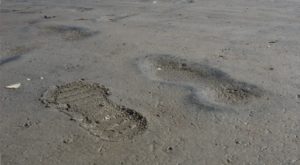 Human footprints found off Canada’s Pacific coast may be 13,000 years old, according to a study published March 28, 2018 in the open-access journal PLOS ONE by Duncan McLaren and colleagues from the Hakai Institute and University of Victoria, Canada.
Previous research suggests that, during the last ice age (which ended around 11,700 years ago), humans moved into the Americas from Asia across what was then a land bridge to North America, eventually reaching what is now the west coast of British Columbia, Canada as well as coastal regions to the south. Along the pacific coast of Canada, much of this shoreline is today covered by dense forest and only accessible by boat, making it difficult to look for the archaeological evidence which might support this hypothesis. In this study, the research team excavated intertidal beach sediments on the shoreline of Calvert Island, British Columbia, where the sea level was two to three meters lower than it is today at the end of the last ice age.
The researchers uncovered 29 human footprints of at least three different sizes in these sediments, which radiocarbon dating estimated to be around 13,000 years old. Measurements and digital photographic analyses revealed that the footprints probably belonged to two adults and a child, all barefoot. The findings suggest that humans were present on the west coast of British Columbia about 13,000 years ago, as it emerged from the most recent ice age.
Happy Sizde-be-dar Celebration of Nature
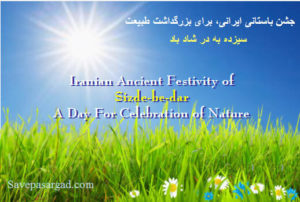 A Day For Celebration of Nature April 1, 2108
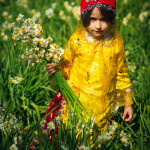
Sizde-be-dar is an Iranian festival, celebrated in the thirteenth day of Nowruz (Iranian New year and first of Spring).
Ancient Iranian believed Sizde-be-dar is a day for celebration of nature
Iranians have a tradition of spending and enjoyed the day outdoors.
Coins from destruction of Second Temple found in time for Passover
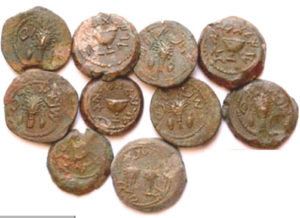 Coins dating from the Jewish revolt against the Roman Empire (66 CE-70 CE) were discovered by archeologists during excavations near the southern wall of the Temple Mount on Monday, according to the Israel Nature and Parks Authority.
The archeological dig, run by Dr. Eilat Mazar of the Institute of Archaeology of the Hebrew University of Jerusalem, uncovered dozens of bronze coins measuring approximately 1.5 cm., as well as numerous fragments of pottery vessels.
The vessels, mainly jars and cooking pots, were left behind by Jewish residents who hid in a large cave that measured seven meters by 14 m.
The discovery of the coins, which were dated from the time of the Roman siege of Jerusalem until the destruction of the Second Temple, was given particular significance as they were found just before Passover, a celebration of Jewish freedom and self-determination.
Archaeologists Are Investigating: 17th-Century Houseguests Slaughtered Hosts
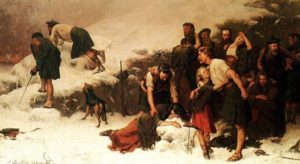 For the chief of a 17th-century Scottish clan, missing a deadline was nothing to shrug off. In fact, on Feb. 13, 1692, when he failed to swear his oath of allegiance to the king on time — possibly held back by a blizzard — a massacre ensued. Soldiers killed dozens of men, women and children who were part of the Clan MacDonald of Glencoe.
Now, archaeologists hope to find out what exactly happened on that infamous day in history. “We are trying to find remains that tie the landscape to the story of the massacre,” said Derek Alexander, the head of archaeology at the National Trust for Scotland (NTS), who is leading the study team.
Read more:
https://www.livescience.com/62056-glencoe-massacre-archaeology.html
First Saharan Farming 10,000 years ago
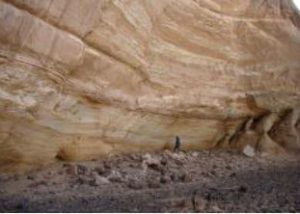 By analyzing a prehistoric site in the Libyan desert, a team of researchers from the universities of Huddersfield, Rome and Modena & Reggio Emilia has been able to establish that people in Saharan Africa were cultivating and storing wild cereals 10,000 years ago. In addition to revelations about early agricultural practices, there could be a lesson for the future, if global warming leads to a necessity for alternative crops.
The importance of the find came together through a well-established official collaboration between the University of Huddersfield and the University of Modena & Reggio Emilia.
The team has been investigating findings from an ancient rock shelter at a site named Takarkori in south-western Libya. It is desert now, but earlier in the Holocene age[our present age], some 10,000 years ago, it was part of the “green Sahara” and wild cereals grew there. More than 200,000 seeds – in small circular concentrations – were discovered at Takarkori, which showed that hunter-gatherers developed an early form of agriculture by harvesting and storing crops.
But an alternative possibility was that ants, which are capable of moving seeds, had been responsible for the concentrations. Dr Stefano Vanin, the University of Huddersfield’s Reader in Forensic Biology and a leading entomologist in the forensic and archaeological fields, analyzed a large number of samples, now stored at the University of Modena & Reggio Emilia. His observations enabled him to demonstrate that insects were not responsible and this supports the hypothesis of human activity in collection and storage of the seeds.
The investigation at Takarkori provides the first-known evidence of storage and cultivation of cereal seeds in Africa. The site has yielded other key discoveries, including the vestiges of a basket, woven from roots, that could have been used to gather the seeds. Also, chemical analysis of pottery from the site demonstrates that cereal soup and cheese were being produced.
A new article that describes the latest findings and the lessons to be learned appears in the journal Nature Plants. Titled Plant behaviour from human imprints and the cultivation of wild cereals in Holocene Sahara, it is co-authored by Anna Maria Mercuri, Rita Fornaciari, Marina Gallinaro, Savino di Lernia and Dr Vanin.
One of the article’s conclusions is that although the wild cereals, harvested by the people of the Holocene Sahara, are defined as “weeds” in modern agricultural terms, they could be an important food of the future.
“The same behavior that allowed these plants to survive in a changing environment in a remote past makes them some of the most likely possible candidates as staple resources in a coming future of global warming. They continue to be successfully exploited and cultivated in Africa today and are attracting the interest of scientists searching for new food resources,” state the authors.
Research based on the findings at Takarkori continues. Dr Vanin is supervising PhD student Jennifer Pradelli – one of a cohort of doctoral candidates at the University of Huddersfield funded by a £1 million award from the Leverhulme Trust – and she is analyzing insect evidence in order to learn more about the evolution of animal breeding at the site.
Source: University of Huddersfield
PHF announces: The Iranian New Year 1397 is named as “The Year of Iranian Women”
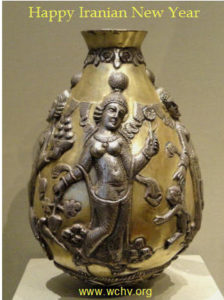 PHFAnnouncement:
The Iranian New Year 1397 is named as
“The Year of Iranian Women”
Pasargad Heritage Foundation (PHF), observing its annual tradition, and on the occasion of “Nowruz” – the Iranian festival and celebration of the beginning of the Spring and New Year – has suggested naming the year 1397 (Iranian Calendar) as the “Year of Iranian Women”.
Every year, the selection of a name for the incoming year is enacted within the framework of preservation and guardianship of the tangible and intangible cultural and historical heritage of Iran.
The goal is to attract the attention of people to the unique values of Iranian culture that are based on reason and love – the very values that have greatly been neglected and experienced discrimination and enmity and are now openly exposed to degeneration and destruction.
This year, and upon the following considerations, PHF has named the year of 1397 as “The Year of Iranian Women”
– Iranian women are amongst those women of the world who continuously have guarded the cultural heritage of their homeland.
– For Years the Iranian women have preserved and transferred their national traditions, festivities, as well as their tangible and intangible heritage that are mostly declared forbidden by the current Iranian government to the next generation.
– Regardless of their personal religious beliefs, The Iranian women, whether Zoroastrian, Christian, Jew, Bahai, or Moslem, have played a major role in the transference of the non-religious and secular culture of Iran to the next generation.
– And during this past year, the Iranian women have introduced a rare tactic to obtain their freedom from oppression and compulsory dress-code (wearing hejab). The freedom (of a woman) to dress as she wishes has in fact been a part of ancient Iranian culture that was taken away by the invading Arabs and the imposition of their newly formed faith. The present movement of Iranian women to get back one of their human rights and to revive old Iranian traditions is of utmost significance. All through history, and whenever possible, Iranian women have struggled for their freedom to choose what to wear. They had enjoyed this freedom for 43 years (Between 1314 and 1357) and until the advent of the Islamic revolution. In this regard, their struggle could also be recognized as a cultural endeavor.
Along with naming of the year 1397, PHF would like to wish everyone a very joyous New Year and a happy great and beautiful Nowrooz.
Let us begin the New Iranian Year by appreciating the long and unstoppable struggle of the Iranian women for preserving their culture and gaining their freedom. Let us hope for a year full of happiness, peace and freedom for the people of Iran and the whole world.
Shokooh Mirzadegi
PHF Executive Director
Pasargad Foundation Awards “Personality of the Year 2018”
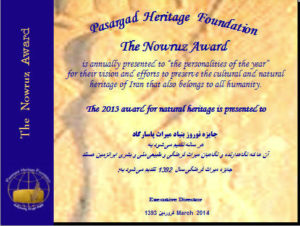
The Pasargad Heritage Foundation Presents:
The Nowruz Award March 21, 2018.
This press release has been published by the Pasargad Heritage Foundation to the Personalities of the Year for their vision and efforts to preserve the national, cultural, historical, and natural heritage of Iran that also belongs to all humanity.
– His endless efforts in preservation and dissemination of historical and cultural heritage of Iran; – Publishing the long forgotten works of cultural personalities of Iran; – Authoring a dictionary of Avesta-ic names for the first time in the whole world; – Collecting and authoring of an encyclopedia of Ancient Iran, for the first time; – Collecting and authoring a unique book on ancient Iranian festivities; – And for his life-long endeavor and efforts to preserve and introduce the historical and cultural heritage of Iran. Read the entire article on this page
 Mr. Hashem Razi, Iranologist, researcher, translator and author of ancient manuscripts, and 80 books is the recepient of the “Personality of the Year 2018”, in the field of “Cultural and Historical Heritage”, for:
– Her unwavering efforts in directing and writing subjects related to refugees and people living in exile. – Her special attention to Iranian cultural issues and reflecting them in her plays. – Her persistent focus on women’s rights and degradation of Iranian women’s position in today’s Iran compared to the ancient Persian culture. – Her distinct and humanistic look at the Human Rights issues in Iran especially in her plays written in German.
 Ms. Niloofar Beyzaie, a playwright, theater director, researcher and translator has been selected as the Personality of the Year 2018, in the field of “Art and Culture”, for:
– His 20-year-long activities in the literary and artistic world of Iranian Diaspora and exiled community; – His many publications that focus on variegated aspects of contemporary Iranian cultural and literary creations in exile; – His focus on collecting and registering the artistic creations of Iranian exiled artists and writers, to be preserved for future.
 Mr. Assad Seif, an author and journalist is the recipient of “The Cultural Personality of the Year 2018”, for:
Happy Chahar Shanbeh Suri 2018
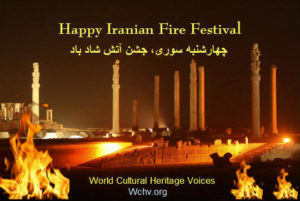 Last Wednesday of the Iranian year (Nowruz) know as Chahar Shanbeh Souri, is celebrated in the evening of the last Tuesday of each year, Iranians celebrate a fire festival with its roots in the ancient customs and history of the country.
Jumping over a bonfire is the ritual of “Chahr-Shanbeh Souri” during the Persian celebration of Nowruz, or the Persian New Year. It signifies a time to say goodbye to the darkness of winter and welcome to the lightness of spring.
Bonfires are lit to “keep the sun alive” until early morning. The celebration usually starts in the evening, with people making bonfires in the streets and jumping over them singing “zardi-ye man az toh, sorkhi-ye toh az man”. The literal translation is, my yellow is yours, your red is mine. This is a purification rite. Loosely translated, this means you want the fire to take your pallor, sickness, and problems and in turn give you redness, warmth, and energy.