Introduction and Preamble
Major political events often imprint their own profound repercussions upon historical memory. Nation-building, the consolidation of political power and movements against that consolidation often result in the differentiation of points of view. The tragic events in Iran (past and current at time of writing) are certainly no exception. As is so often the case in the Iranian arena, the very history and identity of Iran have been questioned, despite a documented thousands-year long tradition.
Much of this is based on literature from the late 1970s in Iran and select politicized venues attempting to depict much of the history of pre-Islamic Iran as “propaganda” by the former Pahlavi establishment. Notable are the July 2008 Spiegel Magazine and Daily Telegraph articles portraying Cyrus the Great as a blood-thirsty conqueror, and wholly rejected all favourable Greek, Babylonian, Biblical, etc. references as “propaganda“. Both of these articles were widely condemned by the Iranian community and the diaspora. Almost a year after (July-August 2009) a very select few attempted to claim that the sword-wielding Lion and Rayed sun are dated to and solely representative of the former Pahlavi establishment of Iran thereby having no basis in Iranian history or identity. This is yet another demonstration of shifting partisan politics with no solid grounding in historiography.
Historically and culturally speaking, the Lion and the Sun have existed as potent mythological symbols of Iran for thousands of years. While true that the background colours of Iranian flags have varied across the centuries, the Lion and Sun motifs have endured the test of time. It is also important to note that the primary standards of the Achaemenid and Partho-Sassanian eras were (as generally agreed at this time) the Eagle standard and the Drafsh-e-Kaviani (the Standard of Kaveh) respectively. However it is possible that the simultaneous depiction of the Lion-Sun motif may have existed during the late Sassanian era as well.
The brief survey below will discuss the origins of the Lion and Sun motifs in Iran since the Achaemenid era, through the Partho-Sassanian and post-Islamic eras up to 1979.
The Pre-Achaemenid Era: The God Mithras
The sun has been a major ancient Iranic symbol and has appeared alongside the moon and heaven on the banners, standards and flags of Iran since pre-Achaemenid times (Khorasani, 2006, p.316; Nayenuri, 1965, pp.1). Mithra, who was to become the Sun-God, is perhaps one of the best known Iranic gods, and was at one time widely worshipped in the Roman Empire. Mithra in Avestan is translated as “pact, contract, covenant“. As the god who controls the order of the cosmos, hence the change of seasons and night into day, Mithra …
“…was associated with fire and the sun…” [Sarkhosh-Curtis, 1993, p.13].
This is affirmed in the ancient Yasht writings which describe Mithra as:
“…first of the heavenly gods reaches over the Hara [Alborz Mountains in Iran]; before the undying swift-horsed Sun; who foremost in a golden array, takes hold of the beautiful summits, amd from there looks over the abode of the Aryans [Iranic peoples] with a beneficent eye ” [Yasht 10, 13].
The connection between Mithra and the Sun is seen in the cult of Mithras where Mithra is, according to Sinclair:
“…identified with the sun, the bringer of light to humanity, the mediator in the cosmic struggle” [Sinclair, 2008, p.9].
Mithras was also popular in India as a result of the Indo-Aryan migrations into the subcontinent thousands of years ago. The Roman Empire too was to also adopt the cult Mithras, where it enjoyed a strong following from 100-400 AD (Hinnels, 1988).
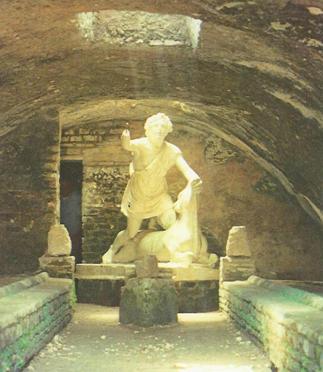
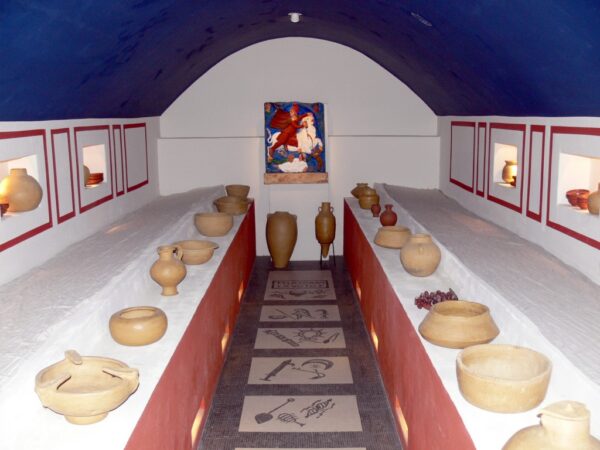
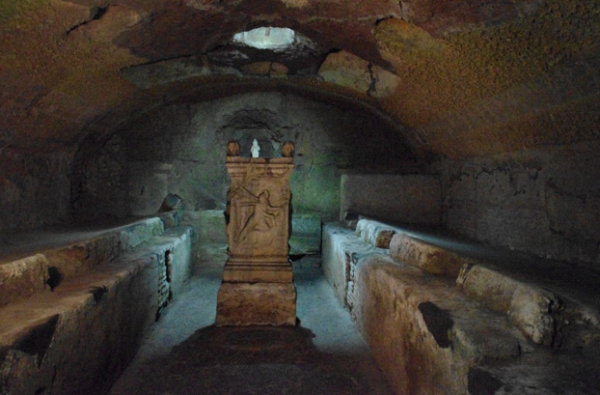
A Roman version of the statue of Mithras in a Mithraic temple in Ostia, Italy (Consult, Hinnels, 1988, pp.83). Note the opening on the ceiling just above Mithras, allowing from the sun rays to “illuminate” the god. Mithras in Iranian mythology is the bringer of light and justice and a manifestation of the eternal sun.
The ancient Iranic cult of Mithras from which the sun motif is derived, has had a thousands year long tradition. Variants of this cult are still practised among the Kurds of Iran.
Kurdish man engaged in the worship of Mithras in a Pir’s (mystical leader/master) sanctuary which acts as a Mithraic temple (Courtesy Kasraian & Arshi, 1993, Plate 80). Note how he stands below an opening allowing for the “shining of the light”, almost exactly as seen with the statue in Ostia, Italy. These particular Kurds are said to pay homage to Mithras three times a day.
Over the course of time Mehr or Mithra (Meher in Armenia) and the Sun were to be considered as the same entity (Khorasani, 2006, p.320).
The pre-Achaemenid and the Achaemenid Era: The First Simultaneous Representation of the Lion-Sun Motif
The simultaneous representation of the lion (Shir e Iran) and the Sun has often been attributed to the post-islamic era, especially from the 13th century AD. In reality, the Lion-Sun motif first appeared together at least as early as the Achaemenid era. However there is evidence that their simultaneous appearance occurred even earlier.
Khorasani (2006, pp.320) and Nayenuri (1965, pp. 78) note that the oldest evidence for the simultaneous representation of the Lion and the Sun date to a cylinder of King Sausetar dated to 1450 BC. The image is that of a sun-disc resting on a base flanked by two wings, with two lions guarding at the base.
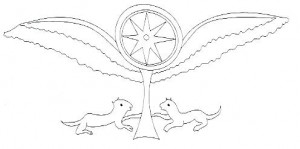
The Cylinder of King Sausetar (Courtesy of Khorasani, 2006, pp.320). This is the odlest evidence of the Lion-Sun motif as noted by Nayernuri (1965, p. 78).
The primacy of the sun as a major symbol appears to have taken place at a later date during the Achaemenid dynasty, as the moon had played this role during Xerxes’ invasion of Greece in 480 BC (Khorasani, 2006, p.317; Nayernuri, 1965, p.28). In Iranic mythology, the Goddess Anahita is the virgin mother of the Sun-God Mithra.
A plaque from Achaemenid times depicting such a motif seen with Artaxerxes II (404-359 BC ) being faced with the figure of goddess Anahita who is depicted as riding a lion – in the background (of Anahita) is the clear depiction of the sun.
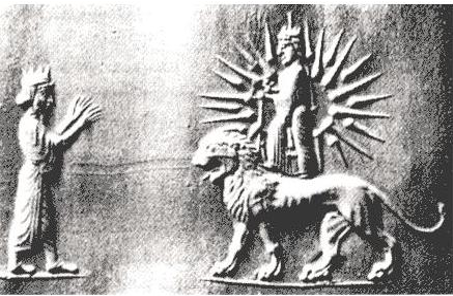
King Artaxerxes II (at left) facing the godess Anahita who sits atop a lion. In the background to Anahita can be seen the clear display of the sun which is a representation of the ancient Iranic god Mithras. Note that the sun emanates 21 rays, the same symbol which is used by various ancient Iranic cults among the Kurds of Iran, Iraq and Turkey. The 21 rays may be related to the festival date of Mehregan (Festival of the Sun-god Mithra) which takes place from the 16th to the 21st of Mehr of the Iranian calendar.
As noted already, the sun is a manifestation of the ancient Iranic god Mithras, whose cult predates the Achaemenid dynasty. The sitting figure of Anahita represents fertility and life. The temples of Anahita often had canals for water streams, most likely representing another aspect of the life-giving force of the goddess Anahita. In a sense the manifestation of Mithras and Anahita go beyond mere tribal symbols – they are an expression of ancient Iranian mysticism and theology.
The lion too was another one of ancient Iran’s most enduring mythological icons as well as an ancient symbol of Iranian identity. The theme occurs at the reliefs of the city palace at Persepolis.
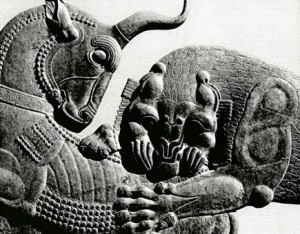
Depiction of a Lion tormenting prey at the stairway of the Apadana Hall of Persepolis. The Lion was an Iranic mythological symbol of strength and virility. The same type of Lion hunter theme is also in the arts of North Iranic peoples such as the Scythians of ancient Ukraine and south Russia.
Ancient Iran had a number of symbols in addition to the sun of Mithras and the lion; examples being the eagle and the ram. At this time both the lion and the sun appear to have had religious and mythological symbolic significance and were not crude “tribalistic” symbols.
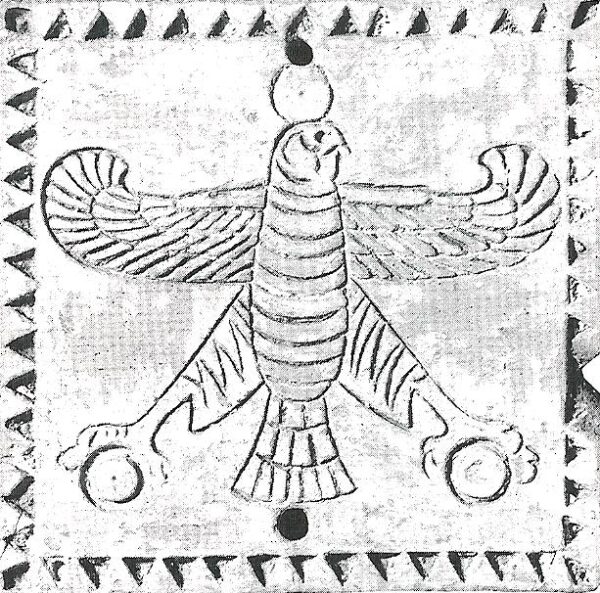
Achaemenid eagle as displayed upon a tile at Persepolis, which was according to Sekunda “… probably representing the Royal standard” (1992, p.12). This symbol along with the lion and the ram was to endure well into Sassanian times. The lion motif however was to survive the Islamic conquests and resurface on the banners and flags of Iran well into the twentieth century.
As noted by Khorasani (2006, p.316), the eagle was both a symbol of heaven as well as a good omen.
The lion and lioness however consistently appear in the arts of ancient Iran. The Lion/Lioness has a close connection with the Persian royalty and state authority of the time. Examples include rows of lions decorating Achaemenid garments and the covers of thrones (Consult Tilia, 1978, pp. 46-57 as well as figures. 3, 4, 6);
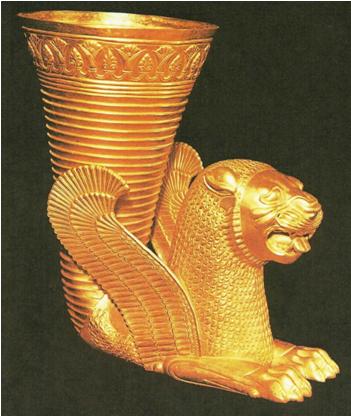
Achaemenid Rhython in the shape of a Lioness. Iranian rhython arts also influenced the arts of ancient Greece as seen in the Athenian rhython now housed at Museo di Archeologia Ligure, Genova.
As noted by Hinnels, a leading expert of ancient Iranian theology: “The lion is a traditional symbol of power” [Hinnels, 1988, p.10].
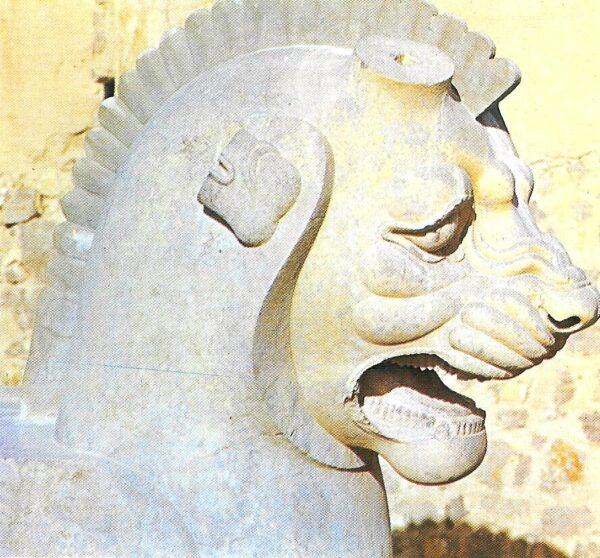
This lion’s head from the top of a column at Persepolis (Consult Hinnels, 1988, p.10).
By the end of the Achamenid era, the sun was a central symbol of Iranian royalty or “Farr” (divine glory). Quintus Curtius, (3.3,8) for example, noted that the tent of Darius III (approximately 380-330 BC) was associated with:
“a crystal image of the sun“
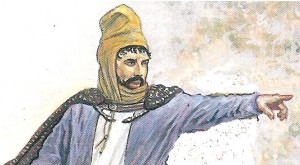
A reconstruction by Duncan head and Richard Scollins (1992, Plate Eight) of Darius III (380-330 BC) the last Achaemenid king. By this time, the image of the sun (like the lion) had become a primary symbol of the Iranian realm.
It is also important ot note of the astrological relationship between the Lion and Sun in Iranic mythology, a relationship that has spanned across centuries of time. As noted by Nafisi (1949, p.55) the unique relationship between the Lion and the Sun is an ancient Iranian concept which views this relationship as a Zodiac sign.

A winged Lion (or griffin) as depicted in Achaemenid arts. As noted by Darius Kadivar, this image was falsely depicted as a “Roman” symbol in the blockbuster movie, Gladiator starring Russell Crowe.
The Northern Iranians: The Scythians of ancient Eastern Europe and Central Asia
Much of what is now southern Russia and Ukraine as well as Central Asia was settled by northern Iranian peoples known as the Scythians (or Saka) (Channon & Hudson, 1995, p.18; Newark, 1998, p.6; Mariusz & Mielczarek, 2002, p.3; Sulimirski, 1970, p.22).
The Saka who are represented in the Persepolis reliefs, shared much of their culture, architecture and arts with their Medo-Persian Iranic cousins. One vivid example of the Persepolis type lion motif (attacking its prey) is seen in a golden large necklace of an Iranian queen or princess who had lived in the vicinity of what is now northern Ossetia (in southern Russia) to the north of the Georgian Republic.
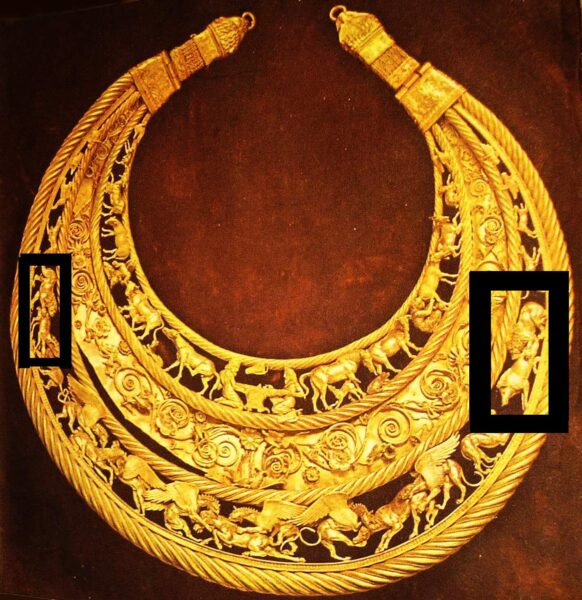
Golden necklace or pectoral of an ancient Iranian queen in what is now North Ossetia. The areas shown with black rectangles depict lions attacking their prey – these are virtually identical to those seen in the Apadana stairway at Persepolis.
The symbolism of the lion is also seen in the world’s first Persian carpet found at Pazyryk in Central Asia.
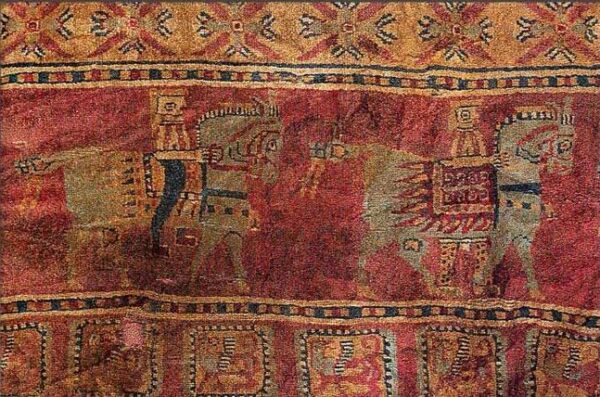
A portion of the Pazyryk carpet found in Central Asia dated to 2,500 years ago. Known as the first known Persian carpet, note the depictions of mythical (winged) lions on the bottom panels. Of interest are the “X” type symbols along the top panels. These were to become a central motif in the major standard of Partho-Sassanian Iran: the Drafsh e Kaviani or the Standard of Kaveh.
The Partho-Sassanian Era: Mithras and the Lion
The Parthian dynasty (c. 250 BC-224 AD) was the first iranic dynasty to succeed the post-Alexandrian Seleucids in Iran. As noted by Tertullian, the Parthian standard displayed an image of the sun (Apologeticum, 16).
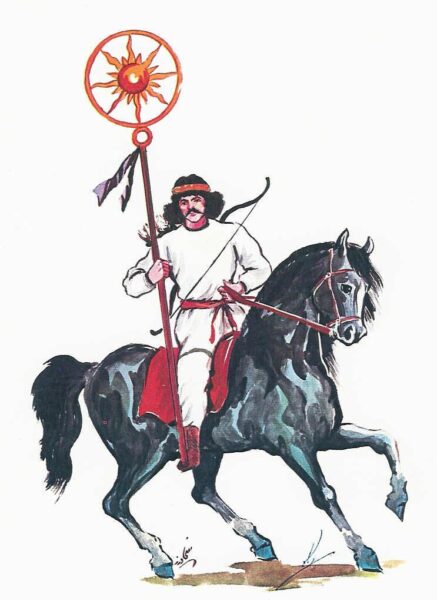
A Parthian standard bearer with the Sun of Mithras standard (Iranian army reconstruction in 1971).
The Sassanians (224-651 AD) defeated the Parthians at Hormuzgan in 224 AD. The Sun-God was to increase in significance during the Sassanian dynasty. Stone inscriptions of Ardashir for example do mention the name of Mithras or “Mehr”, which as stated earlier is manifested by the sun symbol. The post-Sassanian Iranian epic, the Shahname, also states that the symbol of the pre-Islamic Iran was the sun (Khorasani, 2006, pp.317; Nayernuri, 1965, pp.28). This is exemplified by this verse:
Ke chon mah Torkan bar ayad boland [and when the moon of the Turks ascends]
ze Khorshid Iranash ayad ghazand [it shall be damaged by the Sun of Iran]
An interesting citation by Malalas (18.44) notes of the hail from the “Persian king, the Sun of the East…” in a letter to the “…Roman Caesar, the Moon of the West“. By “Rome” we are referring to not only the Roman Empire but also its “eastern” successor, the Romano-Byzantine Empire which ruled over much of what is now the Middle East past eastern (and at times western) Iraq and Anatolia. The latter was referred to as “Rum” by the Iranians, a designation inherited by the later Arabs and Turks of the Islamic era.
The Sun-God Mithras known as “Mehr” is also the name of various Partho-Sassanian and other Iranic kings: Mehr-dad (in Iranic) or Mithradates (n Greco-Roman sources). is now a major entity. Mehr or Mithras is clearly displayed in Sassanian relief work at Tagh-e-Bostan near Kermanshah.
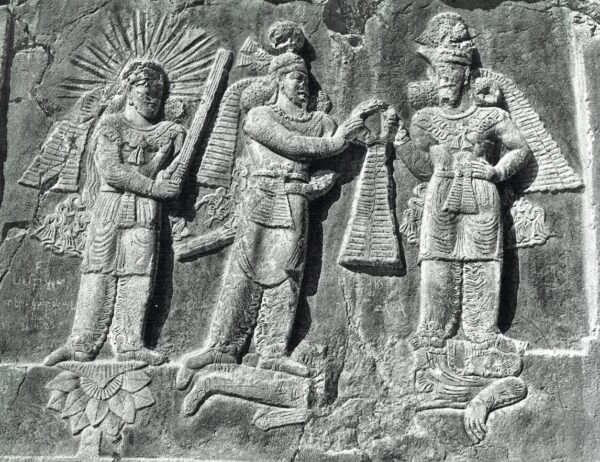
Investiture of Ardashir II (r. 379-383) (center) by the supreme God Ahuramazda (right) with Mithra (left) standing upon a lotus (Ghirshman, 1962 & Herrmann, 1977). Trampled beneath the feet of Ahura-Mazda and Ardashir II is an unidentified defeated enemy (possibly Roman Emperor Julian). Of interest are the emanating “Sun Rays” from the head of Mithras. Note the object being held by Mithras, which may be some sort of diadem or even a ceremonial broadsword, as Mithras appears to be engaged in some sort of `knighting`of Ardahsir II as he receives the `Farr`(Divine Glory) diadem from Ahura-Mazda.
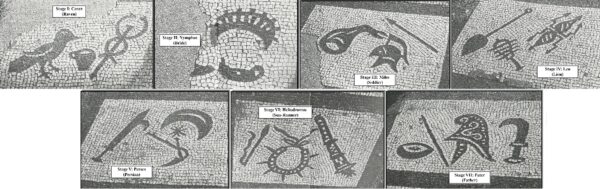
Another expression of the Sun-God is found in the western or Roman version of Mithraism, which (as noted earlier) was popular in the Roman Empire from 100-400 AD. Roman Mithrasim’s had seven stages of ascension, namely Stage I-Cerax (the raven), Stage II-Nymphos (the bride), Stage III-Miles (the soldier), Stage IV-Leo (the lion), Stage V-Perses (the Persian), Stage VI-Heliodromus (the Sun Runner), and Stage VII-Pater (the Father).
Three of these stages are of interest, namely Stage IV (Leo or lion), Stage V (Perses or Persian), and Stage VI (Heliodromus or the Sun Runner), as they signify strong mythological ties between Roman Mithrasim and ancient Iranian mythology. The lion and the Sun in particular feature prominently in the Roman version of Mithraism (Hinnels, 1998, pp.84-85).
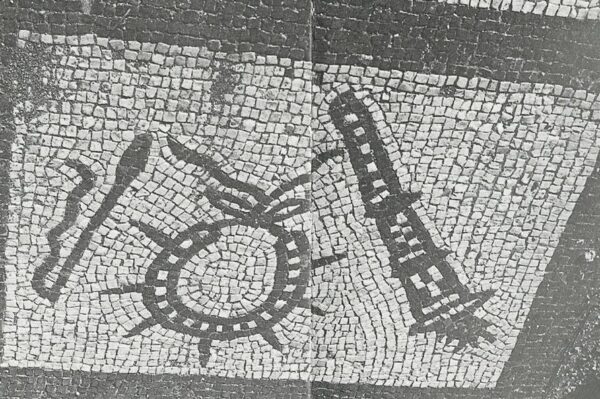
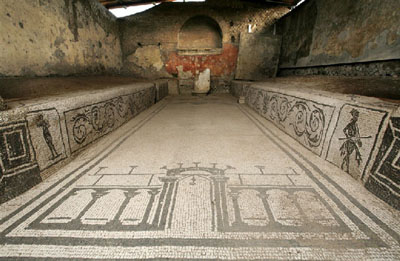
The Heliodromus (Sun-Runner) as seen in the mosaic isle of the Temple of Mithras at Felicissimus at Ostia, Italy. It is a historical irony that even as the Romans were fighting their enemies the Parthians and the Sassanians, they had adopted an ancient Iranic cult from the land of their enemies.
By Sassanian times a number of motifs existed which were carried on flags and banners and also appeared on various art works. Motifs included the Sun-Disc, the Mithras symbol, lion, :ibex, tiger, elphant, mythological creatures, etc. (Farrokh, 2005, pp. 20-23). While the Sun and Lion were among the primary symbols of Sassanian Iran, these are not seen as appearing in a single-motif as each motif was represented with its own unique banner or flag.
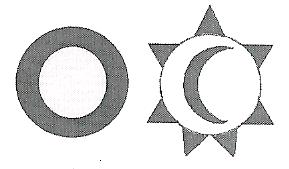
The Khwor or Sun-Disc carried on flagpoles and swords (left) and a possible Mithras symbol from the Sassanian era at right – note inset crescent moon (Farrokh, 2005, pp.23).
The lion-theme is clearly seen is lions decorated on the pectoral worn by Ardashir on his Naqsh-e Rostam investiture relief (Hinz, Pl. 63). This was also found decorated on various works of arts.
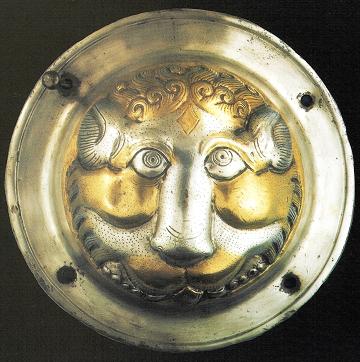
Sassanian disc with head of a lion. This symbol which appeared on banners, continued to be seen as a symbol of Iranian state authority and prowess.
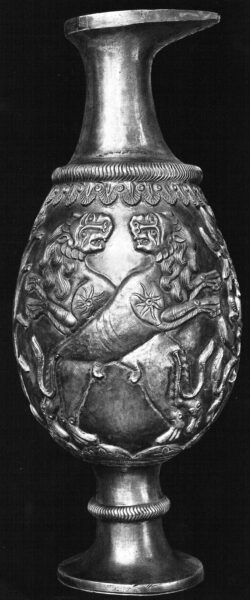
Sassaniian ewer with crossed lions; note star on each lion.
The only “combined” motif symbol found in the Sassanian era is that of Sassanian Iran`s primary standard, the aforementioned Drafsh-e-Kaviani (Standard of Kaveh). Legned ascribes this to a certain blacksmith by the name of Kaveh who united the ancient Iranians against the mythical oppresor, Zahak. In reality, the banner most likely existed during the Parthian era as Iran`s royal standard.
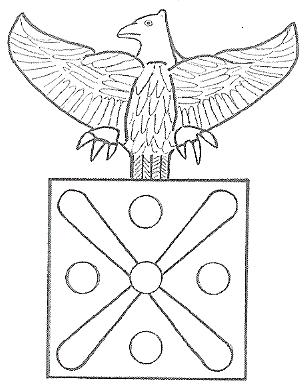
A reconstruction of the Sassanian Royal Standard, the Drafsh-e-Kaviani (Farrokh, 2005, p.22). There were apparently a number of versions of these, however the major national banner measured roughly 16 by 20 feet and was studded with gold, silver and jewels. This was captured by Arabo-Islamic forces after the Battle of Qaddisisyah in 637 AD. Note that the above version also displays the eagle which was seen among the royal standards of the Achaemenids, centuries before the Sassanians. The eagle symbol was viewed as a benevolent protector and sign of good heavenly fortune. Harper (1978, p.84) has noted that Sassanian warriors often adorned their weapons with the feather decoration of the bird-god Varagna.
The actual origins of the Drafsh-e-Kaviani may be traced to the Achaemenid era, to the aforementioned Pazyryk carpet. There are four petals facing northwest, northeast, southwest and southeast with fixtures at north, south, east and west.
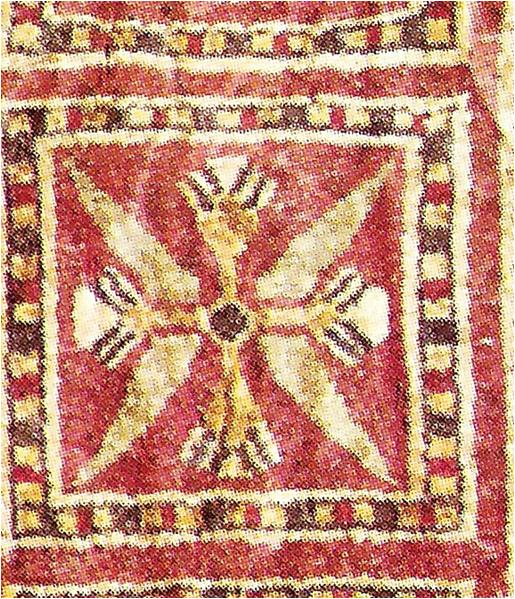
The Pazyryk carpet displays the first depiction of the Drafsh-e-Kaviani. The Pazyryk region was settled by North iranic Scythian peoples. It is possible that the Parthians, who were of Scythian stock, introduced this ancient Iranic theme as Iran`s major standard.
The rise of Turco-Persian Civilization: A shared Legacy between Iranians and Turks
After the overthrow of the Sassanian Persian Empire by the Arabo-Islamic forces (637-651 AD), the use of images on flags ceased with the arrival of the Caliphate. However the Iranian use of imagry in the arts did not cease, and these very soon re-emerged in venues such as metalworks, masonry, etc. However the specific use of a national flag as seen with the aforementioned Kaveh standard was not to re-emerge until centuries later.
The arrival of Turkic peoples into Iran witnessed a revival of ancient Iranian traditions. This was mainly due to an already existing symbiotic cultural relationship between Turkic and Iranian peoples since at least the 4th century AD or earlier. The Turks and the Iranians underwent a cultural synthesis in what is now Central Asia, a region which had been Iranic for thousands of years. By the early 7th century AD, successive waves of Turkic peoples had made powerful inroads into Central Asia. These however were to be profoundly influenced by the cultural and linguistic legacy of ancient and post-Islamic Iran.
Even as the Caliphate was at the height of its power, the Turkic dynasties such as the Ghaznavids (975-1187 AD) did much to promote Iranian culture and the Persian language. These Turks were also fond of Iranian mythology and much work was done by them to promote the Iranian-epic, the Shahname. Iranian motifs from the pre-Islamic era made a vigorous resurgence under Turkic-ruled Central Asia.
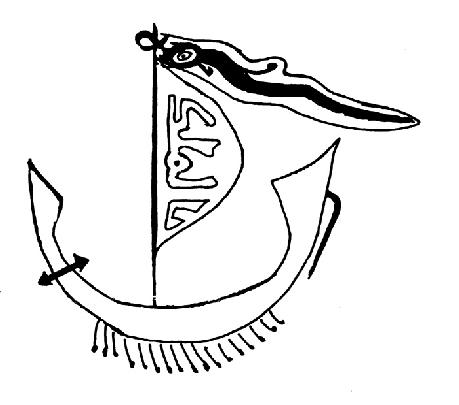
One notable example of pre-Islamic Iranian motifs enduring in post-Islamic Turkic-ruled Central Asia is a ceramic work from Nishabur dated to the 9th century AD (two centuries after the fall of Sassanian Persia). The above drawing is from a ceramic work showing a small ship flying a banner showing a Simurgh (Iranian phoenix) or Homa (Iranian Griffin) figure (consult Papadopoulo, fig. 420).
The Ghaznavids are known to have displayed a number of heraldic figures that resembled those found in pre-Islamic Iran. Examples of Ghaznavid patronage of ancient Iranian motifs include the ancient Shir e Iran (Lion of Persia/Iran) and other ancient Iranian motifs such as Homa (Iranic Griffin) (Nafisi, 1949, p. 45, 48-58; Yusofi, 1962, p. 422).
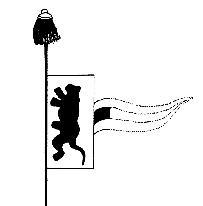
Ghaznavid depiction of a Lion.
The History of Rashid e Din shows a number of Ghaznavid banners bearing the “checkered squares” motif (Rice & Gray, 1967, consult Plates. 38, 44, 57, 60); this is also what is seen in ancient Achaemenid armies (Sekunda, 1992). Readers are also referred to the works of Kasravi and Nafisi with respect to reference works in this topic.
A steady arrival of Turkic peoples from Central Asia entered Iran through Khorasan from the 11th century AD. The bulk of these were to find their way into Azarbaijan, Arran (modern Republic of Azarbaijan) and further westwards into Anatolia. One of the most important Turkic tribes to arrive upon the Iranian plateau (and beyond) was the Seljuks.
The Seljuk dynasty (ruled in Iran 1037-1194 AD) became a great patron of Iranian arts, language, literature and culture. The Seljuks virtually revived a number of ancient Iranian mythological themes such as the Simugh (Iranic Phoenix), Homa (Iranic Griffin), the Stara (Iranic for “Star”), Shir e Iran (Lion of Persia/Iran), etc. (Consult Nafisi and Minovi in references).
One example is the appearance of the mythical lion symbol on the coins of Sultan Ghiasol-Din Kay-khosrow (reigned 1236-1246 AD), one of the Seljuk rulers in Anatolia known by the ancient Iranic designation of “Rum“, in reference to the region’s Romano-Byzantine legacy. What is of interest is the ruler’s name which had both Sassanian (i.e. Khosrow) and Shahname (i.e. Kay) roots. The usage of the lion motif was evidently the Sultan’s attempt to symbolize his political and military prowess.
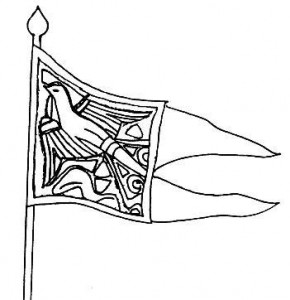
Illustration of the ancient Simurgh (Iranic Phoenix) on banners from the Seljuk era (Nafisi, 1949, pp. 46, 57). Seljuk banners also depicted Lions in the Iranian manner.
The coins of Sultan Ghiasol-Din Kay-khosrow depicted the Lion and the Sun together (see drawing below). But what is perhaps of even greater interest is Khorasani’s study of a Seljuk-era brass pitcher in the National Museum of Iran in Tehran. This pitcher has 12 angles; each of these having a Zodiac sign. As noted by Khorasani (2006, pp.321):
“For the sign Leo, there is an image of the Lion and the Sun “.
This is yet another indication of the crucial role of Turkic peoples such as the Seljuks in the revival of Iranic culture. Recall that the ancient Iranians had considered the Lion-Sun motif as an astrological symbol.
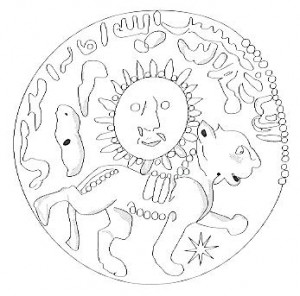
A coin of Sultan Ghiasol-Din Kay-khosrow in the 13th century (Courtesy of Khorasani, 2006, p.321).
The Mongol invasions and aftermath
As noted in the preamble, in late December 2006 when the ILNA News Service in Iran reported that an Iranian archaeological team at the ancient Castle of Nishabur and Shadiakh had discovered one of the oldest simultaneous representations of the Lion-Sun motif. Quoting the archaeological supervisor, Rajabali Labbaf-Khaniki, ILNA noted that:
“…the castle built by the most skillful craftsmen of the time had caught fire due to unknown reasons following the Mongul invasion… humans who settled in Shadiakh had a rich culture and civilization…Inspired by ancient Persian art, Shadiakh artists made skillfully-designed works“.
The report however did not produce photographs of the Lion-Sun motif at the site and did not specify dates as to when the motif had been produced. The sites originated well before the pre-Islamic era and the term Neshabur itself is derived from Sassanian Pahlavi “Nev-Shapur” from the 3rd century AD.
What is certain is that the Lion-Sun motif at the sites pre-date the Mongol arrivals and are derived from the locale’s ancient Iranic artistic and cultural traditions. These little-reported findings are of major significance as they demonstrate the antiquity of both the Sun and Lion motifs, and in this case, their simultaneous depiction.
The Mongol invasions of Iran (1218-1260) were indeed devastating however these too became highly influenced by the culture of the country they conquered. Prior to their invasions, the Mongols had had significant admixture with Turkic and Iranic peoples in Central Asia over the centuries. It is significant that the Mongols were fond of the rising sun symbol (Spuler, 1985), which is virtually identical to various Iranic solar depiction of Mithras. It is possible to attribute this to a common Turco-Iranian culture or as Kriwaczek has noted due to the long-standing Iranic influence in Central Asia from pre-Islamic times (2000, pp.53-83).
One of the major consequences of the Mongol invasion was the weakening of the authority of the Abbasid Caliphate as a result of Hulagu Khan’s sack of Baghdad in 1258 AD. The decline of the Caliphate’s authority may partly explain why the lion and sun motif witnessed a virtual expansion in the Iranian realm in mediums such as metal works, tiles, clothing and textiles as well as coins (consult Nafisi, 1949, pp.54-60). The lion and sun motif did appear together in banners following the Mongol conquests (see further below).
The Turks and Mongols cultivated a symbiotic relationship with Iranian culture. One example is the Shahname of Shams e Din e Kashani (presently housed at the Bibliothèque Nationale de Paris) which was composed to provide an epic of the Mongol conquests. What is remarkable in Kashani’s work is that one of the miniatures shows a number of presumably Mongol horsemen approaching Nishabur with one of the horseman carrying a banner with a simultaneous representation of the Shir-e-Iran (lion of Persia/Iran) and the Sun (a facet of the ancient Iranic god Mithras). It is clear that while the Turks and Mongols militarily conquered many Iranian realms (especially in Central Asia), they too had been heavily influenced by the culture of those whom they had conquered.
There are numerous traces of the enduring ancient Iranian cultural legacy in Central Asia, one example being the Shir-Dar at Samarkand (discussed further below).
The post-Mongol Il-Khanids (1256-1335) continued the patronage of ancient Iranian motifs. One example is the depiction of a dragon-banner in an Il-Khanid era Shahname. This is of interest as the dragon-banner was a major standard among the armies of the pre-Islamic Parthians and Sassanians as well as the Northern Iranian peoples (e.g. the Alans) who had entered Europe by the 4th century AD.
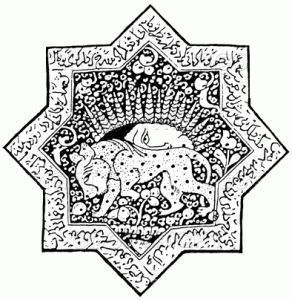
Tile from Iran in 13th century depicting the Lion-Sun motif (Savory, 1976, p.245). This image is of great significance as it symbolic of an enduring Iranian tradition of “Farr” (kingly glory) as represented by the Sun (an aspect of the ancient god Mithras) and the lion (symbol of strength, prowess and authority).
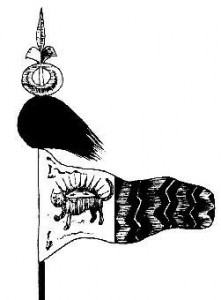
The armies of Timur e Lang or Tamerlane (1336-1405), one of the post-Mongol Turkmen warriors from Central Asia also witnessed the appearance of the simultaneous lion-sun motif. The above depiction is attributed to the year 1450 by Martin (Plate 60).
Savory, noting of the consequences of the Fall of the Caliphate in Baghdad, writes:
“…for six hundred the years the Caliphate had been the visible symbol of the unity of the Islamic world, and this symbol had now been removed. For Iranians who, as we have seen, had steadfastly preserved their sense of separate identity throughout this long period, this was an event of utmost importance. When Hulagu established a Mongol dynasty with its capital in Iran, Iran for the first time since late Antiquity ceased to be a mere geographical expression. By creating a state whose boundaries roughly coincided with those of the ancient Persian empires, Hulagu and his successors created, albeit unwittingly, the pre-conditions for the establishment of an Iranian national state under the Safavids at the beginning of the 16th century“. [Savory, 1976, p.146.].
The case of the Shir Dar in Samarkand
Perhaps one of the most interesting portrayals of the Lion and Sun motif lie outside the territorial coundaries of modern Iran, namely the “Shir Dar” (The Lion gate/doorway) city of Samarkand in modern Uzbekistan. Central Asia as a whole is heir to the Turco-Persian or “Persianate” civilization and for many centuries much of Central Asia was part of the Iranian realm. The cities of Samarkand and Bukhara played a very important role in the revival of the Persian language and literature after the Arabian conquests of Sassanian Persia.
Paul Kriwaczek, who undertook a massive study of Iranian theology (especially Mithraism, Zoroastrianism and Manicheism) and its influence on cultures and theologies (ast and west), has noted the following:
“Mithra stood for the contract, therefore for fairness, therefore for justice, therefore for honesty, therefore for truth, therefore for light, therefore for the sun. In Christendom, it is Jesus with whom believers have a personal relationship, rather than the austere, if unimaginably glorious, figure of God the Father. In iran it was Mithra rather than Ahura Mazda. He became, like Christ, the mediator between God and humanity. The sacred rite in a Zoroastrian temple is performed in a consecrated area known as Mithra’s gateway (Dar-e-Mehr). Upholder of truth and justice, it is he who bestows kingship. hence the Mithra-Sun on the Sher-Dar madrasah at Samarkand.” [Kriwaczek, 2002, p.120]
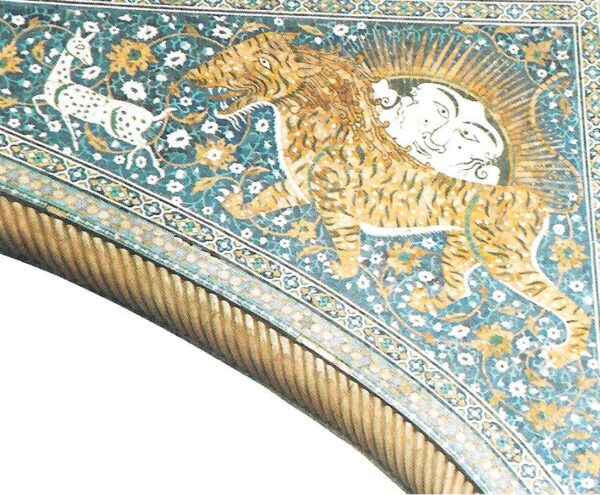
The “Shir Dar” (Lion Gate/doorway) of the Islamic college at Samarkand built originally in 1627 (Nafīsī, 1949, p.62). The sun motif is characterized by Kriwaczek (2002, picture Plate 1) as”…the image of Mithra, the rising and unconquered sun, Zoroastrian intercessor between God and Humanity.” (Courtesy of Kriwaczek, 2002).
The Samarkand Shir-Dar is significant in that it is much more than a symbol of Iranian cultural identity. As noted earlier, these symbols are also representative of a very ancient theological tradition, one that predates even the Achaemenid dynasty.
The Safavids: Revival of Iranian pre-islamic Symbols
The Safavid dynasty (1501-1722) was the first Iranian dynasty which finally reunited much of the old realms of the pre-Islamic Sassanian state. While certainly true that the Safavids were fierce proponents of the Shia branch of Islam, they were very cognizant of the Iranian national ethos and identity.
Western historians however, correctly point out that the lion-sun motif cannot be seen in art works and references depicting Jonayd’s son, Shah Ismail (1487-1524).

The flag of Iran at the time of Shah Ismail. It was a basic green color inset with the yellow figure of the moon. The Safavid flag however was to soon transform into the Lion-Sun motif, while retaining its green-color background.
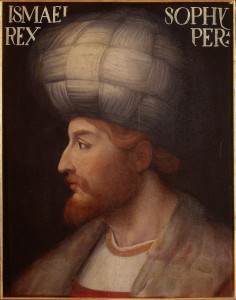
[Click to Enlarge] A 16th century European portrait of the founder of the Safavid dynasty Shah Ismail I (1487-1524) now housed at the Ulfizi Gallery, Florence, Italy. Partially visible Latin lettering states Ismail as the king (note the term “Rex”) of Persia (note the “Per” is evident on the top right side of this partial photo).
After Ismail, the Sun motif was to re-emerge as one of Iran’s major symbols centuries after the Arabo-Islamic conquests.
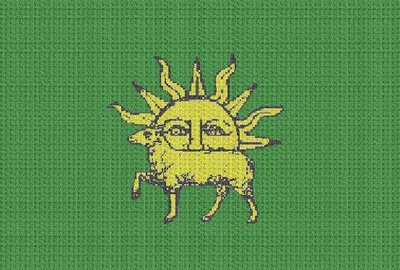
Safavid flag at the time of Tahmasp (1524-1576) son of Shah Ismail. Note the sun and the ram or sheep . The ram or sheep was a potent symbol in pre-Islamic Sassanian times and was often used as a banner by the ancient clans of Iran. The ram however was to be permanently displaced by the lion as the symbol of Persia or the Iranian state.
The Safavids however did draw upon two of Iran’s most ancient symbols: the sun and the lion. These became emblazoned on various metal and arts works and even coins (consult Naiīsi, 1949, p. 65). This had become apparent on the Iranian flag following the reign of Tahmasp (1524-1576). But perhaps most significant was their appearance on the Iranian banner.
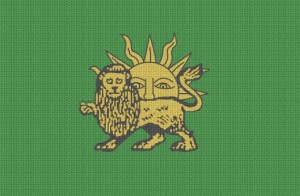
Safavid flag at the time of Ismail II (1576-1578). The lion has now become the primary symbol with the face of the sun rising in the background. Background is green.
European accounts of travelers to Iran during the reign of Shah Abbas I The Great (1587-1629) note that the lion and the emerging sun on the Iranian flag had appeared as early as the time of Sheikh Jonayd (consult Herbert, 1928, p.239).
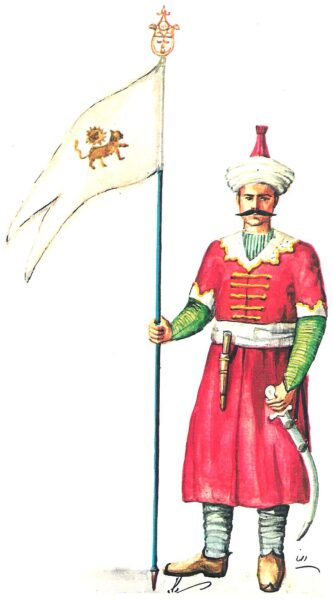
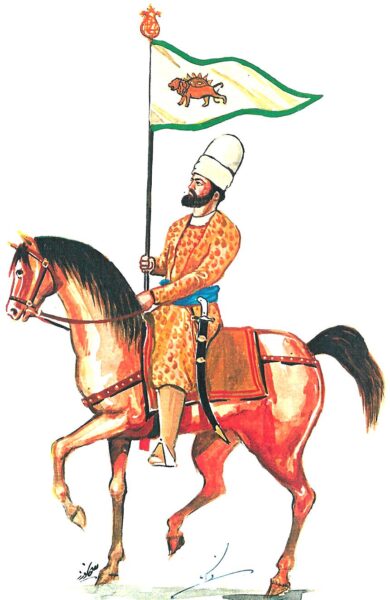
An Iranian army reconstruction in 1971 of a Safavid Alamdar or standard-bearer holding a two-pronged white banner with the lion and sun motif. It is of interest that the Safsvids defined these symbols both within a Shahname context as well as Shiite symbols.
By the time of Shah Abbas, lion-sun motif had become Iran’s national symbol. In their quest to revive the national ethos of Iran (albeit within a Shia Islamic interpretation), the Safavids (like the Turco-Persian dynasties cited before) appear to have drawn their inspiration from the Shahname, Iran’s equivalent of the Greek Illiad.
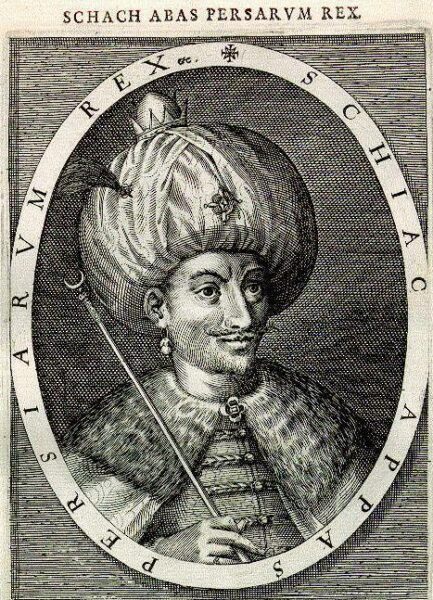
The copper engraving shown above of Shah Abbas, made by Dominicus Custos lists him among the Atrium of the heroic “Caesars” of history. Note the Latin insciption at the top of the plate “Schach Abas Persarum Rex” which translates as “Shah Abbas the Great monarch of Persia”. This was in reference to Shah Abbas’ victories over the Ottomans. Custos makes a particular emphasis on linking Shah Abbas to the “Mnemona Cyrus” (the Memory of Cyrus the Great of Persia). The Safavids regarded themselves as the heirs of the Persian Empire, founded by Cyrus the Great (559-530 BC), as corroborated by European sources (Consult Matini 1992).
Perhaps most revealing is the European drawing made by Egedius Sadeler in 1601. This pertains to an illustration of the envoy of Shah Abbas, Hossein Ali-beg Bayat, who had been sent as the Iranian emissary to the European courts.
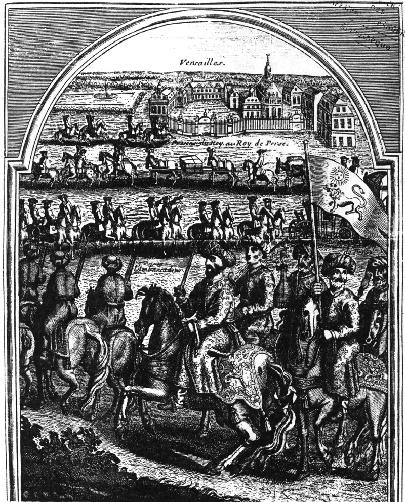
An Iranian delegation led by Mohammad-Reza Beg visits French dignitaries at Versailles, August 1715. Note the Iranian flag with Lion and Sun motif carried by the “Alamdar-Bashi” or standard bearer at Versailles (Consult Herbette, pp. 115 originally in a print in the Gazette de France).
A European traveler Adam Olearius, who visited Iran in 1636 noted that:
“Nowadays [meaning 1630s] the Turks use the crescent moon (as their emblem), and the Persians the sun which is mostly placed above the lion.”
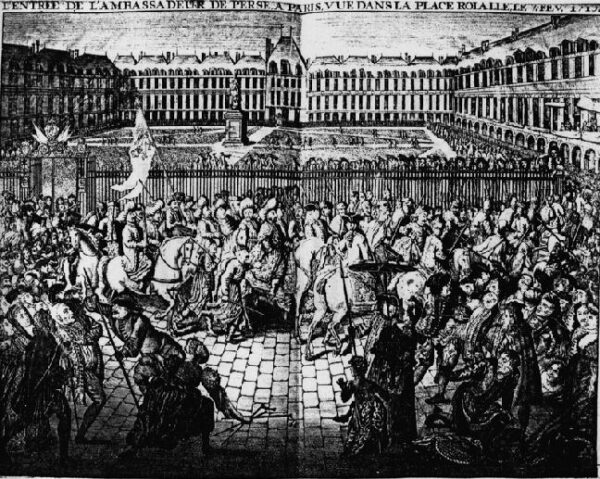
Iranian ambassador Reza Beg enters Paris to a warm welcome by the local French populace. Note the banner with the Lion and Sun motif carried by the standard bearer or “Alamdar-Bashi” (Consult Herbette, 1928, p.115, original from the Cabinet des Estampes).
The fact that the Safavids were immensely popular in Europe had much to do with their battles against the Ottoman Turks. This has received only passing reference by western historiography. Had Persia been conquered by the Ottomans, Europe would have had face the full wrath of the mighty Ottoman superpower. The Turks were a formidable military power and were pioneers in the use of cannon in reducing many of Eastern Europe’s powerful fortresses to rubble during their early conquests in the Balkans. The Ottomans ruled much of Eastern Europe and Greece for hundreds of years and very nearly captured Vienna. Safavid military action did much to assuage Ottoman military pressure upon Europe during the 17th to 18th centuries.
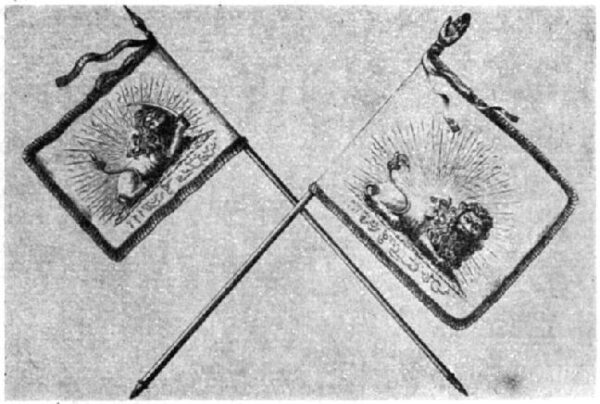
A European drawing of the Iranian flag in the early 19th century (Consult Honar o Mardom 31, p. 18. and Falsafī, 1955-67, IV, opp. p.160).
As in Sassanian times, the sun is used to refer to Iran as “Khorsheed e Iran” or “the Sun of Iran“. This is of keen interest as the western rivals of the Safavids, the Ottoman Turks, had adopted the crescent shaped moon as their symbol. As noted earlier, the pre-Islamic Sassanians had referred to the Romano-Byzantines to the west as being symbolized by the moon. By the time of the Safavids, the Ottoman Turks had fully displaced the Byzantines in Anatolia. As in Sassanian times both the lion and the sun acquired an exalted status, however in this case, these two motifs became central to the Iranian flag.
However it is important to note that the Safavid selection of the sun and lion motif was also applied within a Shiite Islamic context as well. The sun of Mithras was in pre-Islamic Iran, yet another display of the celestial “Farr” or “Divine Glory“. By the post-Islamic era and especially by the onset of the Shiite Safavids, the “Farr” had been redefined as “Nur” or “light” in Arabic. The Prophet of Islam and the Imam Ali were ascribed with the “Nur ol Anwar” or “light of lights“. It is of interest that Iranian post-Islamic arts often portray divine figures in possession of the “Nur ol Anwar” as being bestowed with halos of light (consult Qazvini, 1979, p.165), without actually revealing their faces.
The lion motif was also “linked” to Shiite theology. The pre-Islamic lion of Persia also known as the “Shir e Khoda” or “Lion of God” now also referred to the Imam Ali as “Asadollah” or “Lion of God” in Arabic (consult Qazvini, 1979, pp. 165, 472). Interestingly the Safavids also claimed descent from the house of Imam Ali (Kasravi, 1944).
These attributions created a powerful counter-reaction from the followers of the Sunni branch of Islam. From the Sunni view, the Shiites of Iran had desecrated or “corrupted” Islam by linking it to the ancient pre-Islamic traditions of Sassanian Iran (see discussion in Boyce, pp.33-35). This is a major factor which inflamed the relations between (Shiite) Safavid Iran and the (Sunni) Ottoman Empire.
The animosity of the doctrinal Sunnis was to endure well into the 20th century, and by implication, the modern age. An example of this can be seen in the statements of Ibn Saud, one of the founders of Wahhabism who mentioned to William Shakespear (British political agent in Arabia at the time) that:
“We Wahhabis hate the Turks only less than we hate the Persians for the infidel practices which they have imported into the true and pure faith revealed to us in the Koran” {Allen, 2006, p.245].
Already in British India, a powerful anti-Iranian and anti-Indian movement had been initiated by pan-Muslim purist thinkers. As noted by Drefuss and Lemarc:
“The son of Shah Wallullah, Shah Abdel-Aziz, gathered around him a network of disciples who visited India in 1809. Radiating from Indian centers where the British Colonial Office ruled, Eastern mysticism engendered a revival of xenophobic, Islamic purity that considered all outside influences as suspect and evil. Some of the Islamic orders demanded that all Muslims safeguard themselves from the penetration of Persian traditions and Indian habits” [Dreyfuss & LeMarc, 1980, p.119].
In the eyes of the Sunni purists and their pan-Muslim offshoots (such as the modern Taliban, Wahhabites, Muslim Brotherhood, etc.), the Iranians had “corrupted” Islam in their attempt to retain their ancient traditions. This may partly explain why Iranian pan-Muslim activists remain unfavorable towards native Iranic theological symbols,
Nader Shah and Karim Khan Zand: Reassertion of Iran’s cultural identity and territorial integrity
Nader Shah (c. 1688-1747) revived the power of Iran following the fall of the Safavid dynasty in 1722. He forced the Russians and Ottomans to yield the territories they had seized after the fall of the Safavids and ejected the Afghans who had occupied Iran from 1722 (consult Axworthy, 2006).
Nader Shah retained the Lion-Sun motif as Iran’s major emblem. In general, the Lion-Sun circled the words Allah ol Malek (Arabic: God the sovereign) (Consult Nayernuri, 1964, figure 4). The choice of colors however for the Iranian imperial standards did transform in relation to the former Safavid era. The choice of Green was consciously avoided by Nader Shah, perhaps in an attempt to distance himself from the powerful Shiite tradition of the Safavids.
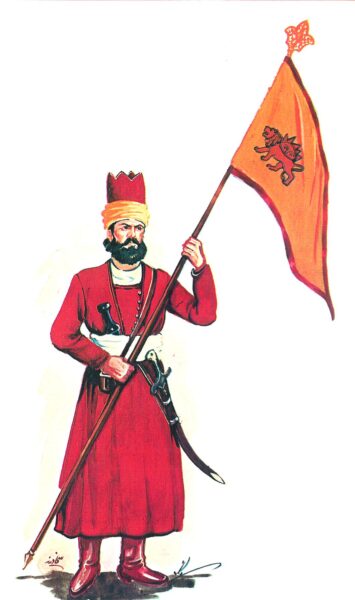
Standard bearer from the time of Nader Shah bearing the Lion and Sun motif (Iranian Army reconstruction, 1971). As noted by Axworthy (2006), one of the major reasons for Nader Shah’s military successes was due to his use of organized infantry musketry and cannon.
There also were two imperial multi-color standards at the time of Nāder Shah.
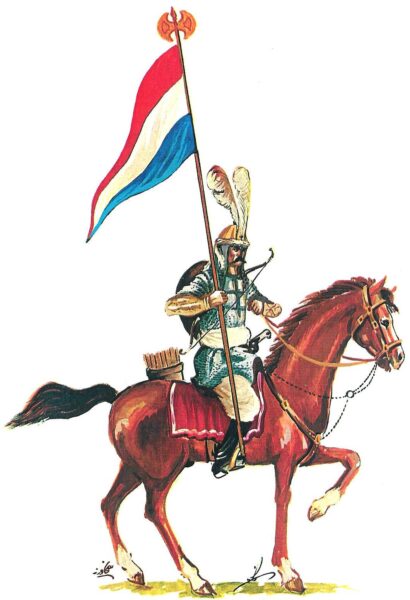
Standard bearer from the time of Nader Shah bearing a mulitcolor motif (Iranian Army reconstruction, 1971). Note the coincidental resembalnce of the tri-color to those of the French flag. As noted by Hanway:there was also another banner “…in stripes of red, blue and white, and the other of red, blue, white and yellow, without any other ornaments” (I, p. 248).
Bakhturtash (1969, pp.124) and Khorasani (2006, pp.326) report of a royal seal of Nader Shah in 1746 in which a lion faces to the right with a sun rising in the background.
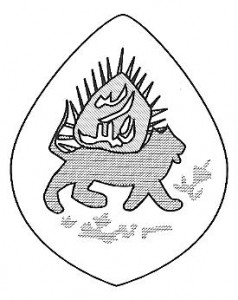
Royal seal with Lion and Sun motif during the reign of Nader Shah. Note the word Al-Molkollah (Arabic: The earth as God)) within the sun (Courtesy Khorasani, 2006, pp.326).
The succeeding administration of Karim Khan Zand also retained the Sun-Lion motif (Nafīsī, 1949, p. 73).
Standard bearer from the time of Karim Khan Zand bearing a banner with Lion and Sun motif (Iranian Army reconstruction, 1971).
Khorasani (2006, p.326) has exmained the swords of Karim Khan Zand in the Pars Museum in Shiraz and the Military Museum of Tehran. He notes that both swords have gold-inlaid inscriptions which refer to the:
“…celestial lion…points to the astrological relationship to the Zodiac sign of Leo…”
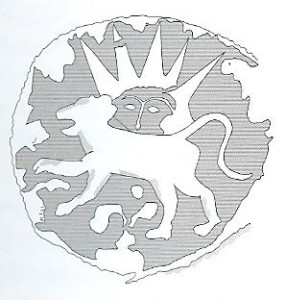
The Lion-Sun motif as seen on a tombstone dated to the Zand dynasty (Courtesy of Khorasani, 2006, pp.326).
The Qajars: Retaining the Iranian Flag
As noted by Nafisi (1949, p.74), the Qajars considered themselves as the heirs of the Safavids. In this respect, Agha Mohammad Khan Qajar (1742-1797) was to retain the Lion-Sun motif as Iran’s primary symbol.
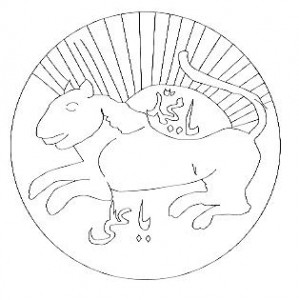
Emblem of the Lion and the Sun on a coin dated to Agha Mohammad Khan Qajar (Courtesy of Khorasani, 2006, p.327). The inscription on the bottom reads “Ya Ali” or “hail Imam Ali”.
Khorasani, Bakhturtash and Nayernuri fully explain the appearance of the Lion-Sun motif on stamps, regalia, flags, etc. Fathali Shah (r. 1797-1834) worked to establish the Lion-Sun motif as the sole official flag of Iran. However by the time of Fathali Shah’s successor, Mohammad Shah (1834-1848), Louis Dubeux reports that the latter had two distinct flags:
“one with the sword of Alī, which is double-pointed… [the other] with a lion couchant and the sun rising from its back.” (Dubeux , 1841, p.462).
It is important to note that it was the latter (lion and Sun) which was Iran’s primary flag; a fact illustrated by Russian artists depicting Iranian armies during the Russo-Persian wars.
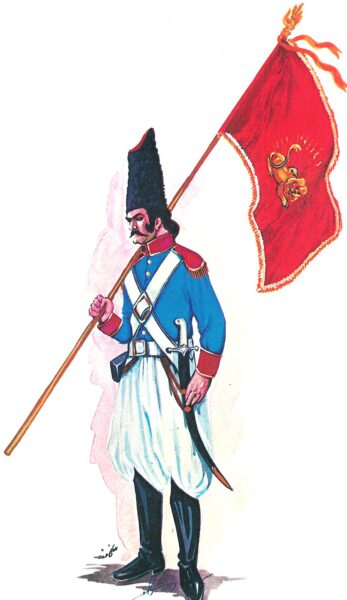
Qajar Standard bearer bearing a red banner with Lion and Sun motif (Iranian Army reconstruction, 1971). There was also a white and a green version of the same flag, although the red version was the one used during the Russo-Persian wars. This is a uniform typical of Abbas Mirza’s regular troops in the early 19th century during his wars against Russian expansion into Iranian territories in the Caucasus. The Russians prevailed and forced Iran to yield all her Caucasian possesions in the Treaty of Turkmenchai in 1828.
The “two flags” [lion-Sun and Sword of Ali] were combined during the regin of Mohammad Shah (Khorasani, 2006, p.328; Nayernuri, 1965, p.328). However the notion that the sword-wielding lion originates in the Qajar era is not supported by literary citations.
The Shahname epic of Firdowsi does describe a flag depicting a lion wielding a sword. As noted by Khorasani (2006, p.328), this coincides with the pre-Islamic Godarz Gahsvaz’s banner which displays a lion holding a sword.
The sword is an ancient and powerful symbol in Iranian theology. North iranic peoples such as the Scythians and Sarmatians worshiped the sword as a mythological symbol (Littleton & Malcor, 2000).
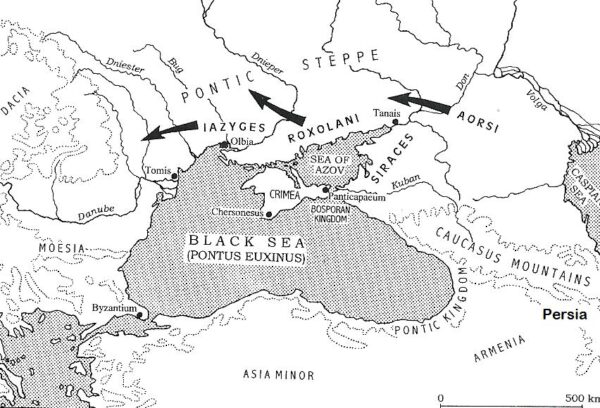
The movement of North Iranian peoples from Eastern Europe and the Caucasus into Central Europe and the Balkans. These arrivals allowed for the transmission of a number of Iranic theological themes such as sword-worship into Europe (Map courtesy of Brzezinski & Mielczarek, 2002, p.7).
The veneration of the sword existed also among the Iranic peoples in pre-Islamic Persia. Despite the passage of thousands of years, this pre-Islamic ritual has survived among the Kurds. Izady notes of Iranic pre-Islamic rituals among the Kurds including:
“…the represenation of the deity in the shape of a sword or dagger stuck into the ground” (Izady, 1992, p.156):
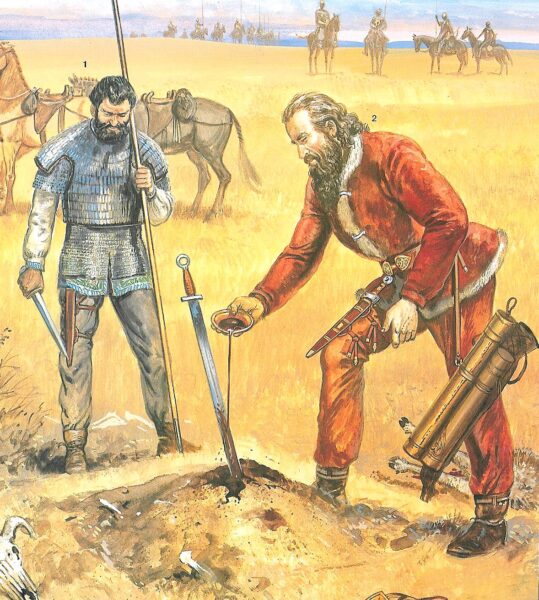
Sarmatian-Alan warriors engage in ancient rituals in the burial of a late comrade. An important ritual was the thrusting of the sword into the earth, a tradition still found in surviving ancient cults in parts of western Iran. The sword was a potent theological symbol in ancient Iranic rites. The above reconstruction is also of interest in that it shows that lamb sacrifice and the spilling of blood have pre-existed among Iranian peoples before the arrival of Islam into Sassanian Persia, Anatolia or the Caucasus (Map courtesy of Brzezinski & Mielczarek, 2002, Plate B).
The aforementioned Sassanians had a designated “Shapsheraz” or “he who brandishes the sword” (Farrokh, 2005, p.62, E2). The function of the Shapsheraz was to carry a ceremonial sword in the court at Ctesiphon, the ancient Sassanian capital (now in iraq, just 40 km away from modern Baghdad).
The Sassanian broadsword continued to be used in a ceremonial fashion, even after this had been militarily obsolete from the late 5th century AD onwards (Farrokh, 2005, p.12). A vivid example of this can be clearly seen at the investiture of Khosrow II (r. 590-628 AD) at Tagh-e-Bostan near Kermanshah.
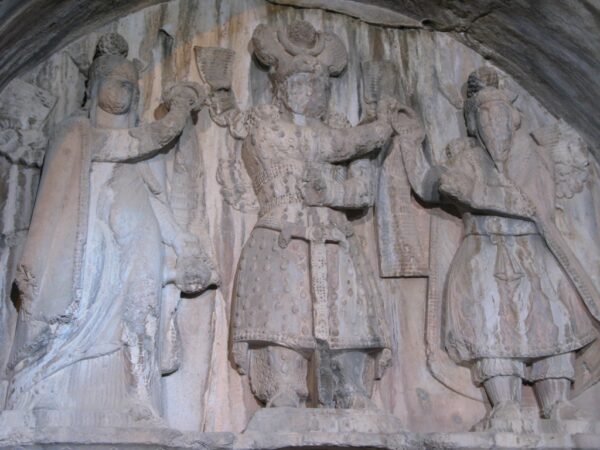
The investiture of Khosrow II at Tagh-e-Bostan. Note the broadsword held by Khosrow II at center, flanked by Ahura-Mazda at right and Goddess Anahita to the left. The straight broad sword appears often in Sassanian arts. It is worth noting that the Qajars also carved reliefs at Tagh-e-Bostan, perhaps in an aendeavor to associate their dynasty with more ancient Iranian icons.
Given the ancient Iranian tradition of veneration for the sword, it is not altogether surpsring that post-Islamic Iranians (especially with the onset of Shiism during the Safavid era) would adopt the Zulfaqar, or the sword of Imam Ali as a potent religious symbol.
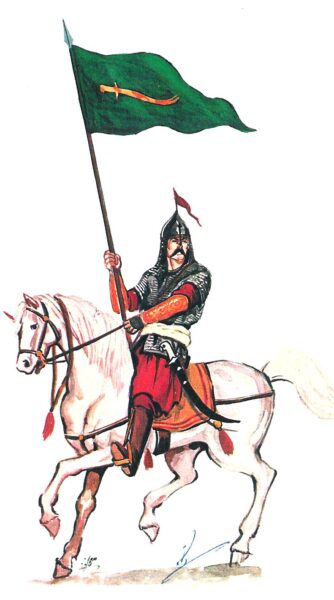
A Safavid Alamdar or standard bearer carrying a banner with the Zolfaqhar sword of Imam Ali one of Shiite Islam’s most revered figures. (Iranian Army reconstruction, 1971). Note that the original Arabo-Muslims did not carry the curved sword at the time of the Muslim conquests – their swrods were straight like those carried by the Romano-Byzantines and the Sassanians during the 7th century. The sabre is a later Turkic invention during the post-Islamic era.
From the time of Mohammad Shah Qajar onward, the sword-wielding lion was to become modern Iran’s state emblem up to 1979. As noted already in this article, the lion, the sun and the sword are ancient symbols in iranic customs and mythology.
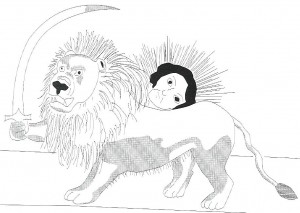
The lion and sun motif as seen in a newspaper during the reign of Nasser e Din Shah Qajar (1831-1896) (Courtesy of Khorasani, 2006, p.330). Note that the lion is now rampant and wielding a curved sword. Nevertheless, the notion that this sword first appeared during Nasser e Din Shah’s reign can now be questioned.
In a 2011 trip to Stepankert in Karabakh Professor George Nercessian discovered a walled structure housing a lion-sun emblem with the lion bearing a curved saber (see below):
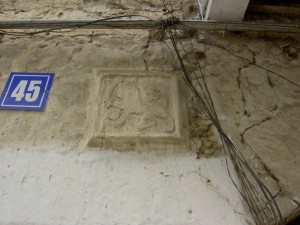
[Click image to Enlarge]. The Iranian Lion and Sun emblem on a tile embedded in an old wall structure in Khankendi, Karabakh. This structure dates to the early 19th century (not Nasser e Din Shah’s time) – the karabakh khanate and all other Caucasian Iranian khanates (i.e. Baku, Shirvan, etc.) were conquered from Iran by imperial Russia by 1828 (Photo courtesy of Professor George Nercessian, 2011).
The appearance of the Green-white-red tri-color motif appears to have been later during the Qajar era. The color of Mohammad Shah’s flag at a siege near Herat is reported as triangular with a green border with white inset bearing the lion (without sword) and Sun motif. The earlier red color version of the flag is also reported in 1850; this having the Sun and lion which carries staff (instead of a sword) with the name of Imam Ali. By 1886 the tricolor (Green-White-Red) legend was applied onto the Iranian flag bearing the Sword-wielding lion and Sun motif.
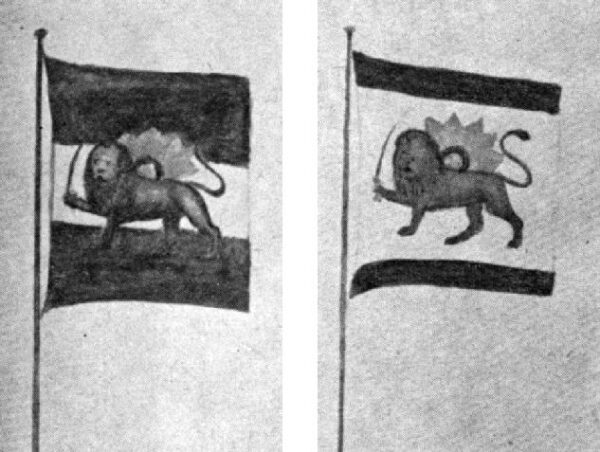
Qajar flags by 1886. Though not evident here both have the green color on top, white in the middle and red at the bottom. The version of the flag at the right was designed by stateman Amir Kabir (1807-1852) probably sometime between 1848-1852. It was the “equal stripe width” version at left which gained prominence from the late 1800s onwards.
The actual meaning of the colors is heavily debated. In general, Green is said to represent Islam, white peace and industriousness and red for courage. The latter color (red) was reported among Sassanian troops by Ammianus Marcellinus (24.8, 1).
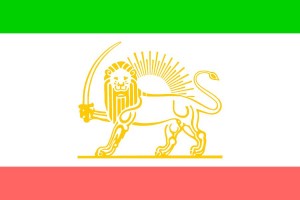
Another view of the Amir Kabir version of the Iranian flag. This was the forerunner to the “equal stripe width” version discussed above.
The Constitutional Revolution (1906-1911): The Tri-Color and Lion-Sun Motif
The Iranian Constitutional Movement was the first of its kind in advocating human rights, equality and democracy in Western Asia (see Chaqueri, 2001). The aim of the Iranian Constitutionalists was to limit the absolute powers of the Qajar Shahs in favour of a democratically elected parliament. As noted by Professor Atabaki:
“In the constitutional revolution, like minded Azerbaijanis, Persians, Bakhtiyaris, and Gilanis fought alongside one another against…the absolute arbitrary power of the monarchy…their objective was not to divide this power (of Law and government) among the different ethnic groupings in the country in order to establish separate independent states based on ethnic identity.” (Atabaki, 2000, pp.28)
Sattar Khan (1868-1914) and his allies from Iran’s different regions fought under the Iranian flag bearing the lion and sun motif. The motifs (i.e. the Lion of Persia, the Sun-god Mithras, etc.) are ancient symbols and despite the centuries, have continued to provide common ground among Iran’s diverse linguage groups.
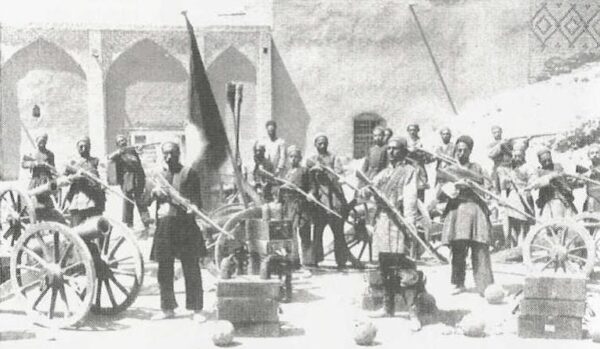
Constituionalist troops fight in the name of democracy against Qajar Royalists and their Russian allies in Tabriz sometime in 1906. Note that these troops fight under the Iranian flag. Note that the colors are of equal width.
Despite an attempt by some constitutionalists to display red banners, these were easily overruled in favor of the tri-clor Lion-Sun motif. Most significant however is the late Professor Shapur Shahbazi’s observation in Encyclopedia Iranica that an amendment to the Iranian Constitution of 1906 established the Iranian flag with :
“…”three colors (in stripes of equal width and length) of green, white and red, with a lion (sword-bearing and passant) and sun as its device“
Simply put, the tri-color Iranian flag with the Lion-Sun motif is not dateable to the Pahlavi era – it had already been estbalished as the national Iranian flag during the Constitutional Revolution which was greatly indebted to Sattar Khan. What is significant is that the Iranian flag during the Constitutional revolt was not solely representative of the ruling cast at the time – the Qajars.
The Evolution of the Flag from 1925
The Pahlavi regime which attained power in 1925, is certainly not the creator of the Lion-Sun motif of the Iranian flag. In fact it is by all appearances very similar to its predecessors in the 19th and early 20th centuries.
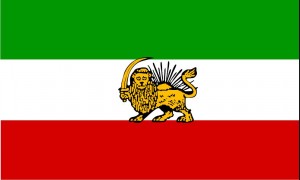
The Iranian flag from 1925-1964.
In 1964, however modifications were applied upon the Iranian flag. These were the application of a wreath and a crown around the existing symbols (lion and sun).
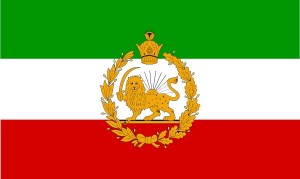
The Iranian flag from 1964-1979. Note the addition of the wreath and the crown. The Sun in this case is visible but somewhat diminished compared to earlier versions of the Iranian flag seen in pre-Islamic, pre-safavid, Safavid, Afsharid, Zand and Qajar eras.
While the wreath and the crown were certaInly new additions upon the already-existing Lion-Sun motif, the roots of the sword-wielding lion and sun can be traced back across the millenia to ancient Iranian mythology, astrology, statecraft, and cultural identity.
Following the 1979 revolution, the colors of the Iranian flag were retained, with major changes occurring with respect to its symbols. The recent wreath and crown were removed as were the more ancient Lion-Sun motif.
References
Allen, C. (2006). God’s Terrorists: The Wahhabi Cult and the Hidden Roots of Modern Jihad. London, England: Abacus.
Atabaki, T. (2000). Azerbaijan: Ethnicity and the Struggle for Power in Iran. Published I.B. Taurus.
Axworthy, M. (2006). Sword of Persia. IB Taurus.
Bakhturtash, N. (1969). Parcham va Paykareye Shir o Khorshid [The Flag and Lion and Sun Symbol]. Tehrna: Moasseseye Matbouatiye Atai.:
Boyce, M. (1967). Bībī Shahrbanu and the Lady of Pars. Bulletin of the School of Oriental and African Studies, 30, pp. 30-44.
Brzezinski, R., & Mielczarek, M. (2002). The Sarmatians 600 BC-450 AD. Oxford: Osprey Publishing.
Channon, J. & Hudson, R. (1995). Penguin Historical Atlas of Russia, Penguin Books.
Chaqueri, C. (2001). Origins of Social Democracy in Iran. Seattle: University of Washington Press.
Darley-Doran, R. E. (). Saljūgid: Numismatics. EI2 VIII, pp. 973-78.
Jamalzadeh, M.A. (1965). “Beyraqhaye iran dar Asr-e safaviyeh [The banners of iran during the Safaivd Era]”. Honar o Mardom publications, volumes 39-40, pp. 10-13.
Dreyfuss, R. & LeMarc, L. (1980). Hostage. New York: new Benjamin Frabklin Press Publishing Company.
Dubeux, L. (1841). La Perse [Persia]. Paris.
Falsafi, N. (Produced in five volumes from 1955 with latest print in 1996). Zendeganiye Shah Abbas [The Life of Shah Abbas]. Tehran: Chapkhaneye Maharat.
Farrokh, K. (2005). Sassanian Elite Cavalry 224-651. Oxford: Osprey Publishing.
Farrokh, K. (2007). Shadows in the Desert: Ancient Persia at War. Oxford: Osprey Publishing.
Head, D., & Scollins, R. (1992). The Achaemenid Persian Army. Stockport: Montvert Publications.
Harper, P.O. (1978). The Royal Hunter: Art of the Sassanian Empire. New York: Charles E Tuttle Company.
Herbert, T. (edited and abridged, W. Foster in 1928). Travels in Persia 1627-1629. London.
Hinnels, (1988). Persian Mythology. Hamlyn.
Hinz, W. (1969). Altiranische Funde und Forschungen [Findsand Investigations of Ancient Iran]. Berlin: De Gruyter .
Kasraian, N., & Arshi, Z. (1993). The Kurds of Iran. Tehran: Seke Press.
Kasravi, A. (1944). Din va jahan [Religion and the World]. Tehran.
Khorasani, M.M. (2006). Arms and Armor from Iran: The Bronze Age to the End of the Qajar Period. Germany: Verlag.
Kriwaczek, P. (2002). In Search of Zarathustra: The First Prophet and the ideas that Changed the World. London: Weidenfeld & Nicolson.
Littleton, C.S., & Malcor, L.A. (2000). From Scythia to Camelot. London: Garland Publishing.
Mariusz, R. & Mielczarek, R. (2002). The Sarmatians: 600 BC-450 AD. Osprey.
Matini, J. (1992). Nazaree be naghshe-ha-ye ghadeeme-ye Iran [An examination of the ancient maps of Iran]. Iranshenasi: A Journal of Iranian Studies, IV (2), p.269-302.
Newark, T. (1998). Barbarians: Warriors & Wars of the Dark Ages. Blanford.
Nafisi, S. (1949). Derafsh-e Iran va Shir o Khoshid [The Banner of Iran and the Lion and the Sun]. Tehran: Chap e Rangin.
Nayernuri, H. (1965). Tarikhcheye Beyraq e Iran va Shir o Khorshid [A History of the Banner of Iran and the Lion and the Sun]. Tehran: Entesharat e Motalleat va Tahghighat e Ejtema.
Papadopoulo, A. (translated by R.E. Wolf 1979). Islam and Muslim Art. New York.
Qazvīnī A. R. (1979) in Ketāb al-Naqż, edited by J. Ormavī Moadde. Tehran.
Rice, D. T., & Gray, B. (1967). The Illustrations of the “World History” of Rashīd al-Dīn. Edinburgh.
Savory, (1976). The Land of the lion and the sun. In Chapter 10, B. Lewis (Ed.), The World of Islam: Faith, People, Culture. London: Thames & Hudson.
Sekunda, N. (1992). The Persian Army 560-330 BC. London, England.
Shahbazi, Sh. A. (2009). Flags of Persia. Encyclopedia Iranica.
Sinclair, A. (2008). The Grail: The Quest for a Legend. The History Press.
Spuler, B. (1985). Die Mongolen in Iran: Politik, Verwaltung und Kultur der Ilchanzeit 1220-1350. Brill.
Sulimirski, T. (1970). The Sarmatians, London: Thames & Hudson.
Tilia, A. B. (1978). Studies and Restorations at Persepolis and Other Sites of Fārs II, Rome.
Yusofi, G.H. (1962). Farrokh e Sistani. Mashad.[/fusion_builder_column][/fusion_builder_row][/fusion_builder_container]
Related posts: