 The article below by Dr. Ken R. Vincent discusses the ancient prophet Zoroaster and his impact on human theology and the world’s major religions.
Dr. Ken R. Vincent’s writings all contain a strong undercurrent of Universalist thought. In his book The Magi: From Zoroaster to the Three Wise Men, he compares the religion of the Magi (Zoroastrianism) to Christianity and shows the parallels of Universal Restoration in both faiths.
Kindly note that the article below contains pictures and captions that do not appear in Dr. Vincent’s original posting of the article.
=======================================
1. Zoroaster, the Prophet of the Magi
Once upon a time, before wisdom was confined to books, Shamans of the “Great Spirit’ anticipated an afterlife for their peoples. But the earliest existing expression of the Universalist idea of an afterlife where God saves ALL people can be found in the revelation of Zoroaster, Prophet of the Magi. Truly, it is one of many profound influences that Zoroaster’s new religion had on the subsequent development of Judaism, Christianity, and Islam. Known as Zoroaster by the Greeks and Zardust by the Arabs, he is properly called Zarathustra by the followers of the religion he founded. (Since he is best known in the West by the Greek name Zoroaster, that name will be used in this paper; interestingly, the Greek name “Jesus” also became favored over the Hebrew “Yeshua.”)
According to the Holy Book of the Magi, Zoroaster was born in eastern Iran and lived from about 660 BCE to 583 BCE. Like Moses (who is thought to have lived between 1600 and 1200 BCE), there is virtually no corroborative historical evidence for his life outside the religious writings. Most scholars place Zoroaster’s life earlier in history (as long ago as 1200 – 1800 BCE), mainly due to the ancient Eastern Persian language he used to compose his Hymns (Gathas).
Zoroaster’s parents were middle-class, and his father was probably a horse or camel trader as well as a priest. He was married and had children. His major revelations occurred at age 30 after he, like Jesus, went into the wilderness to seek God. After this experience, he was inspired to say that:
“God declared to me that silent meditation is the best for attaining spiritual enlightenment” (Y43.15).
The Holy Book of the Magi relates how Satan tempted him in the wilderness with a promise of a 1,000-year rule. He preached for ten years without success, after which he converted his cousin, the rest of his family, and King Vishtaspa.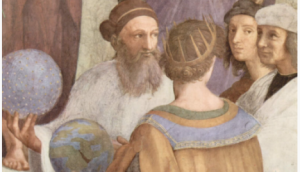 A detail of the painting “School of Athens” by Raphael 1509 CE (Source: Zoroastrian Astrology Blogspot). Raphael has provided his artistic impression of Zoroaster (with beard-holding a celestial sphere) conversing with Ptolemy (c. 90-168 CE) (with his back to viewer) and holding a sphere of the earth. Note that contrary to Samuel Huntington’s “Clash of Civilizations” paradigm, the “East” represented by Zoroaster, is in dialogue with the “West”, represented by Ptolemy. Prior to the rise of Eurocentricism in the 19th century (especially after the 1850s), ancient Persia was viewed positively by the Europeans.
2. An Introduction to Zoroastrianism
Once Zoroastrianism was adopted by the kings of Persia, the religion spread throughout the Persian Empire. The Magi, who at that time were priests of the old pagan religion in western Iran, accepted and taught the new religion of Zoroaster; some believe that Zoroaster himself was a Magus of the old religion prior to his divine revelations. His Hymns to God (Gathas), about the length of the Gospel of Matthew, were first recited orally and eventually written into the Holy Book of the Magi (Avesta). We know that he was assassinated by a rival priest at the age of 77 years. While Zoroaster claimed no divinity for himself, later traditions created miraculous stories that were characteristically attached to persons held in high esteem in the ancient world. A fond tradition claims that Zoroaster laughed (instead of crying) at birth!
In the religion of the Magi, humanity has free will to choose between good and evil, and we are required to be active participants with God in the eventual defeat of evil. The core beliefs are often summarized succinctly in the phrase:
“Good thoughts, good words, and good deeds.”
Zoroaster’s name for God is “Ahura Mazda” which means, “Lord of Life and Wisdom” or simply “Wise Lord.” This can be compared to the literal translations of the names for God in Hebrew Scriptures: “Yahweh” which means “I AM” and “Elohim” which means “God“. For Zoroaster, God is wholly good; God unconditionally and totally loves all his Creation and all humanity – always. God is not angry, jealous, or vengeful; God would never tempt humans into doing evil. We are made of the essence of God and are cherished by God. Fasting, celibacy, and the austere life have no place in the religion of the Magi; one is simply directed to BE LIKE GOD – Do Good and Oppose Evil. (Christians may recall that in Matthew 5:48, Jesus also commands us to be like our heavenly Father.) Because all creation is sacred, it is also humanity’s duty to protect creation and not defile it or pollute it. (In a very real way, Zoroaster was the first environmentalist!)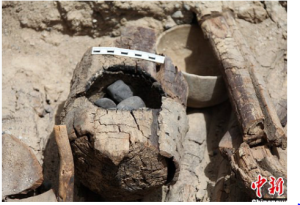 Archaeologists in Northwest China’s Xinjiang Uygur Autonomous Region have discovered major Zoroastrian tombs, dated to over 2,500 years ago. (Caption and Photo Source: Chinanews.com). As noted in the China News report: “This is a typical wooden brazier found in the tombs. Zoroastrians would bury a burning brazier with the dead to show their worship of fire. The culture is unique to Zoroastrianism…This polished stoneware found in the tombs is an eyebrow pencil used by ordinary ladies. It does not just show the sophistication of craftsmanship here over 2,500 years ago, but also demonstrates the ancestors’ pursuit of beauty, creativity and better life, not just survival. It shows this place used to be highly civilized”. For more on this topic, see here…
God is opposed by an evil force called “The Demon of the Lie” which Zoroaster described as “that which is not and never was” — almost as if he saw the devil as a vacuum. Satan is responsible for all death, destruction, decay, and darkness. Satan has no physical presence on Earth but does have the ability to corrupt God’s creation. However, Satan is dim-witted and disorganized and can be defeated by the Good!
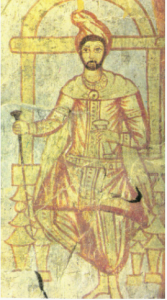 A drawing of Zoroaster that was made by a Manichean initiate at Dura Europus (Source: Clioamuse); for more on the creed of Mani, see here…
Like Christianity, the religion of the Magi has a concept of the Holy Spirit as being the part of God that is present with us on the Earth. God is both immanent (present) and transcendent (other). It is the Holy Spirit or Mentality of God (Spenta Mainyu) that counters the Evil Spirit or Mentality (Angra Mainyu). In the words of Zoroaster:
“Through his Holy Spirit
And his Sovereign mind,
Ahura Mazda will grant
Self-realization and immortality
To him whose words and deeds
Are inspired by righteousness,
Moral courage and Divine Wisdom.” (Y47.1)
3. Zoroastrianism: The Origin of God as Light
Both the ancient Magi and the modern followers of Zoroaster see God as Light, the oldest non-anthropomorphic conception of God. God is the light above us, around us, and within us. For Zoroaster, the contrast between light and darkness is always a metaphor for the conflict between Good and Evil. In speaking of the God of the Magi, the 3rd-century Greek philosopher Porphyry said:
“God’s body is Light, and His Spirit Truth.”
In more modern times, Einstein saw all matter as frozen light, and physicist Stephen Hawking stated:
“When you break subatomic particles down to their most elemental level, you are left with nothing but pure light.”
Sometimes observers of this religion from ancient to modern times have mistaken the Magi for fire worshippers because of the “eternal flame” present in all of their temples. However, the fire has never been worshiped; the flame of the fire represents LIGHT, their symbol for God.
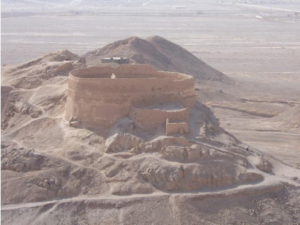 An ancient Zoroastrian Tower of Silence in Yazd (Source: The Heritage Institute).
4. Zoroastrianism: The Origin of a Final Judgment
Concepts of the afterlife in the religion of the Magi are almost identical to those of Christianity. Joseph Campbell suspects direct borrowing of the ideas of the Magi by Dante in his vivid descriptions of a multi-layered Heaven and Hell. According to Zoroaster’s vision, each human soul is required to face judgment on the “Bridge of Judgment.” If there is a preponderance of good deeds, the soul is allowed to pass over a wide bridge to Heaven on which the good deeds meet him or her in the form of a beautiful 15-year-old girl. The soul of the saved asks:
“Who are thou, for I have never seen a young girl on Earth more beautiful or fair than thee? In answer, the young girl replies, “I am no girl, but thy own good deeds.”
If the human soul contains a preponderance of evil deeds, a young girl “who has no semblance of a young girl” comes to meet it, and the soul of the damned says:
“Who are thou? I have never seen a wench on Earth more ill-favored and hideous than thee.” In reply, the ill-favored wench says, “I am no wench, but I am thy deeds – hideous deeds – evil thoughts, evil words, evil deeds, and evil religion.”
Unlike Dante whose Limbo is for the righteous who are not Christians, Limbo in the religion of the Magi is for those whose good deeds and bad deeds are in equal balance. The Hell of the Magi is not eternal but only a temporary detour while you “shape up” and the evil in you is purified. Zoroastrians, like other Universalists, believe God is too good to sentence humans to Eternal Hell. Some modern minimalist scholars dispute the fact that Zoroaster was a Universalist and say that Universal Salvation came into Zoroastrianism later; however, as Mary Boyce points out in Textual Sources for the Study of Zoroastrianism, the religion was definitely Universalist many years before Christianity when the 4th century B.C. Greek, Theopompus stated that:
“Zoroaster prophesies that some day there will be a resurrection of all the dead. In the end Hades shall perish and men (people) shall be happy …”
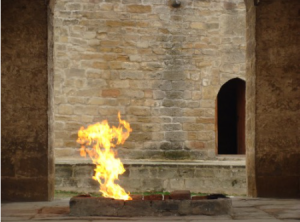 The main fire altar at the Atash-kade (Zoroastrian Fire-Temple) of Baku in the Republic of Azerbaijan (known as Arran and the Khanates until 1918) (Picture Source: Panoramio). This site is now registered with UNESCO as a world heritage site. For more on Zoroastrian and Mithraic temples in the Caucasus, see here…
5. Zoroastrianism: The Origin of Angelic Beings
In the religion of the Magi, the Archangels – called the “Bounteous Immortals” – are very powerful, as you can tell from their names: “The Good Mind“, “Righteousness“, “Divine Power“, “Universal Love“, “Perfection“, and “Immortality.” Interestingly, half are male and half are female. They were created by God and with the Angels serve as a link of communication between humanity and God. Additionally, they are manifestations of the characteristics present in men and women of good will – those that each of us needs to integrate into our lives in order to serve God. For instance, good men and women manifest the characteristics of the Archangel of the Good Mind, while evil people are beset with the Evil Mind. The Archangels have been called deities erroneously by some scholars. Some scholars maintain that Zoroaster’s original conception was that of highly abstract Archangels which represent mere aspects of God. Tradition and, more importantly, followers of the modern Zoroastrian religion interpret them literally as Archangels. The Magi also believed that there were Earth Angels of which the prophet Zoroaster was one. Dr. J. J. Modi sees parallels between the Christian angel Michael and the Zoroastrian angel Mithra, as well as between the Christian angel Gabriel and the Zoroastrian angel Sraosha.
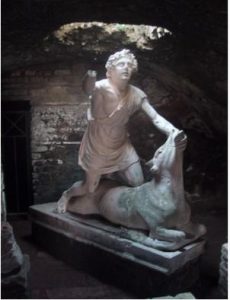 A Roman version of the statue of Mithras “Bringer of Light” in a Mithraic temple in Ostia, Italy (Consult, Hinnels, 1988, pp.83). Note the opening on the ceiling just above Mithras, allowing the sun rays to “illuminate” the god. Mithras in Iranian mythology is the bringer of light and justice as well as a manifestation of the eternal sun (Picture source: Public Domain). For more on Mithras, see here…
The name of Mithra may sound familiar to Westerners because of a heretical cult during Roman times that extended as far west as England. This “mystery religion” (which allowed only men) worshipped Mithra as a god, and its popularity is said to have rivaled the early Christian movement. Curiously, Mithra’s birthday is December 25, a date adopted later by the Christian Church for Christmas in its effort to discourage participation in this pagan celebration. Mithra is still worshipped as a god in India. However, in the orthodox religion of the Magi, Zoroastrians consider Mithra “only” an Angel and not even an Archangel! Sophy Burnham, author of A Book of Angels, credits Zoroaster with the development of the concept of angels. Before their contact with the Magi, the Hebrews often refer to the messengers of God as simply men (as in Genesis 18 when three men, one of whom is God, appear to Abraham). After their contact with the Magi, Judaism and later Christianity and Islam have a well-developed system of Archangels and Angels.
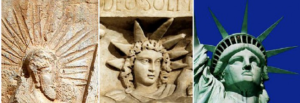 Mithras’ Enduring Legacy? (Left) Mithras at Taghe Bostan, Western Iran; (Middle) Deo Sol Invictus, Italy; (Right) The Statue of Liberty, Staten Island, New York. For more on Mithras, see here…
6. Zoroastrianism: The Origin of Universalism
Both a spiritual afterlife of the soul and a physical resurrection at the end of time are concepts of Zoroaster. Humanity can fall prey to evil, but after “purification” in Hell, ALL are saved at the end of time. When the victory over evil is complete, the end of time will come where nothing ever dies or decays, and there is no darkness – only LIGHT.
In the spirit of Universalism, Zoroaster tells of future Saviors possibly coming from different nations:
“Indeed such shall be the Saviors
Of the countries who follow
The call of Duty by good thoughts
Because of their deeds
Inspired by righteousness
In accord with your command
O Mazda, they certainly have been marked out
As smiters of wrath.” (Y48.12)
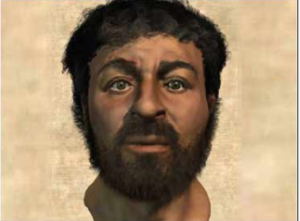 The historical Jesus as reconstructed by modern anthropologists (see BBC Report…).
7. Zoroastrianism: The Origin of Dualistic Good Versus Evil
One ongoing issue in Zoroastrianism present since antiquity is the debate between those who interpret Zoroaster’s understanding of God as “ethical dualism” (monotheism) and those who maintain the concept of “cosmic dualism” (God and Satan co-exist). Although Zoroaster was very sure that God is wholly good and that man is free to choose good or evil, his teachings were unclear about the source of evil in the world. That is, if God the Creator is all good, where does evil come from? Those supporting ethical dualism (monotheism) would answer that evil originates in the mind of humanity and is the byproduct of creation; because the Universe is incomplete and unfinished, there is a capacity to alter the status quo. That is why humanity must be active in helping God to overcome evil. The Zoroastrian scholar and modern-day believer, Prof. Farhang Mehr, sees Zoroaster as a pure monotheist who taught ethical dualism rather than cosmic dualism.
Throughout the long history of this religion, the concept of cosmic dualism has been more widely accepted; that is, a belief that good comes from God and that evil comes from Satan, although God is Eternal and Satan is not. Interestingly, this same concept of cosmic dualism is used throughout the New Testament by both Jesus and St. Paul, although the monotheism of Christianity is never doubted. Satan is a very real and powerful being to Jesus; he is tempted by Satan in the three Synoptic Gospels (Matthew 4:1-11, Mark 1:12-13, Luke 4:1-13). He asks:
“How can Satan cast out Satan? If a kingdom is divided against itself, that kingdom cannot stand” (Matthew 12:25-26, Mark 3:23-24, Luke 11:17-18).
In Ephesians 6:11, Paul writes:
“Put on the whole armor of God so that you may be able to stand against the wiles of the Devil.” (Ephesians 6:11)
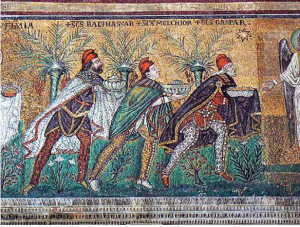 The Three Wise Men as depicted in Ravenna (Sant’Apollinare Nuovo), Italy (Source: Public Domain). Note the European depiction of Partho-Sassanian Iranian dress, caps and cloaks.
The proponents of cosmic dualism feel comfortable with modern-day “Process Theology” which expresses the idea that God cannot bestow free will and remain all powerful. A concept in modern physics that may reinforce the reality of cosmic dualism is that “a little chaos” is present in every atom of the Universe.
The God of the Magi is Universal, and Zoroaster was the first to proclaim this truth. In the words of the Persian (and Zoroastrian) King Darius:
“I am King of all the Nations by the will of God.”
In the words of Zoroaster, God is supreme:
“When I held you in my very eyes
Then I realized you in my mind, O Mazda,
As the first and also the last for all Eternity,
As the Father of Good Thoughts,
As the Creator of Righteousness
And Lord over the actions of life.” (Y31.8)
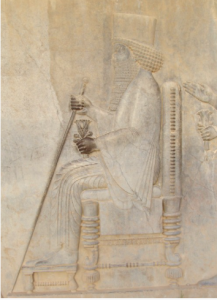
A relief of Darius I (r. 522–486 BCE) at Persepolis (Source: Public Domain); Darius was the third monarch of The Achaemenid Empire (550-330 BCE).
8. Zoroastrianism’s Influence on World Religions
Although the Persian Empire fell to Alexander (331 BCE), the Magi continued to be very influential throughout the Middle East and the Western World, and the religion of the Magi continued as the primary religion in the middle east until the Moslem conquest (642 CE). The Magi were prized as teachers of great wisdom and power, and Zoroaster remained a highly respected figure.
Of course, Zoroastrian ideas have been enormously important to subsequent religious thought. Many scholars contend that it was Zoroaster’s cursing of the Hindu gods that initiated the break between the religious approaches of the East (Hindu, Buddhism) and those of the West (Judaism, Christianity, Islam). In the Dead Sea Scrolls of the Essenes, the imagery of the “Sons of Light” and “Sons of Darkness” is a direct borrowing from the Religion of the Magi. Six hundred years after the Moslem conquest, the Sufi Mystic, Attar of Nishapur, wrote:
“We are the Eternal Magi, we are not Muslims.”
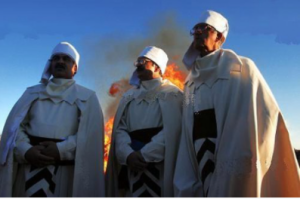
Zoroastrian magi from Kerman during the Jashne Sadeh ceremonies (Source: Heritage Institute).
The Cypress slender Minister of Wine in the Rubaiyat of Omar Khayyam is a Magi. Omar Khayyam once said he wore the belt of a Magi because he was ashamed of his Islam.
Zoroaster taught that God loves us all and that, after evil is finally defeated, all humanity will be saved at the end of time, although those whose bad deeds outweigh their good deeds will need to be “purified” in Hell before joining God in Heaven.
The following example illustrates the views of Zoroaster concerning Universal Salvation:
“If you understand these laws of happiness and pain
Which Mazda has ordained, O mortals,
(There is) a long period of punishment for the wicked
And reward for the pious
But thereafter eternal joy shall reign forever.” (Y30.11, emphasis added)
9. References
Boyce, M. (1984). Textual sources for the study of Zoroastrianism. Chicago: The University of Chicago Press.
Burnham, S. (1992). A book of angels: Reflections on angels past and present and true stories of how they touch our lives. Ballantine Books.
Mehr, F. (2003). The Zoroastrian tradition: An introduction to the ancient wisdom of Zarathushtra. Mazda Pub.
Modi, J. J. (2010). A catechism of the Zoroastrian religion. Nabu Press.
Vincent, K. R. (1999). The Magi: From Zoroaster to the “Three Wise Men.“ North Richland Hills, TX: Bibal Press.
Related posts:
-
- John Palmer: Zoroaster – Forgotten Prophet of the one God
-
- Fezana Journal article on the Legacy of ancient Yalda Festival
-
- Fezana Journal article on Kurdish ties to ancient Iranian Mythology & Zoroastrianism
-
- Ancient Zoroastrian Temple discovered in Northern Turkey
-
- Kaveh Farrokh Interviews: Persian Heritage Magazine and Voice of America
-
- Photos of the Atashgah (Zoroastrian Fire Temple) in Tbilisi, Georgia
-
- Mani: Forgotten Prophet of Ancient Persia
-
- Zoroastrian “Towers of Silence”
-
- Zoroastrian and Mithraic Sites of the Caucasus
-
- Archaeologists uncover Zoroastrian Links in Northwest China
https://www.kavehfarrokh.com/cyrus-the-great/dr-ken-r-vincent-zoroaster-the-first-universalist/

 According to local Iranian news agencies, the lithographs of “Kul-e-Farah” and “Eshkaft-e Salman” as well as other lithographs of the Elamite period in the historical landscape of Izeh, most of which are about 4700 years old, have been left unprotected and are in complete decline. These sites were intact until a few years after the revolution, and their colors were bright and completely visible. Now their conditions are dangerously deteriorating and exposed to natural factors like the wind, rain, and sun, with some rocks having visible signs of cracks. These sites have been greatly neglected by Iranian governmental authorities, who have abandoned the upkeep and preservation of the ancient Persian sites.


 Izeh
Izeh