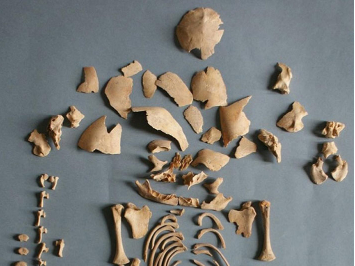
 ADELAIDE, AUSTRALIA—According to a statement released by the University of Adelaide, statistician Adam “Ben” Rohrlach of the University of Adelaide, Kay Prüfer of the Max Planck Institute for Evolutionary Anthropology, and an international team of researchers screened some 10,000 DNA samples taken from human remains dating from the Mesolithic period through the mid-nineteenth century for evidence of autosomal trisomies, or a third copy of one of the first 22 chromosomes in the human genome. The researchers were able to identify six infants with Down syndrome, which occurs when a person carries an extra copy of chromosome 21. “This is the first time we’ve been able to reliably detect cases [of Down syndrome] in ancient remains,” Rohrlach said. The study also identified the remains of a perinatal infant who had Edwards syndrome, a condition caused by three copies of chromosome 18. “These individuals were buried according to either the standard practices of their time or were in some way treated specially,” Rohrlach added. Read the original scholarly article about this research in Nature Communications.
News
Shapour Shahbazi: The Achaemenid Army
Shapour Shahbazi: The Achaemenid Army
The posting below highlights the late Shapour Shahbazi’s discussion of the Achaemenid army which was orginally published in the Encyclopedia Iranica on December 15, 1986 .
==========================================================================
The Achaemenid army is well known through descriptions by Herodotus, Xenophon, and Arrian as well as by illustrations on Persepolitan and Greco-Persian monuments (see especially G. Rawlinson, The Five Great Monarchies of the Ancient Eastern World III, London, 1871, pp. 172ff.; E. Meyer, Geschichte des Altertums [1939 ed., Stuttgart] IV/I, pp. 63-73; W. Hinz, Darius und die Perser II, Baden-Baden, 1979, pp. 135-50). Of particular importance for the topic are the Greek representations of Persian warriors (A. Bovon, “La représentation des guerriers perses et la notion du barbare dans la Ire moitié du Ve siècle,” Bulletin de correspondence hellénique 87, 1963, pp. 579-602) and the evidence of the so-called Alexander Sarcophagus from Sidon (V. v. Graeve, Der Alexandersarkophag und seine Werkstatt, Berlin, 1970, pp. 95ff.). The Persians whom Cyrus united (Herodotus 1.125) did not possess a professional army: as in days of old, the “people” of a region was represented by its backbone, the “military force,” so the two words were used synonymously in one Old Persian term, kāra (cognate with Lithuanian kãrias/kãris “war, army,” Gothic harjis “army,” and German Heer “army,” see W. Brandenstein and M. Mayrhofer, Handbuch des Altpersischen, Wiesbaden, 1966, p. 129), a sense still retained in the New Persian term kas-o kār “relatives and supporters.”
https://youtu.be/ujmke0KBMBM?t=3
A video history of the Achaemenid Empire providing a succinct summary of their (political and military) history, economy, governance and human rights (Source: See U in History in YouTube).
At first the Achaemenid army consisted wholly of Persian warriors, and even when other regions were subjugated, Persians formed the nucleus of the imperial army (C. Hignett, Xerxes’ Invasion of Greece, Oxford, 1963, pp. 40ff.). Darius advises his successor: “If thus thou shalt think: “May I not feel fear of (any) other,” protect this Persian kāra; if the Persian kāra shall be protected, thereafter by the will of Ahuramazdā happiness shall come down uninterruptedly and eternally upon this royal house” (Darius, Persepolis e, 13ff.). With the expansion of the petty kingdom of Persis into a world-empire embracing all Iranian groups from Central Asia to the Danube, a standing army was formed from Persians, Medes, and closely related peoples, and an imperial army was organized by incorporating warriors of all subject nations. Persepolitan representations, and official Persian economic and military documents ultimately used by Herodotus (3.90ff.; 7.61ff.) prove that the closer a nation was to the Persians, the more it shared in the domination of the empire by paying less tribute but contributing more soldiers. Thus, the Medes who had the second position in the empire furnished more soldiers than others and indeed many of the imperial generals were chosen from the Medes (Mazares, Harpagus, Taxmaspāda, Datis, etc.). Then came the Sacians, Bactrians, Hyrcanians, and other East Iranian groups (see in general P. J. Junge, Dareios I. König der Perser, Leipzig, 1944).
The general term for the professional army was spāda. This consisted of infantry (pasti), cavalry (asabāri “horse-borne,” and occasionally ušabāri “camelborne”), and charioteers (only the noblest warriors used the then obsolete but symbolic chariot), and a large number of camp followers (Rawlinson, op. cit., pp. 172ff.; Meyer, op. cit., pp. 64ff.; Hinz, op. cit., pp. 137ff.; M. Ehtecham, L’Iran sous les Achéménides, Freiburg, 1946 [revised Persian version: Īrān dar zamān-e Haḵāmanešīān, Tehran, 1976, pp. 57ff.]). From the moment they met the Greeks, the Persians incorporated subject or mercenary Greeks in their army (Ionians and Aeolians in the army of Cyrus: Herodotus 1.171; in the army of Cambyses: ibid. 3.1.25). As the time went by, not only Persian satraps in Asia Minor but also the Great King employed Greek mercenaries, each of whom received free board and a monthly wage (a gold Daric per month in 401 B.C., Xenophon, Anabasis 1.3.21). By the time of Alexander, these mercenaries had become a regular part of the spāda and their leaders had been incorporated into Iranian aristocracy (for Greek mercenaries in Persian service see H. W. Parke, Greek Mercenary Soldiers, Oxford, 1933; J. Roy, “The Mercenaries of Cyrus,” Historia 16, 1967, pp. 287-323; G. F. Seibt, Griechische Söldner im Achaimenidenreich, Bonn, 1977). They played a major role in Greco-Persian cultural relations, and helped an eastward expansion of Hellenism.
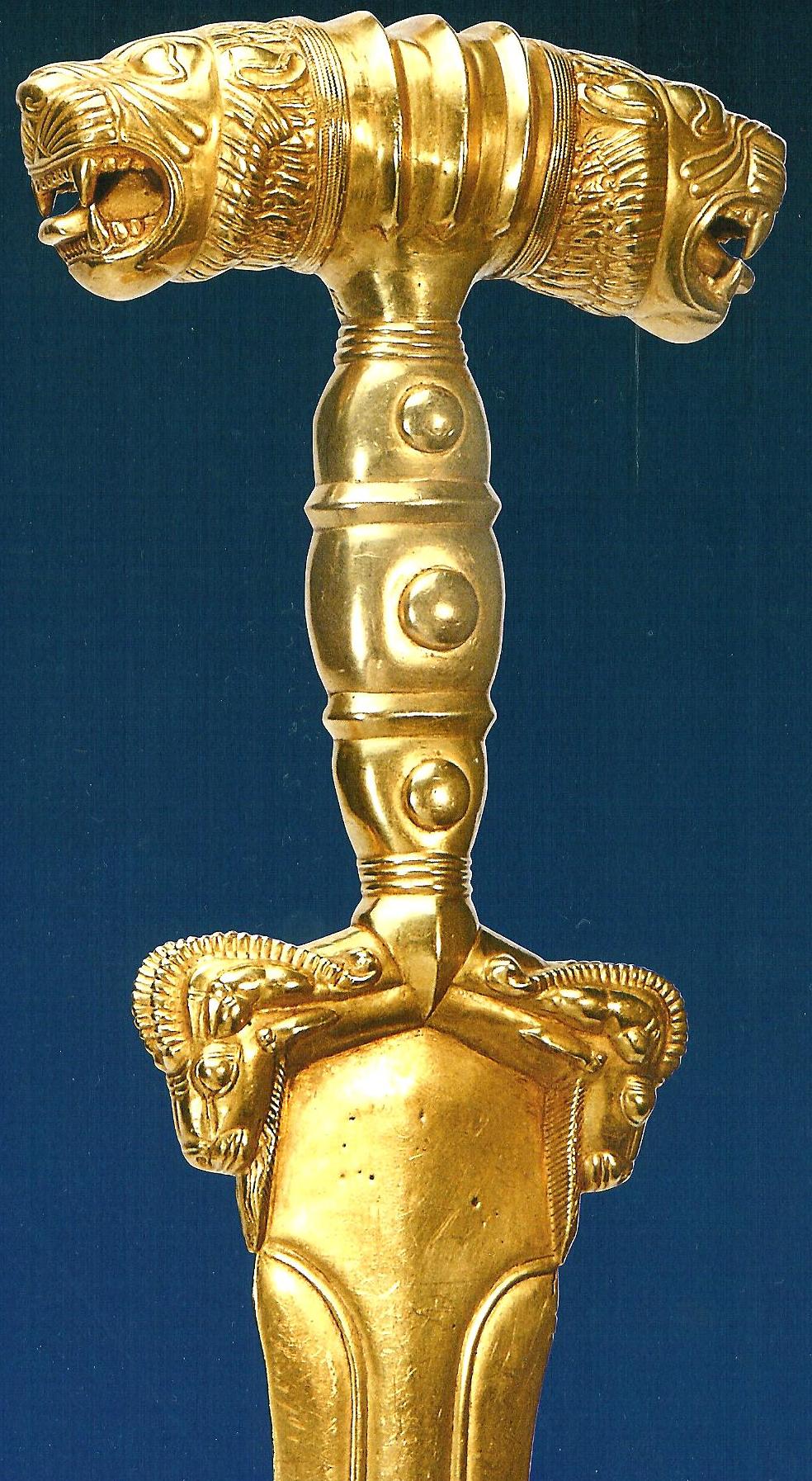
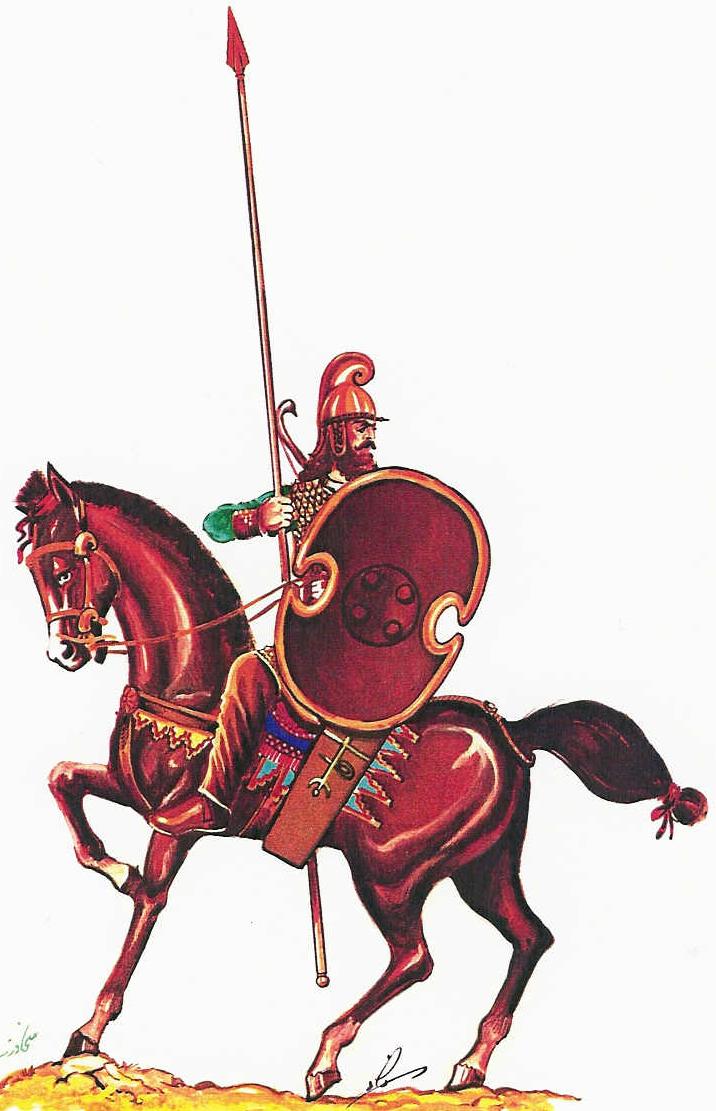
Achaemenid Achenakes. Note the lion and ram motifs, both symbols of ancient Iran (Copyright, Manouchehr Moshtagh Khorasani, Arms & Armor from Iran: The Bronze Age to the End of the Qajar Period, 2006).
The size of the imperial army was never as large as the Greeks asserted. Careful examination of topography, logistics, organization of the spāda, and official battle orders enable historians to arrive at reasonable figures for Persian forces. Thus, Xerxes’ 3,000,000 fighting men (Simonides cited by Herodotus 7.228) or 2,641,610 soldiers and an equal number of attendants (Herodotus 7.185f.) are reduced to 70,000 infantry and 9,000 horsemen (Hignett, op. cit., p. 355); the 900,000-strong army of Artaxerxes II at Cunaxa (Xenophon, Anabasis 1.7.12) was in reality no more than 40,000 (E. Meyer, Geschichte des Altertums V [1921 ed., Stuttgart], p. l85), and the 1,040,000 soldiers of Darius III at Gaugamela (Arrian, Anabasis 2.8.8; 3.8.6) is brought down to 34,000 cavalry and some infantry (E. W. Marsdon, The Campaign of Gaugamela, Liverpool, 1964, p. 37). Unfortunately, historians have seldom paid attention to these exaggerations, accordingly, their judgments of Persian tactics, strategy, and motives have been impaired by faulty calculations (Hignett, op. cit., pp. 344ff.).
The organization of the spāda was based on a decimal system “far superior to anything on the Greek side” (Hignett, ibid., p. 42) and was not employed in any Asiatic army until the Mongols (Hinz, op. cit., p. 135). Ten men composed a company under a daθapati (on the term see W. Hinz, Altiranisches Sprachgut der Nebenüberlieferungen, Wiesbaden, 1975, p. 87 with literature); ten companies made up a battalion under a *θatapati (Hinz, op. cit., p. 240); ten battalions formed a division under a *hazārapati (J. Marquart, Untersuchungen zur Geschichte von Eran I, Göttingen, 1896, p. 57); and ten divisions comprised a corps under a *baivarapati (Marquart, op. cit., p. 19 n. 84). The whole spāda was led by a supreme commander (probably *spādapati, although a generalissimo with full civil authority was called *kārana [Greek karanos]; Xenophon, Hellenica 1.4.1-4), who was either the Great King himself or a trusted close relative or friend (e.g., Mazares the Mede led Cyrus’ army and Datis the Mede that of Darius at Marathon). A characteristic of the Achaemenid period is that commanders and dignitaries participated in actual fighting, and many of them lost their lives in action (five of the eleven sons of Darius the Great fell on the front: Ariabignes [Herodotus 7.89], Achaemenes [ibid., 3.12; 6.7.], Arsames [Aeschylus, Persae 36f., 310], Abrocomas, and Hyperanthes [Herodotus 7.224]).
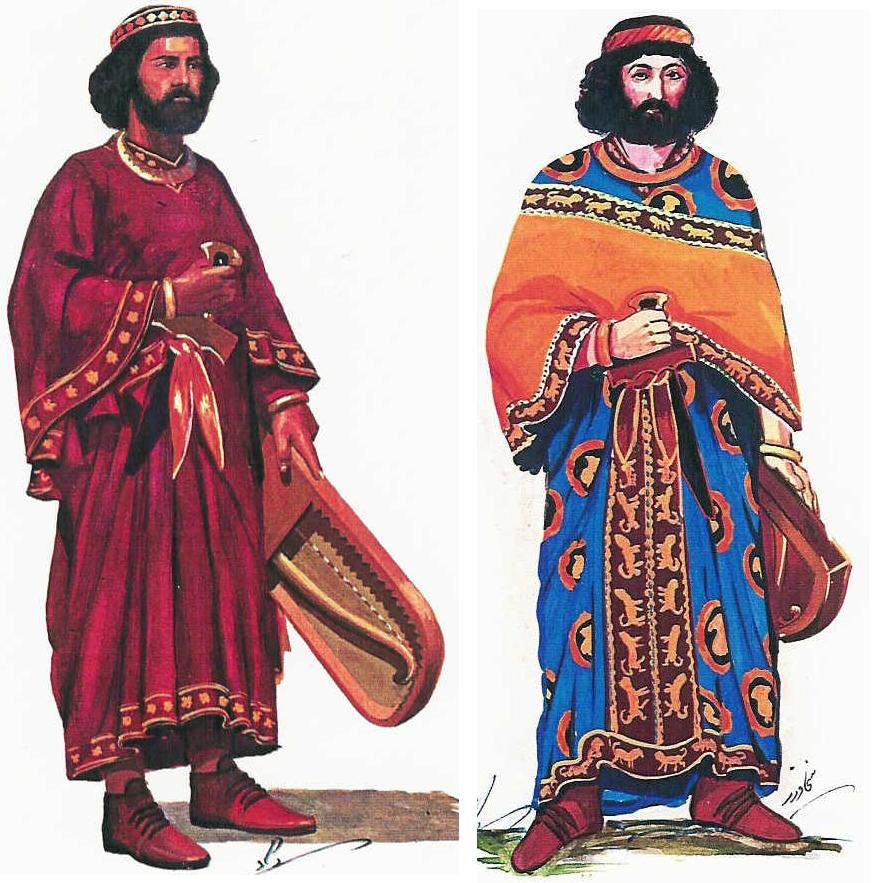
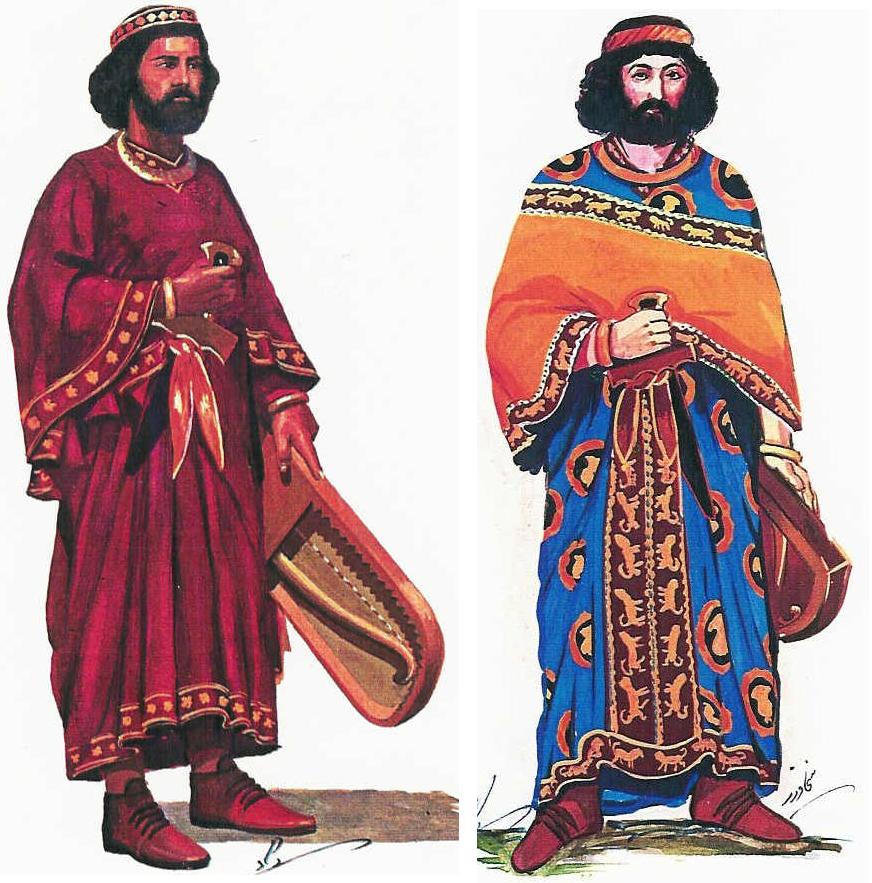
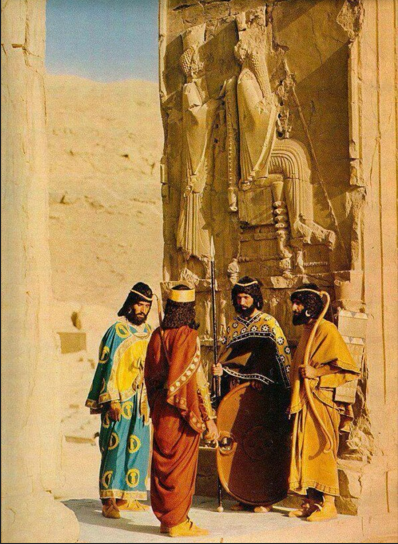
Achaemenid Persian officers as they would have appeared during Xerxes’ invasion of Greece.
The training of the Persian nobility was arduous. As a youth, the Persian was schooled—in companies of fifty—in running, swimming, horse grooming, tilling the land, tending the cattle, making various handicrafts, and getting accustomed to standing at watch; he would be trained in the arts of the chase (both afoot and on horseback), archery, throwing the spear and javelin, and of sustaining forced marches in unfriendly climate (Strabo 15.3.18, 19; Herodotus 1.136, 9.122; Xenophon, Cyropaedia 1.2.9-11). At twenty he started his military profession (Herodotus 1.209; Strabo 15.3.19) which lasted till the age of fifty (Strabo 15.3.19) as a foot soldier or a rider. The elitist groups were trained for both tasks. Thus, Darius says proudly: “Trained am I both with hands and with feet. As a horseman I am a good horseman. As a bowman I am a good bowman both afoot and on horseback. As a spearman I am a good spearman both afoot and on horseback” (Darius, Naqš-e Rostam b, 40-45, tr. Kent, Old Persian, p. 140). The foot soldier carried a short sword (acinaces), a spear with wooden shaft and metal head and butt, a quiver full of arrows of reed with bronze or iron heads, and a bow about one meter long with ends formed in animals’ heads, and a case which combined the bow-case and quiver-holder (Herodotus 7.61, cf. Rawlinson, op. cit., pp. 174ff.; Hinz, Darius und die Perser II, pp. 140ff.). A symbol of kingship and the Iranian national arm, the bow was held in the hand of the Great King on his tomb and coins. Battle-axe was also used, especially by North Iranians (Walser, Die Völkerschaften, pp. 65, 93ff.). For protection, the infantryman relied on his wicker shield (made of sticks evidently threaded through a wet sheet of leather capable of stopping arrows: P. H. Rahe, “The Military Situation in Western Asia on the Eve of Cunaxa,” American Journal of Philology 101, 1980, pp. 82f.). The shield was either small and crescent-shaped or large and rectangular; the latter could be planted in the ground allowing the archer to discharge his arrows from behind it (Herodotus 9.61, 102). Some guards carried the large “figure-of eight”-shaped shield known as the Boeotian, while the Gandharans carried round shields not dissimilar to those of Greek hoplites (Walser, op. cit., pls. 28, 77; Hinz, op. cit., pl. 14).
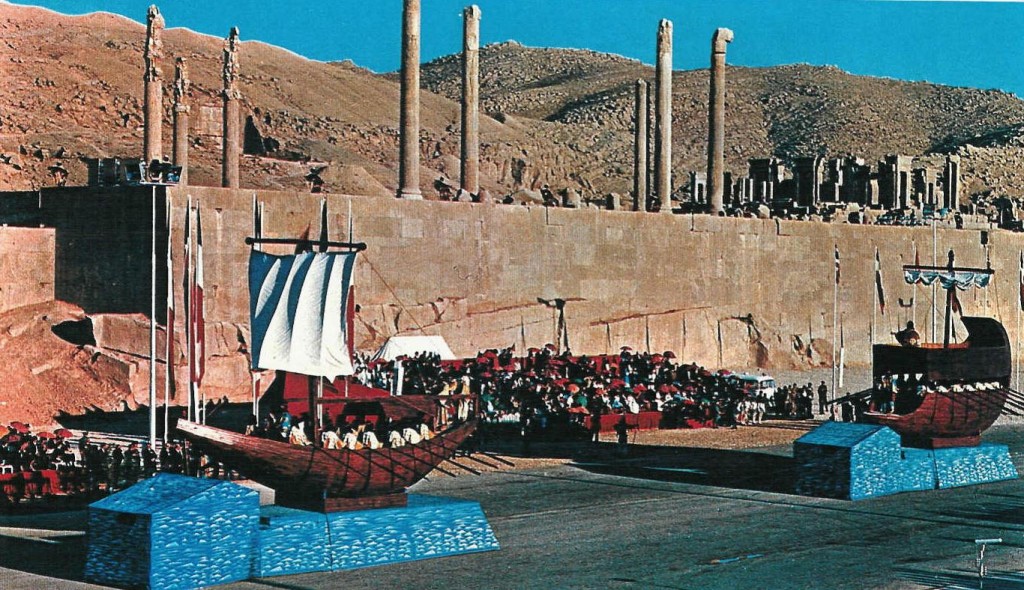
Reconstruction of Achaemenid ships in 1971.
Some Persians wore metal helmets, but only the Egyptians and the Mesopotamian contingents wore armor for body protection (Hignett, op. cit., p. 44 with references). The elite infantry had variegated costumes: either the fluted hat, short cape over a shirt, pleated skirt and strapped shoes of the Elamite court dress, or the conical felt hat, tight-fitting tunic and trousers and boots of the Median cavalry suit. One division of the infantry comprised “one thousand spearmen, the noblest and bravest of the Persians” who formed a special royal guard; their spears had golden apples as butts from which they were called the Apple-bearers (Herodotus 7.41). As a prince, Darius served in this guard of spearmen under Cambyses (Herodotus 3.139). Their commander was the hazārapati of the empire, who, as the officer next to the king, possessed vast political power (F. Justi, “Der Chiliarch des Dareios,” ZDMG 50, 1896, pp. 659-64; Marquart, op. cit., pp. 57-63; P. J. Junge, “Hazārapatiš,” Klio 33, 1940, pp. 13-39; E. Benveniste, Titres et noms propres en iranien ancien, Paris, 1961, pp. 67-70). All members of this guard fell at Plataea defending their position (Herodotus 9.63).
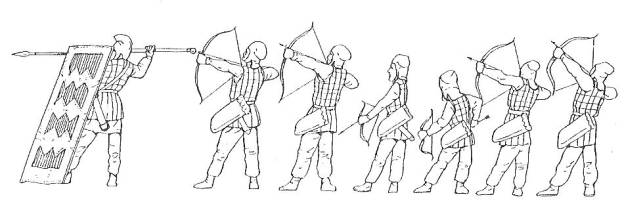
Achaemenid Archers in standard firing volley (Source: Head, D. (1992). The Achaemenid Persian Army. Stockport, England: Montvert Publications).
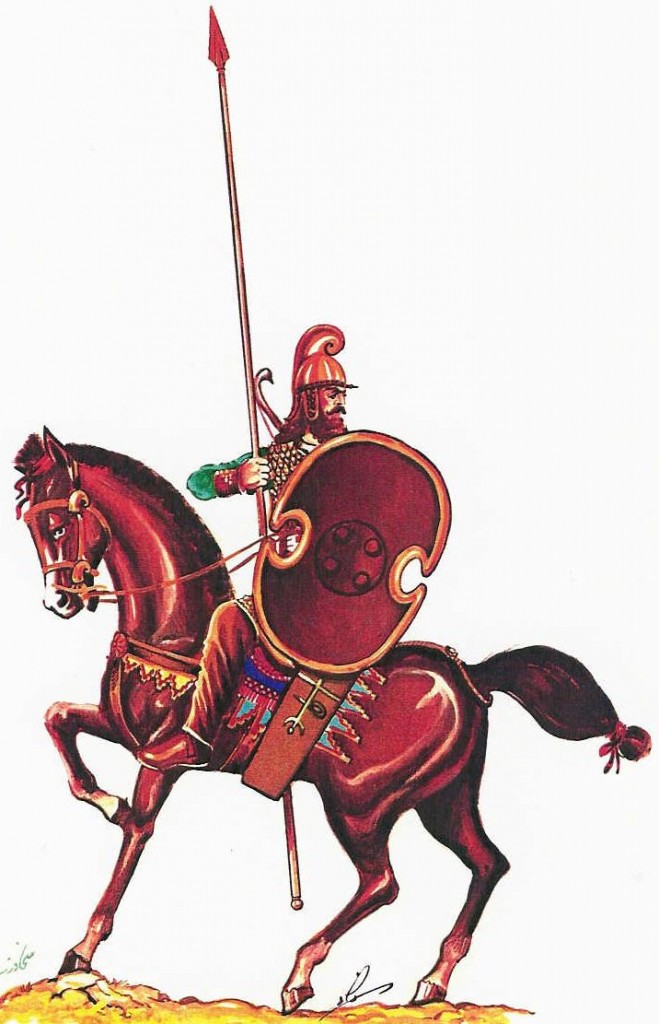
One corps of the spāda consisted of ten thousand elite Iranian foot soldiers, the so-called “Immortal Guard,” whose “number was at no time either greater or less than 10,000” (Herodotus 7.87 where his “Persians” must be understood in the sense of Iranians, as Persis alone could not furnish such an army). These had variegated costumes (A. T. Olmstead, History of the Persian Empire, Chicago, 1948, pp. 238-39 describes the dress) and acted as the Imperial Guards (Herodotus 7.41). “Of these one thousand carried spears with golden pomegranate at the lower end instead of spikes; and these encircled the other nine thousand, who bore on their spears pomegranates of silver” (Herodotus 7.41). The cavalry had been instrumental in conquering subject lands, and it retained its importance to the last days of the Achaemenid empire. The horseman was equipped more or less like the foot soldier; but he carried two javelins, one for throwing and one for fending—at least this was the case in Xenophon’s time—(Anabasis 1.8.3; The Art of Horsemanship 12. l2). Some wore metal helmets and padded linen corselets covered with metal scales (the Chwarazmians had formed heavy cavalry units—predecessors of the Parthian Cataphracti—by Cyrus’ time: B. Rubins, “Die Entstehung der Kataphraktenreiterei im Lichte der chorezmischen Ausgrabungen,” Historia 4, 1955, pp. 264f.; for remnants of lamellar armor from Persepolis see E. F. Schmidt, Persepolis II, Chicago, 1957, p. 100 with pl. 77). A Babylonian document dated to the second year of Darius II lists the requirements of a horseman as follows: a horse along with its girdle (?) and bridle, a helmet, a cuirass of iron, a bronze shield, 120 arrows, a mace of iron, and two iron spears (E. Ebeling, “Die Rüstung eines babylonischen Panzerreiters nach einem Vertrage aus der Zeit Darius II,” ZA, N.F. 16, 1952 pp. 204-13, esp. p. 210). There were also units of camel-borne troops, and some riding chariots and scythed-chariots, but these were very seldom effective against massed infantry. At Gaugamela 15 elephants were also present but their action is not recorded (Arrian, Anabasis 3.8). Various divisions bore particular standards (Herodotus 9.59), but the imperial banner was a golden eagle with outstretched wings borne on a spear at the side of the commander-in-chief of the army (Xenophon, Anabasis 1.10.12, Q. Curtius 3.3.10).
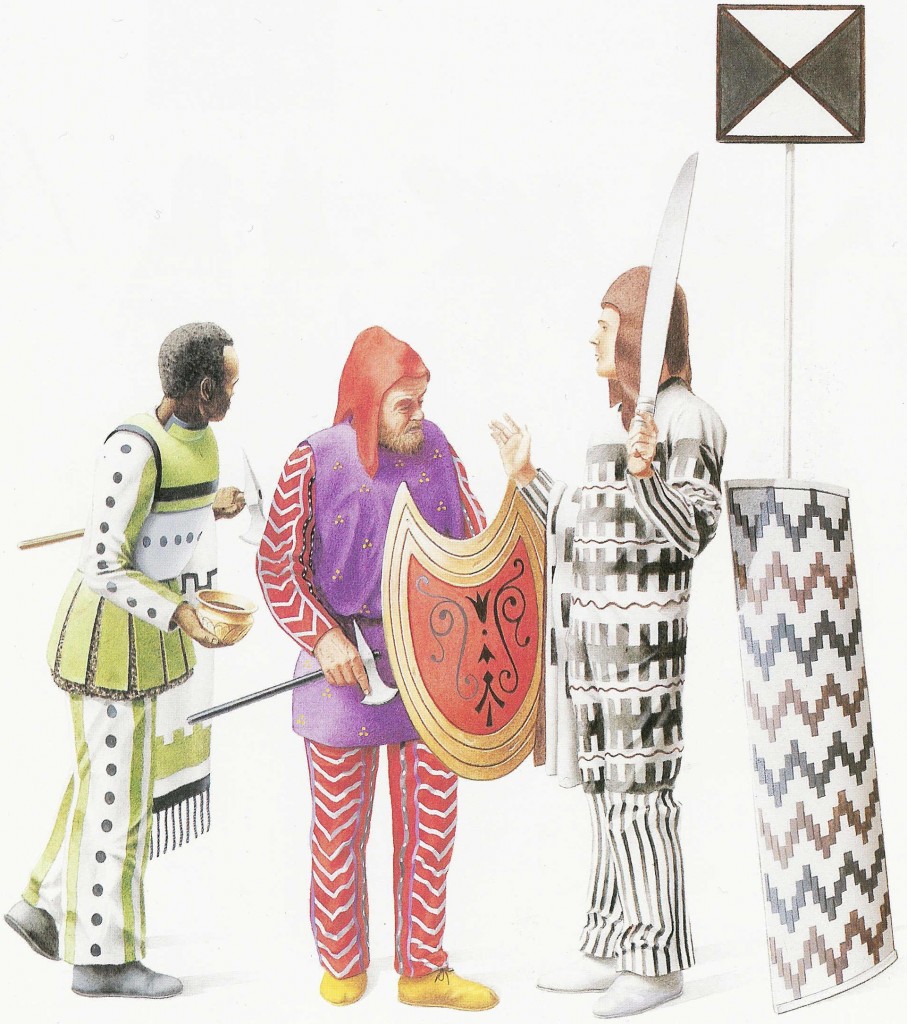
Ethiopian marine (left), Iranian warrior (centre) and Iranian spear bearer (Nick Sekunda, The Persian Army, Osprey Publications, 1992, Plate C; Paintings by Simon Chew). Note how these re-constructions differ from how Iranians have been portrayed in the “Alexander” and “300″ movies.
Apart from the standing army, the rest of the levies were recruited when the need arose, and it took a long time, sometimes years, to muster a grand army. There were many Persian garrisons in important centers of the empire, and satraps and governors also had their guards and local levies, but these could not be depleted to form an army on short notice because the danger of revolt was always present. Tribal troops, especially from East Iran, were more readily available. Levies were summoned to a recruiting station (*handaisa, Hinz, Altiranisches Sprachgut, p. 115) where they were marshaled and reviewed. Campaigns usually started in early spring (Herodotus 4.43, 7.37, cf. 1.190). Provisions were stored at various magazines along the route of the army, and were also brought with it in baggage-trains (Rawlinson, op. cit., pp. 192f.; Meyer, op. cit., pp. 66ff.). Royal and religious emblems accompanied the center of the army where the commander had his position: the eagle standard and the holy fire in portable fireholders attended by Magi chanting hymns, and the sacred chariots of Miθra, Ahura Mazdā and others (Herodotus 7.40; Xenophon, Cyropaedia 8.3.12; Q. Curtius 3.8.11). Mounted scouts were sent in advance to watch the enemy’s movements (Xenophon, Anabasis 1.7.11; Arrian, Anabasis 2.8). There was also an excellent system of communication: couriers on the royal road changed
horses at short intervals and speedily conveyed their messages to their destinations (Herodotus 8.98); also by their light and mirror signals the kings in Susa and Ecbatana received the news from the whole empire—it is claimed—on the same day (Aristotle, de Mundo 398a). Fire signals communicating the news from towers and heights were widely used with good results (Hinz, Darius II, p. 146). Fortified gates were set up in narrow passes leading into various provinces not only for custom checks but also for stopping the advance of an enemy (e.g. Cilician Gates: Xenophon, Anabasis 1.2.21; Arrian, Anabasis 2.4; The Caspian Gates, Arrian, ibid., 3.2.; The Persian Gates: ibid., 3.18.2). The Persians disliked night marches and did not attack at night; their daily marches were, however, in slow pace because of the heavy baggage-train which often comprised litters for conveying the wives and concubines of the commanders (Rawlinson, op. cit., pp. 188ff, with references). When night fell, they encamped in a flat area, and if they were approaching the enemy, they dug a ditch and set up ramps of sand-bags around it (ibid., pp. 190f.). Rivers were forded by using rafts, boat-bridges, or inflated skins or simply by riding across on horses and camels (Herodotus 1.90.208; Xenophon, Anabasis 1.2.5; Darius, Behistun 3.86ff.).
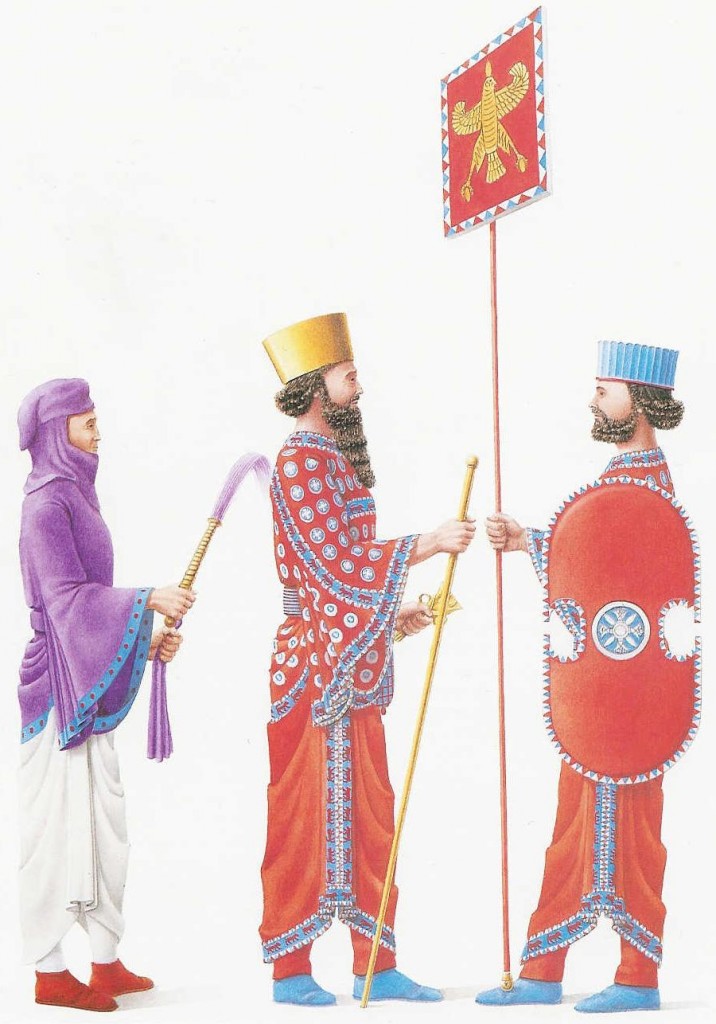
Court Eunuch (left), King Xerxes (centre) and Royal Spear bearer (right) (Nick Sekunda, The Persian Army, Osprey Publications, 1992, Plate B; Paintings by Simon Chew).
Before the battle (hamarana), a council of war was held and plans of action discussed. The line of battle was usually drawn up as follows: the foot archers were stationed in the front, flanked by cavalry and supported by light-armed and heavier-armed infantry. The commander-in-chief occupied the center, observing the lines and directing the actions from an elevated point, where he was best protected, and his orders were received by both wings at the same time. When the battle was joined the archers discharged their arrows, and the slingers (there were units of them: Xenophon, Anabasis 3.3.6, 4.16; Q. Curtius 4.14; Strabo 15.3.18) threw their stone missiles (lead missiles with longer range became fashionable from 400 B.C., and an actual lead bullet bearing the name of Tissaphernes in Greek has survived: C. Foss, “A Bullet of Tissaphernes,” Journal of Hellenic Studies 95, 1975, pp. 25-30). The aim was to throw the enemy lines into confusion. The effective range of the Persian archer was about 120 yards (Hignett, Xerxes’ Invasion of Greece, p. 44 with n. 6). Then the heavier infantry with spear and sword moved in, supported by cavalry attacking the flanks. These tactics worked well against Asiatic armies, but failed against heavy-armed Greek infantry (hoplites) and Macedonian phalanxes: the arrows were simply stopped by the body armor and the huge shield of the hoplites, and once the hand to hand combat began, no amount of personal bravery could compensate for the Persians’ lack of armor and their inferior offensive weapons (see especially W. W. How, “Arms, Tactics, and Strategy in the Persian Wars,” Journal of Hellenic Studies 43, 1923, pp. 117ff.; Hignett, op. cit., pp. 40ff. with extensive documentation; Rahe, op. cit., 79ff.). At the battle of Plataea, for instance, a fierce hand-to-hand combat raged between the Persians and the Greek hoplites: The Persians “many times seized hold of the Greek spears and broke them; for in boldness and warlike spirit the Persians were not a whit inferior to the Greeks; but they were without shields, untrained, and far below the enemy in respect of skill in arms. Sometimes singly, sometimes in bodies of ten, now fewer and now more in number, they dashed forward upon the Spartan ranks, and so perished” (Herodotus 9.62). Another weakness of the Persians was the attitude towards their commander: with an able and farsighted general, they displayed unsurpassed courage, but the same men took to disorderly flight as soon as the commander was killed or forced to flee (Rawlinson, op. cit., pp. 186-87 with references). Knowing that the Great King was the heart of his army, Cyrus the Younger ordered Clearchus—his Greek mercenary leader—to attack the center where the Great King was stationed: “and if,” he said, “we are victorious there, our whole task [of defeating his army] is accomplished,” (Xenophon, Anabasis 1.8.12-13).
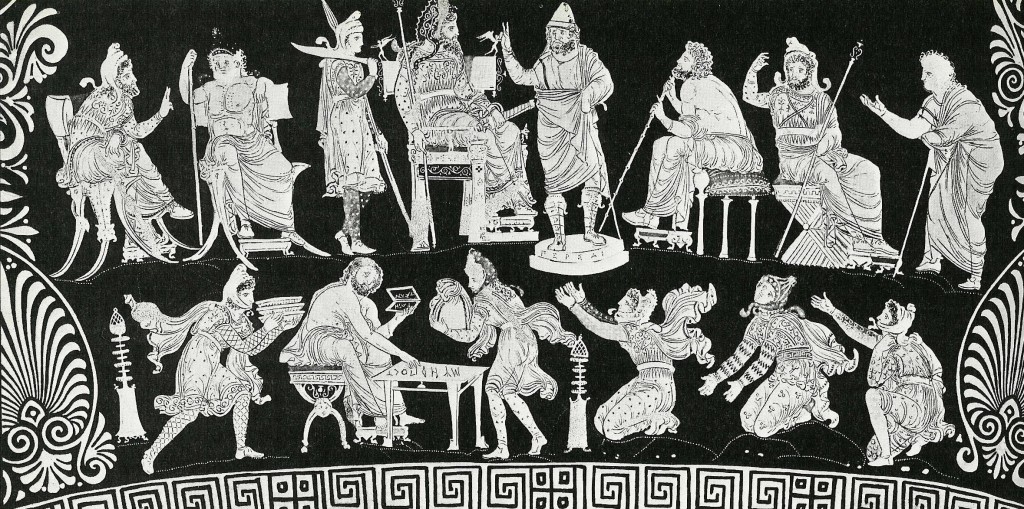
Greek depiction of Darius the Great (seated on throne in top row at centre) debating with his advisers as to whether he should invade Greece in 490 BC. Prince Xerxes is seen on the top row, second from the right.
Cyrus the Younger who knew both the Persian and Greek armies, tactics and strategies, nearly succeeded in removing Persia’s military weaknesses. He supplemented his Asiatic force with a large army of Greek hoplites, formed battalions of heavy cavalry which wore helmets, breast-plates, and thigh-guards (this protected the sides of the horse as well), and carried a Greek sword in addition to their own arms; their horses too were protected with frontlets and breast-pieces (Xenophon, Anabasis 1.8.6, cf. The Art or Horsemanship 12.8-10 and P. Bernard in Syria 41, 1964, pp. 195-216; J. K. Anderson in Journal of Hellenic Studies 80, 1960, p. 9; A. Sh. Shahbazi, Irano-Lycian Monuments, Tehran, 1975, pp. 140-42). He made effective use of the coordination of heavy cavalry and heavy infantry—an art which later Agesilaus and especially Alexander employed to the fullest and with the best results. It must be remembered, however, that the effectiveness of the Persian shock cavalry was severely hampered by the lack of stirrup and the saddle. “Encumbered with a corslet of scale armor and poised precariously atop his steed, the horseman kept his seat only through the pressure of his knees. He will have been in serious danger of being unhorsed whenever he delivered a blow with his saber or came within reach of an enemy soldier” (Xenophon, Anabasis 3.2.18-19; cf. Rahe. op. cit., p. 85).
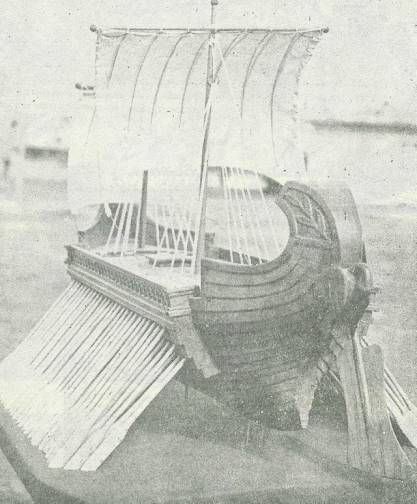
An example of a reconstructed Achaemenid ship (above prototype in the scale of 120 by 40 by 60 cm). These were part of a series of studies of Iranian Aero-Marine research Center of Malek Ashtar University in Iran. The Archaeological wing of this were archaeologists of the university (under the direction of Dr. Kambiz Alampour) who has studied the Achaemenid Navy extensively. Consulting 47 different sources (Iranian and non-Iranian) the Alampour team reconstructions in Shiraz pertain to Iranian vessels of the Darius-Xerxes era.
The Persians gave quarter to the adversary who requested it, and usually treated their captives with respect and kindness. Noble prisoners were accorded due honor, and princes treated royally. Even rebellious peoples were deported only to be given new lands and houses and enrolled as ordinary subjects. Personal valor was greatly esteemed, and special boons were conferred on brave servants of the empire (Rawlinson, op. cit., pp. 193ff. with references). Records of battles were kept, detailing the course of an engagement and casualty figures (Darius, Behistun 1-5). The commander-in-chief’s scribe wrote down distinguished deeds of warriors: “During the whole battle Xerxes sat at the base of the hill…, and whenever he saw any of his own captains perform any worthy exploit he inquired concerning him, and the man’s name was taken down by his scribe, together with the names of his father and city” (Herodotus 8.90). In the same way Darius recorded the names of his six helpers, together with those of their fathers and nationality, adding: “Thou who shalt be king hereafter, protect well the family of these men” (Behistun 4.80ff.). In 335 B.C. both Athens and Thebes sought Persian help, and the ambassadors of the latter city were received with the greatest honor at the royal court and their wishes were granted on the account that their forebears had rendered military assistance to Xerxes 150 years earlier (Diodorus 17.14).
Related posts:
By Dr. Kaveh Farrokh|January 21st, 2023|Achaemenid Military History, Achaemenids|Comments Off
Ancient Roman Medical Tools found in Turkey
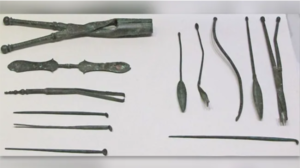 Hundreds of Roman-era medical instruments now being examined by scientists may come from one of the earliest known examples of a group medical practice, or at least a place where health care workers congregated to treat people.
A total of 348 artifacts linked to medicine were found at the site of Allianoi, an ancient town that also hosted a large spa-like bath in what is now Turkey. The vast number of the 1,800-year-old artifacts may indicate the site once featured an ancient medical center. The instruments were discovered during rescue excavations that were carried out between 1998 and 2006, before the construction of a dam that flooded the site. Most of the artifacts, which have been studied over the years, were found within two buildings in a larger complex.
“Allianoi was, perhaps, one of the earliest known cases of an organized, group medical practice,” Sarah Yeomans, an archaeologist at St. Mary’s College of Maryland, wrote in the abstract of a paper she presented at the annual meeting of the Society for Classical Studies, which ran from Jan. 4 to 7 in Chicago.
“The categories and variety of surgical instruments indicate that relatively sophisticated surgical procedures were undertaken at Allianoi,” Yeomans wrote. These include instruments used to remove hemorrhoids, as well as tools to extract bladder and kidney stones. Other instruments indicate that cataract surgery, or the removal of a person’s cloudy eye lens, and the suturing of wounds may also have taken place at the center.
The researchers don’t know how many medical practitioners worked at the site at any one time, “though it was likely dozens or more, depending on the time period,” Yeomans told Live Science in an email.
International Day of Commemoration in Memory of Victims of the Holocaust
 Every year around 27 January, UNESCO pays tribute to the memory of the victims of the Holocaust and reaffirms its unwavering commitment to counter antisemitism, racism, and other forms of intolerance that may lead to group-targeted violence. The date marks the anniversary of the liberation of the Nazi Concentration and Extermination Camp of Auschwitz-Birkenau by Soviet troops on 27 January 1945. It was officially proclaimed, in November 2005, International Day of Commemoration in Memory of the Victims of the Holocaust by the United Nations General Assembly.
The Holocaust profoundly affected countries in which Nazi crimes were perpetrated, with universal implications and consequences in many other parts of the world. Member States share a collective responsibility for addressing the residual trauma, maintaining effective remembrance policies, caring for historic sites, and promoting education, documentation and research, more than seven decades after the genocide. This responsibility entails educating about the causes, consequences and dynamics of such crimes so as to strengthen the resilience of young people against ideologies of hatred. As genocide and atrocity crimes keep occurring across several regions, and as we are witnessing a global rise of antisemitism and hate speech, this has never been so relevant.
https://www.unesco.org/en/days/holocaust-remembrance
The Process of Roman Winemaking Investigated
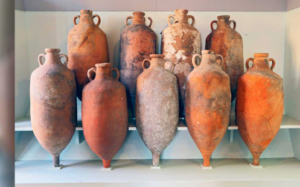 CAMBRIDGE, ENGLAND—According to a report in The Charlotte Observer, Dimitri Van Limbergen of Ghent University and Paulina Komar of the University of Warsaw compared Roman dolia, a type of large, earthenware jar used to make, ferment, and store wine, with qvevri, a similar sort of vessel used in Georgia, where wine making dates back some 8,000 years. The process of making wine in Georgia in antiquity was documented in more detail than in Rome, however, and qvevri are still used in Georgia to produce the beverage. The study found that mineral content in the clay of the dolia contributed to the flavor of the finished wine. It was also determined that the egg shape of the vessel created internal convection currents that stirred up the dead yeasts, grape skins, and other solids in the grape juice mixture to produce a more homogenous final product. Depending upon whether or not the grape skins had been left in the mix, or filtered out with strainers, the finished wine could have come in a range of colors, such as white, reddish-yellow, blood red, and black. Burying the dolia, as they have been found at Pompeii and Villa Regina in Boscoreale, would have created a constant temperature for the fermentation process over a period of months. Limbergen and Komar concluded that finished Roman wine was likely spicy and smelled like toast, apples, roasted walnuts, and curry. Read the original scholarly article about this research in Antiquity.
The Persian Prince Pirouz (Pirooz)
The Persian Prince Pirouz (Pirooz)
The article “The Persian prince Pirooz“ by Yang Guifei was originally printed in the Tang Dynasty Times. Kindly note that excepting one image, none of the other images, video and accompanying descriptions appear in the version printed below. For more on the Sassanians consult:
Military History and Armies of the Sassanians
===================================================================
Sometime around the year 670, a shining prince — Pirouz (or Pirooz) the son of the last Sassanid King — arrived in the Tang capital. He was there to beg for protection from the Arab invaders who now occupied his country. Exhausted and covered in dust from the journey, the young prince– who was barely out of boyhood–was led into the Great Hall. It had taken him the best part of a decade to arrive. In fact, he never believed he would actually make it; imagining instead being murdered or perhaps dying from cold and exhaustion somewhere en route over the towering mountains and terrifying deserts through which he had passed on his way East.
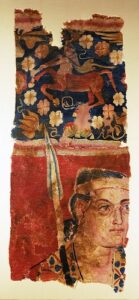 A rectangular piece of tapestry coming from the Xingjian Ughur Autonomous Region of China clearly showing Sasanian Persian influences in design and artwork. The physiognomy of the person drawn in the tapestry is Caucasoid as opposed to Asiatic, indicative of the strong Indo-European presence in the region since proto Indo-Europeans (i.e. the Tocharians) first entered the region thousands of years ago (Picture source: Houston Museum of Natural Science). Several Western researchers however suggest that the person depicted above is a Greek.
Somehow, though, he did make it, and arriving at dusk, just before the gates of the great city were secured shut for the night, a regiment of guards from the Chinese Emperor’s Palace arrived to escort him through the city.
And what a city it was.
When he was a child, his father had told him much about the great capital to the East– larger and richer than even Rome or Byzantium. Rome, of course, had been sacked two centuries before, and Byzantium was itself in decline. And then there was his own glorious empire– it still brought tears to his eyes just thinking of it. The Sassanid Empire had been the greatest empire on earth– rivaled only by Byzantium to the West and China to the East, but it now lay in ruins. His family all dead, his heritage scattered like the sands of the desert blown here and there in the wind.
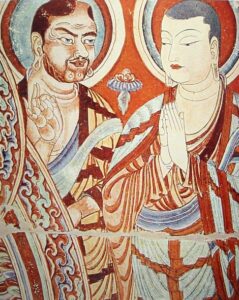 Fresco along the Tarim Basin, China depicting an Iranian-speaking Buddhist monk (Kushan, Soghdian, Persian or Tocharian?) [at left] instructing a Chinese monk [at right] on philosophy (c. 9th-10th Century). Iranian peoples of Central Asia were the link between Asia as a whole and the civilizations of ancient Iran, notably Sassanian and post-Sassanian culture(s). Open and tolerant, the Soghdians, Kushans, Tocharians, etc. established a sophisticated literature and urban culture (Lecture slide from Kaveh Farrokh’s lectures from the course “The Silk Route: origins & History“).
When the Arabs had invaded, he and his family– along with a great entourage of supporters– had fled eastward. Born in 226 a.d. the ancient Persian Sassanid Empire had once stretched from the Levant and Constantinople in the West to the Indian subcontinent in the East and had encompassed all of present-day Iraq, Armenia and Afghanistan; as well as much of Turkey, Syria, Arabia and Pakistan. These lands– as well as the Persian colonies in Central Asia– were all part of the great Persian sphere of influence; whose emperors were held as equals by both the Roman and the Chinese emperors.
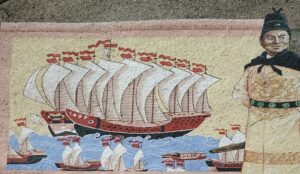
Chinese Admiral Zheng He who was of Persian descent. Zheng He is recognized for having sailed with his giant fleet to Europe and Africa. (Source: Chris Heller/CORBIS & The Mail).
For 400 years, they had been called Shahanshah– or, the “King of Kings.” And, theirs was the last great Persian empire prior to the invasion of the Arabs and the beginnings of Islam. Zororastrians by religion, it was a Kingdom ruled by a federation of aristocratic families whose splendid cultural achievements would be taken up by their Arab conquerors with gusto. In fact, much of what later came to be known as Islamic culture– from calligraphy and poetry to garden design and architecture– was borrowed largely from the Sassanian empire.
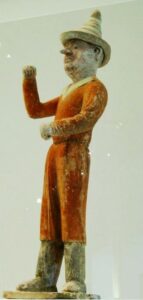 Tang dynasty depiction of foreign merchant in northern China, (7th century CE) housed at Paris’ Musee Guimet (Source: Per Honor et Gloria in Public Domain).
When the Arab conquerers stormed the Persian capital of Ctesiphon in 637, such were their numbers that his Father’s only choice had been to flee. From Ctesiphon, located on the Tigris, just a bit downstream from Baghdad (founded about 150 years later), on horseback they had raced East in the hope of gathering support for their cause. None of the great families, however, had agreed to help them mount an army to oust the Arab invaders, and by the time they had reached Merv, on the Eastern edge of their empire, they were spent.
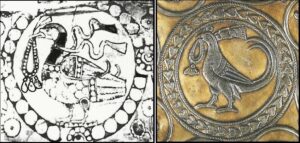 Tse-Niao (Bird) motif mural painting in Kizil, Sinkiang, 6-7th Centuries AD. (left) and a Pheasant as depicted in late Sassanian arts 6-7th Centuries CE (Slide and caption from Kaveh Farrokh’’s lectures at the University of British Columbia’s Continuing Studies Division and were also presented at Stanford University’s WAIS 2006 Critical World Problems Conference Presentations on July 30-31, 2006).
It was there that the greatest tragedy of all happened. His Father had been murdered– right in front of his own eyes. And what had been perhaps the greatest blow was that he had been murdered by a commoner. Robbed and murdered for his purse, the great Shahanshah, Yazdgerd III, had been killed by a miller. It was 651, and they had been in flight for some 14 years.
So, that had been that. With their cause now dead, the aristocratic and ruling families who had followed them East decided to stay and put down roots in Merv, as well as in the nearby Persian areas of Sogdiana, Tashkent and Khotan. Our young Prince, however, would always live with a price on his head. He, therefore, required protection. He thought and thought, but there seemed nowhere to turn– until he remembered his sister. Before he was born, she had already been married off to the great Tang Emperor to the East. And, so he had set out East–to China.
It was the heyday of the Silk Road, so he had just followed the well-worn path of other Persians before him. First into Sogdiana and then crossing the Pamirs, he had had to make it across the unending stretch of sand of the deserts of inner Asia. Skirting the southern edges of the Taklamakan Desert, first he traveled to Kashgar; then on to Yarkand, Khotan, and all the way to Dunhuang. From there, it had just been a matter of descending down off the plateau and heading East, toward the capital.
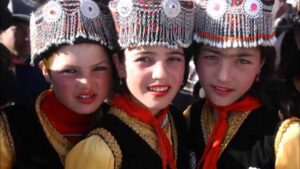 Chinese girls of ancient Iranian descent (Source:Iranian People Of China (中国的伊朗人)).
Persian peoples dominated the entire route. The great middle men of the Silk Road, Persian communities (and most notably the Sogdians) had greeted him in every town he passed through along the way. From Merv to Chang’an, whenever he stopped, he had stayed in Persian inns, eaten Persian foods and had spoken in the refined Persian language of the Court– and he was, for the most part– understood.
He would be further stunned to see of his country’s influence in China proper as well. It gave him heart. Yes, theirs had been the greatest civilization of the world– for even the Chinese thought so.
The Chinese capital, though, he had to admit, had surpassed even the Persian capital during its height. As French scholar Michel Beurdeley has noted, “the title of Middle Kingdom was richly deserved by China during the Tang dynasty,” as the high civilization and celebrated cosmopolitanism of the Tang dynasty truly had no precedent anywhere on earth prior to that time– not even Byzantium saw such a rich display of goods and peoples.
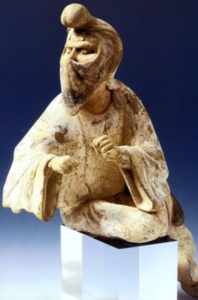 The above figure is from a Tang dynasty burial site, now housed now at the museum at Turin, Italy. Curators and scholars continue to debate the figure’s origins; one possibility is that he was of Iranian descent (Picture source: The Wall Street Journal).
While the Tang capital of Chang’an was the largest, most international city in the world of the time, the Second Capital of Loyang was no less impressive. Both cities were inhabited by traders, entertainers and religious teachers and students from places as far-flung as Syria, Oman, Iran, Khotan, Sogdiana, Turkestan, Tibet, India, Champa, Funan, Korea, and Japan, just to name a few. There were Mosques, Jewish, Manichean and Zoroastrian temples, Nestorian churches, as well as Buddhist monasteries of all sects, some of which were great centers of scholarship. Most surprising (considering the inward turn China would take in the coming centuries) was how stunningly exotic and open the city was.
It was a city where wealthy ladies adorned their cheeks with crimson laq from Vietnam and anointed their bodies with perfumed oils of Cambodia; where aristocrats kept falcons from Korea, parrots from the jungles of Java and lapdogs from Samarkand. Sleeping in Turkish felt tents was the latest fashion as were the dance moves from Sogdiana. And, the music. The capital saw glorious performances by dancers from Central Asia and India showing dances of such beauty that the famed Tang poets of the time composed poem after poem about them. Grape wine had also come into fashion and was served in glass ewers from Persia. There were lychees from Canton and those oh-so famous peaches of Samarkand.
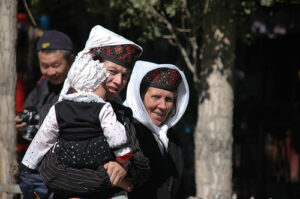 Iranian-speaking Tajik women from China. These are mainly clustered in the Karakorum region.
Of all the foreign fashions, the influence of Iran was without a doubt most significant of all. During the Tang, anything Persian– from music and dancing, to clothes, hairstyles and the game of Polo– enjoyed huge popularity at Court and among the aristocracy– indeed, they were considered to be the very height of fashion. This surprising turn in history came about as part of the Tang Dynasty’s political and military incursions further and further West, into Central Asia (to the land of their prized “blood sweating” stallions and jade) as well as into the Middle East (where beautiful glass and the mineral cobalt was secured).
It was the Iranian Sogdian peoples who held the greatest influence. They were the great merchants, traders and entertainers of the legendary silk road. Known in Chinese as hu jen 胡人, their cultural influence among the Chinese aristocrats was remarkable. It is written in the Tang histories that “the food of the aristocrats was hu food, their music hu music, and their women clothed in the most exotic hu robes that money could buy.” Indeed, in the words of one Japanese scholar, the Tang capital of Chang’an was “painted entirely in the colors of hu.”
https://youtu.be/lTuzU5M5Dh0?t=212
Video by Kings & Generals on the history of the last Sassanians and their anti-Caliphate alliance with the Tang dynasty of China (Source: Kings & Generals in YouTube).
And so our Persian Prince was pleasantly surprised. Such was the Chinese Emperor’s great appreciation of the accomplishments of the Persian civilization that upon their first meeting they declared themselves brothers. Born and raised the song of a King, the Prince knew not to make eye-contact with the Son of Heaven, and instead fell to his knees. The great Emperor rose to his feet and stepping off his dais, he bent down to bid the young Prince to his feet.
“You’ve come a long way. Have no more fears. For you are my brother and this is your new home.”
Prince Pirooz was to spend the rest of his days within China. He is said to have learned Kung Fu and then went on to become a general in the army. Sent West to fight their mutual enemies the Arabs, the Persian Prince used his remaining money and resources to make whatever trouble he could. He had probably given up all hope of re-taking his empire– still it must have felt good to win a battle or two. The Tang chronicles state that when the Chinese emperor died, Pirooz and his son Narseh were allowed to be stationed along the western border garrisons by the new Chinese emperor. Immediately, they started clashes against the Umayyad Arabs. Soliciting the aid of Turkish tribes, Prince Pirooz spent the rest of his days fighting the Arabs along China’s Western corridor.
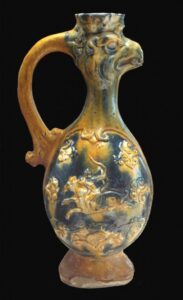 A well-preserved Tang vase (8-9th century CE) housed at the Guimet Museum. This bears distinct Sassanian artistic influences.
He died around 700 in the West, still fighting the Arabs wherever he could. His son– who also became a respected general in the Chinese army, wrote this in his diary (from Frank Wong’s article which is pretty much the only thing around online about Prince Pirooz):
Pirooz requested only a simple burial and the Chinese emperor approved. The entire exiled court was in attendance along with the Chinese emperor. The Chinese emperor held Pirooz’s shaking hands. Pirooz looked west and said: “I have done what I could for my homeland (Persia) and I have no regrets.” Then, he looked east and said: “I am grateful to China, my new homeland.” Then he looked at his immediate family and all the Persians in attendance and said: “Contribute your talents and devote it to the emperor. We are no longer Persians. We are now Chinese.” Then, he died peacefully. A beautiful horse was made to gallop around his coffin 33 times before burial, because this was the number of military victories he had during his lifetime. Pirooz was a great Chinese general and great Persian prince devoted and loyal to his people.
And so our Prince died in one of the most remote regions on earth; fighting his enemies till the very end. He was buried facing West.
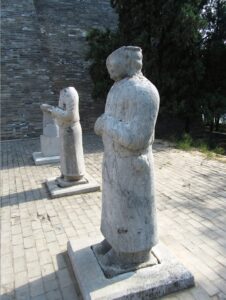 There is a tomb and statue in China which bears this inscription: Pirouz, Shah of Iran, crowned in Tang dynasty court: Commander-in-chief of Iranian Army, Martial General of the Right [Flank] Guards, Awe-inspiring General of the Left [Flank] Guards. Peroz asked for Chinese military assistance in 661 CE against the Arabs occupying Iran. Pirouz’s descendants in China adopted the Tang dynasty’s Imperial Family Name of Li. Visitors to the tomb of Emperor Gaozong (r. 649-683 CE) and Empress Wu Zetian of the Tang dynasty (618-907 CE) will see that one of the statues guarding the emperor as depicted above has the name of Sassanian prince Pirouz (d. 679 CE) as seen above (Picture source: 猫猫的日记本 in Public Domain). The statue had typical Iranian features, complete with long curly hair and the Parthian style mustache making it likely that this is either Pirouz himself or possibly his son Narseh. Pirouz was crowned in China after the Arab invasion which toppled the Sassanian Empire in 637-651 CE.
One of Iran’s great contemporary playwrights, Bahram Beyzaie, wrote a very popular play about the murder of the last Sassanian King (Pirouz’s father) called the Death of Yazdgard. Put on just after the Revolution in Iran, it was not well-received by the authorities. Still it was made into a film and has been staged several times outside Iran (as recently as 2006, in fact). The play, which is compared to in significance to that of A Streetcar Named Desire or Death of a Salesman, basically explores issues of invasion (on many levels) and good kingship. This article about the Darvag performance in Berkeley and San Francisco is really interesting, especially about how they had to purge the play for any references about the ancient Arab invasion, because “we didn’t want to cause any misunderstandings — especially after 9-11.“
Related posts:
Pirooz in China: Defeated Persian army takes Refuge
Impact of Iranian Culture On East Asia
Matteo Compareti: The last Sassanians in China
Dr. Masato Tojo: Zen Buddhism and Persian Culture
An Overview of Iranians in Japan during Earlier Times
Chinese-Iranian Relations in Pre-Islamic Times
The Plurality of the Persian Empire: The Achaemenids to the Sassanians
Marco Polo and the Persian Gulf
By Dr. Kaveh Farrokh|January 3rd, 2024|Central Asia, Culture, Heritage, India and Asia, Iran and Central Asia, Iran and China, Sassanians|Comments Off
On the anniversary of the publication of Machiavelli’s “The Prince”. THE BOOK THAT SHAPED MODERN POLITICS
On the anniversary of the publication of Machiavelli’s “The Prince”
THE BOOK THAT SHAPED MODERN POLITICS
By Amir Taheri
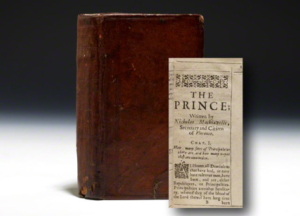 For over 1500 years, people interested in the political dimension of human existence regarded one book as their ultimate guide to a labyrinthine world that tempted and terrorized them at the same time. The book was Aristotle’s “Politics” that, though originally written as a depiction of political ideals in ancient Greece, appealed to other cultures across centuries and continents. In Europe, Aristotle’s book generated centuries of speculation on and experimentation about the art of government. The Scholastics, notably Saint Thomas Aquinas, used it as a plank in reconciling Christianity with philosophy. Although “Politics” was not fully translated into Arabic and Persian, the two major languages of classical Islam, its partial renditions did inspire numerous treatises on the “behavior of princes” (sirat al-moluk) and the art of good governance in general (Siasatnameh)..
However, Aristotle’s masterpiece was a recipe for ideal government in “the most perfect political community” which the First Teacher described as “one in which the middle class is in control, and outnumbers both of the other classes.” That conjecture was not to be reached until the 20th century when the middle classes established their hold on political power in a number of Western societies. But even then, it did not take long before it became clear that middle class or, as Marx would say bourgeois, rule did not necessarily create “the most perfect political community.”
Aristotle had studied the ideal; but what was needed was to examine the real. That was the task that one retired civil servant set for himself in 1513. The man in question was Niccolo Machiavelli who had been imprisoned and forced into exile as a result of one of the frequent regime changes experienced by his native city Florence. Machiavelli’s project shaped up into a slim book, in most editions just over 100 pages, first published under the title “De Principatibus” (On Rulership) in 1513-14.
Thus, the world is now marking the 500th anniversary of Machiavelli’s work with numerous seminars held by universities and research centers in more than 50 countries. The fifth centenary of “The Prince”, as the little book came to be known after its definitive edition appeared in 1532, has also inspired hundreds of books and many more essays. President Barack Obama prides himself in owning a copy as does North Korean dictator Kim Jong-il. “The Prince” is also the bedside book for both Vladimir Putin of Russia and Japanese Premier Shinzo Abe. Over the centuries the term “Machiavellianism” has entered almost every major language often as a synonym for diabolical cunning and absence of principles.
Interest in “The Prince”cuts across ideological barriers.
Jean-Jacques Rousseau regarded the book as a draft for his own social contract.
Voltaire and Diderot regarded “The Prince” as the first major attempt at de-sacralizing political power while David Hume and Adam Smith saw it as a humanist manifesto for a new political system. The English historian Thomas Macaulay read “The Prince” as a recipe for democratic republican government. He wrote: “It is notorious that Machiavelli was, through life, a zealous republican.. We are acquainted with few writings which exhibit so much elevation of sentiment, so pure and warm zeal for public good, so just a view of the duties and rights of citizens, as those of Machiavelli.”
The Founding Fathers of the United States, the first nation-state created as a shareholding company with a constitution, made much wise, though partial, use of Machiavelli’s ideas on government structures and the role of political institutions.
Hegel believed that Machiavelli wrote “The Prince” as a plea for the creation of a powerful state to forge unity among peoples. Fichte, however, presented Machiavelli as an advocate of “nations” at a time that Europe was moving away from the idea of empire towards the concept of nationhood. In 1803 Hegel, disappointed ion his own dreams of German national unity asserted that “Machiavelli’s voice has dies without effect.”
ISLAMIC BENEVOLENT DESPOT
In the 19th century Islamic reformers, among them Jamaleddin al-Afghani, saw “The Prince” as a treatise on the “benevolent despot” they thought was needed to save the people of Islam from poverty, ignorance and decline.
Giuseppe Manzoni, one of the fathers of Italian nationalism, saw “The Prince” as an idealized depiction of what a future Italian state “inspired by God” should look like. However, he missed one crucial point. Manzoni’s God is universal while Machiavelli’s is quintessentially Italian. While Manzoni wanted to enlist God’s support in Italy’s struggle for independence across the board, Machiavelli was satisfied with a divine blessing for what Italians did themselves. ” God is not willing to do everything, and thus take away our free will and that share of glory which belongs to us,” he wrote.
To Hannah Arendt, Machiavelli was “the spiritual father of revolution in the modern sense.” In the 1920s, Bolshevik theoretician Lev Kamenev described”The Prince” as a “zoological study of power in pre-Communist societies.” Benito Mussolini spoke of “my Machiavelli” and claimed the Florentine as the spiritual father of the fascist movement. Mussolini’s compatriot, Antonio Gramsci, however, insisted the Machiavelli’s “The Prince” should be seen as a metaphor for the Communist Party.
Thus, here is a book that has appealed to and intrigued people from across the ideological spectrum. Some like Marx dismissed it as “unscientific while others, like Leo Strauss described it as “a scientific book, because it conveys a general teaching that is based on reasoning .
At any rate, at the start of 2014, Machiavelli’s little book is still top of best-seller lists in the”politics” category not only in the West but also in such unlikely places as China, Japan and Iran.
Most dictionaries define Machiavellianism as “the political theory of Machiavelli; especially: the view that politics is amoral and that any means however unscrupulous can justifiably be used in achieving political power”.
That definition, however, is based on a superficial reading a text that, may be because of its beguiling simplicity, id often unjustifiably densified. Machiavelli regards politics as amoral, not immoral. For him politics is the art of building a solid state that is capable of ensuring the security of tis subjects and/or citizens within the framework of law.
Since none could feel secure without enjoying basic freedoms, it goes without saying that the politics that Machiavelli talks about is not intended to create a tyranny.
Within Machiavelli’s politics, the individual subject or citizen has the choice of being moral or immoral. In fact, it is to Machiavelli’s credit that he denies the state any claim on defining, let alone trying to impose, any form of morality outside the law of the land. To him politics is a neutral, pragmatic means of organizing the affairs of the community in a way that benefits the largest number possible. Though politics and ethics are separate and distinct domains in Machiavelli this does not mean that politics should not be subjected to ethical critique as any other part of the human condition. In fact, the 18th century English theologian Sir Thomas Browne claimed that “The Prince” establishes a political deontology that subjects every ruler to permanent ethical judgment.
GOOD GOVERNANCE AS SCIENCE
Without saying so, Machiavelli treats governance as science and, thus, could be regarded as father of the modern concept of politics as a science rather than an art. Thus the rules of politics, like those of science, are neither moral nor immoral. Take for example, the law of gravity. If you push a tyrant out of a high window, gravity would operate in the same way as if you pushed a loveable grandmother. The chief task of “The Prince” is to ensure the preservation of the state, that is to say maintaining a measure of law and order needed for people to live and work in peace and harmony. Because chaos is the principal enemy, a bad prince that ensures peace and stability should always be preferred to a good one that leads the ship of state into uncertain stormy waters. “The Prince must learn not to be good when necessary,” he states.
But how does the prince achieve the coveted degree of stability? Machiavelli suggests “good armies” and “good laws” as the necessary ingredients for achieving stability. That, in turn, leads him into acknowledging other necessities. There could be no “good armies” without a good economy to support the machinery needed for ensuring law and order. And, could there be “good laws” without their wiling acceptance by a majority of citizens? The answer is: no. But how would that acceptance be assessed? Machiavelli did not imagine democratic elections as they developed four centuries after he wrote his book. What he did, however, was to urge close and systematic consultations through which “The Prince” is informed of the opinions of his subjects. He uses an intriguing term, “riscontro”, a rough equivalent of the German “Zeitgeist”, which means “the spirit of the time or “the mood of the moment.”
At any given time, regardless of laws and traditions there are things that society does not tolerate. For example, in every society there comes a time when the idea of preventing girls from going to school is no longer acceptable. Thus the “Prince” who tries to impose a ban on schooling for girls would run counter to “rioscontro” wit grave consequences for the stability of the state. At the same time, the fact that the “Prince” might want something does not necessarily mean it could or should be undertaken. If it runs against “riscontro” it should be shelved without much ado. A successful “Prince” moves with his time and his people as defined in time, neither faster nor more slowly.
Having made his distinction between ideology and governance, Machiavelli proceeds to depict the political space as separate from that of religion. This does not mean that Machiavelli should be regarded as the father, or at least grandfather, of modern secularism. In his time, the concept did not yet exist. What he does is to understand that religion is the realm of the ideal while politics is that of the real.
Religion is all about certainty while politics is the province of doubt, second-thoughts, U-turns and compromises. Dragging religion into the mud-swamps of politics is bad for both. In religion, man seeks perfection-a perfection forever beyond his reach. This is how Machiavelli describes men who “are ungrateful, fickle, false, cowardly, covetous, and as long as you succeed they are yours entirely; they will offer you their blood, property, life, and children when the need is far distant: but when it approaches they turn against you. . . . Men have less scruple in offending one who is beloved than one who is feared, for love is preserved by the link of obligation which, owing to the baseness of men, is broken at every opportunity for their advantage; but fear preserves you by a dread of punishment which never fails.”
Here is yet another passage: “One can generally say this about men: they are ungrateful, fickle, simulators and dissimulators, avoiders of dangers and greedy for gain. While you work for their benefit, they are completely yours, offering you their blood, their property, their sons and their lives, when the need to do so is far away. But when the need draws nearer to you, they turn away.”
To many students of Machiavelli that crucial passage is the most glaring example of his cynicism. However, to those familiar with history and the political realities of our societies across the world , the statement has a ring of truth. The statement may be of interest for another reason. It punctures whatever pretense that we might have about achieving perfection by dissolving the real in the ideal. Admitting that we are full of flaws, that we are not perfect, could bless us with a degree of humility without which we cannot live in peace and harmony with our fellow human beings. Machiavelli could not have imagined the type of politics that Western societies were to develop 200 years after him on their way to democratization. Nevertheless, he did imagine what he called “Civil Principality”. In “The Prince” the whole of Chapter IX is devoted to that topic. Machiavelli defines the subject in this way: “When a private citizen becomes Prince of his native city not through intrigue or any other intolerable violence but with the favor of his fellow citizens, this can be called a civil principality, the acquisition of which neither depends completely upon virtue, nor upon fortune, but on a fortunate astuteness.” Machiavelli does not suggest how that “favor of fellow citizens” could be ascertained. But traditional societies, both in Christendom and Islam, developed a number of devices, including act of allegiance and pledges of fealty (bay’ah) that legitimized the new prince. Interestingly, Machiavelli makes it clear that “ a civil principality founded on people’s support is more stable than one founded on aristocratic support.
THE REDEEMER AND NATIONHOOD
It is not only by foreseeing democratic participation, a culture of secularism, and the search for the lowest common denominator that “The Prince” has helped shape the politics in the modern world. Almost 300 years before the very concept of nationalism stared to dominate European, and later, global thought Machiavelli realized that the imperial forms under which diverse communities had been wrought together for over 1500 years were no longer efficient. It would not be far-fetched to regard Machiavelli as the grandfather, if not the father, of modern nationalism. ” I love my fatherland more than my soul,” he wrote. In fact, successive generations of Italians have regarded Machiavelli’s book as a manifesto for Italy’s resurgence (Risorgimento) as a unified nation. “The Prince” ends with an “Exhortation” that is a clarion call for Italians to throw off the foreign yokes under which they live and create a new independent state.
Many readers find the “Exhortation” chapter as an incongruous afterthought to “The Prince”. Throughout the book we are made to understand that the ideal ruler need not be an extraordinary man.
All he needs to achieve success is good sense, temperance, an ability to understand the mood of his time, and readiness to change his words and policies to ensure the stability ad perennity of the state. In “exhortation” , however, Machiavelli seeks a ” Redeemer”, an exceptional heroic figure that Italy, trampled underfoot by bigger powers such as France, Spain, Austria and even Switzerland, needs to unite and re-emerge as an independent nation-state. To be sure, Machiavelli does not quite tell us where his ideal Italy is actually located. He refers to Rome, Tuscany, and the Kingdom of Naples as constituent blocs of his dream Italy. But he makes no reference to Savoy, Sicily, Sardinia and Veneto among other regions. In reality, Italy had never existed as Italy which designates the boot-like peninsula; it had been a patchwork of mini-states based on two dozen cities or had found expression in the Roman Empire stretching across three continents.
Machiavelli’s knowledge of Roman history is, at times, surprisingly approximative. (For example he puts Emperor Commodus after Severus.)
In any case, Machiavelli names only four “ redeemers” in history, men who freed their nations from subjugation and went on to found new states. The four are Moses for Hebrews, Cyrus for Persians, Theseus for the Greeks and Romulus for Romans. Machiavelli’s “Redeemer” is a prophet armed who embarks on a divine mission to create a new world. He is wise, eloquent and humane, in other words, exceptional. In his Opera Nabucco, in 1842, Verdi offered his immortal Va’ Pensero aria of the slaves inspired by Machiavelli’s idea of a “Redeemer”. But Italy did not get a “Redeemer”, even though it did become independent in 1870. It did get caricatures of the “redeemer”, however, in the form of Mussolini’s Il Duce (The Duke), and more recently, Silvio Berlusconi’s Il Condottiere (The Conductor)
Not all nations could have a “Redeemer” all the time. Most mortals must live under an ordinary “Prince”, hoping he has read Machiavelli and learnt a few tips from him.
Buried for 4,000 years, this ancient culture could expand the ‘Cradle of Civilization’
The article “Buried for 4,000 years, this ancient culture could expand the ‘Cradle of Civilization’” was originally written by Antonio Ratti and published in the National Geographic on February 25, 2021.
Kindly note that none of the pictures and accompanying captions printed below appear in the original National Geographic report.
Readers further interested in this domain may consult the below sources:
Pleistocene to Pre-Achaemenid Eras
The ancient Civilization of Jiroft
Jiroft: The Forgotten Civilizational Legacy of Ancient Iran –جیرفت زادگاهی از تمدن جهان– (Video)
Maymand, an Exemplar Manmade-Cave dwelling
The Ziggurat of Jiroft: Largest and Oldest of its Type in the World?
======================================================================================
Flooding in 2001 near Jiroft, Iran, exposed the ruins of an ancient necropolis from a Bronze Age culture that flourished alongside Mesopotamia. In 2001 a flood of archaeological objects began appearing in the antiquities market seemingly out of nowhere. For sale were distinctive pieces of jewelry, weapons, finely crafted ceramics, drinking vessels, and game boards—featuring unusual artistry and magnificent inlays of carnelian and lapis lazuli. These extraordinary pieces featured a complex symbology of animals, both wild and domesticated, depicted fighting among themselves or with human figures, the humans always triumphant. There were beautifully realized bucolic scenes of animals grazing in vast palm groves and architectural reproductions of temples or palaces.
Data provided by the internet sites and auction houses selling these mysterious pieces was sparse and, at best, vague. Their origins were often listed as “from Central Asia.” At first, it was assumed that the pieces were the work of expert forgers, but as more came on the market in the following months, scholars began to speculate that they could be genuine, deriving from an undocumented site whose location was unknown to them. In 2002 more appeared on the market.
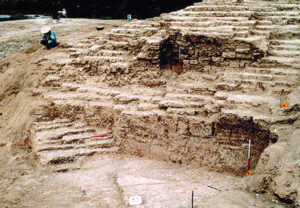
Excavations at Jiroft’s Konar Sandal A, one of the site’s two major mounds, are revealing the base of what may have been one of the world’s largest ziggurats. (Source: Mohammad Eslami-Rad /Gamma in CAIS).
Iranian police solved the mystery later that year. A coordinated investigation led to the arrest of several traffickers and the confiscation of a hoard of artifacts. These objects were being prepared to be shipped from Tehran, Bandar ‘Abbas, and Kerman to buyers around the world. Investigators revealed that most of these distinctive pieces could be traced back to a location in the Halil River Valley, about 25 miles south of Jiroft, a remote and peaceful city in southeastern Iran, not far from the Persian Gulf.
But where did these mystery artifacts come from? At the time, scholars knew of no dig sites in the area, but when they looked closer, they found a simple yet surprising explanation. In early 2001 flooding caused the Halil River to overflow its banks and erode the surrounding lands. Layers of sediment were washed away, and the remains of an ancient cemetery were exposed. Locals and looters quickly recognized the importance of the find and moved to collect and sell the artifacts they were finding.
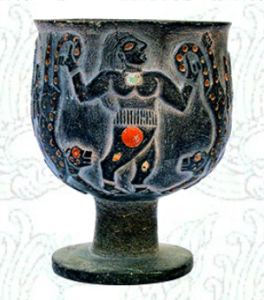 Chlorite cup from Jiroft, c. 3rd millennium BCE (Source: CAIS). Chlorite vessels similar to the stunning examples recently unearthed at Jiroft in southeastern Iran have been found from the Euphrates to the Indus, as far north as the Amu Darya and as far south as Tarut Island, on the Persian Gulf coast of Saudi Arabia. Iranian-born archeologist Professor Yousef Madjidzadeh speculates that some of these objects were in fact imported from Jiroft, which he is convinced is the legendary third-millennium-BC city of Aratta. Other archeologists, however, dispute this conclusion, maintaining that the vases, bowls and cups from Mesopotamian and Indus Valley sites were manufactured locally. What is clear is that Jiroft traders brought lapis lazuli from Afghanistan and carnelian from the Indus to decorate the ornate vessels they manufactured.
The full import of the discovery became clearer after archaeologists made formal surveys of the area and found that this undocumented culture dated back nearly 5,000 years to the Bronze Age. Looters had ransacked thousands of graves in the necropolis, taking artifacts and damaging the site, but archaeologists were determined to study what remained. They traveled from universities around the world to join an Iranian team to protect as much of the exposed site as possible and excavate nearby areas to learn more about this ancient culture and its people. (History’s first superpower—the Persian Empire—sprang from ancient Iran.)
New Urban Culture
Lasting for several seasons, excavations near Jiroft began in February 2003, under the direction of Iranian archaeologist Yousef Madjidzadeh. Madjidzadeh’s team identified a main necropolis, which they named Mahtoutabad. Most of the initial findings and artifacts are believed to have come from this site despite the looting of grave goods prior to the excavations. Almost a mile to the west of the necropolis, archaeologists targeted for further study two large artificial mounds that rose above the plain.
About a mile apart from each other, the two mounds were named Konar Sandal South and Konar Sandal North. They turned out to contain the remains of two major architectural complexes. The northern mound included a cult building, while in the southern one were the remains of a fortified citadel. At the foot of the mounds, buried under many feet of sediment, were the remains of smaller buildings. It’s believed that the two mounds had once formed part of a unified urban settlement that stretched many miles across the plateau.
 “The artists had such a naturalistic way of rendering images,” says Yousef Madjidzadeh, foreground. “It was a style that was not seen anywhere else in that era.” (Source: CAIS). “There must certainly have been a school of stonecarvers, because you see such an aesthetic unity of these objects throughout the kingdom. This high-level artistic quality did not suddenly appear from nowhere,” he maintains. “The traditions must have taken 300 to 400 years to develop.”
Madjidzadeh’s preliminary conclusions from the partial data available made a big impression on the scientific community. Some scholars, most notably American archaeologist Oscar White Muscarella, strongly questioned his findings, sparking furious academic debates. Critics were concerned that the initial looting of the site’s artifacts made it difficult to accurately assess their age and authenticity.
Despite the controversies, work continued at the Iranian site over the course of several seasons with visiting scholars from all over the world, including American archaeologist Holly Pittman from the University of Pennsylvania. The first phase of excavations at the site lasted through 2007.
The initial picture of the Jiroft civilization that existed became clearer. Madjidzadeh published the team’s findings, which suggested that an urban center had been established at the Jiroft site as long ago as the end of the fifth millennium B.C. His optimistic conclusion stated that “the region of Jiroft . . . was a major occupation of urban character in the region during the third millennium B.C. Its center was in the valley of the Halil River where large sites with monumental architecture, sizable craft production areas, domestic quarters, and extensive extramural cemeteries dominated the landscape.”
Archaeologists found distinctive objects—some practical, some decorative, and others sacred—that often featured carved semiprecious stones such as calcite, chlorite, obsidian, and lapis lazuli. The citizens of this city seem to have maintained close contact with cities in Mesopotamia, the region located between the Tigris and Euphrates Rivers (roughly coinciding with present-day Iraq). Painstaking excavation of Konar Sandal South revealed that the citadel there had once been surrounded by a monumental wall of brick and had several rooms that through radiocarbon analysis have been dated to between 2500 and 2200 B.C. (These centuries-old windmills in Iran are still turning.)
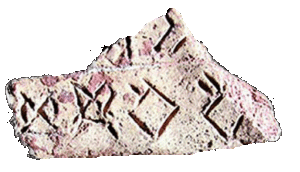 Digging at the Jiroft site halted for seven years and began again in 2014 as Iranian archaeologists returned to the site. Scholars from Italy, France, Germany, and other nations have taken part in these new digs, which have been uncovering even more detailed information about the Bronze Age people of Jiroft.
Arts and letters
Archaeologists were thrilled to discover the complexity and beauty of the artworks found at the Jiroft site. The decorative iconography present on hundreds of the vessels is rich with skillfully executed symbolism and shows remarkable similarities with the iconography associated with the Mesopotamian tradition. The scorpion images found at Jiroft echo the scorpion-men depicted in the royal necropolis at Ur (mid-third millennium B.C.). The bull-men of Jiroft call to mind the bull-man Enkidu from the Akkadian Epic of Gilgamesh. The parallels are so pronounced that it is theorized that the two cultures could share a common cultural heritage. (Here’s how a self-taught scholar discovered Gilgamesh, the world’s first action hero.)
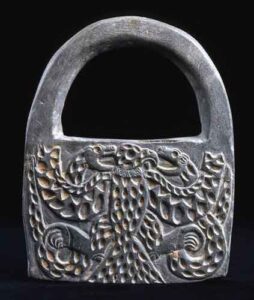 “Handbag” looking artifact with decorative motifs excavated from Jiroft (Source: Iran Atlas). The artefact may have been a weight standard for measurements.
Most striking of all are the recurrent, distinctive images of an inverted bull with an eagle hovering above it and of battles between eagles and snakes. These two motifs appear on many of the vessels found at Jiroft and seem to evoke one of the most famous Mesopotamian myths: that of Etana, the mythical shepherd-king of Kish who is cited on the Sumerian king list, as the first sovereign after the universal flood.
In the myth, one of the most complex and exciting tales from this early period, Etana needs a way to ascend into heaven to attain a magic plant that will allow his wife to give birth to an heir. Meanwhile, an eagle and a serpent struggle; the pair, while once sworn allies, will become mortal enemies after the eagle eats the snake’s offspring. The snake wreaks revenge on the eagle, leaving him to die in a pit. On the advice of the sun god Shamash, Etana saves the eagle, and in gratitude the bird bears Etana up to heaven to retrieve the plant he needs to ensure his succession.
The motif of the universal flood, a central one for the Sumerians and Babylonians, may also appear in some representations from Jiroft. Italian archaeologist Massimo Vidale noted in his work on Jiroft that:
“on a vase, a kneeling character holds two zebu whose heads produce waves. A mountain rises from the waves; another character with the divine symbols of the Sun and the Moon lifts something that looks like a rainbow, beyond which we can see chains of mountains that emerge . . . Although it is essential to be cautious, it is difficult for the writer to leave aside the impression that the image tells an ancient myth about a great flood.” (Explore the ancient water tunnels below Iran’s desert.)
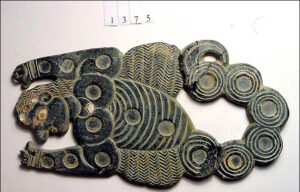 Artifact excavated at Jiroft featuring a scorpion with a human head (Source: Iran Atlas).
In one of the entrances to the citadel of Konar Sandal South, scholars found a fragment from a baked clay tablet inscribed with writing. In another spot, some 500 feet to the north, three other tablets bearing written texts in two different writing systems were found. Whoever these people were, they had a writing system. One of them appears similar to the so-called linear Elamite, a script used in the cities of the kingdom of Elam, on the border with Mesopotamia. The other script was geometric in form and had not been seen before. The obvious inference from the two finds is that the civilization at Jiroft was literate.
Identification ideas
In 2003, after examining the huge collection of confiscated archaeological finds, Madjidzadeh, the director of operations, put forward an intriguing hypothesis. Based on his observations of the site and a study of ancient Mesopotamian cuneiform texts, Madjidzadeh believes that the Jiroft civilization is Aratta, a land that was praised for its wealth in numerous Sumerian poems. An ancient text describes a conflict between Aratta and the Mesopotamian city of Uruk. In the telling, Aratta is a vibrant place:
“battlements are of green lapis lazuli, its walls and its towering brickwork are bright red, their brick clay is made of tinstone dug out in the mountains.”
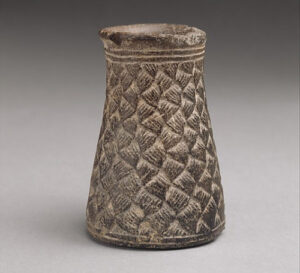 Jar or vase figure from Jiroft (Source: Iran Atlas).
Madjidzadeh points to the site’s geographical position surrounded by mountains, the abundance of semiprecious stones, and the high degree of civilization as factors in favor of an Aratta identification. Skeptics criticize Madjidzadeh’s theory as lacking in solid evidence. There is no documentary proof to suggest that Aratta existed anywhere outside of the Sumerian poems and that Aratta was just a Bronze Age myth.
Other scholars have theorized that the civilization near Jiroft may correspond to the ancient kingdom of Marhasi. This theory has some textual support. First, there are the inscriptions of the kings of Akkad, a Mesopotamian empire, that describe their glorious Akkadian feats during the fight against a powerful state in the Iranian highlands. In one of these texts, the epilogue of the conflict is narrated in great detail: “Rimush [King of Akkad] defeated Abalgamash King of Marhasi in battle . . . When he conquered Elam and Marhasi he took 30 gold mines, 3,600 silver mines and 300 male and female slaves.” There is firm evidence that the city of Akkad existed between 2350 and 2200 B.C. Since Marhasi was Akkad’s contemporary, Marhasi can also be dated to that time, which lines up with the data from the Jiroft dig sites. Unlike Marhasi, Aratta cannot be identified with a specific period. (Here’s how archaeologists determine the date of ancient sites and artifacts.)
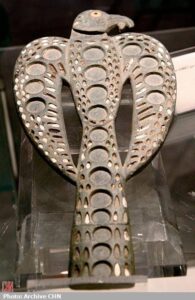 Upright eagle from Jiroft (Source: Iran Atlas).
No one had ever dreamed that from the sands of such a remote and arid region, considered by many to be an unlikely spot for the development of a complex civilization, that a refined culture could emerge. Since excavations began nearly two decades ago, numerous discoveries—once thoroughly analyzed—will make it possible to place Jiroft it in its proper historical perspective. Since 1869, when the remnants of Sumerian culture were uncovered, Mesopotamia has been considered the cradle of civilization. But the remarkable findings at Jiroft demand a reassessment of that interpretation.
Related posts:
The Ancient Civilization of Jiroft
The Ziggurat of Jiroft: Largest and Oldest of its Type in the World?
Rock art from unknown ancient civilization in Iran discovered on top of mountain
Excavations Reveal Rare Find of Bronze Age Culture in Iran
Mysterious Script of Biblical Elam Is Deciphered After 5,000 Years
Kaldar cave in Iran estimated to date over 63,000 years
Arctic Mummy from Civilization with Links to Persia
Petroglyphs hold clues to 14,000 years of human life in Iran
An Overview of the Ancient “Shahr-e Sukhte” (Burnt City)
By Dr. Kaveh Farrokh|December 27th, 2023|Ancient: Prehistory – 651 A.D., Anthropology, Archaeology, Architecture, Bronze Age, Jiroft, Pre-Achaemenid|Comments Off
Happy New Year 2024!
To Our Friends and Supporters of World Cultural Heritage Voices.
 On behalf of our colleagues and volunteers at WCHV, and on the occasion of the Global New Year of 2024, we would like to extend our regards and best wishes for a Happy New Year. Thank you for your support of WCHV, which has been so instrumental in achieving our goals and mission.
Yalda: the celebration of the sun’s victory and the defeat of darkness
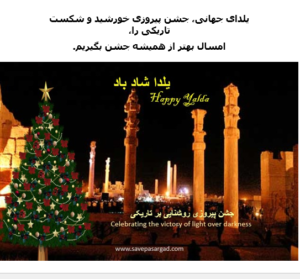 Yalda: the celebration of the sun’s victory and the defeat of darkness.
Click here for Yalda Youtube video
This year, let’s celebrate it globally better than ever.
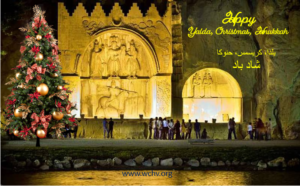 For thousands of years, on the same day in December and the Persian month of Azar, the shortest day of the year, the people of Iran prepare for a big and nationwide celebration: one without any god or servant inviting them, without any bullying ruler commanding it, without any rich person paying for it, and without the proprietor of any religion or belief promising heaven or companionship. The people of Iran, however, celebrate the victory of the sun, the only vitalizing and life-giving presence of their astute culture, testifying to the undoubted end of all darkness, cruelty, and evil.
This year, the rulers of darkness, along with all their inhumanity and anti-culture, have tried to change the name of Yalda on the first anniversary of the inscription of Yalda on the UNESCO’s List of the Intangible Cultural Heritage of Humanity. It is as if they do not know that this idea will only bring them nothing but more embarrassment. It makes us believe more than ever in the importance of our national celebrations, those which are based on kindness, wisdom, and charity.
Pasargad Heritage Foundation congratulates everyone on this occasion of Yalda. We hope that this year, we can all globally celebrate Yalda better than ever before, while sitting next to adorned evergreen trees.
Let’s say to the dark thinkers who don’t have the knowledge and capacity to see the light:
“Can you not see and must ask, where is this bright day?
Let the sun shine in your eyes, saying: “Here I am!”
Yalda 2023 (1402)
Pasargad Heritage Foundation