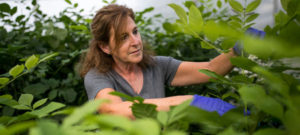
Forest geneticist Jennifer Koch inspects cuttings in the greenhouse at the Forest Sciences Laboratory in Delaware, Ohio on September 17, 2020.
Forest geneticist Jennifer Koch hopes her ash breeding strategy could save other threatened trees.
Can an ambitious breeding effort save North America’s ash trees?
DELAWARE, OHIO—On a weekday morning in August, just one pickup truck sat in the sprawling visitors’ parking lot here at the U.S. Department of Agriculture’s (USDA’s) Forestry Sciences Laboratory. A decadeslong decline in research funding had been slowly quieting the place—and then came the pandemic.
But in a narrow strip of grass behind a homely, 1960s-era building, forest geneticist Jennifer Koch was overseeing a hive of activity. A team of seven technicians, researchers, and students—each masked and under their own blue pop-up tent—were systematically dissecting 3-meter-tall ash trees in a strange sort of arboreal disassembly line. Over 5 weeks, the researchers would take apart some 400 saplings, peeling wood back layer by layer in search of the maggotlike larvae of the emerald ash borer (Agrilus planipennis), the most devastating insect ever to strike a North American tree. Since the Asian beetle was first discovered in Michigan in 2002, it has killed hundreds of millions of ash trees across half the continent and caused tens of billions of dollars of damage.
“We have contests for who can successfully pull out the smallest larvae and the biggest larvae,” Koch says. “People get pretty excited and competitive about it. You have to do something, because it is very tedious—and [the larvae] are really gross.”