 Recent research highlights the power of the canine nose to uncover buried remains from ancient human history On a sunny summer day in Croatia several years ago, an archaeologist and two dog handlers watched as two dogs, one after another, slowly worked their way across the rocky top of a wind-scoured ridge overlooking the Adriatic Sea.
Bodies had lain in beehive-shape tombs on this necropolis, part of the prehistoric hill fort of Drvišica, since the Iron Age. The two dogs, trained to detect human remains, were searching for scents that were thousands of years old.
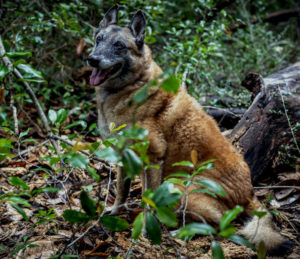
Panda, a Belgian Malinois with a “sensitive nose,” according to her handler, Andrea
Pintar, had begun exploring the circular leftovers of a tomb when she suddenly froze, her nose pointed toward a stone burial chest. This was her signal that she had located the scent of human remains.
Ms. Pintar said the hair on her arms rose. “I was skeptical, and I was like, ‘She is kidding me,’” she recalled thinking about her dog that day. Archaeologists had found fragments of human bone and teeth in the chest, but these had been removed months earlier for analysis and radiocarbon dating. All that was left was a bit of dirt, the stone slabs of the tomb and the cracked limestone of the ridge.
Human-remains detection dogs, or cadaver dogs, are used worldwide on land and water. Well-trained dogs help find the missing and dead in disasters, accidents, murders and suicides. But the experiment in Croatia marked the start of one of the most careful
inquiries yet carried out of an unusual archaeological method. If such dogs could
successfully locate the burial sites of mass executions, dating from World War II through
the conflicts in the Balkans in the 1990s, might they be effective in helping
archaeologists find truly ancient burials?
On the scent of new tombs
Panda wasn’t kidding. Neither was Mali, the other Belgian Malinois trained by Ms. Pintar
and her husband, Christian Nikolić. Each dog gave her final indications that day by either sitting or lying inside the flattened circle of the tombs, their noses pointing toward the burial chests within. In some cases they leapt into the small burial chests before offering an alert.
The dogs’ archaeological expedition had been initiated by Vedrana Glavaš, an
archaeologist at Croatia’s University of Zadar. She already knew a great deal about the necropolis at Drvišica, having fully excavated and analyzed the contents of three tombs
there. Inside each were rough limestone burial chests. She and her team recovered amber beads, belt buckles, bronze pins, teeth and phalanges. Each chest once held at least two bodies, which radiocarbon dating confirmed were 2,700 years old. The skeletal material was highly fragmented, however, and is still being analyzed.
But were there other tombs on the site, and could the dogs help locate them?
After that first preliminary search and its surprising result, Dr. Glavaš had beers at a local pub with the dogs’ handlers. They decided to hold off any discussion for a few weeks. That “test run” was the beginning of a careful study on whether human-remains detection dogs could be an asset to archaeologists. Setting up a controlled study was difficult. Dr. Glavaš had to learn the scientific literature, such as scent theory, far outside the standard confines of archaeology; the same was true for Ms. Pintar and the field of archaeology.
The training challenges were also difficult. Ancient human remains probably present a
different and fainter scent profile than more recently deceased cadavers, especially as
decades turn into centuries and then millenniums. False negatives seemed likely to occur.
“I think dogs are really capable of this, but I think it’s a logistical challenge,” said Adee
Schoon, a scent-detection-animal expert from the Netherlands who was not involved in
the study. “It’s not something you can replicate again and again. It’s hard to train.”
And, as Dr. Schoon noted, dogs are “great anomaly detectors.” Something as subtle as
recently disturbed soil can elicit a false alert from a dog that is not rigorously trained.
Nonetheless, the team returned to the necropolis for the first controlled tests in September 2015, and again a full year later. Both times, they used all four of Ms. Pintar and Mr. Nikolić’s cadaver dogs: Panda, Mali, a third Belgian Malinois and a German shepherd. They worked them on both known and double-blind searches, in areas where nobody knew if tombs were located.