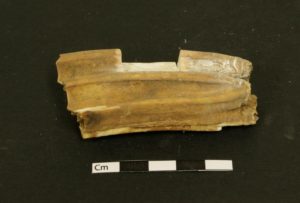
 Archaeologists in Iceland have for decades examined the remains of more than 350 graves from the Viking Age. In approximately 150 of these, teeth or bones of horses were found. Geneticists and archaeologists have now
examined ancient DNA from 19 horses in such graves, and it turned out that all horses – except one – were male.
Iceland was a heavily forested, uninhabited island until the Vikings settled there in the
870s. The first Vikings were, according to stories in the Landnámabók, noblemen with
their families who traveled to Iceland to get away from the harsh rule of the king Harald
Fairhair. Around 930 the population of Iceland had already increased to 9000, and in light of this it is puzzling that only 350 graves dating to the Viking Age have been found so far.
“There should be thousands of such graves”, says PhD student Albína Hulda Pálsdottir at CEES, Department of Biosciences at the University of Oslo. As a zooarchaeologist, she is an expert in studying animal remains from archaeological excavations.
The modest number of Viking graves makes it all the more interesting to study those that have been found, in the hope of getting a better insight into how the Vikings of Iceland
lived and thought. And now we have a clearer picture of the Viking burial ritual, because
a multidisciplinary research team of archaeologists and geneticists from Iceland, Norway,
Denmark, United Kingdom and France have examined ancient DNA (aDNA) from 19
horses that were found in these graves.
“It is reasonable to believe that a Viking who received a horse in the grave, must have
had a certain amount of power and influence. We would therefore like to know more
about these horses, for example of which sex they were”, says Pálsdottir.
Ancient DNA revealed the horses’ sex
But it is not very easy to determine the sex of more than 1000-year-old bone fragments
and teeth from horses. Male and female horses are quite similar, both in size and
appearance. Zooarchaeologists have previously tried to sex horse remains from the
Vikings’ graves by looking at the canines and pelvis, and they found that most horses
were male – stallions or geldings. The pelvis of male horses looks a little different from
that of female horses, and in most cases males have large canines while most mares do
not have canines at all.
“These morphological sexing methods can’t always be used when the skeletons are badly
preserved. Often the burial remains don’t contain any canines or pelvic bones. We have
therefore now sexed the remains of 19 horses from Viking age graves in Iceland by
analyzing the ancient DNA preserved in the fragments. Then it turned out that 18 of them
were male”, says Sanne Boessenkool – she is also based at CEES at the Department of
Biosciences.
The horses in the burials were in their prime; they were thus not buried because of old
age or illness. Sanne Boessenkool, who is a biologist and expert in evolution and the
analysis of ancient DNA, adds that DNA remains cannot provide answers to whether the
buried male animals were stallions or geldings (castrated animals).
Stallions as symbols of power
The Arctic fox, also called the polar fox, was the only land mammal that existed in
Iceland before people settled there. But this changed quickly when the Vikings arrived
and imported animals such as dogs, sheep, cows, pigs, goats, chickens and horses. In the
end there were many horses in Iceland, and archaeologists have therefore been uncertain
what it really meant when a Viking was buried with a horse. But when 18 of the 19
buried horses analyzed turned out to be male, it appears to have been a conscious choice
to place a male horse in a burial.
“It is natural to imagine that the slaughter of the virile and to some extent aggressive male
animals must have been part of a burial ritual that was intended to convey status and
power”, explains archaeologist Rúnar Leifsson from The Cultural Heritage Agency of
Iceland (Minjastofnun Íslands). He is one of the collaborators on the scientific paper that
is now published in the Journal of Archaeological Sciences.
“In addition to the 19 buried horses, we have examined the remains of three horses that
were found outside graves. All of these were female”, says Sanne Boessenkool. These
horses had not been given a ceremonial funeral and were likely eaten. The impression is
therefore that male and female animals had a different status.
New light shed on graves
It has been a challenge to interpret the grave remains from the Viking Age in Iceland,
because many of the graves were found during road works or other construction projects
between 50 and 100 years ago. In many cases the burials were not examined by an
archaeologist and only a small part of the material found was sent back to the National
Museum of Iceland. Therefore most of the skeletons are incomplete.
“It is striking that we find almost exclusively middle-aged men in the graves on Iceland.
There are almost no infants or children, and very few women. We don’t know how the
rest of the population was buried. Perhaps they were laid in swamps or lakes, or sunk in
the sea”, suggests Pálsdottir.
It is also striking that the Vikings in Iceland apparently developed their own burial
customs.
“It was common to cremate the dead in Scandinavia, where the Vikings of Iceland came
from. But we find no traces of cremation on Iceland. Other scientists have studied the
occurrence of different isotopes in the Viking skeletons, and it turned out that the buried
women who were found must have come to Iceland during adulthood. This may indicate
that the men from the first settlement brought women to Iceland from Scandinavia”,
suggests Pálsdottir.
The Vikings didn’t think like us
Sanne Boessenkool stresses that we should not mirror our own modern cultural ideas
when we attempt to interpret the grave finds from Viking Age Iceland.
“Today, we think of death and a funeral as an ending, and then it may seem wasteful to
slaughter a great stallion just to bury it. But if the people at the time believed in a life
after death, they maybe thought that the horse had a function”, suggests Boessenkool.
Albína Hulda Pálsdottir agrees:
“Nowadays, it is easy to imagine such rituals as a form of demonstrating power, perhaps
as “conspicuous consumption” that was intended to demonstrate wealth and status, rather
than to cover real needs. But maybe the Vikings thought totally different, Pálsdóttir
points out.
It is noted that the term conspicous consumption was at the time introduced by the
Norwegian-American economist and sociologist Thorstein Veblen, who felt that the
motivation was to demonstrate power and prosperity, rather than to satisfy one’s own
desires and needs.
Skulls on stakes
Researchers have in some cases been able to see how the animals were killed before they
were placed in Viking graves.
“If a horse skull has a fracture on the forehead, it is very clear that it was slaughtered with
a hit on the forehead. There are also a few cases where the horse has been beheaded,
meaning the head has been separated from the rest of the body. An interesting example
that is not included in our study, comes from the farm at Hofstaðir in northern Iceland.
There archaeologists found many cattle skulls with fractures in the forehead that showed
weathering on the front, but not on the back”, says Pálsdóttir.
Archaeologist’s inferred that these animals had been killed ceremonially in connection
with for example a festivity where skulls were put on stakes outside the Viking hall.
Maybe as a sign of warning; an enemy may think twice before approaching a Viking
farm surrounded by skulls on stakes. Weathering suggests that the skulls must have been
left on display long enough for the weather and wind to leave its marks on the side of the
skull that was most exposed.
The ancestors of the Icelandic horse
Albína Hulda Pálsdottir and Sanne Boessenkool emphasize that the horses that existed in
Iceland under the Viking Age, are not necessarily exactly the same as what we today call
the Icelandic horses.
“The horse breeds we have today are bred up in the course of the last 200 years or so, but
the horse bones we have examined are of course much older. But we can assume that
these horses are the ancestors of the Icelandic horses today”, Boessenkool says.
The researchers at CEES are now working on sexing the remains of several animal
species from the Viking Age using ancient DNA.
“In the course of this project we have developed a simple method for sex determination
using ancient DNA. It is an important advance, because it would not have been possible
to sex over half of the horses in the study with other methods”, Boessenkool explains.
“The method is fairly easy to use for all species that have sex chromosomes, and we have
shown that the method is robust. We also do not need a lot of DNA to get secure results,
so we expect that other researchers will take advantage of the method we present in the
paper”, she adds.
Most aDNA from bacteria
The researchers’ method is described in more detail in the scientific article, but the first
step is to pick a tooth or a bone that is then cleaned. Then the researchers cut out a little
bit which is crushed into powder, and then the DNA is extracted from the powder. The
DNA is then analyzed using a method called shotgun sequencing, which implies that the
researchers sequence all the DNA in the sample. But in a tooth from the Viking Age there
can be a lot of DNA that comes from other organisms:
“Most of the old DNA we find is not actually from horse! In some cases, as much as 99.5
percent is from bacteria or undefined organisms”, Boessenkool says.
Sanne Boessenkool and Albína Hulda Pálsdottir have many good experiences with the
interdisciplinary collaboration in the project.
“Interdisciplinary work is difficult, not the least because biologists and archaeologists in
a way speak different languages and write scientific articles in different ways. But when
we really get into it and make an effort, as we did here, we are able to do research and
find things that none of us could have done alone”, says Pálsdottir.
University of Oslo, Faculty of Mathematics and Natural Sciences