 DESERT RESEARCH INSTITUTE—Reno, NV (May 14, 2018): To learn about the rise and fall of ancient European civilizations, researchers sometimes find clues in unlikely places: deep inside of the Greenland ice sheet, for example.
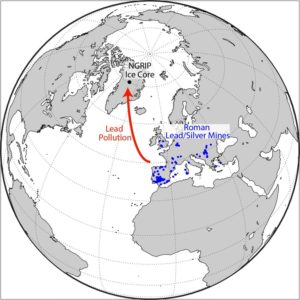
Thousands of years ago, during the height of the ancient Greek and Roman empires, lead emissions from sources such as the mining and smelting of lead-silver ores in Europe drifted with the winds over the ocean to Greenland – a distance of more than 2800 miles (4600 km) – and settled onto the ice. Year after year, as fallen snow added layers to the ice sheet, lead emissions were captured along with dust and other airborne particles, and became part of the ice-core record that scientists use today to learn about conditions of the past.
In a new study published in PNAS, a team of scientists, archaeologists and economists from the Desert Research Institute (DRI), the University of Oxford, NILU – Norwegian Institute for Air Research and the University of Copenhagen used ice samples from the North Greenland Ice Core Project (NGRIP) to measure, date and analyze European lead emissions that were captured in Greenland ice between 1100 BC and AD 800. Their results provide new insight for historians about how European civilizations and their economies fared over time.
Read more:
https://popular-archaeology.com/article/lead-pollution-in-greenland-ice-shows-rise-and-fall-of-ancient-european-civilizations/