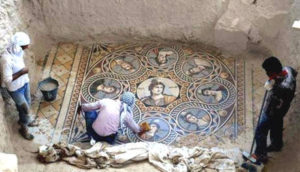
 According to a report in the Hurriyet Daily News , a floor mosaic featuring a woman’s portrait has been unearthed in southern Turkey by a team of researchers led by Ümit
Kayişoğlu of the Osmaniye Museum Directorate. He said that the woman’s pose resembles that of Leonardo da Vinci’s Mona Lisa. “This mosaic area is the only known mosaic area with human figures in Osmaniye,” he added. “This is the remains of a villa built in the first and second centuries A.D.” Kayişoğlu suggests that the woman featured in the mosaic may have owned the villa.
Archives
2,500-Year-Old Coffins Recovered in Egypt
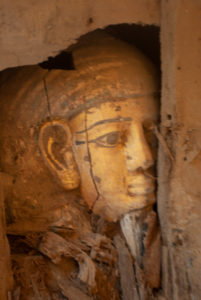 According to an Ahram Online report, Khaled el-Anany, Egypt’s Tourism and Antiquities Minister, announced the discovery of more than 100 sealed, painted coffins; some 40 gilded statues of the funerary goddess Ptah Soker; and golden funerary masks in the Saqqara necropolis, which is located about 20 miles south of Cairo. Most of the
coffins have been dated to the 26th Dynasty (688–525 B.C.), but coffins dated to the
Ptolemaic period (304–30 B.C.) were also found. The well-preserved coffins were recovered from three deep burial shafts, where they had been protected from decay. A CT scan of one of the mummies revealed the remains of a man who had died at about 40 years of age. Team member Bassem Gehad added that the body had been mummified with its arms crossed over its chest, in what was known as the Osiris shape, after the god of the dead and resurrection who was often depicted holding the crook and flail with his legs in mummy wrappings. The coffins and artifacts will be distributed between the Cairo Museum in Tahrir Square; the Grand Egyptian Museum, which is scheduled to open next year; and the National Museum of Egyptian Civilization
Can an ambitious breeding effort save North America’s ash trees?

Forest geneticist Jennifer Koch inspects cuttings in the greenhouse at the Forest Sciences Laboratory in Delaware, Ohio on September 17, 2020.
Forest geneticist Jennifer Koch hopes her ash breeding strategy could save other threatened trees.
Can an ambitious breeding effort save North America’s ash trees?
DELAWARE, OHIO—On a weekday morning in August, just one pickup truck sat in the sprawling visitors’ parking lot here at the U.S. Department of Agriculture’s (USDA’s) Forestry Sciences Laboratory. A decadeslong decline in research funding had been slowly quieting the place—and then came the pandemic.
But in a narrow strip of grass behind a homely, 1960s-era building, forest geneticist Jennifer Koch was overseeing a hive of activity. A team of seven technicians, researchers, and students—each masked and under their own blue pop-up tent—were systematically dissecting 3-meter-tall ash trees in a strange sort of arboreal disassembly line. Over 5 weeks, the researchers would take apart some 400 saplings, peeling wood back layer by layer in search of the maggotlike larvae of the emerald ash borer (Agrilus planipennis), the most devastating insect ever to strike a North American tree. Since the Asian beetle was first discovered in Michigan in 2002, it has killed hundreds of millions of ash trees across half the continent and caused tens of billions of dollars of damage.
“We have contests for who can successfully pull out the smallest larvae and the biggest larvae,” Koch says. “People get pretty excited and competitive about it. You have to do something, because it is very tedious—and [the larvae] are really gross.”
Denisovan DNA Detected in Pleistocene Hominin Fossil
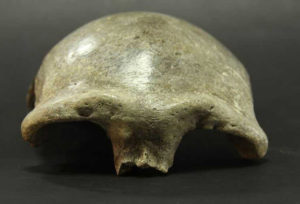 According to a statement released by the Max-Planck Institute for
Evolutionary Anthropology , a team of researchers from the institute and the Mongolian Academy of Sciences has analyzed a genome extracted from a 34,000-year-old fossil
discovered in 2006 in eastern Mongolia’s Salkhit Valley. The unusual skullcap had been
thought to belong to a Neanderthal or a Homo erectus individual, but the genetic study has shown that the remains belonged to a modern human woman. About 25 percent of her genetic material had been inherited from western Eurasians, who may have come from Siberia. She also carried DNA from Denisovans, who inhabited Asia before the arrival of modern humans, and Neanderthals. Diyendo Massilani of the Max-Planck Institute said that the study suggests that populations living across Eurasia frequently migrated and interacted with each other at least 35,000 years ago. The Denisovan DNA fragments in the ancient genome overlap with those found in today’s East Asians, he added, and yet are different from those found in people who currently live in Oceania. This indicates that modern humans and Denisovans are likely to have mixed multiple times
Remains of Medieval Bridge Found in Scotland
 According to a report in The Scotsman , remains of the Ancrum Old Bridge have been
found in southern Scotland’s River Teviot and dated to the mid-fourteenth century. The
multiarched bridge was part of the Via Regia, or King’s Way, which stretched from
Edinburgh to Jedburgh and the Borders. Built during the reigns of David II of Scotland
and Edward III of England, the bridge stood for more than 400 years, based upon archival research and dendrochronological dating of the native oak timbers that once supported the bridge piers. “In those times, during flood or high water, the Ancrum Bridge may have been the only place to cross the Teviot between Hawick and Berwic, making it one of the most important structures in medieval Scotland,” said Geoff Parkhouse of the Ancrum and District Heritage Society.
Relief Plate from the 9th Century found in Bosnia and Herzegovina
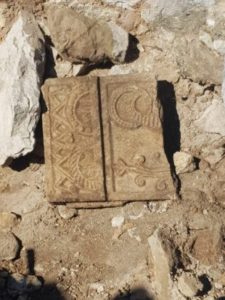 At the site of Crkvina in Zavala, in the municipality of Ravno, a stone relief plate of the
altar partition on the site of the remains of the Church of St. Peter from the 9th century was found, which represents a large archaeological discovery.
The archeological site of Crkvina is a national monument of Bosnia and Herzegovina.
The discovery of a stone relief altar partition also surprised archaeologists. The plaque
was found by chance, during the conservation of the site, which was considered a researched site. Snjezana Vasilj, an archaeologist stated: “We were surprised because we found one of the rare slabs of the altar partition, which was once built into a Romanesque church. It turned out to be the oldest church from the 9th century, the time of the Romanesque. I must point out that this three-passive church, the Romanesque church, is unique in Bosnia and Herzegovina. Apart from here, they have two more in Croatia ”, BHRT writes.
The site of the Church is a national monument of Bosnia and Herzegovina. This
archaeological site is recognizable by the remains of two churches of St. Peter and St.
Petka, and a necropolis of stećak tombstones.
Throughout history, five churches have been built on the site. The archaeological team
from the University of Mostar came to this knowledge after a revision of the research
conducted in 1957.
“The research included two churches, and when we finished the research, it turned out
that there were five churches. It is a big place with 42 excavated graves, both in church
graves and around them,” Vasilj said.
The churches are located near the Vjetrenica cave and the monastery in Zavala. After
conservation, a museum is planned to be built on the site.
This area is known for processing stone materials, the masters of this area will have the
opportunity to show their skills.
https://www.sarajevotimes.com/relief-plate-from-the-9th-century-found-in-bosnia-and-
herzegovina/
International Day for Preventing the Exploitation of the Environment in War and Armed Conflict
 On 5 November 2001, the UN General Assembly declared 6 November of each year as
the International Day for Preventing the Exploitation of the Environment in War and Armed Conflict (A/RES/56/4 ).
Though mankind has always counted its war casualties in terms of dead and wounded soldiers and civilians, destroyed cities and livelihoods, the environment has often remained the unpublicized victim of war.Water wells have been polluted, crops torched, forests cut down, soils poisoned, and animals killed to gain military advantage.
Furthermore, the United Nations Environment Programme (UNEP) has found that over
the last 60 years, at least 40 percent of all internal conflicts have been linked to the
exploitation of natural resources, whether high-value resources such as timber, diamonds, gold and oil, or scarce resources such as fertile land and water. Conflicts involving natural resources have also been found to be twice as likely to relapse.
The United Nations attaches great importance to ensuring that action on the environment is part of conflict prevention, peacekeeping and peacebuilding strategies – because there can be no durable peace if the natural resources that sustain livelihoods and ecosystems are destroyed.
On 27 May 2016, the United Nations Environment Assembly adopted
resolution UNEP/EA.2/Res.15 , which recognized the role of healthy ecosystems and
sustainably managed resources in reducing the risk of armed conflict, and reaffirmed its
strong commitment to the full implementation of the Sustainable Development
Goals listed in General Assembly resolution 70/1, entitled “Transforming our world: the
2030 Agenda for Sustainable Development ”.
Celebrating Cyrus day, even virtually
 This year is the 16th year that the people of Iran, both within and outside of the country, celebrate October 29th (Aban 7th on the Iranian Calendar) as “Cyrus the Great Day.” The day coincides with the arrival of Cyrus in Babylon and the issuance of a charter within which, for the first time, human rights were stated.
In the early years of “Cyrus the Great Day,” many people from all over Iran went to Pasargadae and celebrated, marking the day with dancing and singing. (Pasargad is the Tomb of Cyrus, a UNESCO World Heritage Site).
However, the Islamic Republic of Iran, which only celebrate sadness, and at the same time cannot bear to honor a great leader who is the first flag-bearer of religious freedom in the world, has instead been using cannons, tanks, guns, and threats for several years. Recently, the threat of imprisonment has prevented people from going to Pasargadae.
 In recent years, however, people have come to celebrate Cyrus’ Day on the roads leading to Pasargadae, or in schools, universities, private halls, or even in their own homes. And these celebrations have been getting bigger every year.
Fortunately, in the last three or four years, people in other countries in addition to the people of Iran have also started to celebrate the day of Cyrus. The people of Tajikistan, for example, have been more diligent than any other country, because, unlike the Islamic Republic of Iran, the Tajik government is vigilant and observant in encouraging the people to celebrate on this special occasion.
It is a perfectly timely and natural reaction for the people in the lands once ruled by Cyrus the Great to realize now, centuries later, the exceptional values of his character, and to pay homage to him on different occasions. It is true that man today cannot live up to the standards of his past. Every sensible and rational human being can inevitably make a logical comparison between the orders and behaviors of Cyrus the Great (2550 years ago), and the brutal behavior and reactionary orders of the Islamic government in Iran in the 21 st century. Hundreds of years apart, the two are completely different
governments: one (Cyrus’s government) gave people the right to choose their faith and religion, transformed their citizens’ lives from unconscious beings to human beings with rights and decisions, and the other (today) deprives people of their simplest and most basic human rights.
It is clear that due to the pandemic and COVID-19 this year it is not possible to easily gather anywhere, without taking into account all mandated health precautions and restrictions. But fortunately we are in a time with the most advanced digital and media systems and we can use these to facilitate us wherever we are and to hold the day of Cyrus the Great in the most beautiful way, even if it is just done simply.
Today, while many people have lost loved ones and might have endured difficult times, we remember the great leadership Cyrus the Great showed to his citizens and the people of the world.
The Pasargad Heritage Foundation proposed years ago this day as the day to celebrate Cyrus the Great, and is once again asking everyone to celebrate today as a reminder of our common civil struggle against
oppression and tyranny.
Wishing you health and joy
Shokooh Mirzadegi
Pasargad Heritage Foundation
www.savepasargad.com
Cyrus was a pragmatic human being who knew the needs of his time
By Dariush Bieniaz
 Recognition of the position of Cyrus the Great (530-590 BC) must first be understood in the context of the world history of his time. Simultaneously with the rise of Cyrus the Great in Persia, in two other corners of the world, far apart from each other, the same approach was born, namely the establishment of a just and nonviolent government. In China it was in a figure like Confucius (551-479 BC) and in Greece in a figure like Solon (638-558 BC).
Cyrus, Confucius, and Solon were the children of their time. They were tired of the endless wars between the tribes and city states that had drained many of their livelihoods and taken lives. They were children of an era of misery and had seen people tired of bloody and destructive wars.
Cyrus was not a philosopher like Confucius or Solon. He was a soldier, but a soldier who “felt” the needs of his time and acted on that feeling. While Confucius and Solon sought to formulate the theoretical foundations of a just and nonviolent government, Cyrus the Great was implementing the same principles that Confucius and Solon set out for future generations.
Cyrus the Great was not a philosopher writing about his political philosophy, but he was a pragmatic man who recognized the needs of his time. Cyrus did not write anything about himself, but there were others who wrote about his behavior and political actions. We see the written reflection of Cyrus’ behavior both in the Old Testament Gospel, in Xenophon’s “Cyrus Letter,” and in the charter attributed to him.
From: Pasargad Heritage Foundation
www.savepasargad.com
A Great Honor for an Iranian
By: Dr. Ata Hoodashtian
 Achaemenid Cyrus initiated a new civilization and a new look at power and politics, and brought great honor to Iran. While in command, he set an example that became a model for other thinkers. In the 4th century BC, Plato cites Cyrus as an outstanding ruler against Pericles. In a critical look at the fragmented Italy of the 15 th century, Machiavelli in Prince regarded the reign of Cyrus as a prime example and model of progress for the time. In his philosophy of history and philosophy of law, Hegel referred to Cyrus as an example of centralized power that Germany needed at the time and as a modern administration. Today, Iran has the right to return to its Iranian-ness and that of Cyrus in the face of governmental ignorance.