For thousands of years, Iranians of all faiths have marked the longest night of the year by gathering around a fire (in the ancient tradition and more recently with light), celebrating, dancing, rejoicing, drinking wine and anticipating the birth of the sun, what gives life and removes darkness.
However, over the last 1,400 years, two key elements of the Yalda celebration have been suppressed:
– Public Celebration: Joyful, public gatherings were prohibited, forcing people to celebrate national rituals in their homes or in secret.
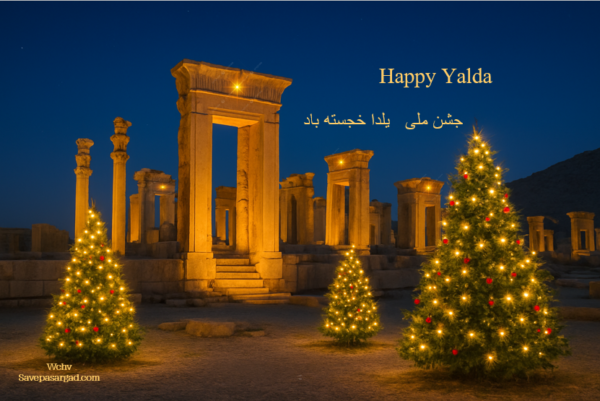
– Decoration of Evergreen Trees: The custom of decorating cypress and pine trees—which our ancestors viewed as symbols of resistance (to darkness and cold) and hope for light—was abolished.
Fortunately, the tradition of decorating the evergreen Yalda tree was carried to European countries (from Iran) by Roman soldiers and survives globally today, similar to the modern Christmas tree. We also experienced a revival of national celebrations during the Pahlavi era, where they were successfully expanded into public spaces, leaving a lasting impact.
Despite the current prohibitions by the Islamic Republic against celebrating national holidays widely and publicly, our affection for our heritage and traditions have intensified. To the extent that, despite the reoccupation of our territory by the Islamic Republic and the unsheathing of the sword of prohibition and the destruction of our national heritage, (both tangible and intangible) our love for this heritage has intensified.
At the same time, for years, we have observed religious holidays and mourning ceremonies held with large budgets and great pomp in public places. Meanwhile, the current Islamic revolutionary council actively encourages people to limit national holidays to private “family gatherings.”
We must advocate for the glorious return of our national celebrations to public spaces once again.
Extracts from the statement of the Pasargad Heritage Foundation