We believe that all cultural, historical and natural heritage, wherever they are should be preserved. LEARN MORE
News

Default Category

International Youth Day 12 August

The United Nations’ (UN) International Youth Day is celebrated on August 12 each year to recognize efforts of the world’s youth in enhancing global society. It also aims to promote ways to engage them in becoming more actively involved in making positive contributions to their communities.

International Youth Day focuses on young people all over the world.©iStockphoto.com/Jacob Wackerhausen

What Do People Do?

Many activities and events that take place around the world on International Youth Day promote the benefits that young people bring into the world. Many countries participate in this global event, which may include youth conferences on issues such as education and employment. Other activities include concerts promoting the world’s youth, as well as various sporting events, parades and mobile exhibitions that showcase young people’s achievements.

Background

The UN defines the worlds’ youth as the age group between 15 and 24 years old, making up one-sixth of the human population. Many of these young men and women live in developing countries and their numbers are expected to rise steeply. The idea for International Youth Day was proposed in 1991 by young people who were gathered in Vienna, Austria, for the first session of the UN’s World Youth Forum. The forum recommended that an International Youth Day be declared, especially for fundraising and promotional purposes, to support the United Nations Youth Fund in partnership with youth organizations.

In 1998 a resolution proclaiming August 12 as International Youth Day was adopted during the World Conference of Ministers Responsible for Youth. That recommendation was later endorsed by the UN General Assembly in 1999. International Youth Day was first observed in 2000. One of the year’s highlights was when eight Latin American and Caribbean youth and youth-related organizations received United Nations World Youth Awards in Panama City, Panama.

Historic Windsor mill destroyed by fire

WINDSOR — Federal and state officials are investigating what caused a fire that destroyed a historic mill in Windsor. The  the blaze early Sunday destroyed the Windsor Mill. No injuries are reported. Smoke permeated Windsor’s streets, and foam insulation debris littered surrounding streets.

The federal Bureau of Alcohol, Tobacco, Firearms and Explosives and the Colorado Bureau of Investigation are investigating.

Mayor Kristie Melendez said everyone in town had been excited that the 1899 flour mill, listed on the National Register of Historic Places, was being transformed. Fort Collins-based developer Blue Ocean was working toward a fall opening of a brewery, restaurant and office space in the building.

The town supported a $3.7 million economic incentive package for the building’s renovation.

“We had so many folks excited about the direction we had taken for that,” Melendez said.

This isn’t the first time the mill has faced a setback: It was hit by a tornado in 2008.

Melendez said she hopes Blue Ocean will work to rebuild after the fire.

“They hope that enough remains there that they can come back in and rebuild,” she said.

Steve Schroyer, director of real estate for Blue Ocean said, “We’re just in assessment mode right now. All we know is it’s burned pretty much to the ground.” Schroyer said the company does have insurance on the building.
An area brewery owner, who did not give his name, said an announcement of the businesses slated to fill the historic building had been coming soon.

“We were pretty excited,” he said.

But now developers and the town will just have to wait and hope, Melendez said.

On Sunday morning, many Windsor residents held each other close as they turned out to see the damage. “What horrible news we all woke up to this morning,” Melendez said. The mill, built in 1899, reminded residents of their agricultural history, Melendez said.

“I think the mill testified to all of us where our history and where our roots come from,” she said. Although the news had many residents in tears, Melendez said she is grateful no one was hurt. Crews worked to cut the gas line to the building Sunday morning. Rick Klimek, Windsor police chief, said Main Street was  closed until at late afternoon.

In addition to Windsor Severance Fire Rescue personnel, workers from the following organizations assisted: Front Range Fire Rescue, Loveland Fire Rescue, Poudre Fire Authority, Eaton Fire Rescue, Berthoud Fire, UC Health EMS, Weld County Sheriff, Weld County Communications, Windsor Police Department, Windsor Public Works, and Xcel Energy.

Debris was visible on roads several blocks away from the mill.

Windsor-Severance Fire Chief Herb Brady described the fire as probably the largest in the town’s history in terms of damage and destruction.

The fire was reported at 1:49 a.m., and Brady said there were reports of an explosion or multiple explosions during the fire. He said that’s not unusual for a building that is under construction. He said it could take a week to determine the cause of the fire.

Read the full article at GreeleyTribune.com

80 medieval tombs found at Bulgaria’s Perperikon

Professor Nikolai Ovcharov’s archaeological team working at the ancient sacred site of Perperikon in Bulgaria has discovered more than 80 tombs in a necropolis estimated to date from the 12th to the 14th centuries CE.

The number of tombs found, in the southern section of Perperikon, is expected to increase to more than 100, an announcement about the July 2017 find said.

Ovcharov said that in 2016, his archaeological dig team had uncovered 37 tombs, containing what he described as some very interesting finds, including earrings, other jewellery and beautiful ornaments.

1,800 year old mosaic found in ancient Perge

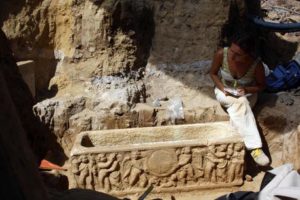
A 1,800-year-old mosaic, which showed the sacrifice of Iphigenia, the daughter of Agamemnon and Clytemnestra during the Trojan War in Greek mythology, was found at excavation works in the ancient city of Perge in Turkey’s Mediterranean region.

Perge excavations head and Antalya Museum Director Mustafa Demirel said a new mosaic was unearthed when the archaeological team was working to open a shop in the west wing of the site.

“We have found a 1,800-year-old mosaic that depicts the sacrifice of İphigenia during the Trojan War in the city of ancient Perge. This finding, which makes us quite excited, was unearthed when we were working to open a shop in the west wing. We have found out that this was a sacred cult area,” he said.

Iphigenia was the daughter of Agamemnon and Clytemnestra in Greek mythology.

While the Greek army was preparing to set sail for Troy during the Trojan War, Agamemnon caused the anger of the goddess Artemis, because he killed a sacred deer. So, she decided to stop all winds, so the ships would not be able to sail. The seer Calchas realized what the problem was and informed Agamemnon that to appease the goddess, Agamemnon had to sacrifice Iphigenia to her. Reluctant at first, Agamemnon was forced to agree in the end. He lied to his daughter and his wife by saying that Iphigenia was to marry Achilles before they left.

The mother and daughter happily went to the port of Aulis, only to find out the horrible truth. Achilles, unaware that his name was used in a lie, tried to prevent the sacrifice, but Iphigenia ultimately decided to sacrifice herself in honor and of her own volition. The most popular version of what happened afterwards is that in the moment of the sacrifice, the goddess Artemis substituted Iphigenia for a deer, but Calchas who was the only witness remained silent. Iphigenia was then brought by Artemis to the city of Tauris where she became the goddess’ priestess.

The ancient city of Perge has been dubbed as “Turkey’s second Zeugma” for the alluring appearance of the mosaics that have been unearthed so far.

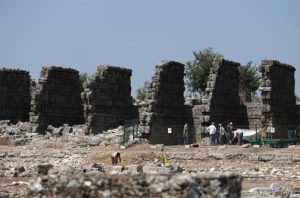
The city of Perge is situated 17 kilometers east of Antalya, within the borders of Aksu. The important monumental structures of the city have been excavated since 1946 and due to the excavated sculptures, the Antalya Museum has one of the richest collections of Roman sculptures.

Source: Anadolu Agency

Ancient Royal Limousine

Archaeologists have found an ancient royal “limousine” in central China once owned by the Lord of Zheng State dating back to 2,400 years, after five months of excavation. The giant, extravagant chariot, which is 2.56 metres long and 1.66 metres wide, was equipped with rain and sun protection on the top and decorated with bronze and bone ornaments. It has more than 26 spokes in each wheel, which indicated the owner’s noble status.

The “limousine” was excavated in a funerary pit in tomb of Lords of Zheng State, in Xinzheng City, a vassal state during the Spring and Autumn Period (770-476 B.C) and the Warring States Period (475-221 B.C), state-run Xinhua news agency reported. “The chariot is the largest and most extravagant one so far in the excavation site,” said Ma Juncai, leader of an archaeological team with Henan Provincial Institute of Cultural Heritage and Archaeology.

International Day of Friendship

The International Day of Friendship is a United Nations (UN) day that promotes the role that friendship plays in promoting peace in many cultures. It is observed on July 30 each year.


What Do People Do?

To mark the International Day of Friendship, the UN encourages governments, organizations, and community groups to hold events, activities and initiatives that promote solidarity, mutual understanding and reconciliation.

Background

In 2011, the UN proclaimed the International Day of Friendship with the idea that friendship between peoples, countries, and cultures can inspire peace efforts and build bridges between communities. The UN wanted for the day to involve young people, as future leaders, in community activities that include different cultures and promote international understanding and respect for diversity.

‘Striking’ Face of 4,500-Year-Old English Man Revealed

excerpt from –  Live Science………

The face of a man who died in England around 4,500 years ago has been reconstructed, revealing a “striking” image that should help humans alive today feel a personal connection, researchers said.

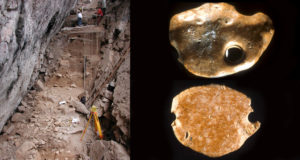
The man’s remains were excavated in the 1930s and 1980s at Liff’s Low bowl barrow, a burial mound located in Derbyshire, England. He was found buried with a type of pot called a beaker and a stone pendant that was likely worn on a necklace, the researchers said.

Anthropological analysis done in the 1980s found that the man was about 5 feet, 7 inches (1.7 meters) tall and was between the ages of 25 and 30 when he died, said Claire Miles, a collections assistant at the Buxton Museum. The anthropologists at the time found that the man had a fracture in his left elbow that had “healed poorly,” Miles said, noting that the cause of the man’s death is unknown.

The museum commissioned Face Lab, a team of forensic specialists at Liverpool John Moores University, to reconstruct the man’s face ahead of an exhibit featuring his remains scheduled to open in September. 


Maryam Mirzakhani, Stanford mathematician and Fields Medal winner, dies

Stanford mathematics Professor Maryam Mirzakhani, the first and to-date only female winner of the Fields Medal since its inception in 1936, died Friday, July 14, after a long battle with cancer. Mirzakhani was 40 years old.

By Andrew Myers and Bjorn Carey

Stanford mathematics Professor Maryam Mirzakhani, the first and to-date only female winner of the Fields Medal since its inception in 1936, died Friday, July 14. She had been battling breast cancer since 2013; the disease spread to her liver and bones in 2016. Mirzakhani was 40 years old.

Professor Maryam Mirzakhani was the recipient of the 2014 Fields Medal, the top honor in mathematics. (Image credit: Courtesy Stanford News Service)

The quadrennial Fields Medal, which Mirzakhani won in 2014, is the most prestigious award in mathematics, often equated in stature with the Nobel Prize. Mirzakhani specialized in theoretical mathematics that read like a foreign language by those outside of mathematics: moduli spaces, Teichmüller theory, hyperbolic geometry, Ergodic theory and symplectic geometry.

Mastering these approaches allowed Mirzakhani to pursue her fascination for describing the geometric and dynamic complexities of curved surfaces – spheres, doughnut shapes and even amoebas – in as great detail as possible. Her work was highly theoretical in nature, but it could have impacts concerning the theoretical physics of how the universe came to exist and, because it could inform quantum field theory, secondary applications to engineering and material science. Within mathematics, it has implications for the study of prime numbers and cryptography.

Mirzakhani joined the faculty of Stanford University in 2008, where she served as a professor of mathematics until her death.

“Maryam is gone far too soon, but her impact will live on for the thousands of women she inspired to pursue math and science,” said Stanford President Marc Tessier-Lavigne. “Maryam was a brilliant mathematical theorist, and also a humble person who accepted honors only with the hope that it might encourage others to follow her path. Her contributions as both a scholar and a role model are significant and enduring, and she will be dearly missed here at Stanford and around the world.”

Despite the breadth of applications of her work, Mirzakhani said she enjoyed pure mathematics because of the elegance and longevity of the questions she studied.

A self-professed “slow” mathematician, Mirzakhani’s colleagues describe her as ambitious, resolute and fearless in the face of problems others would not, or could not, tackle. She denied herself the easy path, choosing instead to tackle thornier issues. Her preferred method of working on a problem was to doodle on large sheets of white paper, scribbling formulas on the periphery of her drawings. Her young daughter described her mother at work as “painting.”

“You have to spend some energy and effort to see the beauty of math,” she told one reporter.

In another interview, she said of her process: “I don’t have any particular recipe [for developing new proofs]. … It is like being lost in a jungle and trying to use all the knowledge that you can gather to come up with some new tricks, and with some luck you might find a way out.

Mirzakhani was born in Tehran, Iran, and – by her own estimation – was fortunate to come of age after the Iran-Iraq war when the political, social and economic environment had stabilized enough that she could focus on her studies. She dreamed of becoming a writer, but mathematics eventually swept her away.

She attended an all-girls high school in Tehran, led by a principal unbowed by the fact that no girl had ever competed for Iran’s International Mathematical Olympiad team. Mirzakhani first gained international recognition during the 1994 and 1995 competitions. In 1994, she earned a gold medal. In 1995, she notched a perfect score and another gold medal.

After graduating college at Sharif University in Tehran, she headed to graduate school at Harvard University, where she was guided by Curtis McMullen, a fellow Fields Medal winner. At Harvard, Mirzakhani was distinguished by her determination and relentless questioning, despite the language barrier. She peppered her professors with questions in English. She jotted her notes in Farsi.

McMullen described Mirzakhani as filled with “fearless ambition.” Her 2004 dissertation was a masterpiece. In it, she solved two longstanding problems. Either solution would have been newsworthy in its own right, according to Benson Farb, a mathematician at the University of Chicago, but then Mirzakhani connected the two into a thesis described as “truly spectacular.” It yielded papers in each of the top three mathematics journals.

“The majority of mathematicians will never produce something as good,” Farb said at the time. “And that’s what she did in her thesis.”

Iranian President Hassan Rouhani said the “unprecedented brilliance of this creative scientist and modest human being, who made Iran’s name resonate in the world’s scientific forums, was a turning point in showing the great will of Iranian women and young people on the path towards reaching the peaks of glory … in various international arenas,” according to Iranian state media.

“What’s so special about Maryam, the thing that really separates her, is the originality in how she puts together these disparate pieces,” said Steven Kerckhoff, at the time of her Fields Medal award. Kerckhoff is a professor at Stanford who works in the same area of mathematics. “That was the case starting with her thesis work, which generated several papers in all the top journals. The novelty of her approach made it a real tour de force.”

After her doctorate at Harvard, Mirzakhani accepted a position as assistant professor at Princeton University and as a research fellow at the Clay Mathematics Institute before joining the Stanford faculty.

“Maryam was a wonderful colleague,” said Ralph L. Cohen, the Barbara Kimball Browning Professor of Mathematics at Stanford. “She  not only was a brilliant and fearless researcher, but she was also a great teacher and terrific PhD adviser.  Maryam embodied what being a mathematician or scientist is all about:  the attempt to solve a problem that hadn’t been solved before, or to understand something that hadn’t been understood before.  This is driven by a deep intellectual curiosity, and there is great joy and satisfaction with every bit of success. Maryam had one of the great intellects of our time, and she was a wonderful person.  She will be tremendously missed.”

In recent years, she collaborated with Alex Eskin at the University of Chicago to answer a mathematical challenge that physicists have struggled with for a century: the trajectory of a billiard ball around a polygonal table. That investigation into this seemingly simple action led to a 200-page paper which, when it was published in 2013, was hailed as “the beginning of a new era” in mathematics and “a titanic work.”

“You’re torturing yourself along the way,” she would offer, “but life isn’t supposed to be easy.”

Mirzakhani is survived by her husband, Jan Vondrák, and a daughter, Anahita.

The university will organize a memorial service and an academic symposium in her honor in the fall, when students and faculty have returned to campus.

Editor’s note: An earlier version of this story said she died on July 15.  Mirzakhani died on Friday, July 14.

Yazd city inscribed on UNESCO World Heritage

UNESCO, the United Nations Educational, Scientific and Cultural Organization ― designated eleven new sites on Sunday and may continue to do so throughout next week until the annual World Heritage Committee meeting ends on July 12. 

The ancient city of Yazd in Iran is one of UNESCO’s new World Heritage Sites. The City of Yazd is located in the middle of the Iranian plateau, close to the Spice and Silk Roads. It bears living testimony to the use of limited resources for survival in the desert. Water is supplied to the city through a qanat system developed to draw underground water. The earthen architecture of Yazd has escaped the modernization that destroyed many traditional earthen towns, retaining its traditional districts, the qanat system, traditional houses, bazars, hammams, Zoroastrian temples and the historic garden of Dolat-abad.

Seljuk sultans bath discovered in Anatolia

Hurriyet Daily News (Turkey) reports that A bath used by the Seljuk sultans 1,000 years ago” has been found in Gevele Castle on Takkeli Mountain, located in central Anatolia. The bath water was heated with a furnace and circulated through gaps in the lower part of the bath. “We did not expect to find such a structure,” said Ahmet Çayci of Necmettin Erbakan University The team also found private rooms that may have been used for washing. Gevele Castle is known for its small mosque, cistern, tunnels, and dungeons. . “The castle should have a view terrace and the venues where the sultan was hosted,” Çayci added. “We are continuing to search for it.”