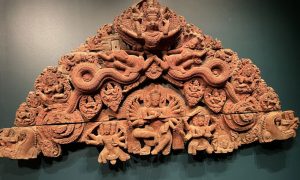
NEW YORK, NEW YORK—According to a New York Times report, the Rubin Museum of Art will repatriate to Nepal two wooden sculptures that were determined to have been smuggled from religious sites. The first is the upper section of a seventeenth-century wooden torana, or ornamental gateway, from the Yampi Mahavihara temple complex in Patan, which is located in the south-central Kathmandu Valley. The second, a fourteenth-century wooden carving of a female spirit, or apsara, bearing a garland, was part of an ornamental window at the Itum Bahal monastery in Kathmandu. Both objects had been purchased in private sales. “The proactive response and thoughtful collaboration from the Rubin have positively contributed to Nepal’s national efforts to recover the lost artifacts,” commented Bishnu Prasad Gautam, acting Consul General of Nepal
Saudi Arabia: 4,500 year-old ‘funerary avenues,’ burial monuments discovered in AlUla
Published: 12 January ,2022: 09:51 AM GSTUpdated: 17 January ,2022: 12:09 PM GST
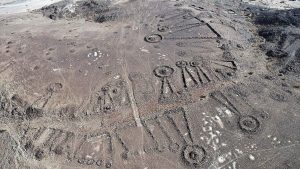
Archeologists have uncovered ancient 4,500 year-old highway-like roads in Saudi Arabia that date back to the 3rd millennium BCE where thousands of burial monuments surround the pathways, the official Saudi Press Agency (SPA) reported on Tuesday.
University of Western Australia (UWA) researchers determined that inhabitants of ancient north-west Arabia built long-distance ‘funerary avenues’ that linked oases and pastures, suggesting a high degree of social and economic inter-connectivity.
The findings were published in ‘The Holocene’ journal by the team working under the Royal Commission for AlUla (RCU).
The site was discovered and studied using satellite remote sensing, low altitude aerial photography, ground surveys, excavation and radiometric dating.
The task is being undertaken to “shed light on the lives of the ancient inhabitants of Arabia,” the SPA reported.
The study suggests that complex social horizons existed 4,500 years ago across a huge swathe of the Arabian Peninsula.
An important finding from the study confirms that the densest concentrations of funerary structures are located near permanent water sources.
The direction of the roads suggests that many of these pathways were used to travel between major oases, including those of Khaybar, AlUla and Tayma.
Archeologists discover 4,500 year-old ‘funerary avenues’ and burial monuments in AlUla. (SPA)
Other avenues fade into the landscapes surrounding the oases, possibly meaning that they were used to move herds of domestic animals into nearby pastures during periods of rain, according to SPA.
The UWA team’s work is part of a wider effort that includes 13 archaeological and conservation project teams from around the world collaborating with Saudi experts in AlUla and neighboring Khaybar regions within Saudi Arabia.
“The work done by our archaeological teams in 2021 demonstrates that Saudi Arabia is a home for top-flight science – and we look forward to hosting more research teams in 2022,” declared Amr al-Madani, CEO of RCU.
Projects similar to the UWA team’s work have been ongoing in AlUla for at least three years, according to Dr. Rebecca Foote, Director of Archaeology and Cultural Heritage Research for RCU.
“These articles are just the beginning of many publications that will advance our knowledge of prehistoric to modern times and have significant implications for the wider region,” added Foote.
The new article is the UWA team’s fourth publication in less than a year in a peer-reviewed scientific journal on research at AlUla and Khaybar.
Archeologists discover 4,500 year-old ‘funerary avenues’ and burial monuments in AlUla. (SPA)
In March of 2021, the team reported in the Journal of Field Archaeology that they had discovered the remains of the oldest known domesticated dog in Arabia.
A month later, in April, the team detailed in the journal Antiquity that the monumental structures known as mustatils are much older than previously believed, dating as far back as 5,200 BCE, and appear to have had a ritual function.
In August, in the journal ‘Arabian Archaeology and Epigraphy,’ the team dated the pendant-shaped tombs of Khaybar Oasis to the 3rd millennium BCE, marking the first article in a peer-reviewed journal regarding the Bronze Age in Khaybar.
The RCU has embarked on a 15-year working plan to “regenerate AlUla and parts of Khaybar as a leading global destination for cultural and natural heritage,” according to the SPA report.
Major destruction of historical monuments in flooded provinces
According to reports from Iran, floods in fourteen provinces of Iran have caused significant destruction to almost 50% of historical monuments. The flooding has also caused major human and financial losses.
The historical sites and great monuments include some which have been standing for hundreds of years. However, due to a lack of proper care and neglect for the past few decades since the Iranian revolution, they have been damaged and are now further damaged by the effects of floods, earthquakes, and other natural disasters.
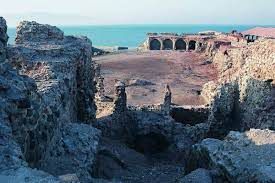
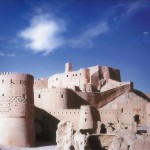
Hormozgan Province is one of the provinces affected by the floods. It is said that eight historical monuments have been severely damaged in this province so far. Some of the damaged historical sites include: Hazareh castle, Gorband castle, Kordar castle, Moghayeh castle, the city of Bandar Lengeh, and the Khan castle and bath, which was badly damaged in Bastak city. The Portuguese forts on the island of Hormuz and the Kamiz castle in Rudan have also been damaged by recent rains.
Neolithic Figurine Unearthed in Central Turkey
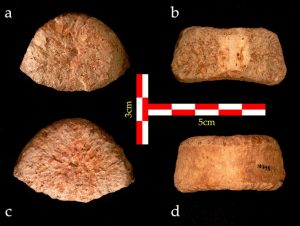
The Anadolu Agency reports that a two-inch marble statuette has been unearthed at central Turkey’s Neolithic site of Çatalhöyük by a team of researchers led by Ali Umut Türkcan of Anadolu University. As many as 8,000 people are thought to have lived at Çatalhöyük, which dates back about 9,000 years. The 8,500-year-old carving looks like a reclining human figure, and similar to artifacts uncovered in previous excavations and identified as depicting a man leaning back on the back of an animal, Türkcan explained. Most of the figurines recovered in this area of the site have depicted women, he added
Medieval Runes Discovered in Norway
OSLO, NORWAY—Science Norway reports that a stick and a bone inscribed with runes have been unearthed in Oslo’s Medieval Park, where a carving depicting a king with a falcon on his arm was found last month. The bone, thought to be a piece of a rib from a horse or a cow, bears Norse inscriptions on both sides, according to archaeologist Solveig Thorkildsen of the Norwegian Institute for Cultural Heritage Research. The inscription includes a person’s name or nickname, and runes for the word bone, referring to the object itself. Thorkildsen’s colleague, Ingeborg Hornkjøl, was working in wet soil at the site when she discovered the rune stick, which is inscribed on three sides in Latin and in Norse. Runologist Kristel Zilmer of the University of Oslo said that the Latin inscription includes the words manus, or hand, and Domine or Domini, for lord or God, in addition to Bryngjerd, a woman’s name. This inscription may record Bryngjerd’s dedication of her life to the service of God, Zilmer explained. Examination of the artifacts under a microscope should reveal more information, she added.
Lidar Survey at Machu Picchu Reveals Ceremonial Structures
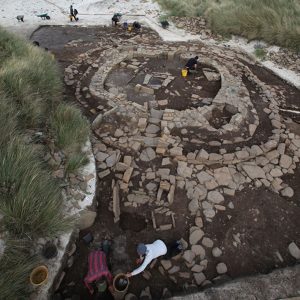
WROCŁAW, POLAND reports that a team of Polish researchers and specialists from Peru’s National Archaeological Park of Machu Picchu led by Bartłomiej Ćmielewski of Wrocław University of Science and Technology has conducted a lidar survey of the Chachabamba ceremonial complex within Machu Picchu. Several buildings set on a small square, small ritual baths, and a large stone with carved altars, stairs, and a channel for sacrificial liquids are situated in the center of the ceremonial complex. Obtained with a lidar scanning device attached to a drone, the new images of the land surface beneath the cover of tropical forest show several previously unknown structures, according to team member Dominika Sieczkowska of the University of Warsaw. These structures include channels that carried water into the complex from a nearby river and several buildings on the outskirts of the ceremonial complex. “We have a dozen or so small structures erected on the plan of a rectangle and a circle,” Sieczkowska said. “We believe that they were staff residences.” The images suggest these structures had been built with less care than the structures in the center of the complex, she added. Projected water flow through a model of the channels indicates that the supply of water was small and therefore probably for ritual use, Sieczkowska explained.
https://www.archaeology.org/news/10267-220105-machu-picchu-lidar
Happy New Year 2022!
Dear Friends, and Supporters of World Cultural Heritage Voices.
On behalf of our colleagues and volunteers at WCHV, and on the occasion of the Global New Year of 2022, we would like to extend our regards and best wishes for a Happy New Year. Thank you for your support of WCHV, which has been so instrumental in achieving our goals and mission.
Three priests visit the birthplace of Christ
By Dr Amir Khalili , historian
Translation by WCHV
The story of the three astrologers (three magi) from the East quoted in Matthew’s Gospel is familiar to most readers, but here is a very brief account:
The Gospel of Matthew states that three astronomers (three magi) from the east met King Herod, who had been appointed king of Palestine by the Romans. These three magi inform Herod of the appearance of a star. This star, according to Zoroastrians, symbolized the birth of a king, Christ. After meeting Herod, the Zoroastrians go to the birthplace of Christ with the guidance of the star. After hearing about the birth of a baby who could become the future king, Herod orders the killing of all babies up to the age of two.
This story of the Zoroastrian priests in the Gospel of Matthew, like most religious stories, is not completely based on historical facts, but nevertheless there is a historical truth in the Gospel story of the three priests visiting the birthplace of Christ. The fictional story in the Gospel of Matthew of the Three Magi, written between 80 and 100 AD, may be related to the actual journey of Tiridates I, king of Armenia (Tiridates I, son of the Parthian king Blash I, ruler of Armenia) to Rome. Historians have reported that Tiridates I left for Rome with an army of 3,000 men in 66 AD to swear allegiance to Nero, the Roman emperor. In Rome, Tiridates I swears allegiance to Nero: “My God, I came to you to worship you like Mitra.” After hearing this admirable speech, Nero ties a royal ribbon adorned with many jewels to the forehead of the King of Armenia. It is also said that Tiridates I introduced the Roman emperor to Mithraism. After meeting with the Roman emperor Tiridates I, he returns to Armenia not from the route he had already chosen, but from Asia Minor.
The Gospel of Matthew mentions the return of the three Magi. Tiridates I was known as a magician, and Pliny, a Roman writer of the first century AD, also gave the title of magician to this Parthian king. One may deduce from reading the Gospel of Matthew, that the intention of the three Magi to visit Christ, could have also been to show that Mithraism was a serious rival to the new religion of Christianity, and to understand the great influence of Mithraism on the development and shaping Christianity.
This picture depicts three astronomers or priests visiting the birthplace of Christ
A message from Pasargad Heritage Foundation on the occasion of the annual celebration of Yalda
The absence of the national celebration of Yalda on the World Heritage List
Once again we are on the eve of beautiful Yalda, another Iranian national holiday celebration. Thousands of years ago on such a night, the longest night of the year, the people of Persia celebrated and gathered around a cedar tree, which was adorned with colorful fabrics and shiny stones.
In those days, the values and secrets of nature were not yet known, and Persians like other peoples of the world saw nature as powerful elements or gods with a tremendous impact on their lives and existence. Some people in the world were terrified of these natural powers, however Persians loved all the elements of nature and worshiped the sun as the greatest and most “loving” God, because light and heat energy were considered to be the savior of their lives.
Our ancestors thought that the sun was born at the end of the longest night of the year, to announce the victory of light and heat over darkness and cold. With discovering the secrets of nature, the status of a god was taken from the elements of nature. But the Persians kept their celebrations as an earthly gift—a real, tangible, happy and universal gift. And so it is that most Iranian celebrations have remained thriving, happy and modern to this day.
For the past few decades, while the Islamic government has prevented national celebrations from being held in public places, it has tried its best to replace them with religious events. However, the people of Iran, all over the world and within Iran, despite all the challenges they are facing, celebrate these beloved Persian festivities to an even great extent.
At the Pasargad Heritage Foundation, we believe that even though it is still not recognized on the list of intangible world heritage, Yalda, as one of the most beautiful world celebrations, should be celebrated greatly and fully. That is why we in 2007 submitted a petition to UNESCO for its consideration.
Unfortunately, based on UNESCO’s rules, governments are legally responsible for submitting national celebrations for UNESCO’s consideration, and due to the religious bigotry of the Islamic government and its opposition to our Iranian culture, it has only submitted other religious events and concepts. These have included “Ta’zieh,” “Ashura,” “carpet weavers,””Arba’een” and “aqeeqah,” which the Iranian government has considered as ceremonies worthy of globalization. The Islamic government not only refuses to send Yalda, Mehregan, Sadeh and other Iranian humanistic celebrations and rituals for UNESCO’s consideration, but also suppresses them under various titles and measures.
We believe that the victory of the armies of love and enlightenment over armies of sorrow and cruelty is still unquestionable, as we know that Yalda and our other Iranian celebrations will be victorious through efforts of people who love our culture and the symbol of humanity and love they represent.
Let us celebrate the birth of the beautiful sun of our land next to the evergreen Yalda tree this year as well, while the sun that rises every day in our world exemplifies its victory over eternal darkness.
May your life be bright and your Yalda a happy one.
Shokooh Mirzadegi
Pasargad Heritage Foundation
Yalda 2021
Happy Human Rights Day
Human Rights Day is observed every year on 10 December — the day the United Nations General Assembly adopted, in 1948, the Universal Declaration of Human Rights (UDHR). The UDHR is a milestone document, which proclaims the inalienable rights that everyone is entitled to as a human being – regardless of race, colour, religion, sex, language, political or other opinion, national or social origin, property, birth or other status. Available in more than 500 languages, it is the most translated document in the world.