Press release issued on behalf of the UK COP26 Presidency and the COP25 and COP26 High-Level Climate Champions
-
- Commitments at COP today focus on real action to limit rising temperatures
-
- Collaboration on green innovation, landmark deforestation commitments, historic methane pledge on the agenda
-
- Day three of COP26 answers yesterday’s calls for urgency with tangible action
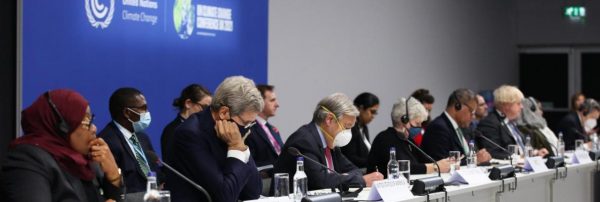 World leaders are in the UK for day three of COP26 where a wide range of announcements focused on signalling a clear shift from ambition to immediate action. Countries have made unprecedented commitments to protect forests, reduce methane emissions and accelerate green technology.
Amid powerful pleas heard in Glasgow yesterday, world leaders, young people and campaigners all stressed the urgency of taking tangible action to keep the prospect of holding back global temperature rises to 1.5C and building resilience to climate impacts.
114 leaders took a landmark step forward at a convening of world leaders on forests by committing to halt and reverse forest loss and land degradation by 2030. The pledge is backed by $12bn in public and $7.2bn in private funding.
Countries from Canada to Russia to Brazil – which also increased its NDC yesterday – China, Colombia, Indonesia and the Democratic Republic of the Congo all endorsed the Glasgow Leaders’ Declaration on Forest and Land Use.
Together, they support 85% of the world’s forests, an area of over 13 million square miles which absorbs around one third of global CO2 released from burning fossil fuels each year.
This announcement was bolstered with a commitment by CEOs from more than 30 financial institutions with over $8.7 trillion of global assets – including Aviva, Schroders and Axa – committing to eliminate investment in activities linked to deforestation.
Today is also the first time a COP in recent history has hosted a major event on methane, with 103 countries, including 15 major emitters including Brazil, Nigeria and Canada, signing up to the Global Methane Pledge. This historic commitment, led by the US and EU alongside the UK COP26 presidency, equates to up to 40% of global methane emissions and 60% of global GDP.
More than 35 world leaders have also backed and signed up to the new Glasgow Breakthrough Agenda that will see countries and businesses work together to dramatically scale and speed up the development and deployment of clean technologies and drive down costs this decade. Signatories include the US, India, EU, developing economies and some of those most vulnerable to climate change – collectively representing more than 50% of the world’s economy and every region.
The aim is to make clean technologies the most affordable, accessible and attractive choice for all globally in the most polluting sectors by 2030, particularly supporting the developing world to access the innovation and tools needed for a just transition to net zero.
Work will focus on five key sectors – power, road transport, hydrogen, steel and agriculture – which together represent more than half of total global emissions and further demonstrates how countries are moving from commitments to tangible action.
Leaders signed up to the Glasgow Breakthroughs also committed to discussing global progress every year in each sector starting in 2022 – supported by annual reports led by the International Energy Agency in collaboration with International Renewable Energy Agency and UN High Level Champions – and annual discussions of Ministers across government convened around the Mission Innovation and Clean Energy Ministerials. This ‘Global Checkpoint Process’ will seek to sustain and continually strengthen international cooperation across the agenda throughout this decade.
Leaders from South Africa, the United Kingdom, the United States, France, Germany and the European Union have announced a ground-breaking partnership to support South Africa with an Accelerated Just Energy Transition.
As a first step, the international partnership has announced that $8.5billion can be made available over the next 3-5 years to support South Africa – the world’s most carbon-intensive electricity producer – to achieve the most ambitious target within South Africa’s upgraded and ambitious Nationally Determined Contribution.
Alongside these strong signals from leaders, negotiators continued their crucial work on the systems and rules that underpin delivery. Early drafts of negotiating texts have been tabled on many issues and experts are working to find common ground, energised by the clear political direction from leaders.
COP26 President, Alok Sharma said:
“Forests are one of our best defences against catastrophic climate change, and essential to keeping 1.5C alive. This historic commitment will help end the devastating effects of deforestation and support the developing countries and indigenous communities who are the guardians of so much of the world’s forests.
“The Glasgow Breakthroughs will help move us towards a global tipping point, where the clean, green technologies we need to reach net zero and keep 1.5C alive are more affordable, accessible and attractive for all than the polluting practices we are leaving behind.
“Today’s launch of the Global Methane Pledge is also critical to keeping 1.5C alive. I am proud that COP has played host to a historic pledge which will play a vital role in limiting up to 0.2 degrees of warming across the next decade.”
High-Level Climate Champions for COP25 and COP26, Gonzalo Munoz and Nigel Topping, said:
than 18 sectors of the global economy have already achieved critical momentum, with key private sector actors mobilizing behind the breakthroughs necessary to achieve a net-zero world in time. Now, with more than 35 world leaders signing up to the Breakthrough Agenda, governments across the world will help dramatically scale and speed up the race to zero emissions and deliver the promise of the Paris Agreement. This is what the future of COP is all about – catalysing an innovative ambition loop between political leadership and the dynamism of the private sector to drive towards a resilient, prosperous zero carbon future.”
Also at COP today, world leaders, CEOs and philanthropists are expected to launch a series of new initiatives in support of the Glasgow Breakthroughs, including:
-
- The launch of the UK-India led Green Grids Initiative – One Sun One World One Grid, endorsed by over 80 countries, to mobilise political will, finance and technical assistance needed to interconnect continents, countries and communities to the very best renewable sources of power globally to ensure no one is left without access to clean energy.
-
- The Rockefeller Foundation, alongside IKEA Foundation and Bezos Earth Fund, launched the Global Energy Alliance for People & Planet with an initial $10 billion of funding from philanthropies and development banks to support energy access and the clean energy transition in the Global South, in strategic partnership with the UK-led Energy Transition Council.
-
- AIM4C, a new initiative led by the US and UAE, with over 30 supporting countries, committed to accelerating innovation in sustainable agriculture, having already garnered $4 billion in increased investment in climate-smart agriculture and food systems innovation, including $1bn from the US.
-
- The Breakthrough Energy Catalyst, headed by Bill Gates, programme aiming to raise $3bn in concessional capital to catalyse up to $30bn of investments in bring down clean technology costs and create markets for green products for green hydrogen, Direct Air Capture, long-duration energy storage and sustainable aviation fuel including £200m of UK support.
-
- The First Movers Coalition, a US-led buyers club of 25 major global companies making purchasing commitments to help commercialise key emerging clean technologies across hard-to-decabonise sectors like steel, trucking, shipping, aviation, aluminium, concrete, chemicals, and direct air capture
Two days into COP26, progress is already being made. Yesterday saw India, Thailand, Nepal, Nigeria and Vietnam make new net zero pledges which now means that 90% of the global economy is covered by net zero commitments. India’s announcement also included a suite of ambitious 2030 commitments, including 500GW non fossil fuel power capacity, 50% energy requirements from renewable sources and 45% reduction of the carbon intensity of the economy. We’ve heard new NDC announcements from: Argentina, Brazil, Guyana, India, Mauritania, Morocco, Mozambique and Thailand and new Long-Term Strategies announced or submitted by Jamaica, Kazakhstan and the USA. On climate finance, we’ve seen new commitments from: Italy, Spain, Australia and Luxembourg.
ENDS
Note to Editors
-
- On power, road transport, steel, and hydrogen, countries endorsed a Breakthrough goal, the metrics by which it could be measured, and leading initiatives for international collaboration through which it could be achieved. For Agriculture, the UK has committed to working with all interested parties over the course of its Presidency year (2022) to develop similar consensus around the Breakthrough goal, the underlying metrics and the priority initiatives to support the Breakthrough. We are encouraged that the following initiatives have already expressed their willingness to work with us on this: Bill and Melinda Gates Foundation; Global Research Alliance for Agricultural GHGs (GRA); Adaptation Research Alliance (ARA); The global agriculture research organisation known as the CGIAR (formerly the Consultative Group for International Agriculture); 100 Million Farmers Initiative: Transitioning towards net-zero, nature positive food Systems; Ban-ki Moon Centre for Global Citizens.
-
- The Global Methane Pledge is a US-EU led initiative launched at leaders’ level on 2 Nov at COP26. Parties signing the Pledge agree to take national-level, voluntary actions to contribute to reducing global methane emissions by at least 30% by 2030, using a 2020 baseline. Scientists believe this could eliminate 0.2°C of warming by 2050.
-
- Also today, President Biden launched the First Movers Coalition, which brings together major companies from around the world to make purchasing commitments for innovative technologies in hard-to-abate sectors like heavy industry.
-
- Mission Innovation, launched in Paris in 2015, will play a key role in delivering the Breakthroughs. Four new Missions will be announced during the course of COP26, including ones which will support the achievement of the industry-focused Breakthroughs. Meanwhile, Missions announced in June and co-led by the UK will contribute to the Hydrogen and Power Breakthroughs, with Innovation Roadmaps to be released later in the fortnight.
-
- Leaders attended a number of other high-level events throughout the day, including:
1. The Climate Vulnerable Forum, chaired by Bangladesh, hosted an event to deliver a “Dhaka-Glasgow Declaration” of the CVF articulating the interests, efforts, and expectations of the CVF members for COP26 and beyond.
2. India hosted a launch, with PM Modi and PM Johnson present, of a technical assistance facility for climate-resilient
infrastructure aimed at Small Island Developing States.
3. The Accelerating Africa’s Adaptation Event, convened by the DRC, AU, Global Centre on Adaptation and Ban-Ki Moon saw a number of donors and African heads of state come together to demonstrate support for African Adaptation Initiatives.
4. Ocean Panel Members met, convened by Norway and Palau, to discuss interconnected ocean and climate issues releasing a call to ‘ocean based climate action.’
-
- The full list of signatories for the Glasgow Leaders Declaration on Forest and Land Use (as of 1030 GMT, 1 November 2021) is: Albania, Andorra, Angola, Armenia, Australia, Austria, Belgium, Belize, Bhutan, Bosnia and Herzegovina, Botswana, Brazil, Bulgaria, Cameroon, Canada, Chile, China, Colombia, Costa Rica, Cote D’Ivoire, Cyprus, Denmark, Dominican Republic, Democratic Republic of the Congo, European Union, Ecuador, Estonia, Fiji, Finland, France, Gabon, Germany, Ghana, Guatemala, Guinea Bissau, Guyana, Honduras, Iceland, Indonesia, Ireland, Israel, Italy, Japan, Kazakhstan, Kenya, Kyrgyzstan, Latvia, Liberia, Liechtenstein, Lithuania, Luxembourg, Madagascar, Malawi, Mali, Malta, Mauritius, Monaco, Mongolia, Montenegro, Morocco, Mozambique, Nepal, Netherlands, New Zealand, Niger, Nigeria, North Macedonia, Norway, Pakistan, Panama, Papua New Guinea, Peru, Poland, Portugal, Republic of Congo, Romania, Russia, Saint Lucia, Samoa, San Marino, Seychelles, Sierra Leone, Slovakia, Slovenia, South Korea, Spain, Sri Lanka, Suriname, Sweden, Tanzania, Togo, Turkey, United Arab Emirates, Ukraine, Uruguay, United Kingdom, United States of America, Vanuatu, Vietnam, Zambia, Zimbabwe

 According to a statement released by New York University, recently discovered vertebrae fossils from the lower back of a female Australopithecus sediba individual known as Issa indicate that the early hominins were able to walk upright on two legs. The delicate two-million-year-old fossils, found encased in a chunk of breccia at South Africa’s site of Malapa, were viewed through a micro-CT scanner at the University of the Witwatersrand. The bones were then virtually reunited with fossils recovered during earlier work at the site to reconstruct one of the most complete lower backs of an early hominin. Scott Williams of New York University and the University of the Witwatersrand explained that Issa is now one of only two early hominin individuals identified through dentition and a nearly complete lower spine. Both are key to identifying hominin species, he explained. The study also suggests that Issa had a powerful trunk that may have allowed her to climb trees like an ape, added Gabrielle Russo of Stony Brook University. Read the original scholarly article about this research in e-Life.