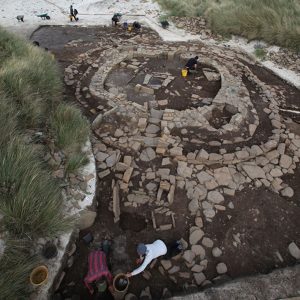
 According to a statement released by the University of Huddersfield, a DNA study of remains unearthed at the Links of Noltland site on the island of Westray indicates that immigrants to Scotland’s Northern Isles in the Early Bronze Age replaced much of the local population. It had been previously thought that the Neolithic cultural center on Orkney became more isolated as Europe entered the Bronze Age. The immigrants, who descended from pastoralists from the steppes north of the Black Sea, likely spoke Indo-European languages. DNA studies of remains in Europe suggest this wave of migration was led by men who mixed with local women. But in Orkney, Martin Richards of the University of Huddersfield and his colleagues found that the newcomers were mostly women who mixed with male lineages from the local Neolithic population. These male Neolithic lineages dwindled during the Iron Age, however, and are very rare today, Richards explained. Archaeologists Graeme Wilson and Hazel Moore suggest that Orkney’s self-sufficient farmsteads may have been stable enough to survive and negotiate with the new arrivals. “This shows that the third-millennium B.C. expansion across Europe was not a monolithic process but was more complex and varied from place to place,” concluded team member George Foody.
News
Archaeologists Uncover 18,000 Ancient Egyptian ‘Notepads’
By Jane Recker
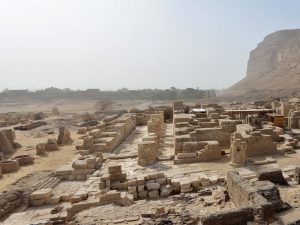 Researchers excavating the ancient Egyptian city of Athribis have discovered more than 18,000 ostraca—inscribed pottery shards that essentially served as “notepads,” writes Carly Cassella for Science Alert. Ranging from shopping lists to trade records to schoolwork, the fragments offer a sense of daily life in the city some 2,000 years ago. Per Newsweek’s Robert Lea, the trove is the second-largest collection of ostraca ever found in Egypt.
Ancient Egyptians viewed ostraca as a cheaper alternative to papyrus. To inscribe the shards, users dipped a reed or hollow stick in ink. Though most of the ostraca unearthed in Athribis contain writing,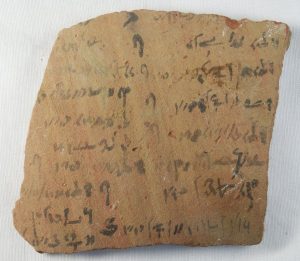 the team also found pictorial ostraca depicting animals like scorpions and swallows, humans, geometric figures, and deities, according to a statement from the University of Tübingen, which conducted the excavation in partnership with the Egyptian Ministry of Tourism and Antiquities.
A large number of the fragments appear to be linked to an ancient school. Over a hundred feature repetitive inscriptions on both the front and back, leading the team to speculate that students who misbehaved were forced to write out lines—a schoolroom punishment still used (and satirized in popular culture) today.
There are lists of months, numbers, arithmetic problems, grammar exercises and a ‘bird alphabet’—each letter was assigned a bird whose name began with that letter,” says Egyptologist Christian Leitz in the statement.
Around 80 percent of the ostraca are written in demotic, an administrative script used during the reign of Cleopatra’s father, Ptolemy XII (81 to 59 B.C.E. and 55 to 51 B.C.E.). Greek is the second-most represented script; hieratic, hieroglyphics, Greek, Arabic, and Coptic (an Egyptian dialect written in the Greek alphabet) also appear, testifying to Athribis’ multicultural history, per Science Alert.
“We will be able to make a case study of daily life in late Ptolemaic/early Roman time[s] once we have analyzed all the texts or at least a larger part of it, which will take years,” Leitz tells Newsweek.
Tübingen archaeologists began digging at Athribis—located about 120 miles north of Luxor—in 2003. Initially, excavations were focused on a large temple built by Ptolemy to honor the lion goddess Repit and her consort Min. The temple was transformed into a nunnery after pagan worship was banned in Egypt in 380 C.E. More recently, the team has shifted focus to a separate sanctuary west of the temple.
According to the statement, Leitz and his team found the ostraca near a series of “multi-story buildings with staircases and vaults” to the west of the main dig site. Prior to the excavation, reports Science Alert, the only comparable collection of ostraca discovered in Egypt was a cache of medical writings found in the workers’ settlement of Deir el-Medineh, near the Valley of the Kings, in the early 1900s.
“This is a very important discovery because it sheds light on the economy and trade in Atribis throughout history,” Mostafa Waziri, secretary-general of the Egyptian antiquities ministry’s Supreme Council of Antiquities, tells Nevine El-Aref of Ahram Online. “The text reveals the financial transactions of the area’s inhabitants, who bought and sold provisions such as wheat and bread.”
Professor Heid-Marie Koch, the great German Iranologist and author of the book “From the Language of Darius”, has died
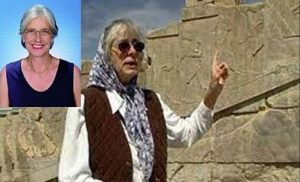 Heidemarie Koch studied mathematics as her major between 1963 and 1966. Subsequently, she worked was a teacher until 1972 in Hannover.
In 1972, she started Iranian Studies at the University of Gottingen and received her doctorate in 1976. The topic of her dissertation under Walther Hinz was Religious Conditions under Darius I with Reference to the Elamite Tablets of Persepolis. Koch took as her minor subjects Classical Archaeology, Byzantine Art History, and Christian Archaeology.
From 1977 to 1986 she was employed at the Department of Iranian Studies and Near Eastern Archaeology in University of Gottingen. In 1986, at the University of Marburg, she worked on the labor administration and the economy in the Persian heartland at the time of the Achaemenids. Then she taught as a lecturer. In 1990-91 Koch worked on research projects funded by German Research Foundation. Between 1993-94 she taught for two semesters as a substitute professor at the Goethe University in Frankfurt. Since 1995 she is a professor of Iranian Studies in the context of ancient history at the University of Marburg.
Her main subject areas are the Persian history and Persian languages of the pre-Islamic period. She puts special emphasis on the cultural and economic history, the management and the religion. She utilizes both written sources and the archaeological remains. A second research focus is the exploration of Elam and its neighboring regions, especially in terms of the influences that they exerted on the subseq
International Day of Commemoration in memory of the victims of the Holocaust
 United Nations General Assembly Resolution 60/7 that established the Holocaust and the United Nations Outreach Programme, also designated 27 January as an annual International Day of Commemoration in memory of the victims of the Holocaust – observed with ceremonies and activities at United Nations Headquarters in New York and at United Nations offices around the world.
International Day of Education

Changing Course, Transforming Education
As it was detailed in UNESCO’s global Futures of Education report, transforming the future requires an urgent rebalancing or our relationships with each other, with nature as well as with technology that permeates our lives, bearing breakthrough opportunities while raising serious concerns for equity, inclusion and democratic participation.
This year’s International Day of Education will be a platform to showcase the most important transformations that have to be nurtured to realize everyone’s fundamental right to education and build a more sustainable, inclusive and peaceful futures. It will generate debate around how to strengthen education as a public endeavour and common good, how to steer the digital transformation, support teachers, safeguard the planet and unlock the potential in every person to contribute to collective well-being and our shared home.
Education is a human right
The right to education is enshrined in article 26 of the Universal Declaration of Human Rights. The declaration calls for free and compulsory elementary education. The Convention on the Rights of the Child, adopted in 1989, goes further to stipulate that countries shall make higher education accessible to all.
Education is key to sustainable development
When it adopted the 2030 Agenda for Sustainable Development in September 2015, the international community recognized that education is essential for the success of all 17 of its goals. Sustainable Development Goal 4, in particular, aims to “ensure inclusive and equitable quality education and promote lifelong learning opportunities for all” by 2030.
Challenges to achieving universal education
Education offers children a ladder out of poverty and a path to a promising future. But about 258 million children and adolescents around the world do not have the opportunity to enter or complete school; 617 million children and adolescents cannot read and do basic math; less than 40% of girls in sub-Saharan Africa complete lower secondary school and some four million children and youth refugees are out of school. Their right to education is being violated and it is unacceptable.
Without inclusive and equitable quality education and lifelong opportunities for all, countries will not succeed in achieving gender equality and breaking the cycle of poverty that is leaving millions of children, youth and adults behind.
Museum Repatriates Smuggled Artifacts to Nepal
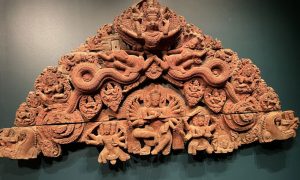 NEW YORK, NEW YORK—According to a New York Times report, the Rubin Museum of Art will repatriate to Nepal two wooden sculptures that were determined to have been smuggled from religious sites. The first is the upper section of a seventeenth-century wooden torana, or ornamental gateway, from the Yampi Mahavihara temple complex in Patan, which is located in the south-central Kathmandu Valley. The second, a fourteenth-century wooden carving of a female spirit, or apsara, bearing a garland, was part of an ornamental window at the Itum Bahal monastery in Kathmandu. Both objects had been purchased in private sales. “The proactive response and thoughtful collaboration from the Rubin have positively contributed to Nepal’s national efforts to recover the lost artifacts,” commented Bishnu Prasad Gautam, acting Consul General of Nepal
Saudi Arabia: 4,500 year-old ‘funerary avenues,’ burial monuments discovered in AlUla
 Published: 12 January ,2022: 09:51 AM GSTUpdated: 17 January ,2022: 12:09 PM GST
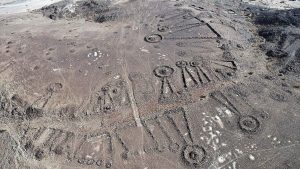
Archeologists have uncovered ancient 4,500 year-old highway-like roads in Saudi Arabia that date back to the 3rd millennium BCE where thousands of burial monuments surround the pathways, the official Saudi Press Agency (SPA) reported on Tuesday.
University of Western Australia (UWA) researchers determined that inhabitants of ancient north-west Arabia built long-distance ‘funerary avenues’ that linked oases and pastures, suggesting a high degree of social and economic inter-connectivity.
The findings were published in ‘The Holocene’ journal by the team working under the Royal Commission for AlUla (RCU).
The site was discovered and studied using satellite remote sensing, low altitude aerial photography, ground surveys, excavation and radiometric dating.
The task is being undertaken to “shed light on the lives of the ancient inhabitants of Arabia,” the SPA reported.
The study suggests that complex social horizons existed 4,500 years ago across a huge swathe of the Arabian Peninsula.
An important finding from the study confirms that the densest concentrations of funerary structures are located near permanent water sources.
The direction of the roads suggests that many of these pathways were used to travel between major oases, including those of Khaybar, AlUla and Tayma.
Archeologists discover 4,500 year-old ‘funerary avenues’ and burial monuments in AlUla. (SPA)
Other avenues fade into the landscapes surrounding the oases, possibly meaning that they were used to move herds of domestic animals into nearby pastures during periods of rain, according to SPA.
The UWA team’s work is part of a wider effort that includes 13 archaeological and conservation project teams from around the world collaborating with Saudi experts in AlUla and neighboring Khaybar regions within Saudi Arabia.
“The work done by our archaeological teams in 2021 demonstrates that Saudi Arabia is a home for top-flight science – and we look forward to hosting more research teams in 2022,” declared Amr al-Madani, CEO of RCU.
Projects similar to the UWA team’s work have been ongoing in AlUla for at least three years, according to Dr. Rebecca Foote, Director of Archaeology and Cultural Heritage Research for RCU.
“These articles are just the beginning of many publications that will advance our knowledge of prehistoric to modern times and have significant implications for the wider region,” added Foote.
The new article is the UWA team’s fourth publication in less than a year in a peer-reviewed scientific journal on research at AlUla and Khaybar.
Archeologists discover 4,500 year-old ‘funerary avenues’ and burial monuments in AlUla. (SPA)
In March of 2021, the team reported in the Journal of Field Archaeology that they had discovered the remains of the oldest known domesticated dog in Arabia.
A month later, in April, the team detailed in the journal Antiquity that the monumental structures known as mustatils are much older than previously believed, dating as far back as 5,200 BCE, and appear to have had a ritual function.
In August, in the journal ‘Arabian Archaeology and Epigraphy,’ the team dated the pendant-shaped tombs of Khaybar Oasis to the 3rd millennium BCE, marking the first article in a peer-reviewed journal regarding the Bronze Age in Khaybar.
The RCU has embarked on a 15-year working plan to “regenerate AlUla and parts of Khaybar as a leading global destination for cultural and natural heritage,” according to the SPA report.
Major destruction of historical monuments in flooded provinces
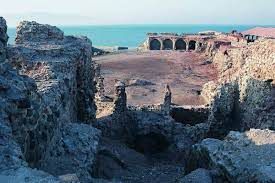 According to reports from Iran, floods in fourteen provinces of Iran have caused significant destruction to almost 50% of historical monuments. The flooding has also caused major human and financial losses.
The historical sites and great monuments include some which have been standing for hundreds of years. However, due to a lack of proper care and neglect for the past few decades since the Iranian revolution, they have been damaged and are now further damaged by the effects of floods, earthquakes, and other natural disasters.
Hormozgan Province is one of the provinces affected by the floods. It is said that eight historical monuments have been severely damaged in this province so far. Some of the damaged historical sites include: Hazareh castle, Gorband castle, Kordar castle, Moghayeh castle, the city of Bandar Lengeh, and the Khan castle and bath, which was badly damaged in Bastak city. The Portuguese forts on the island of Hormuz and the Kamiz castle in Rudan have also been damaged by recent rains.
Neolithic Figurine Unearthed in Central Turkey
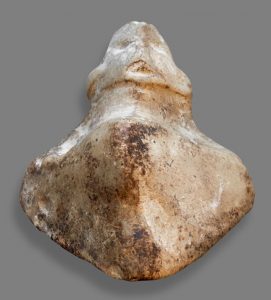 The Anadolu Agency reports that a two-inch marble statuette has been unearthed at central Turkey’s Neolithic site of Çatalhöyük by a team of researchers led by Ali Umut Türkcan of Anadolu University. As many as 8,000 people are thought to have lived at Çatalhöyük, which dates back about 9,000 years. The 8,500-year-old carving looks like a reclining human figure, and similar to artifacts uncovered in previous excavations and identified as depicting a man leaning back on the back of an animal, Türkcan explained. Most of the figurines recovered in this area of the site have depicted women, he added
Medieval Runes Discovered in Norway
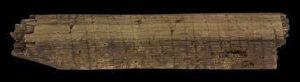 OSLO, NORWAY—Science Norway reports that a stick and a bone inscribed with runes have been unearthed in Oslo’s Medieval Park, where a carving depicting a king with a falcon on his arm was found last month. The bone, thought to be a piece of a rib from a horse or a cow, bears Norse inscriptions on both sides, according to archaeologist Solveig Thorkildsen of the Norwegian Institute for Cultural Heritage Research. The inscription includes a person’s name or nickname, and runes for the word bone, referring to the object itself. Thorkildsen’s colleague, Ingeborg Hornkjøl, was working in wet soil at the site when she discovered the rune stick, which is inscribed on three sides in Latin and in Norse. Runologist Kristel Zilmer of the University of Oslo said that the Latin inscription includes the words manus, or hand, and Domine or Domini, for lord or God, in addition to Bryngjerd, a woman’s name. This inscription may record Bryngjerd’s dedication of her life to the service of God, Zilmer explained. Examination of the artifacts under a microscope should reveal more information, she added.