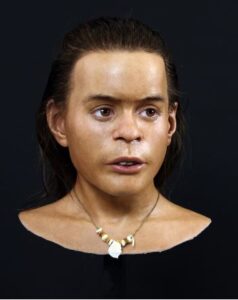
 RANDABERG, NORWAY—Live Science reports that the face of a boy who died some 8,300 years ago has been reconstructed with computed tomography scans of remains discovered near the southwestern coast of Norway in 1907. Analysis of the remains indicates that the well-fed, healthy boy was about 15 years old at the time of death, and stood a little over four feet tall. His skull bones had fused too early, forcing his head to grow into an unusual shape. Osteologist Sean Dexter Denham of the University of Stavanger’s Museum of Archaeology said that the condition of the boy’s skull, known as scaphocephaly, is not associated with any developmental problems or intellectual disabilities, however. DNA analysis of the remains suggests he had brown eyes, dark hair, and an intermediate skin tone, added forensic artist Oscar Nilsson. Decorated bone pendants; hooks, harpoons, and barbed stone tools for fishing; and animal remains were also uncovered in the cave where the remains were found
News
Global Tourism Resilience Day 17 Feb.
 Global Tourism Resilience Day (17 February), proclaimed by the General Assembly in resolution A/RES/77/269, aims to emphasize the need to foster resilient tourism development to deal with shocks, taking into account the vulnerability of the tourism sector to emergencies. It is also a call for action for Member States to develop national strategies for rehabilitation after disruptions, including through private-public cooperation and the diversification of activities and products.
For many developing countries, including the least developed countries, small island developing states, countries in Africa and middle-income countries, tourism is a major source of income, foreign currency earnings, tax revenue and employment. Because tourism connects people with nature, sustainable tourism has the unique ability to spur environmental responsibility and conservation.
Sustainable tourism, including ecotourism, is a cross-cutting activity that can contribute to the three dimensions of sustainable development and the achievement of the Sustainable Development Goals by fostering economic growth, alleviating poverty, creating full and productive employment and decent work for all.
It can also play a role in accelerating the change to more sustainable consumption and production patterns and promoting the sustainable use of oceans, seas and marine resources, promoting local culture, improving the quality of life and the economic empowerment of women and young people, indigenous peoples and local communities and promoting rural development and better living conditions for rural populations, including small-holder and family farmers.
The use of sustainable and resilient tourism as a tool to foster sustained and inclusive economic growth, social development and financial inclusion, enables the formalization of the informal sector, the promotion of domestic resource mobilization and environmental protection and the eradication of poverty and hunger, including the conservation and sustainable use of biodiversity and natural resources and the promotion of investment and entrepreneurship in sustainable tourism.
World’s oldest Hebrew Bible could fetch $50 million at auction
 A Hebrew Bible more than 1,000 years old and described as “one of the most important and singular texts in human history” will go on show later this month, before going under the hammer.
The Codex Sassoon, dating to the late 9th to early 10th, is believed to be the earliest and most complete Hebrew Bible.
It will be on show at Sotheby’s in London from February 22-28, followed by an exhibition tour to Israel and the US. It will go up for auction in New York in May, where it is expected to fetch between $30 million and $50 million.
Sharon Mintz, Sotheby’s senior Judaica specialist, books and manuscripts, told CNN Wednesday that “this is the most important document to come to auction ever.”
Einstein’s ‘God letter’ breaks record and sells for $2.9M at auction
Mintz said this “astonishing record” is likely to generate huge interest from bidders. “This is the most significant document that I have ever had the pleasure of examining, researching [and] holding,” she added.
The Hebrew Bible is the foundation of the three Abrahamic faiths: Judaism, Christianity and Islam.
Scholars have long been aware of the codex named after renowned Judaica collector David Sassoon (1880-1942), but it has remained largely out of public view, Sotheby’s said in a press release Wednesday.
https://www.cnn.com/style/article/oldest-bible-auction-scli-intl/index.html
Destruction of Khoi-Iran historical monuments after the earthquake
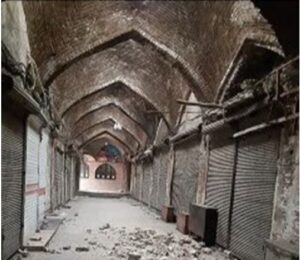
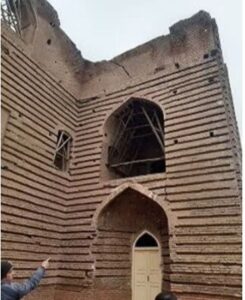 The Secretary General of Cultural Heritage of West Azarbaijan province in Iran has said, regarding the recent earthquakes in Khoi: “Parts of the market and the historical building of the city council, the museum and some other historical buildings in Khoi have been cracked and destroyed.
2500 Year Old Bronze Items and Bones discovered in Poland
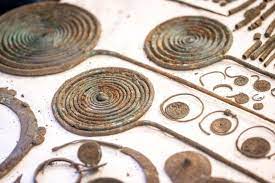 TORTORUŃ, POLAND—Science in Poland reports that a group of metal detectorists from the Kujawy-Pomerania History Seekers Group discovered a 2,500-year-old collection of bronze necklaces, bracelets, greaves, and pins in a plowed field that was once a lake in northern Poland and alerted the authorities. Researchers led by Wojciech Sosnowski of the Office of Conservator of Monuments of Toruń returned to the site, where they found three deposits that had not been disturbed by plowing, and pieces of fabric, rope, tools made of antler, bronze sheet fittings, and bronze horse harness fittings. Jacek Gackowski of Nicolaus Copernicus University examined the artifacts, and said that most of them can be associated with the local Lusatian culture, but some of them may have been made by the Scythians. “It was a time of growing unrest related to the penetration of groups of nomads coming from the Pontic Steppe, probably Scythians or the Neuri, into Central and Eastern Europe,” he said. Human bones found among the artifacts suggest that sacrifices may have been periodically made at the site. “They tried to secure their existence and give ritual resistance to the imminent, as it turned out, inevitable changes,” Gackowski concluded.UŃ, POLAND—Science in Poland reports that a group of metal detectorists from the Kujawy-Pomerania History Seekers Group discovered a 2,500-year-old collection of bronze necklaces, bracelets, greaves, and pins in a plowed field that was once a lake in northern Poland and alerted the authorities. Researchers led by Wojciech Sosnowski of the Office of Conservator of Monuments of Toruń returned to the site, where they found three deposits that had not been disturbed by plowing, and pieces of fabric, rope, tools made of antler, bronze sheet fittings, and bronze horse harness fittings. Jacek Gackowski of Nicolaus Copernicus University examined the artifacts, and said that most of them can be associated with the local Lusatian culture, but some of them may have been made by the Scythians. “It was a time of growing unrest related to the penetration of groups of nomads coming from the Pontic Steppe, probably Scythians or the Neuri, into Central and Eastern Europe,” he said. Human bones found among the artifacts suggest that sacrifices may have been periodically made at the site. “They tried to secure their existence and give ritual resistance to the imminent, as it turned out, inevitable changes,” Gackowski concluded.
A 1,700-Year-Old Castle Was Among the Thousands of Buildings Destroyed by the Deadly Earthquakes in Turkey and Syria
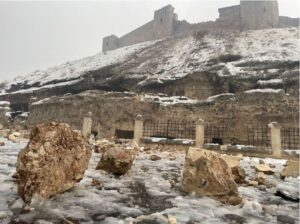 The Gaziantep Castle, built in the second and third centuries, was among the more than 3,000 buildings destroyed.
Taylor Dafoe, February 6, 2023
A Roman-era castle in southeastern Turkey is among the thousands of structures damaged by the deadly earthquakes that struck the country and the neighboring state of Syria today. An estimated 2,300 people died in the disaster, and thousands more have been injured.
Now, as the totality of the destruction is still being measured, officials fear other significant cultural heritage sites may have been impacted too.
An initial 7.8-magnitude earthquake hit in the early hours of February 6, centered near the Turkish city of Gaziantep. Since then, more than 40 aftershocks have been felt as far as Cyprus, Egypt, Israel, and Lebanon, while Turkey itself experienced a related 7.5-magnitude tremor.
The catastrophic incident comes at a particularly vulnerable time for Turkey and Syria, both of which are already facing economic turmoil and refugee crises.
Some 3,000 buildings across at least 10 Turkish cities have also been destroyed. Among them was the Gaziantep Castle, a historic structure first built as a watchtower in the second and third centuries, during the Roman period, and later expanded upon in the fifth century by Byzantine Emperor Justinian 1, according to the Turkish agency that oversees museums and archaeological sites in the country.
The 1,700-year-old site has since served numerous functions. Just last year, part of the castle was converted into the Gaziantep Defence and Heroism Panoramic Museum, a venue honoring the city’s fight against French and English occupation during the Turkish War of Independence a century ago.
“Some of the bastions in the east, south, and southeast parts of the historical Gaziantep Castle in the central Şahinbey district were destroyed by the earthquake,” the Turkish state-run news agency Anadolu reported.
“The debris was scattered on the road. The iron railings around the castle were scattered on the surrounding sidewalks. The retaining wall next to the castle also collapsed. In some bastions, large cracks were observed,” the report said.
A 17th-century Şirvani Mosque located next to the capital also collapsed, according local reports.
International Day of Women and Girls in Science, 11 February 2023
 Innovate. Demonstrate. Elevate. Advance. Sustain. ( I.D.E.A.S.)
Bringing Everyone Forward for Sustainable and Equitable Development
This year, the International Day of Women and Girls in Science (IDWGIS) will focus on the role of Women and Girls and Science as relates to the Sustainable Development Goals(SDGs) in review at the forthcoming High-Level Political Forum (HLPF), namely SDG 6 (clean water and sanitation), SDG 7 (affordable and clean energy), SDG 9 (industry, innovation, and infrastructure), SDG 11 (sustainable cities and communities) and SDG17 (means of implementation), while following up on discussions on water held during from the “Water Unites Us” 7th IDWGIS, the 2nd High-Level International Conference on the International Decade for Action on Water for Sustainable Development 2018-2028, held in Dushanbe, and the 2nd UN Ocean Conference and its High-Level Symposium on Water held in Lisbon, as a contribution for the 2023 UN Water Conference, and other UN Fora.
In doing so the IDWGIS aims to connect the International Community to Women and Girls in Science, strengthening the ties between science, policy, and society for strategies oriented towards the future. The IDWGIS will thus showcase best practices, strategies, applied solutions in addressing SDGs challenges and opportunities. It will also include for the first time a science workshop for Blind Girls and a session from the BLIND fellow SCIENTISTS on “Science in Braille: Making Science Accessible”.
women and girls in science
Get Involved
The 8th International Day of Women and Girls in Science Assembly will take place on 10 February 2023 at the United Nations Headquarters, New York City. Join women experts, youth, and professionals in dialogues and discussion to put Science, Technology, and Innovation at the heart of sustainable development programs.
Background
A significant gender gap has persisted throughout the years at all levels of science, technology, engineering and mathematics (STEM) disciplines all over the world. Even though women have made tremendous progress towards increasing their participation in higher education, they are still under-represented in these fields.
Gender equality has always been a core issue for the United Nations. Gender equality and the empowerment of women and girls will make a crucial contribution not only to economic development of the world, but to progress across all the goals and targets of the 2030 Agenda for Sustainable Development, as well.
On 14 March 2011, the Commission on the Status of Women adopted a report at its fifty-fifth session, with agreed conclusions on access and participation of women and girls in education, training and science and technology, and for the promotion of women’s equal access to full employment and decent work. On 20 December 2013, the General Assembly adopted a resolution on science, technology and innovation for development, in which it recognized that full and equal access to and participation in science, technology and innovation for women and girls of all ages is imperative for achieving gender equality and the empowerment of women and girls.
International Holocaust Remembrance Day
 The United Nations General Assembly designated January 27—the anniversary of the liberation of Auschwitz-Birkenau—as International Holocaust Remembrance Day.
On this annual day of commemoration, the UN urges every member state to honor the six million Jewish victims of the Holocaust and millions of other victims of Nazism and to develop educational programs to help prevent future genocides.
Ostrich Eggs Found at Ancient Campsite in Israel
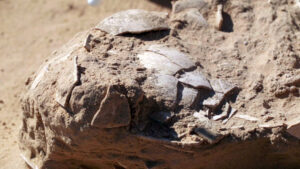 TEL AVIV, ISRAEL—ANSA Med reports that the shells of eight ostrich eggs have been found at an ancient campsite in southern Israel’s Negev Desert. The eggs are estimated to be 4,500 years old, but could be up to 7,500 years old, according to Lauren Davis of the Israel Antiquities Authority. “The proximity of the eggs to the fire pit indicates that it was not a casual discovery but an intentional collection of eggs,” she said. “One of them was directly in the fire pit, which strengthens the conviction that they were used as food.” The shells had been crushed, but were otherwise well-preserved on the surface of the campsite by the shifting desert sands, Davis added. Burned stones, flint, stone tools, and pottery fragments were also recovered
New Thoughts on the Secrets of Roman Concrete
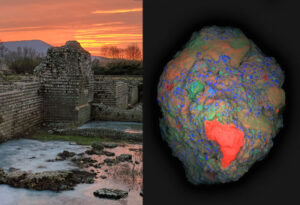 ROME, ITALY—CNN reports that an international team of researchers analyzed samples of Roman concrete taken from a city wall at the site of Privernum, which is located in central Italy. Based upon recipes for concrete found in Roman texts, it had been previously thought that Roman engineers used slaked lime (lime mixed with water) as a binding agent, said Admir Masic of the Massachusetts Institute of Technology. But Masic and his colleagues have concluded that quicklime (calcium oxide) was used instead of, or in addition to, slaked lime. The high temperatures produced by the use of quicklime formed white chunks in the concrete known as lime clasts. Tests of the quicklime concrete recipe suggest that when later exposed to water, the lime clasts dissolved into any cracks in the concrete and sealed them before they could spread, resulting in the long-lasting nature of Roman concrete. Masic and his colleagues also noted that the high temperatures produced by using quicklime to mix concrete reduced its curing and setting times. Read the original scholarly article about this research in Science Advances