We believe that all cultural, historical and natural heritage, wherever they are should be preserved. LEARN MORE
News

Default Category

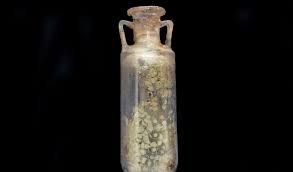
Roman Perfume Found in Spain Analyzed

Spain Unguentarium (Cosano et al. 2023, Heritage)CÓRDOBA, SPAIN—According to a statement released by the University of Córdoba, a team of researchers led by chemist José Rafael Ruiz Arrebola has analyzed the contents of a 2,000-year-old vessel recovered from a mausoleum in southern Spain’s Roman city of Carmo. The mausoleum held the remains of six individuals in six urns, one of which was made of glass. The remains of a woman who died between 30 and 40 years of age were found in this glass urn, along with traces of a cloth bag that held a rock crystal flask sealed with a stone and bitumen and three amber beads. The well-preserved material inside the flask was examined with X-ray diffraction, gas chromatography, and mass spectrometry. The study determined that the ointment base had been made from a vegetable oil, perhaps olive oil, while the scent was derived from Pogostemon cablin, a plant from India used to produce the scent patchouli. The high quality of the flask holding the scent suggests that it was a valuable product. Read the original scholarly article about this research in Heritage. For more on Roman Spain, go to “Making an Entrance.”

International Day of Plant Health

Plants are life – we depend on them for 80 percent of the food we eat and 98 percent of the oxygen we breathe. But international travel and trade has been associated with the introduction and spread of plant pests. Invasive pest species are one of the main drivers of biodiversity loss and threaten the delicate web of life that sustains our planet. Pests and diseases have also been associated with rising temperatures which create new niches for pests to populate and spread. In response, the use of pesticides could increase, which harms pollinators, natural pest enemies and organisms crucial for a healthy environment. Protecting plant health is essential by promoting environmentally friendly practices such as integrated pest management. International standards for phytosanitary measures (ISPMs) in trade also help prevent the introduction and spread of plant pests across borders.

The International Day of Plant Health 2023 calls on everyone to raise awareness and take action to keep our plants healthy and help protect the environment and biodiversity.

U.S. Repatriates Looted Artifacts to Yemen

NEW YORK, NEW YORK—According to a statement released by the Manhattan District Attorney’s Office, three artifacts recovered from a private collector were repatriated to Yemen during a recent ceremony attended by Mohammed Al-Hadhrami, the Yemeni ambassador to the United States, and Assistant Special Agent in Charge, James Deboer, of U.S. Homeland Security Investigations. The objects include an alabaster ram with an inscribed base from the Hayd bin Aqeel necropolis that has been dated to the fifth century B.C.; an alabaster figure of a female deity dated to the second century B.C.; and an inscribed silver vessel from Shabwa dated to the second or third centuries A.D. These antiquities were among 89 objects looted from 10 different countries that were seized during a recent investigation. Because of continuing conditions of war in Yemen, the artifacts will be temporarily held at the Smithsonian Institution in Washington, D.C. To read about three carved ram’s heads found along the Avenue of the Sphinxes, go to “Around the World: Egypt.”

7,000-Year-Old Tomb Excavated in Oman

AL WUSTA, OMAN—Live Science reports that the remains of dozens of people have been found in a unique tomb in central Oman by a team of researchers led by Alžběta Danielisová of the Czech Republic’s Institute of Archaeology in Prague. Constructed with walls and a roof made of rows of thin stone slabs called ashlars, the tomb had been covered with a mound of earth. Inside, it was divided into two circular burial chambers that had been further separated into individual compartments. The dead are thought to have decomposed elsewhere, because bones inside these burial chambers were placed in clusters, while the skulls were found near the outside wall, and the long bones had been arranged so that they pointed toward the center of the chamber. The remains are thought to have been deposited in the tomb over a period of several hundred years, beginning about 7,000 years ago. A smaller, similar tomb was found nearby. Analysis of the bones could reveal what the deceased ate and where they were born. Further research in the area could also determine where these people lived.

Subsurface Imaging Reveals Australia’s Ancient Landscape

ADELAIDE, AUSTRALIA—According to a statement released by Flinders University, a new survey of the Red Lily Lagoon area in Northern Australia’s West Arnhem Land with electric resistivity tomography (ERT) has revealed that some 8,000 years ago, the ocean’s coastline stretched across what is now an inland region. The area is known for Madjedbebe, a 60,000-year-old archaeological site, and its distinctive ancient rock art. Environmental changes at the lagoon are reflected in this rock art, with the appearance of images of freshwater species of fish, birds, and crocodiles in areas that had once been near the ocean and mangrove swamps, explained team member Jarrad Knowlessar. Such environmental changes are also reflected in the types of stone artifacts that were made, and the sorts of foods that were eaten, he added. The new environmental model produced by the survey will also help researchers to identify areas where additional archaeological sites could be found. Read the original scholarly article about this research in PLOS ONE

World Press Freedom Day – 3 May

Shaping a Future of Rights: Freedom of expression as a driver for all other human rights

2023 year marks the 30th anniversary of World Press Freedom Day. Three decades have passed since it was proclaimed in 1993, in which we have seen substantial progress towards achieving a free press and freedom of expression around the world. The proliferation of independent media in many countries and the rise of digital technologies have enabled the free flow of information. However, media freedom, safety of journalists and freedom of expression are increasingly under attack, which impacts the fulfillment of other human rights.

The international community faces multiple crises: conflicts and violence, persistent socio-economic inequalities driving migration, environmental crises and challenges to the health and wellbeing of people all around the world. At the same time, disinformation and misinformation online and offline proliferate, with serious impact on the institutions underpinning democracy, the rule of law and human rights.

It is exactly to counter these critical situations and threats, that press freedom, safety of journalists and access to information take centre stage. The right to freedom of expression, enshrined in Article 19 of the Universal Declaration of Human Rights, is a prerequisite and a driver to the enjoyment of all other human rights. This year’s Special 30th anniversary celebration of World Press Freedom Day is, therefore, a call to recentre press freedom, as well as independent, pluralistic and diverse media, as key to the enjoyment of all other human rights.

Origins and purpose of the Day

World Press Freedom Day was proclaimed by the UN General Assembly in December 1993, following the recommendation of UNESCO’s General Conference. Since then, 3 May, the anniversary of the Declaration of Windhoek is celebrated worldwide as World Press Freedom Day.

After 30 years, the historic connection made between the freedom to seek, impart and receive information and the public good remains as relevant as it was at the time of its signing. Special commemorations of the 30th anniversary are planned to take place during World Press Freedom Day International Conference.

May 3 acts as a reminder to governments of the need to respect their commitment to press freedom. It is also a day of reflection among media professionals about issues of press freedom and professional ethics. It is an opportunity to:

    • celebrate the fundamental principles of press freedom;
    • assess the state of press freedom throughout the world;
    • defend the media from attacks on their independence;
    • and pay tribute to journalists who have lost their lives in the line of duty.

https://www.un.org/en/observances/press-freedom-day

Roman Military Camps Discovered in Arabia

OXFORD, ENGLAND—By using open-source satellite imagery including Google Earth, archaeologists have discovered three previously unknown Roman temporary military camps along the border between Jordan and Saudi Arabia. According to a BBC News report, the researchers were able to identify the forts by their distinctive rectangular shape with entrances on opposite ends. “We are almost certain they were built by the Roman army,” says project leader Michael Fradley of the University of Oxford, who adds the enticing possibility that they may be evidence of previously undocumented military campaign in the region related the absorption of the Nabataean Kingdom into the Roman Empire in A.D. 106. It is extremely rare to find temporary camps in the region and these may have belonged to one or more cohort of camel-mounted troops.

Burial of Roman Physician Excavated in Hungary

BUDAPEST, HUNGARY—Telex reports that archaeologists unearthed the first-century A.D. tomb of a Roman physician in a central Hungarian necropolis. He was buried during the period when the Roman imperial province of Pannonia was being formed. Placed at the feet of the man, who died between the ages of 50 and 60, were two wooden boxes containing medical instruments, including needles, pincers, and silver-plated copper alloy scalpels that were fitted with interchangeable steel blades. A muller found near the man’s knee was likely used to mix herbs and other medicinal substances. Eötvös Loránd University archaeologist Levente Samu said that the high-quality equipment would have been suitable for performing complex medical procedures. The team is planning to conduct isotope analysis and DNA testing to determine the doctor’s place of origin

Researchers use 21st century methods to record 2,000 years of ancient graffiti in Egypt

Working with the University of Ottawa, the researchers published their early findings in Egyptian Archaeology and have returned to Philae to advance the project.

“It’s fascinating because there are similarities with today’s graffiti,” says SFU geography professor Nick Hedley, co-investigator of the Social Sciences and Humanities Research Council (SSHRC)-funded project. “The iconic architecture of ancient Egypt was built by those in positions of power and wealth, but the graffiti records the voices and activities of everybody else. The building acts like a giant sponge or notepad for generations of people from different cultures for over 2,000 years.”

As an expert in spatial reality capture, Hedley leads the team’s innovative visualization efforts, documenting the graffiti, their architectural context, and the spaces they are found in using advanced methods like photogrammetry, raking light, and laser scanning. “I’m recording reality in three-dimensions — the dimensionality in which it exists,” he explains.

With hundreds if not thousands of graffiti, some carved less than a millimeter deep on the temple’s columns, walls, and roof, precision is essential.

Typically, the graffiti would be recorded through a series of photographs — a step above hand-drawn documents — allowing researchers to take pieces of the site away and continue working.

Sabrina Higgins, an SFU archaeologist and project co-investigator, says photographs and two-dimensional plans do not allow the field site to be viewed as a dynamic, multi-layered, and evolving space. “The techniques we are applying to the project will completely change how the graffiti, and the temple, can be studied,” she says.

Hedley is moving beyond basic two-dimensional imaging to create a cutting-edge three-dimensional recording of the temple’s entire surface. This will allow the interior and exterior of the temple, and the graffiti, to be viewed and studied at otherwise impossible viewpoints, from virtually anywhere — without compromising detail.

This three-dimensional visualization will also enable researchers to study the relationship between a figural graffito, any graffiti that surrounds it, and its location in relation to the structure of temple architecture.

While this is transformative for viewing and studying the temple and its inscriptions, Hedley points to the big-picture potential of applying spatial reality capture technology to the field of archaeology, and beyond.

“Though my primary role in this project is to help build the definitive set of digital wall plans for the Mammisi at Philae, I’m also demonstrating how emerging spatial reality capture methods can fundamentally change how we gather and produce data and transform our ability to interpret and analyze these spaces. This is a space to watch!” says Hedley.

https://www.sciencedaily.com/releases/2023/03/230330172143.htm

Traces of ancient empires that stretched across Africa remain in the DNA of people living on the continent, reveals a new genetics study led by UCL researchers.

Published in Science Advances, the collaboration between UCL geneticists working alongside anthropologists, archaeologists, historians and linguists in Africa and beyond found evidence for when different peoples intermixed across the continent. Their findings indicate migration linked to vast empires such as the Kanem-Bornu and the kingdoms of Aksum and Makuria, as well as the spread of the Bantu language group, now spoken by close to one in four Africans.

Much of their study focused on Cameroon, where the researchers had collected the most genomes, and they show that the central African country has as much genetic diversity by some measures as the whole of Europe.

Representing one of the most densely sampled studies of African genomes to date, the study used new genetic data from more than 1,300 individuals from 150 ethnic groups from across Africa (primarily Cameroon, Republic of the Congo, Ghana, Nigeria, and Sudan, plus some more in southern Africa). By comparing genetic variation patterns between present-day people from different parts of Africa and elsewhere, they identified when intermixing occurred between different ethnic groups, which likely indicates relatively high migration at specific times and places.

First author of the study, PhD candidate Nancy Bird (UCL Genetics Institute) said: “We found evidence that roughly 600 years ago people from north and east Africa were migrating into the region of the Kanem-Bornu Empire, likely reflecting its huge impact on trade across Africa. Historical records of the empire are poor, so it is exciting to show how it possibly had such a geographically widespread impact on the continent, perhaps bringing in people from over 1,000 kilometres away.”

The Kanem-Bornu Empire, which covered present-day northern Cameroon and Chad, emerged around 700 CE and existed for more than 1,000 years, at its height spanning almost 2,000 kilometres across north and central Africa. It had vast trading networks linking northern, eastern and western Africa, resulting in genetic traces from all corners of the continent remaining in the DNA of the present-day people of Cameroon.

The study also sheds light on the Kingdom of Aksum, which encompassed northeast Africa and southern Arabia in the first millennium, and was considered one of the world’s four great powers of the third century alongside contemporary empires in China, Persia and Rome, as well as the Kingdom of Makuria, which spread along the Nile in Sudan between the fifth and 16th centuries and signed one of the longest lasting peace treaties in history with Egyptian Arabic groups.

Nancy Bird said: “We see evidence of migrations from the Arabian Peninsula into Sudan during the era of the Kingdom of Aksum, highlighting its importance as a global centre around 1,500 years ago. We also see evidence of Arabic groups migrating into Sudan down the Nile, but importantly these genetic signals almost entirely originate after the peace treaty between Makuria and Egypt had started to break down.”

Furthermore, while previous studies have highlighted the wide-ranging genetic impact of the migration of Bantu speakers from Cameroon into eastern and southern Africa, this study provides compelling evidence that expansions may have also extended to the west, possibly linked to climate change.

Nancy Bird said: “There is some evidence from other researchers of climate change altering the environment around 3,000 years ago, reducing forest coverage. That this corresponds with the timings of some ancient migrations we are detecting suggests climate change may be instigating or facilitating these large-scale movements of people.”

Senior author Dr Garrett Hellenthal (UCL Genetics Institute) said: “The African continent has an immense and complicated pre-colonial history often overlooked by western curricula. The legacy of colonialism means that many events in African history have been deliberately obscured or lost. This includes the range and influence of historical African empires.”

The staggering amount of genetic diversity uncovered in this paper and other emerging studies highlights the vital importance of analysing diverse African genomes from across the continent.

Dr Hellenthal added: “Despite the clear insights into medicine and human history that studying the immense genetic diversity found among African peoples can provide, African genomes have been, and still are, underrepresented in genetic studies compared to other regions of the world.”

Co-author Dr Forka Leypey Matthew Fomine (University of Buea, Cameroon) said: “There are still lots of ethnic groups, for example in Cameroon, that have not yet been studied, whose genomes likely hold many other secrets. We have the capability to collect these samples and are looking for interested collaborators.”

The study, supported by the BBSRC, Natural Environment Research Council, Wellcome, Royal Society and the National Institute for Health Research UCLH Biomedical Research Centre, involved researchers at UCL and other institutions in the UK, Cameroon, Ghana, Sudan, Canada, China, France, Finland, and the US.