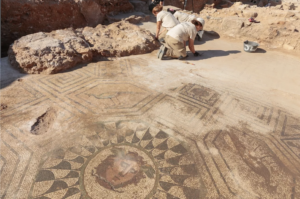
 ÉRIDA, SPAIN—According to a Miami Herald report, a well-preserved mosaic floor has been found in a building at the Huerta de Otero archaeological site by students from the Barraeca II Professional School. The floor is made up of a central depiction of Medusa, images of jellyfish and other fish, peacocks, masks, flowers, and geometric motifs. Team leader José Vargas said that the four peacocks are situated in the four corners of the mosaic and represent the four seasons, while the figure of Medusa would have served as a protection for the inhabitants of the dwelling
News
International Day for the Conservation of the Mangrove Ecosystem, July 26th
 “Mangroves are in danger: it has been estimated that more than three quarters of mangroves in the world are now threatened and with them all the aquatic and terrestrial organisms that depend on them. This is why UNESCO has decided to act to protect them, along with other valuable blue carbon ecosystems, through its Geoparks, World Heritage sites and biosphere reserves.”Mangroves are rare, spectacular and prolific ecosystems on the boundary between land and sea. These extra ordinary ecosystems contribute to the wellbeing, food security, and protection of coastal communities worldwide. They support a rich biodiversity and provide a valuable nursery habitat for fish and crustaceans. Mangroves also act as a form of natural coastal defense against storm surges, tsunamis, rising sea levels and erosion. Their soils are highly effective carbon sinks, sequestering vast amounts of carbon.
Yet mangroves are disappearing three to five times faster than overall global forest losses, with serious ecological and socio-economic impacts. Current estimates indicate that mangrove coverage has been divided by two in the past 40 years.
Message from Ms Audrey Azoulay, Director-General of UNESCO, on the occasion of the International Day for the Conservation of the Mangrove Ecosystem
https://www.unesco.org/en/days/mangrove-ecosystem-conservation
“Unknown Kushan Script” Partially Deciphered
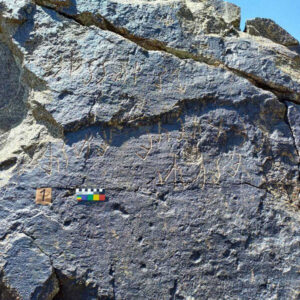 COLOGNE, GERMANY—According to a statement released by the University of Cologne, a team of linguists has partially deciphered a writing system found in inscriptions on cave walls and on pots unearthed in Central Asia called “unknown Kushan script.” The writing system was used by early nomadic peoples of the Eurasian steppe and then the rulers of the Kushan dynasty between about 200 B.C. and A.D. 700. Svenja Bonmann, Jakob Halfmann, and Natalie Korobzow analyzed an inscription in Tajikistan that had been written in both Bactrian and unknown Kushan script, and an inscription in Afghanistan that had been written in Gandhari or Middle Indo-Aryan, Bactrian, and unknown Kushan script. The breakthrough came in the form of the royal name Vema Takhtu, which appeared in both Bactrian texts, and the title “King of Kings,” which was then identified in unknown Kushan script. These discoveries allowed the researchers to recognize other character sequences and determine the phonetic values of individual characters in unknown Kushan script, which they now believe recorded a previously unknown Middle Iranian language. Bonmann, Halfmann, and Korobzow suggest that the language could now be called “Eteo-Tocharian.” They are planning to look for additional inscriptions in Central Asia with Tajik archaeologists. Read the original scholarly article about this research in Transactions of the Philological Society. To read about a merchant city that flourished in what is now Tajikistan from the fifth to eighth century A.D., go to “A Silk Road Renaissance.”
Colonial America’s Printed Money Examined
 SOUTH BEND, INDIANA—According to a statement released by the University of Notre Dame, researchers led by physicist Khachatur Manukyan have analyzed some 600 money notes printed during the British American colonial period over a span of about 80 years. Some of the notes in the study were printed by Benjamin Franklin, who produced some 2,500,000 notes for the monetary system. Manukyan explained that Franklin and his network of printers employed security features in genuine notes to distinguish them from counterfeits, but the ledger recording the details of his methods had been lost. Employing high-tech spectroscopic and imaging instruments, Manukyan and his colleagues determined that counterfeit notes contained high levels of calciSOUTH BEND, INDIANA—According to a statement released by the University of Notre Dame, researchers led by physicist Khachatur Manukyan have analyzed some 600 money notes printed during the British American colonial period over a span of about 80 years. Some of the notes in the study were printed by Benjamin Franklin, who produced some 2,500,000 notes for the monetary system. Manukyan explained that Franklin and his network of printers employed security features in genuine notes to distinguish them from counterfeits, but the ledger recording the details of his methods had been lost. Employing high-tech spectroscopic and imaging instruments, Manukyan and his colleagues determined that counterfeit notes contained high levels of calcium and phosphorus, while genuine bills carry only traces of these elements. They also found that Franklin also used a special black dye made from graphite, instead of lamp black, which is made by burning vegetable oils, or bone black, made from burned bone. Franklin’s notes were also found to contain fibers of colored silks—a practice thought to have been introduced to the monetary system in the nineteenth century. The translucent mineral muscovite, when added to the paper, also made Franklin’s notes more durable and harder to counterfeit, Manukyan concludedum and phosphorus, while genuine bills carry only traces of these elements. They also found that Franklin also used a special black dye made from graphite, instead of lamp black, which is made by burning vegetable oils, or bone black, made from burned bone. Franklin’s notes were also found to contain fibers of colored silks—a practice thought to have been introduced to the monetary system in the nineteenth century. The translucent mineral muscovite, when added to the paper, also made Franklin’s notes more durable and harder to counterfeit, Manukyan concluded
The Search for the Last Common Ancestor of Humans and Apes
 NEW YORK, NEW YORK—Paleoanthropologist Christopher Gilbert of Hunter College and Thomas Cody Prang of Washington University in St. Louis are attempting to determine what the last common ancestor (LCA) of humans and apes might have looked like, according to a Live Science report. The LCA lived between five and 23 million years ago. Fossils from this period are rare, however, and they include species of early apes in a wide range of sizes. A better understanding of these species and their evolutionary relationships could help scientists understand the size of the LCA, Gilbert said. The evidence does suggest that the LCA walked heel-first on four legs, and was capable of climbing. Prang explained that the upper limbs were probably large and heavy with short hind limbs. He added that the LCA’s brain size was smaller than that of a human, while the head would have had a more forward position for walking on all fours, like a gorilla or a chimpanzee. Meanwhile, its fingers may have been long and curved, similar to those of Ardipithecus, a fossil hominin that lived some 4.4 million years ago. “The LCA was neither a gorilla nor a chimpanzee, but it was likely most similar to gorillas and chimpanzees among all known primates,” Prang said. New fossils are needed to fill in the picture, Gilbert concluded.
Switzerland Repatriates Sculpture Fragment to Egypt
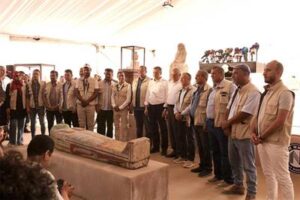 BERN, SWITZERLAND—Ahram Online reports that a fragment of a 3,400-year-old statue was repatriated to Egypt in a ceremony at the Egyptian embassy in Bern. The fragment is part of a larger sculpture at the site of Abydos depicting the pharaoh Ramesses II (reigned ca. 1279–1213 B.C.) with Egyptian deities. The artifact, which was stolen sometime between the late 1980s and early 1990s, was recovered in Geneva during a criminal investigation, according to Carine Bachmann of Switzerland’s Federal Office of Culture. The officials noted that the restitution of the sculpture fragment underlines the joint commitment of Switzerland and Egypt to combat the illicit trade in cultural property
2,500-Year-Old Tombs Discovered in Negev Desert
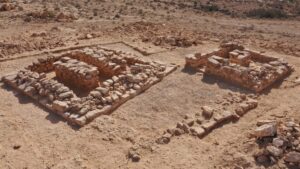 TEL AVIV, ISRAEL—Live Science reports that at least 50 skeletons were found in two square-shaped tombs positioned on an ancient crossroads in southern Israel’s Negev Desert during an investigation conducted ahead of the construction of a water pipeline. The skeletal remains are thought to be about 2,500 years old, and may have been deposited in the tombs over a long period of time, since some of them appear to have been moved. “These kinds of tombs have never been discovered in the region until now and they are not associated with any kind of settlement,” said research team member Tali Erickson-Gini of the Israel Antiquities Authority. Artifacts in the tomb have been traced to the southern Levant, southern Arabia, and Egypt, and have been dated from the seventh century to the fifth century B.C. Many of these objects, such as copper-alloy and iron jewelry, ceramic vases, amulets, and Cypraea shells from the Red Sea, are usually associated with women. Ancient texts, including Minaean inscriptions from Yemen, have recorded the practice in this region of trafficking women for ritual prostitution. The researchers think these women may have been purchased in Gaza or Egypt and perhaps died on the trip to Arabia, where they would have been sold as brides or sacred prostitutes
Monday, July 10, 2023
Rare are and valuable petroglyph of two thousand years old Iranian soldier given to the Islamic government
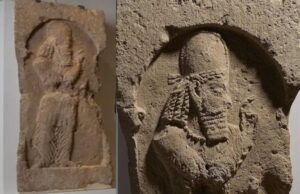 The Chargé d’Affaires of the Islamic Government Embassy in London announced that the statue of the ancient soldier of Iran was officially handed over to them on June 23rd, 2023.
After the revolution, the rare petroglyph was stolen from the Museum of Ancient Iran. However, it was later discovered and confiscated in the United Kingdom in December 2014. However, the officials of the cultural heritage of the Iran Islamic government have never commented on the loss or rather removal of this rare artifact from Iran.
Not long ago, John Simpson, a well-known British archaeologist, who has been aware of the discovery by the British officials said that this valuable petroglyph (the price of which is estimated at £30 million) was taken out of Iran and was severely damaged during the transfer in other countries.
Pasargad Heritage Foundation hopes that this rare Iranian historical petroglyph will be placed in a museum in Iran and where Iranian people can see it. It is our hope that this artifact will not be kept in the warehouse of a museum ‘ as until now, the people of Iran, who are the real owners of historical heritage, have no knowledge of the fate of thousands of historical artifacts which have disappeared.
From:savepasargad.com
International Day for the Elimination of Sexual Violence in Conflict, 19 June
 Sexual harassment and gender-based hate speech
Every new wave of conflict brings with it a rising tide of human tragedy, including new waves of war’s oldest, most silenced, and least condemned crime – sexual violence. Conflict-related sexual violence, whether against women, girls, men, or boys in all their diversity, continues to be used as a tactic of war, torture, and terrorism amid deepening political and security crises, compounded by militarization and the illicit proliferation of arms.
New crises have multiplied as entrenched conflicts have deepened, resulting in shrinking civic space and rising reprisals against human rights defenders, activists, and journalists.
Sexual harassment and gender-based hate speech have surged in the digital space. While the use of information and communications technology has contributed to the empowerment of women and girls and other groups in vulnerable situations, its use has also enabled the propagation of violence.
In some settings, disturbing trends of gender-based hate speech and incitement to violence fuelled conflict in which rape and other forms of sexual violence are used to humiliate and destabilize targeted communities. Hate speech – including online – has become one of the most common ways of spreading divisive rhetoric on a global scale.
We must confront bigotry by working to tackle the hate that spreads like wildfire across the internet.”
António Guterres
Background
On 19 June 2015, the United Nations General Assembly (A/RES/69/293) proclaimed 19 June of each year the International Day for the Elimination of Sexual Violence in Conflict, in order to raise awareness of the need to put an end to conflict-related sexual violence, to honour the victims
Sexual harassment and gender-based hate speech
Every new wave of conflict brings with it a rising tide of human tragedy, including new waves of war’s oldest, most silenced, and least condemned crime – sexual violence. Conflict-related sexual violence, whether against women, girls, men, or boys in all their diversity, continues to be used as a tactic of war, torture, and terrorism amid deepening political and security crises, compounded by militarization and the illicit proliferation of arms.
New crises have multiplied as entrenched conflicts have deepened, resulting in shrinking civic space and rising reprisals against human rights defenders, activists, and journalists.
Sexual harassment and gender-based hate speech have surged in the digital space. While the use of information and communications technology has contributed to the empowerment of women and girls and other groups in vulnerable situations, its use has also enabled the propagation of violence.
In some settings, disturbing trends of gender-based hate speech and incitement to violence fuelled conflict in which rape and other forms of sexual violence are used to humiliate and destabilize targeted communities. Hate speech – including online – has become one of the most common ways of spreading divisive rhetoric on a global scale.
We must confront bigotry by working to tackle the hate that spreads like wildfire across the internet.”
António Guterres
Background
On 19 June 2015, the United Nations General Assembly (A/RES/69/293) proclaimed 19 June of each year the International Day for the Elimination of Sexual Violence in Conflict, in order to raise awareness of the need to put an end to conflict-related sexual violence, to honour the victims and survivors of sexual violence around the world and to pay tribute to all those who have courageously devoted their lives to and lost their lives in standing up for the eradication of these crimes.
The date was chosen to commemorate the adoption on 19 June 2008 of Security Council resolution 1820 (2008), in which the Council condemned sexual violence as a tactic of war and an impediment to peacebuilding.
In response to the rise in violent extremism, the Security Council adopted resolution S/RES/2331 (2016), the first to address the nexus between trafficking, sexual violence, terrorism and transnational organized crime. Acknowledging sexual violence as a tactic of terrorism, it further affirmed that victims of trafficking and sexual violence committed by terrorist groups should be eligible for official redress as victims of terrorism.
and survivors of sexual violence around the world and to pay tribute to all those who have courageously devoted their lives to and lost their lives in standing up for the eradication of these crimes.
The date was chosen to commemorate the adoption on 19 June 2008 of Security Council resolution 1820 (2008), in which the Council condemned sexual violence as a tactic of war and an impediment to peacebuilding.
In response to the rise in violent extremism, the Security Council adopted resolution S/RES/2331 (2016), the first to address the nexus between trafficking, sexual violence, terrorism and transnational organized crime. Acknowledging sexual violence as a tactic of terrorism, it further affirmed that victims of trafficking and sexual violence committed by terrorist groups should be eligible for official redress as victims of terrorism.
Marble Statue of Pan Unearthed in Istanbul
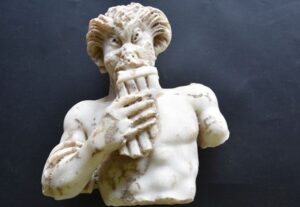 ISTANBUL, TURKEY—According to a Live Science report, a badly damaged marble figure of Pan, the ancient Greek god of the wilds, woods, fields, shepherds, and flocks, has been discovered at the site of St. Polyeuctus, an early Christian church in what was the city of Constantinople. The statue’s surviving head, torso, and an arm measure less than one foot long and show Pan playing a reed pipe. The sculpture was likely transferred to the site with backfill from another location in the city in the 1960s after an archaeological investigation, explained Mahir Polat of the Istanbul Metropolitan Municipality. He added that the figure is thought to have been sculpted during the Roman period and brought to Constantinople between the fourth and sixth centuries A.D. as an historical work of art for display in a public place or a palace.