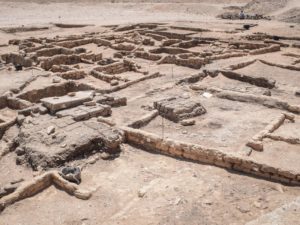
 Hailed as one of the country’s most significant finds in a century, the site dates to a time of political, religious and artistic change in what experts are lauding as one of the most significant Egyptian archaeological finds of the past century, a team has uncovered the country’s largest known ancient city: So’oud Atun , or the “Rise of Aten.”Zahi Hawass , a famous—and controversial— Egyptian scholar, announced the discovery of the “lost golden city” near Luxor , site of the ancient city of Thebes, on Thursday.
As BBC News reports, the city was established during the reign of Amenhotep III ,
between roughly 1391 and 1353 B.C. Many of the Rise of Aten’s walls are well preserved. So far, the research team has identified a bakery, an administrative district and a residential area, as well as scarab beetle amulets, pottery and other everyday items.
Betsy M. Bryan , an Egyptian art specialist at Johns Hopkins University who visited the
site but was not involved in the excavation, says in a statement that the find is “the
second most important archeological discovery since the tomb of Tutankhamun .”
(Through his father, Akhenaten , Tut is actually the grandson of Amenhotep.)
Archaeologists discovered the city in September while searching for a mortuary temple.
It’s located close to a number of important ancient Egyptian monuments, including
the Colossi of Memnon , the Madinat Habu Temple and the Ramesseum .
Amenhotep, ninth king of the 18th Dynasty, ruled during the second half of the New
Kingdom period. He sponsored the construction of a number of huge temples and public buildings. Toward the end of his reign, he shared power with his eldest son, the soon-to-be Amenhotep IV.
Per National Geographic ’s Erin Blakemore, the younger Amenhotep dramatically
changed the country’s direction following his father’s death. He abandoned all the
Egyptian gods except the sun god Aten ; changed his name from Amenhotep IV
to Akhenaten , meaning “devoted to Aten”; and oversaw the rise of a new artistic
movement. He and his wife, Nefertiti , also moved Egypt’s royal seat from Thebes to a
new city called Akhetaten (now known as Amarna ).
As Mia Alberti and Jack Guy report for CNN , the team found an inscription in So’oud
Atun dated to 1337 B.C., just one year before Akhenaten established his capital at
Amarna.
In the statement, Bryan notes that the newly discovered city offers a “rare glimpse into
the life of the ancient Egyptians” at the height of the empire, in addition to shedding light
on the mystery of why the pharaoh and his queen moved to Amarna.
After Akhenaten’s death, his son Tutankhamun’s government reversed his transformation of the country. Tutankhamen and his successor, Ay , continued to use the Rise of Aten, notes BBC News.
Egypt Today ’s Mustafa Marie reports that the archaeologists examined hieroglyphic
inscriptions on the lids of wine vessels and other containers for clues to the city’s history. One vase containing dried or boiled meat was inscribed with the names of two people from the city and information showing that Amenhotep and Akhenaten ruled the city jointly at the time it was made.
The team also found a production area for mud bricks used to build temples and other
structures. The bricks bear Amenhotep’s seal. Casting molds show that workers in the
city produced amulets and decorations for temples and tombs; evidence of spinning and weaving exists at the site, too. A zig-zag wall with just one entry point encloses an
administrative and residential area, suggesting that authorities maintained security by
limiting movement in and out.
One room within the city contains the burial of two cows or bulls—an unusual find that
researchers are still investigating. In another odd discovery, the team found a human
burial with the remains of a rope wrapped around the knees. The team has not yet been
able to fully explore a group of rock-cut tombs accessible through stairs carved into the
rock. “There’s no doubt about it; it really is a phenomenal find,” Salima Ikram , an
archaeologist at the American University in Cairo, tells National Geographic. “It’s very
much a snapshot in time—an Egyptian version of Pompeii.”
https://www.smithsonianmag.com/smart-news/archaeologists-discover-3400-year-ohappy-nowruz-march-21-2020-2ld-
egyptian-city-180977471/